
Main menu

  • HOME
  • CONTENT
    • Early Release
    • Featured
    • Current Issue
    • Issue Archive
    • Blog
    • Collections
    • Podcast
  • TOPICS
    • Cognition and Behavior
    • Development
    • Disorders of the Nervous System
    • History, Teaching and Public Awareness
    • Integrative Systems
    • Neuronal Excitability
    • Novel Tools and Methods
    • Sensory and Motor Systems
  • ALERTS
  • FOR AUTHORS
  • ABOUT
    • Overview
    • Editorial Board
    • For the Media
    • Privacy Policy
    • Contact Us
    • Feedback
  • SUBMIT

User menu

Search

  • Advanced search
eNeuro
eNeuro

Advanced Search


  • HOME
  • CONTENT
    • Early Release
    • Featured
    • Current Issue
    • Issue Archive
    • Blog
    • Collections
    • Podcast
  • TOPICS
    • Cognition and Behavior
    • Development
    • Disorders of the Nervous System
    • History, Teaching and Public Awareness
    • Integrative Systems
    • Neuronal Excitability
    • Novel Tools and Methods
    • Sensory and Motor Systems
  • ALERTS
  • FOR AUTHORS
  • ABOUT
    • Overview
    • Editorial Board
    • For the Media
    • Privacy Policy
    • Contact Us
    • Feedback
  • SUBMIT
Erratum/Corrigendum, Erratum

Erratum: Good et al., “Resting State BOLD Variability of the Posterior Medial Temporal Lobe Correlates with Cognitive Performance in Older Adults with and without Risk for Cognitive Decline”

eNeuro 16 February 2022, 9 (1) ENEURO.0024-22.2022; https://doi.org/10.1523/ENEURO.0024-22.2022

In the article, “Resting State BOLD Variability of the Posterior Medial Temporal Lobe Correlates with Cognitive Performance in Older Adults with and without Risk for Cognitive Decline,” by Tyler J. Good, Joshua Villafuerte, Jennifer D. Ryan, Cheryl L. Grady, and Morgan D. Barense, which published online on March 19, 2020, Figure 3B appeared incorrectly. The values for “3. Memory” and “4. Intelligence” were inadvertently switched. This error does not affect the conclusion of the results.
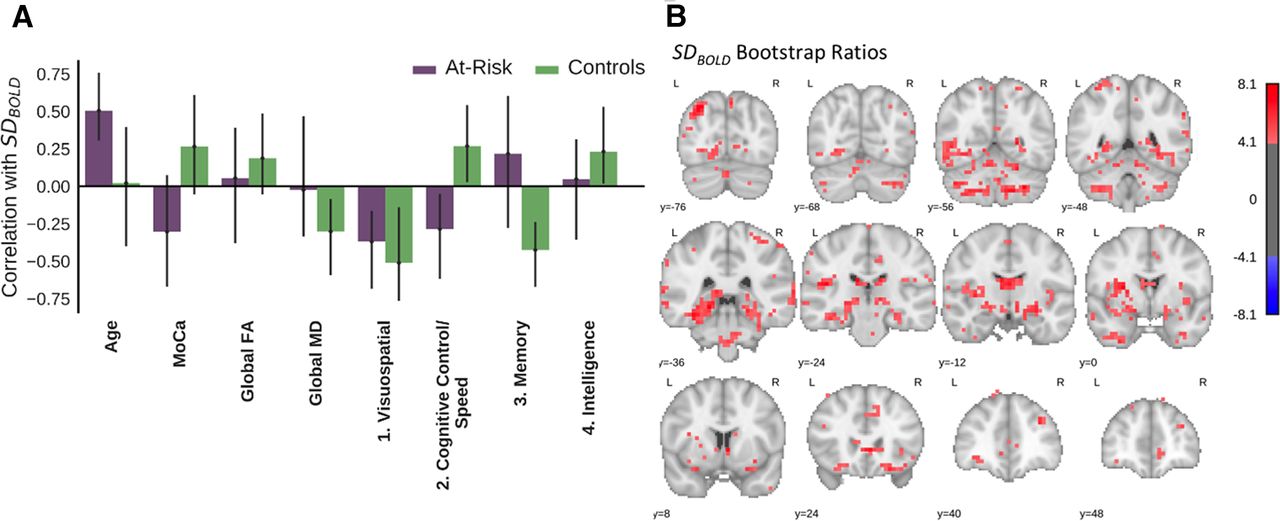
Figure 3.
  • Download figure
  • Open in new tab
  • Download powerpoint
Figure 3.

Multivariate PLS analysis of the relationship between SDBOLD and 8 variables (age, MoCA score, global FA and MD, and score on 4 neuropsychological factors). In controls, SDBOLD (particularly in the MTL) was associated with higher cognitive control/speed and intelligence scores, but lower visuospatial and memory scores. These relationships were weaker in the at-risk group. A, The first latent variable (p < 0.001, 41.1% covariance) from the omnibus, between groups behavioral PLS assessing correlations between the 8 variables and SDBOLD. The bars represent the correlation between each variable with the pattern of SDBOLD shown in the corresponding brain plot (B). The error bars represent 95% confidence intervals, so the error bars of variables significantly contributing to the latent variable will not cross zero. B, Brain plots showing the bootstrap ratios for the latent variable, which may be interpreted like z scores. That is, the highlighted voxels are reliably associated with the related variables in A that significantly contribute to the latent variable. To clearly show the spatial pattern of the respective latent variable, only voxels with bootstrap ratios >|4| are pictured.

  • Copyright © 2022 the authors 2373-2822/00/-000$00.00/0

This is an open-access article distributed under the terms of the Creative Commons Attribution 4.0 International license, which permits unrestricted use, distribution and reproduction in any medium provided that the original work is properly attributed.

  • Home
  • Alerts
  • Follow SFN on BlueSky
  • Visit Society for Neuroscience on Facebook
  • Follow Society for Neuroscience on Twitter
  • Follow Society for Neuroscience on LinkedIn
  • Visit Society for Neuroscience on Youtube
  • Follow our RSS feeds

Content

  • Early Release
  • Current Issue
  • Latest Articles
  • Issue Archive
  • Blog
  • Browse by Topic

Information

  • For Authors
  • For the Media

About

  • About the Journal
  • Editorial Board
  • Privacy Notice
  • Contact
  • Feedback
(eNeuro logo)
(SfN logo)

Copyright © 2025 by the Society for Neuroscience.
eNeuro eISSN: 2373-2822

The ideas and opinions expressed in eNeuro do not necessarily reflect those of SfN or the eNeuro Editorial Board. Publication of an advertisement or other product mention in eNeuro should not be construed as an endorsement of the manufacturer’s claims. SfN does not assume any responsibility for any injury and/or damage to persons or property arising from or related to any use of any material contained in eNeuro.