Main menu

  • HOME
  • CONTENT
    • Early Release
    • Featured
    • Current Issue
    • Issue Archive
    • Blog
    • Collections
    • Podcast
  • TOPICS
    • Cognition and Behavior
    • Development
    • Disorders of the Nervous System
    • History, Teaching and Public Awareness
    • Integrative Systems
    • Neuronal Excitability
    • Novel Tools and Methods
    • Sensory and Motor Systems
  • ALERTS
  • FOR AUTHORS
  • ABOUT
    • Overview
    • Editorial Board
    • For the Media
    • Privacy Policy
    • Contact Us
    • Feedback
  • SUBMIT

User menu

Search

  • Advanced search
eNeuro
eNeuro

Advanced Search


  • HOME
  • CONTENT
    • Early Release
    • Featured
    • Current Issue
    • Issue Archive
    • Blog
    • Collections
    • Podcast
  • TOPICS
    • Cognition and Behavior
    • Development
    • Disorders of the Nervous System
    • History, Teaching and Public Awareness
    • Integrative Systems
    • Neuronal Excitability
    • Novel Tools and Methods
    • Sensory and Motor Systems
  • ALERTS
  • FOR AUTHORS
  • ABOUT
    • Overview
    • Editorial Board
    • For the Media
    • Privacy Policy
    • Contact Us
    • Feedback
  • SUBMIT
PreviousNext
Research ArticleResearch Article: New Research, Cognition and Behavior

The Importance of Semantic Network Brain Regions in Integrating Prior Knowledge with an Ongoing Dialogue

Petar P. Raykov, James L. Keidel, Jane Oakhill and Chris M. Bird
eNeuro 12 September 2022, 9 (5) ENEURO.0116-22.2022; https://doi.org/10.1523/ENEURO.0116-22.2022
Petar P. Raykov
School of Psychology, University of Sussex, Falmer BN1 9QH, United Kingdom
  • Find this author on Google Scholar
  • Find this author on PubMed
  • Search for this author on this site
  • ORCID record for Petar P. Raykov
James L. Keidel
School of Psychology, University of Sussex, Falmer BN1 9QH, United Kingdom
  • Find this author on Google Scholar
  • Find this author on PubMed
  • Search for this author on this site
Jane Oakhill
School of Psychology, University of Sussex, Falmer BN1 9QH, United Kingdom
  • Find this author on Google Scholar
  • Find this author on PubMed
  • Search for this author on this site
Chris M. Bird
School of Psychology, University of Sussex, Falmer BN1 9QH, United Kingdom
  • Find this author on Google Scholar
  • Find this author on PubMed
  • Search for this author on this site
  • Article
  • Figures & Data
  • Info & Metrics
  • eLetters
  • PDF
Loading

Article Figures & Data

Figures

  • Figure 1.
    • Download figure
    • Open in new tab
    • Download powerpoint
    Figure 1.

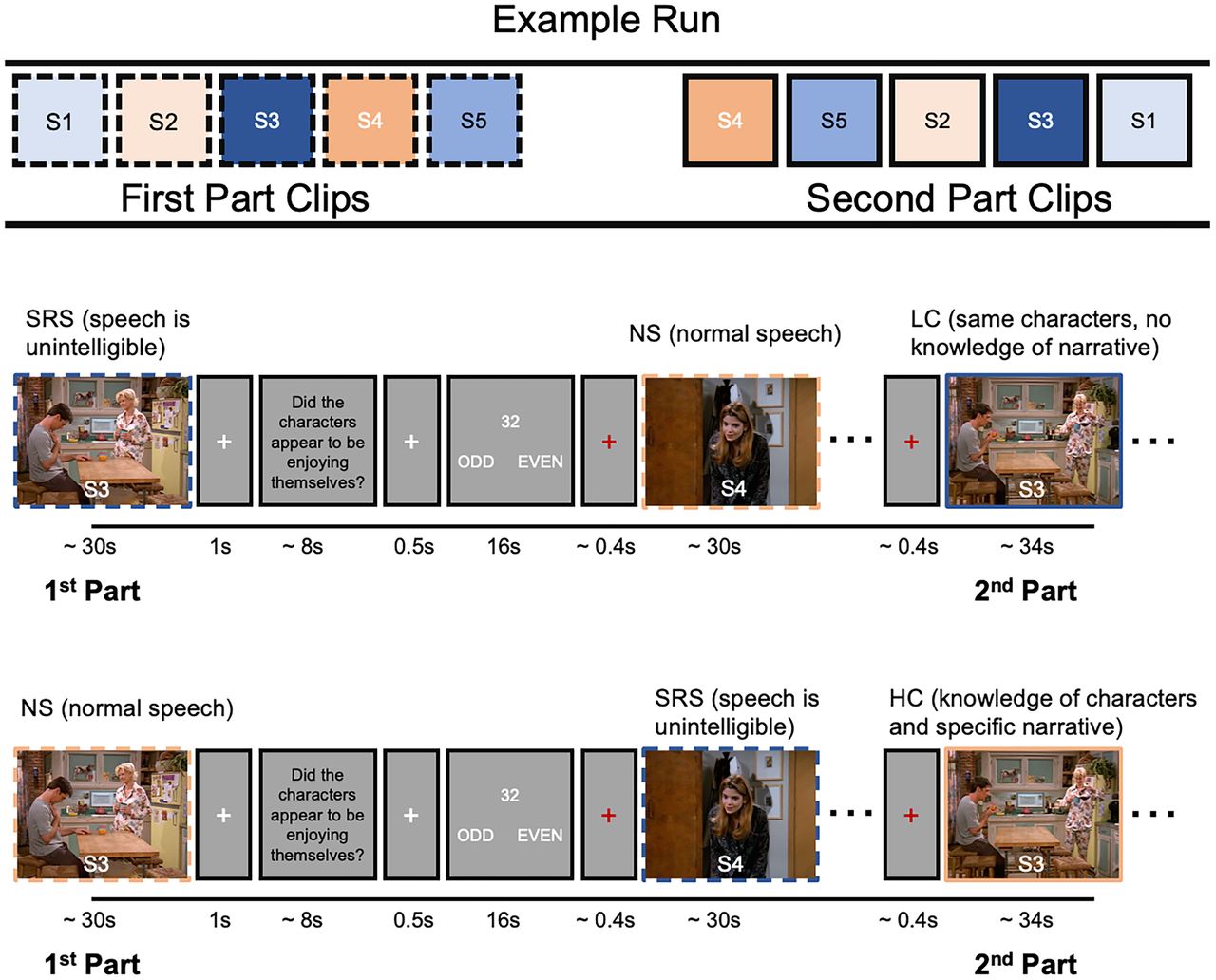
    Schematic of study design. Participants viewed clips from unfamiliar TV sitcoms that were divided into two parts. Top row shows the example order of stimuli (e.g., S1, show 1; S2, show 2). Blue designates LC pairs of part 1 and part 2 clips; orange designates pairs of HC clips. Participants viewed a set of 5 part 1 clips followed by a set of 5 corresponding part 2 clips presented in random order. Ten of the part 1 clips had comprehensible speech, whereas the other 10 had unintelligible speech, created by spectrally rotating the audio. Clips were counterbalanced across participants in a within-subjects design (see middle and bottom rows). All main analyses were on the part 2 clips, which were identical across conditions and differed only in whether participants had knowledge of the preceding (part 1) dialogue (HC condition) or did not (LC condition).

  • Figure 2.
    • Download figure
    • Open in new tab
    • Download powerpoint
    Figure 2.

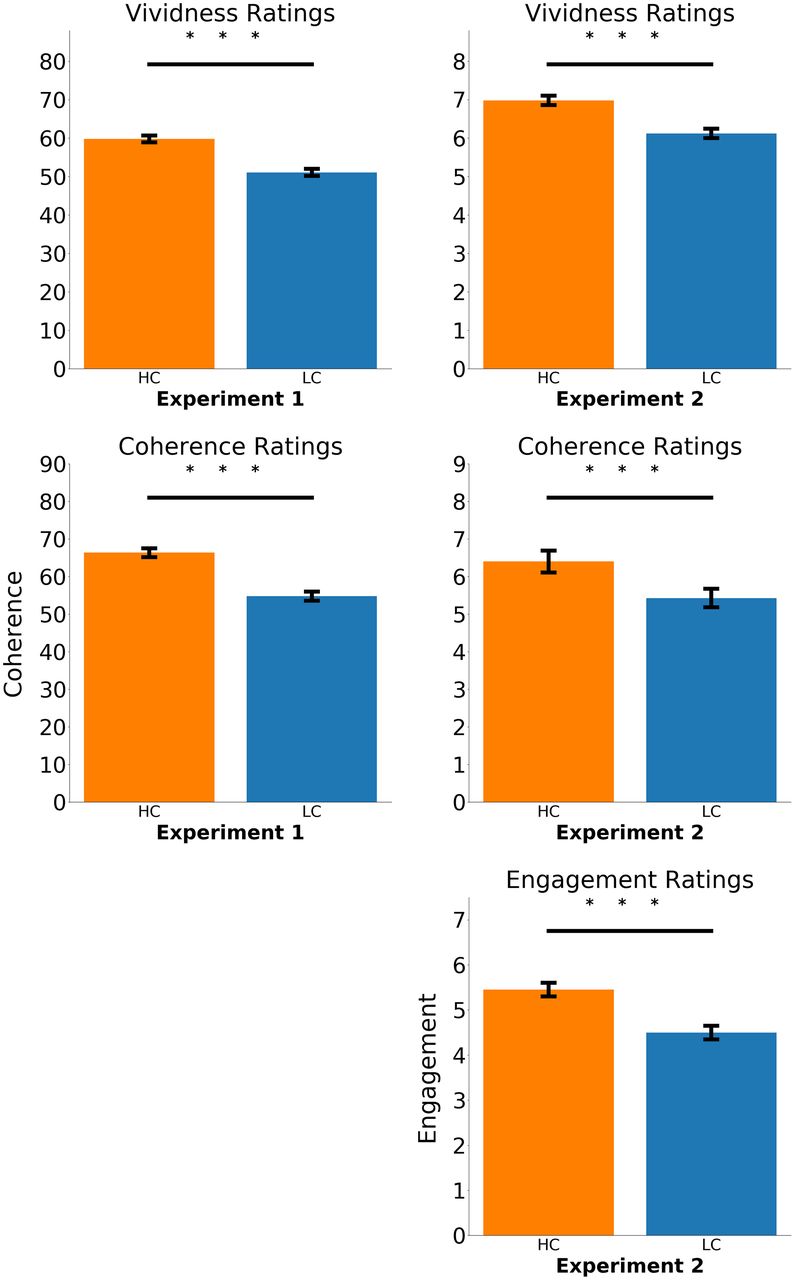
    Subjective memory ratings were better for the HC videos. Left column shows results from subjective measures in experiment 1, and right column shows subjective measures in experiment 2. Error bars represent standard error of the mean. **p < 0.01, ***p < 0.001.

  • Figure 3.
    • Download figure
    • Open in new tab
    • Download powerpoint
    Figure 3.

    Participants remembered the HC videos better. We show that free-recall accuracy was higher for the HC videos compared with the LC videos. Participants in experiment 2 showed better memory, tested with open-ended memory questions, for the HC videos compared with the LC videos. Error bars represent standard error of the mean. **p < 0.01; ***p < 0.001.

  • Figure 4.
    • Download figure
    • Open in new tab
    • Download powerpoint
    Figure 4.

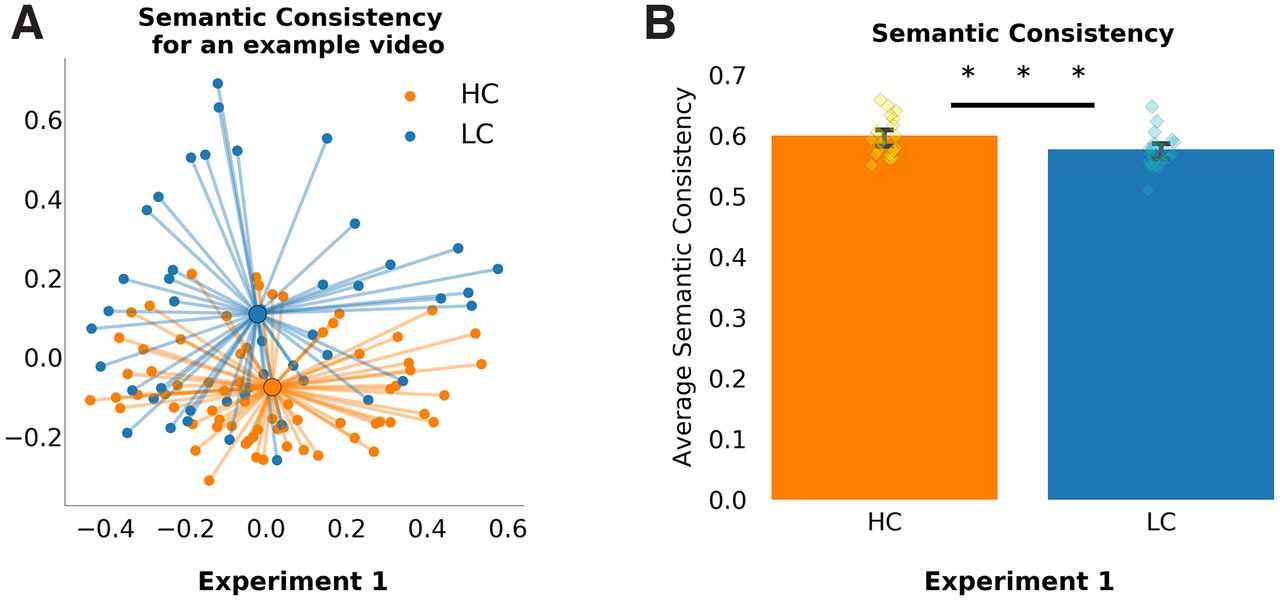
    Semantic consistency is higher among recall of HC videos. A, A PCA projection in 2 dimensions of the semantic vectors that represent all participants’ correct free-recall responses for a single video. Semantic consistency for each video was calculated within each condition. The larger center dots are the condition average semantic patterns for the video based on the free-recall responses. Lines toward the center are for illustrative purposes. B, We calculated the average spread of scores for each video under each condition. One data point in the bar graph represented the average spread of responses across participants watching a video in one condition (e.g., average spread in orange points in A). Semantic consistency was on average higher for the HC videos. Error bars represent 95% confidence intervals. ***p < 0.001.

  • Figure 5.
    • Download figure
    • Open in new tab
    • Download powerpoint
    Figure 5.

    Intersubject correlations. A, The weight matrix (General ISC) tests for video-specific time course similarity across participants. Each cell represents the correlation between subjects’ time course for a particular video with the average time course of all remaining participants for a particular video. The diagonal represents correlations between time courses for the same videos. The off-diagonal represents temporal correlations between mismatching videos within the same run. B, Brain map from video-specific analysis, which shows extended synchronization across the brain for people watching the same videos. C, Weight matrix that tests for the time course similarity across the same videos, depending on their prior knowledge. D, Brain map showing how time course synchronicity was modulated by prior knowledge. Both brain maps show clusters significant at FWE p < 0.05 after permutation testing.
Back to top

In this issue

eneuro: 9 (5)
eNeuro
Vol. 9, Issue 5
September/October 2022
  • Table of Contents
  • Index by author
  • Ed Board (PDF)
Email

Thank you for sharing this eNeuro article.

NOTE: We request your email address only to inform the recipient that it was you who recommended this article, and that it is not junk mail. We do not retain these email addresses.

Enter multiple addresses on separate lines or separate them with commas.
The Importance of Semantic Network Brain Regions in Integrating Prior Knowledge with an Ongoing Dialogue
(Your Name) has forwarded a page to you from eNeuro
(Your Name) thought you would be interested in this article in eNeuro.
CAPTCHA
This question is for testing whether or not you are a human visitor and to prevent automated spam submissions.
Print
View Full Page PDF
Citation Tools
The Importance of Semantic Network Brain Regions in Integrating Prior Knowledge with an Ongoing Dialogue
Petar P. Raykov, James L. Keidel, Jane Oakhill, Chris M. Bird
eNeuro 12 September 2022, 9 (5) ENEURO.0116-22.2022; DOI: 10.1523/ENEURO.0116-22.2022

Citation Manager Formats

  • BibTeX
  • Bookends
  • EasyBib
  • EndNote (tagged)
  • EndNote 8 (xml)
  • Medlars
  • Mendeley
  • Papers
  • RefWorks Tagged
  • Ref Manager
  • RIS
  • Zotero
Respond to this article
Share
The Importance of Semantic Network Brain Regions in Integrating Prior Knowledge with an Ongoing Dialogue
Petar P. Raykov, James L. Keidel, Jane Oakhill, Chris M. Bird
eNeuro 12 September 2022, 9 (5) ENEURO.0116-22.2022; DOI: 10.1523/ENEURO.0116-22.2022
Twitter logo Facebook logo Mendeley logo
  • Tweet Widget
  • Facebook Like
  • Google Plus One

Jump to section

  • Article
    • Abstract
    • Significance Statement
    • Introduction
    • Materials and Methods
    • Results
    • Discussion
    • Footnotes
    • References
    • Synthesis
  • Figures & Data
  • Info & Metrics
  • eLetters
  • PDF

Keywords

  • fMRI
  • memory
  • prior knowledge
  • semantic

Responses to this article

Respond to this article

Jump to comment:

No eLetters have been published for this article.

Related Articles

Cited By...

More in this TOC Section

Research Article: New Research

  • Motor protein disruption critically alters organelle trafficking and excitation contraction coupling
  • Spike generation in electroreceptor afferents introduces additional spectral response components by weakly nonlinear interactions
  • A Multi-Network Approach Identifies Proteins Related to Dendritic Spines in Alzheimer's Disease
Show more Research Article: New Research

Cognition and Behavior

  • Motor protein disruption critically alters organelle trafficking and excitation contraction coupling
  • Spike generation in electroreceptor afferents introduces additional spectral response components by weakly nonlinear interactions
  • A Multi-Network Approach Identifies Proteins Related to Dendritic Spines in Alzheimer's Disease
Show more Cognition and Behavior

Subjects

  • Cognition and Behavior
  • Home
  • Alerts
  • Follow SFN on BlueSky
  • Visit Society for Neuroscience on Facebook
  • Follow Society for Neuroscience on Twitter
  • Follow Society for Neuroscience on LinkedIn
  • Visit Society for Neuroscience on Youtube
  • Follow our RSS feeds

Content

  • Early Release
  • Current Issue
  • Latest Articles
  • Issue Archive
  • Blog
  • Browse by Topic

Information

  • For Authors
  • For the Media

About

  • About the Journal
  • Editorial Board
  • Privacy Notice
  • Contact
  • Feedback
(eNeuro logo)
(SfN logo)

Copyright © 2026 by the Society for Neuroscience.
eNeuro eISSN: 2373-2822

The ideas and opinions expressed in eNeuro do not necessarily reflect those of SfN or the eNeuro Editorial Board. Publication of an advertisement or other product mention in eNeuro should not be construed as an endorsement of the manufacturer’s claims. SfN does not assume any responsibility for any injury and/or damage to persons or property arising from or related to any use of any material contained in eNeuro.