Main menu

  • HOME
  • CONTENT
    • Early Release
    • Featured
    • Current Issue
    • Issue Archive
    • Blog
    • Collections
    • Podcast
  • TOPICS
    • Cognition and Behavior
    • Development
    • Disorders of the Nervous System
    • History, Teaching and Public Awareness
    • Integrative Systems
    • Neuronal Excitability
    • Novel Tools and Methods
    • Sensory and Motor Systems
  • ALERTS
  • FOR AUTHORS
  • ABOUT
    • Overview
    • Editorial Board
    • For the Media
    • Privacy Policy
    • Contact Us
    • Feedback
  • SUBMIT

User menu

Search

  • Advanced search
eNeuro
eNeuro

Advanced Search


  • HOME
  • CONTENT
    • Early Release
    • Featured
    • Current Issue
    • Issue Archive
    • Blog
    • Collections
    • Podcast
  • TOPICS
    • Cognition and Behavior
    • Development
    • Disorders of the Nervous System
    • History, Teaching and Public Awareness
    • Integrative Systems
    • Neuronal Excitability
    • Novel Tools and Methods
    • Sensory and Motor Systems
  • ALERTS
  • FOR AUTHORS
  • ABOUT
    • Overview
    • Editorial Board
    • For the Media
    • Privacy Policy
    • Contact Us
    • Feedback
  • SUBMIT
PreviousNext
Research ArticleResearch Article: New Research, Sensory and Motor Systems

Effects of Noise Exposure and Aging on Behavioral Tone Detection in Quiet and Noise by Mice

Kali Burke, Laurel A. Screven, Anastasiya Kobrina, Payton E. Charlton, Katrina Schrode, Dillan F. Villavisanis, Micheal L. Dent and Amanda M. Lauer
eNeuro 25 May 2022, 9 (3) ENEURO.0391-21.2022; https://doi.org/10.1523/ENEURO.0391-21.2022
Kali Burke
1Department of Psychology, University at Buffalo, The State University of New York, Buffalo, NY 14260
2Department of Otolaryngology–Head and Neck Surgery, Johns Hopkins University School of Medicine, Baltimore, MD 21205
  • Find this author on Google Scholar
  • Find this author on PubMed
  • Search for this author on this site
  • ORCID record for Kali Burke
Laurel A. Screven
1Department of Psychology, University at Buffalo, The State University of New York, Buffalo, NY 14260
2Department of Otolaryngology–Head and Neck Surgery, Johns Hopkins University School of Medicine, Baltimore, MD 21205
  • Find this author on Google Scholar
  • Find this author on PubMed
  • Search for this author on this site
Anastasiya Kobrina
1Department of Psychology, University at Buffalo, The State University of New York, Buffalo, NY 14260
  • Find this author on Google Scholar
  • Find this author on PubMed
  • Search for this author on this site
Payton E. Charlton
1Department of Psychology, University at Buffalo, The State University of New York, Buffalo, NY 14260
  • Find this author on Google Scholar
  • Find this author on PubMed
  • Search for this author on this site
Katrina Schrode
2Department of Otolaryngology–Head and Neck Surgery, Johns Hopkins University School of Medicine, Baltimore, MD 21205
  • Find this author on Google Scholar
  • Find this author on PubMed
  • Search for this author on this site
  • ORCID record for Katrina Schrode
Dillan F. Villavisanis
2Department of Otolaryngology–Head and Neck Surgery, Johns Hopkins University School of Medicine, Baltimore, MD 21205
  • Find this author on Google Scholar
  • Find this author on PubMed
  • Search for this author on this site
  • ORCID record for Dillan F. Villavisanis
Micheal L. Dent
1Department of Psychology, University at Buffalo, The State University of New York, Buffalo, NY 14260
  • Find this author on Google Scholar
  • Find this author on PubMed
  • Search for this author on this site
Amanda M. Lauer
2Department of Otolaryngology–Head and Neck Surgery, Johns Hopkins University School of Medicine, Baltimore, MD 21205
3Department of Neuroscience, Johns Hopkins University School of Medicine, Baltimore, MD 21205
  • Find this author on Google Scholar
  • Find this author on PubMed
  • Search for this author on this site
  • Article
  • Figures & Data
  • Info & Metrics
  • eLetters
  • PDF
Loading

Article Figures & Data

Figures

  • Tables
  • Figure
    • Download figure
    • Open in new tab
    • Download powerpoint
  • Figure 1.
    • Download figure
    • Open in new tab
    • Download powerpoint
    Figure 1.

    Thresholds (dB SPL) for middle-aged mice (A) and old-aged mice (B), and threshold shifts (dB) for middle-aged mice (C) and old-aged mice (D), trained to detect 14-kHz tones in quiet for all test days after exposure. Each plot contains the first two letters of the subject identifier, sex, and age at exposure in d.o. with black symbols representing middle-aged mice and red symbols representing old-aged mice. The dashed vertical line at day 0 represents noise exposure day. The dashed horizontal line in C and D represents pre-exposure thresholds at 0 dB for each mouse.

  • Figure 2.
    • Download figure
    • Open in new tab
    • Download powerpoint
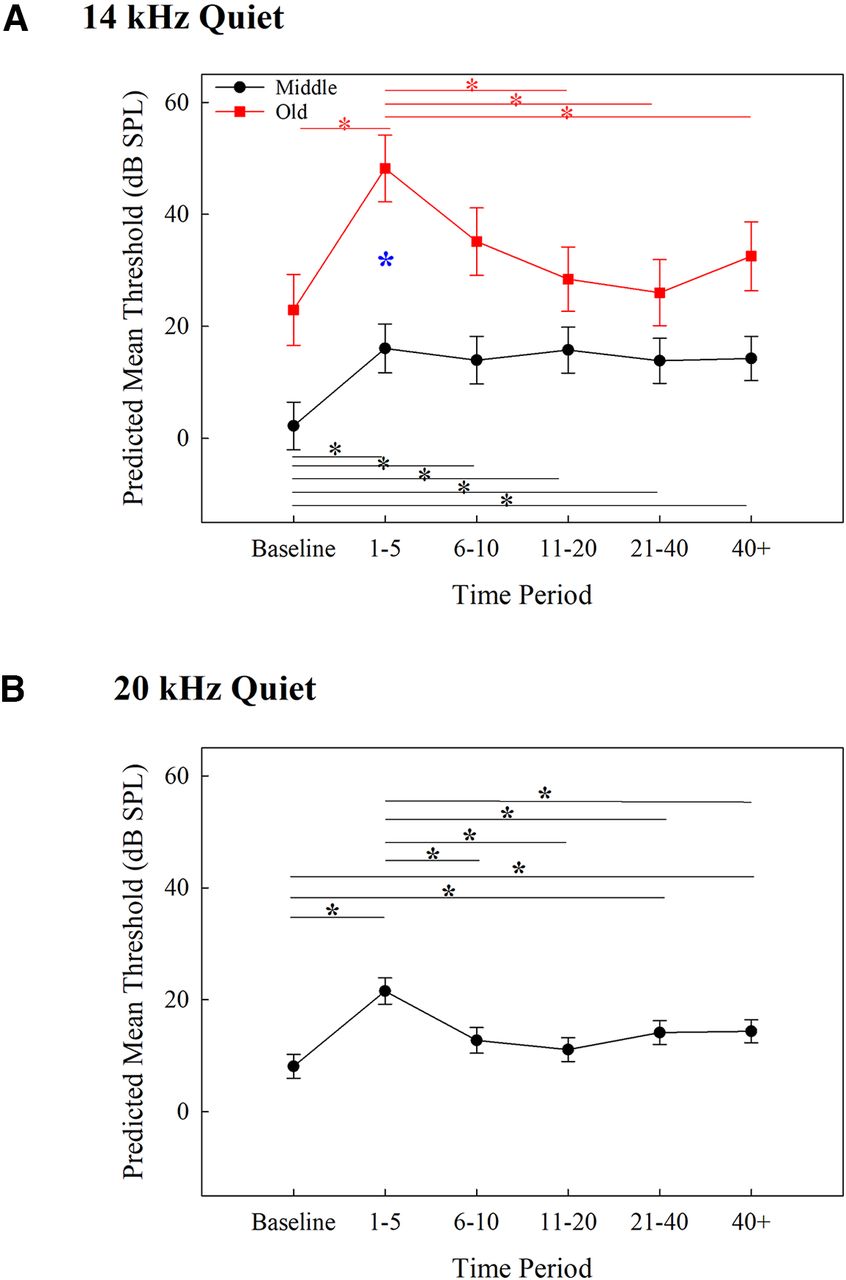
    Figure 2.

    Predicted mean thresholds for tone detection in quiet from the mixed-effects model for 14 (A) and 20 (B) kHz across each time period (corrected p = 0.0014). Middle-aged mice are represented by black circles and within-group significant comparisons are designated with black lines and *. Old-aged mice are represented by red squares and within-group significant comparisons are designated with red lines and *. The blue * in A represents significant between age groups comparisons. Error bars represent SEM.

  • Figure 3.
    • Download figure
    • Open in new tab
    • Download powerpoint
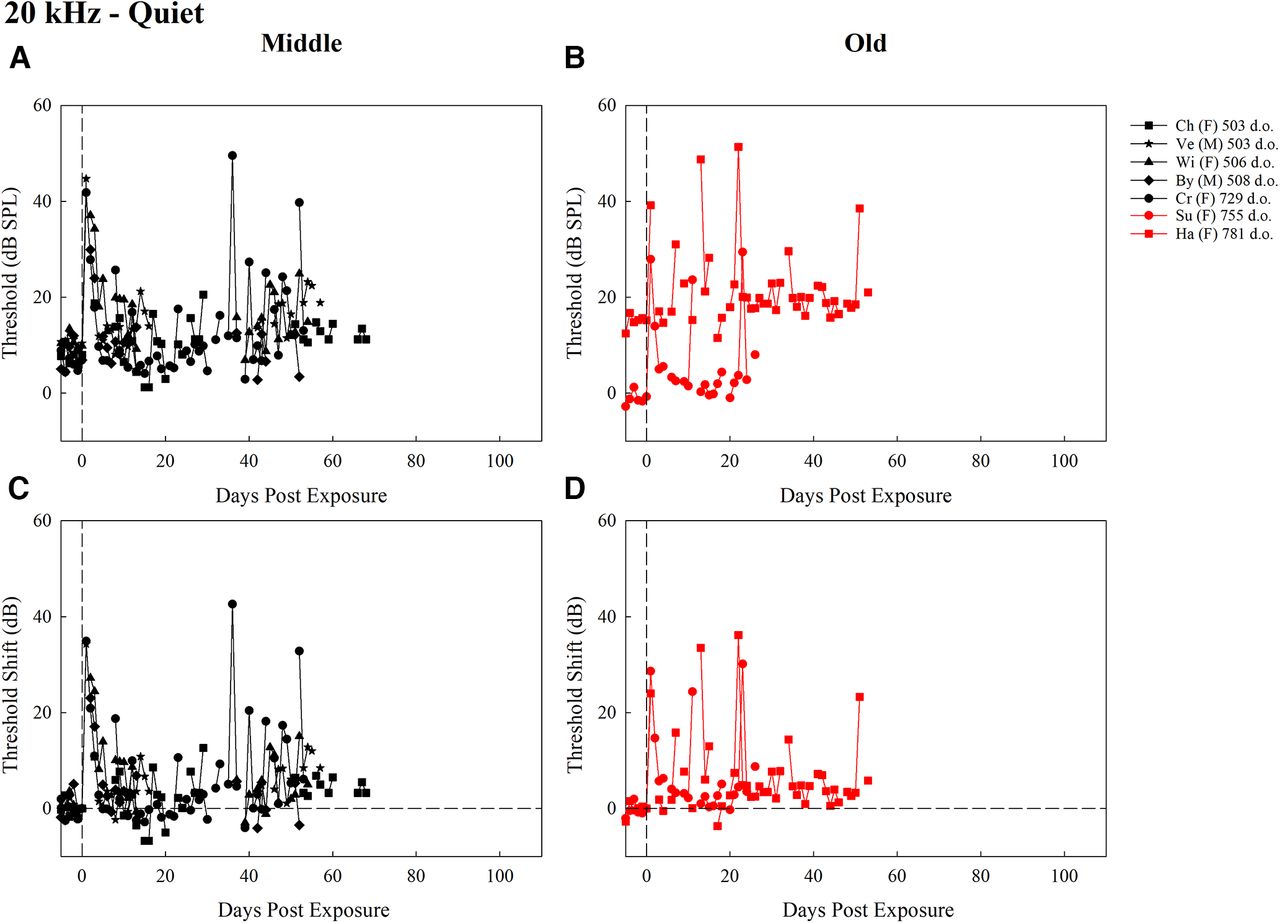
    Figure 3.

    Thresholds (dB SPL) for middle-aged mice (A) and old-aged mice (B), and threshold shifts (dB) for middle-aged mice (C) and old-aged mice (D), trained to detect 20-kHz tones in quiet for all test days after exposure. Each plot contains the first two letters of the subject identifier, sex, and age at exposure in d.o. with black symbols representing middle-aged mice and red symbols representing old-aged mice. The dashed vertical line at day 0 represents noise exposure day. The dashed horizontal line in C and D represents pre-exposure thresholds at 0 dB for each mouse.

  • Figure 4.
    • Download figure
    • Open in new tab
    • Download powerpoint
    Figure 4.

    Thresholds (dB SPL) for middle-aged mice (A) and old-aged mice (B), and threshold shifts (dB) for middle-aged mice (C) and old-aged mice (D), trained to detect 14-kHz tones in a masker for all test days after exposure. Each plot contains the first two letters of the subject identifier, sex, and age at exposure in d.o. with black symbols representing middle-aged mice and red symbols representing old-aged mice. The dashed vertical line at day 0 represents noise exposure day. The dashed horizontal line in C and D represents pre-exposure thresholds at 0 dB for each mouse.

  • Figure 5.
    • Download figure
    • Open in new tab
    • Download powerpoint
    Figure 5.

    Predicted mean thresholds for tone detection in noise from the mixed-effects model for 14 (A) and 20 (B) kHz across each time period (adjusted p = 0.0014). Middle-aged mice are represented by black circles and within-group significant comparisons are designated with black lines and *. Old-aged mice are represented by red squares and within-group significant comparisons are designated with red lines and *. Error bars represent SEM.

  • Figure 6.
    • Download figure
    • Open in new tab
    • Download powerpoint
    Figure 6.

    Thresholds (dB SPL) for middle-aged mice (A) and old-aged mice (B), and threshold shifts (dB) for middle-aged mice (C) and old-aged mice (D), trained to detect 20-kHz tones in a masker for all test days after exposure. Each plot contains the first two letters of the subject identifier, sex, and age at exposure in d.o. with black symbols representing middle-aged mice and red symbols representing old-aged mice. The dashed vertical line at day 0 represents noise exposure day. The dashed horizontal line in C and D represents pre-exposure thresholds at 0 dB for each mouse.

  • Figure 7.
    • Download figure
    • Open in new tab
    • Download powerpoint
    Figure 7.

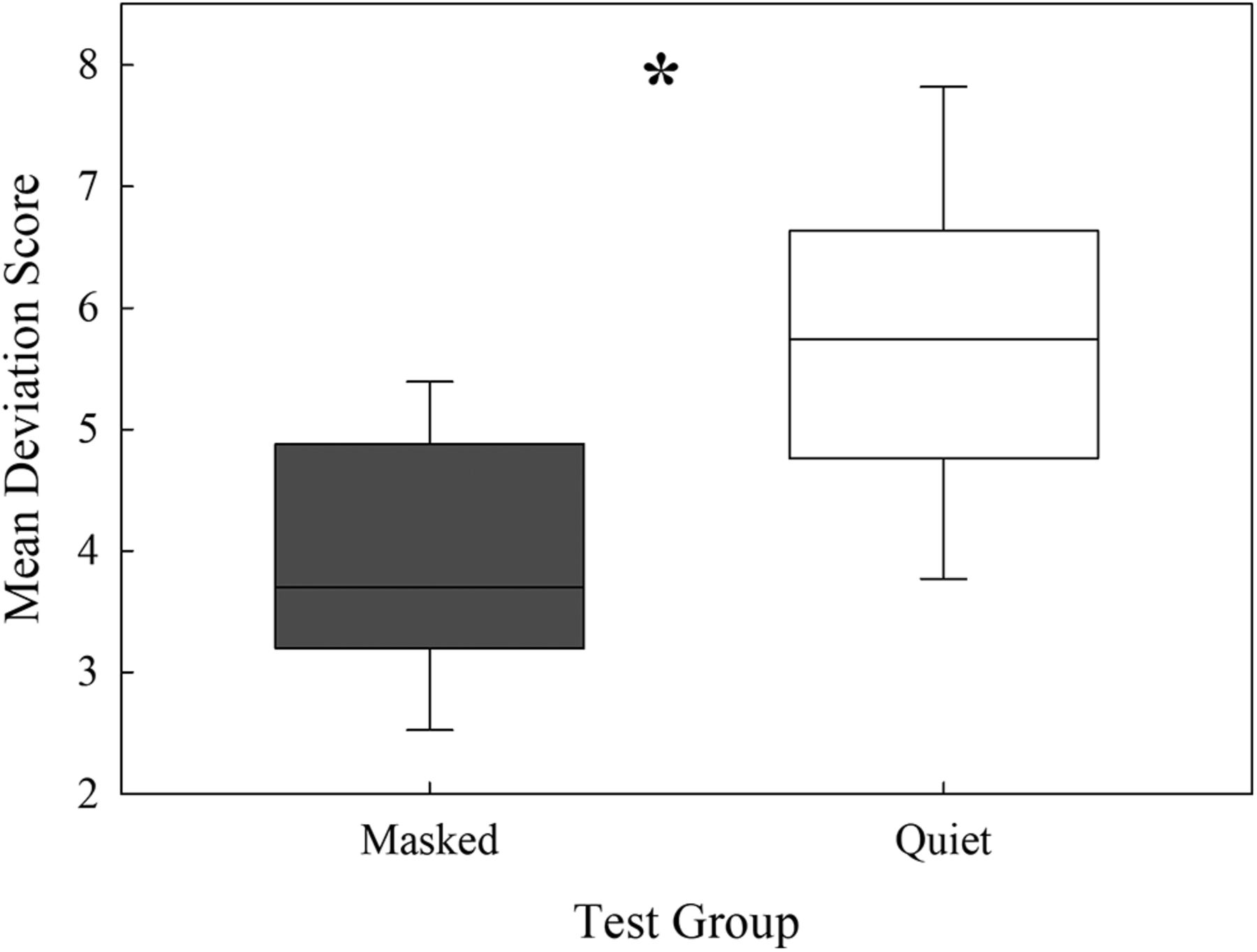
    Mean deviation scores after exposure for masked and quiet listening conditions (*p < 0.05). Box height represents the 75th percentile (Q3), the horizontal line within box represents the median, the bottom of the box represents the 25th percentile (Q1) and the error bars represent represent the maximum observation that falls within the upper limit (Q3+1.5(Q3−Q1)) and the minimum observation that falls within the lower limit (Q1−1.5 (Q3−Q1)).

  • Figure 8.
    • Download figure
    • Open in new tab
    • Download powerpoint
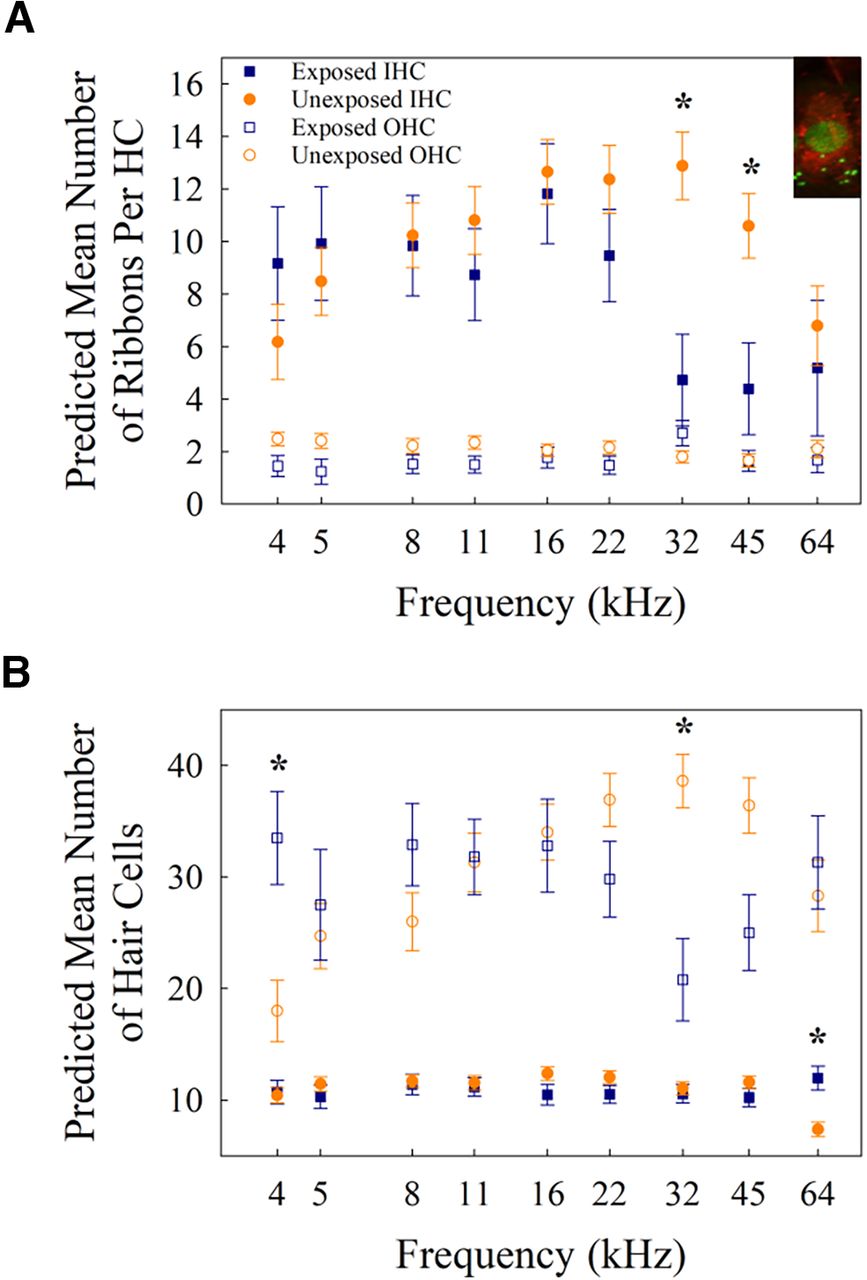
    Figure 8.

    A, Predicted mean number of ribbons per hair HC across frequencies for unexposed (orange) and exposed (blue) mice. Error bars are standard error and *p < 0.0056. The top right corner includes sample cochlear immunohistochemistry with Myosin 6 (red) to visualize the hair cell and CTBP2 (green) to visualize ribbons. B, Predicted mean number of hair cells per 100 μm at each frequency for IHCs (closed symbols) and OHCs (open symbols) in unexposed (orange) and exposed mice (blue). Error bars are standard error and *p < 0.0056.
Tables

  • Figures
    • View popup
    Table 1

    Statistical table for all behavioral modeling including F values, degrees of freedom (numerator, denominator), p values, and effect sizes (ηp2) for quiet (left) and masked (right) conditions separately for 14 kHz (top) and 20 kHz (bottom)

    QuietMasked
    Fdfpηp2Fdfpηp2
    14 kHz
     Age group10.421, 9.400.00980.0790041.361, 6.060.2870.0106
     Time period16.615, 517.763.16e-150.62935521.855, 395.85< 2.2e-160.8506
     Age group:time period7.705, 517.765.39e-070.2916413.565, 395.850.0040.1387
    20 kHz
     Age group0.04921, 6.010.83190.0005
     Time period11.755, 234.483.80e-1010.015, 373.085.26e-90.5059
     Age group:time period9.775, 373.088.69e-090.4936
    • Significant values are bolded.

    • View popup
    Table 2

    Statistical table for all day-to-day variability measurements, including an ANOVA analysis examining the interaction between masker status and stimulus, a post hoc Tukey’s test, and linear regressions examining whether the age of the mouse (in d.o.) could predict changes in day-to-day variability

    Test typeComparisons/independent variablesTest statisticSS dfp valueEffect size
    ANOVAAfter <- stimulus × masker statusF value ηp2
    Stimulus0.8431.17610.36850.0220009
    Masker status15.35321.4210.000740.400876
    Stimulus × masker status0.1030.14310.75150.002676
     Residuals 30.69422  
    Difference scoreCohen’s d
    Tukey’s HSDQuiet vs masked after noise exposure1.821  0.000741.591433
    F valueR2
    Linear regressionQuiet before noise exposure1.07(2, 12)0.32130.0819
    Noise before noise exposure1.3096(2, 10)0.27910.1158
    Quiet after noise exposure2.5804(2, 12)0.13420.177
    Noise after noise exposure1.2205(2, 10)0.29510.1088
    14 kHz in quiet after0.2825(2, 5)0.61780.0535
    14 kHz in noise after1.9356(2, 4)0.23650.3261
    20 kHz in quiet after5.076(2, 5)0.0740.5038
     20 kHz in noise after0.2996 (2, 4)0.61320.0697
    • Significant values are bolded throughout and relevant effect sizes are presented.

    • View popup
    Table 3

    Statistical table for all anatomic tests including F values, degrees of freedom (numerator, denominator), p values, and effect sizes (ηp2) for number of IHCs (top), number of OHCs (second down), number of puncta per IHC (third down), and number of puncta per OHC (bottom)

    TestVariablesFdfpηp2
    Frequency1.15128, 1160.3349010.264604
    Number of IHCsExposure group0.49541, 1160.4829410.014234
    Frequency:Exposure group3.13758, 1160.0030050.721163
    Frequency1.93858, 92.6520.06330.200283
    Number of OHCsExposure group0.15751, 15.5530.69690.002036
    Frequency:Exposure group7.72058, 92.6527.00E-080.797681
    Frequency3.80958, 101.5210.0005990.489336
    Number of puncta per IHCExposure group2.45141, 15.8050.1372170.039362
    Frequency:Exposure group3.66928, 101.5210.0008540.471303
    Frequency0.64068, 81.2080.741360.187705
    Number of puncta per OHCExposure group3.69371, 14.9880.073840.135288
    Frequency:Exposure group2.31058, 81.2080.027590.677006
    • Significant values are bolded.

Back to top

In this issue

eneuro: 9 (3)
eNeuro
Vol. 9, Issue 3
May/June 16
  • Table of Contents
  • Index by author
  • Ed Board (PDF)
Email

Thank you for sharing this eNeuro article.

NOTE: We request your email address only to inform the recipient that it was you who recommended this article, and that it is not junk mail. We do not retain these email addresses.

Enter multiple addresses on separate lines or separate them with commas.
Effects of Noise Exposure and Aging on Behavioral Tone Detection in Quiet and Noise by Mice
(Your Name) has forwarded a page to you from eNeuro
(Your Name) thought you would be interested in this article in eNeuro.
CAPTCHA
This question is for testing whether or not you are a human visitor and to prevent automated spam submissions.
Print
View Full Page PDF
Citation Tools
Effects of Noise Exposure and Aging on Behavioral Tone Detection in Quiet and Noise by Mice
Kali Burke, Laurel A. Screven, Anastasiya Kobrina, Payton E. Charlton, Katrina Schrode, Dillan F. Villavisanis, Micheal L. Dent, Amanda M. Lauer
eNeuro 25 May 2022, 9 (3) ENEURO.0391-21.2022; DOI: 10.1523/ENEURO.0391-21.2022

Citation Manager Formats

  • BibTeX
  • Bookends
  • EasyBib
  • EndNote (tagged)
  • EndNote 8 (xml)
  • Medlars
  • Mendeley
  • Papers
  • RefWorks Tagged
  • Ref Manager
  • RIS
  • Zotero
Respond to this article
Share
Effects of Noise Exposure and Aging on Behavioral Tone Detection in Quiet and Noise by Mice
Kali Burke, Laurel A. Screven, Anastasiya Kobrina, Payton E. Charlton, Katrina Schrode, Dillan F. Villavisanis, Micheal L. Dent, Amanda M. Lauer
eNeuro 25 May 2022, 9 (3) ENEURO.0391-21.2022; DOI: 10.1523/ENEURO.0391-21.2022
Twitter logo Facebook logo Mendeley logo
  • Tweet Widget
  • Facebook Like
  • Google Plus One

Jump to section

  • Article
    • Visual Abstract
    • Abstract
    • Significance Statement
    • Introduction
    • Materials and Methods
    • Results
    • Discussion
    • Acknowledgments
    • Footnotes
    • References
    • Synthesis
  • Figures & Data
  • Info & Metrics
  • eLetters
  • PDF

Keywords

  • age-related hearing loss
  • cochlear pathology
  • hearing in noise
  • noise-induced hearing loss
  • operant conditioning
  • threshold instability

Responses to this article

Respond to this article

Jump to comment:

No eLetters have been published for this article.

Related Articles

Cited By...

More in this TOC Section

Research Article: New Research

  • Sensory-cell population integrity required to preserve minimal and normal vestibulo-ocular reflexes reveals the critical role of type I hair cells in canal- and otolith-specific functions
  • Galanin inhibits histaminergic neurons via galanin receptor 1
  • sAPPα inhibits neurite outgrowth in primary mouse neurons via GABA B Receptor subunit 1a
Show more Research Article: New Research

Sensory and Motor Systems

  • Sensory-cell population integrity required to preserve minimal and normal vestibulo-ocular reflexes reveals the critical role of type I hair cells in canal- and otolith-specific functions
  • Independent Encoding of Orientation and Mean Luminance by Mouse Visual Cortex
  • Different But Complementary Motor Functions Reveal an Asymmetric Recalibration of Upper Limb Bimanual Coordination
Show more Sensory and Motor Systems

Subjects

  • Sensory and Motor Systems
  • Home
  • Alerts
  • Follow SFN on BlueSky
  • Visit Society for Neuroscience on Facebook
  • Follow Society for Neuroscience on Twitter
  • Follow Society for Neuroscience on LinkedIn
  • Visit Society for Neuroscience on Youtube
  • Follow our RSS feeds

Content

  • Early Release
  • Current Issue
  • Latest Articles
  • Issue Archive
  • Blog
  • Browse by Topic

Information

  • For Authors
  • For the Media

About

  • About the Journal
  • Editorial Board
  • Privacy Notice
  • Contact
  • Feedback
(eNeuro logo)
(SfN logo)

Copyright © 2026 by the Society for Neuroscience.
eNeuro eISSN: 2373-2822

The ideas and opinions expressed in eNeuro do not necessarily reflect those of SfN or the eNeuro Editorial Board. Publication of an advertisement or other product mention in eNeuro should not be construed as an endorsement of the manufacturer’s claims. SfN does not assume any responsibility for any injury and/or damage to persons or property arising from or related to any use of any material contained in eNeuro.