Main menu

  • HOME
  • CONTENT
    • Early Release
    • Featured
    • Current Issue
    • Issue Archive
    • Blog
    • Collections
    • Podcast
  • TOPICS
    • Cognition and Behavior
    • Development
    • Disorders of the Nervous System
    • History, Teaching and Public Awareness
    • Integrative Systems
    • Neuronal Excitability
    • Novel Tools and Methods
    • Sensory and Motor Systems
  • ALERTS
  • FOR AUTHORS
  • ABOUT
    • Overview
    • Editorial Board
    • For the Media
    • Privacy Policy
    • Contact Us
    • Feedback
  • SUBMIT

User menu

Search

  • Advanced search
eNeuro
eNeuro

Advanced Search


  • HOME
  • CONTENT
    • Early Release
    • Featured
    • Current Issue
    • Issue Archive
    • Blog
    • Collections
    • Podcast
  • TOPICS
    • Cognition and Behavior
    • Development
    • Disorders of the Nervous System
    • History, Teaching and Public Awareness
    • Integrative Systems
    • Neuronal Excitability
    • Novel Tools and Methods
    • Sensory and Motor Systems
  • ALERTS
  • FOR AUTHORS
  • ABOUT
    • Overview
    • Editorial Board
    • For the Media
    • Privacy Policy
    • Contact Us
    • Feedback
  • SUBMIT
PreviousNext
Research ArticleResearch Article: New Research, Integrative Systems

Histochemical Characterization of the Dorsal Raphe-Periaqueductal Grey Dopamine Transporter Neurons Projecting to the Extended Amygdala

Qin Zhao, Tetsufumi Ito, Chika Soko, Yoshie Hori, Takafumi Furuyama, Hiroyuki Hioki, Kohtarou Konno, Miwako Yamasaki, Masahiko Watanabe, Satoshi Ohtsuka, Munenori Ono, Nobuo Kato and Ryo Yamamoto
eNeuro 17 May 2022, 9 (3) ENEURO.0121-22.2022; https://doi.org/10.1523/ENEURO.0121-22.2022
Qin Zhao
1Department of Physiology, Kanazawa Medical University, Uchinada, Ishikawa 920-0293, Japan
6Department of Neurology, Tongji Hospital, Tongji Medical College, Huazhong University of Science and Technology, Wuhan 430030, China
  • Find this author on Google Scholar
  • Find this author on PubMed
  • Search for this author on this site
Tetsufumi Ito
2Systems Function and Morphology Laboratory, Graduate School of Innovative Life Science, University of Toyama, Toyama, Toyama 930-0194, Japan
  • Find this author on Google Scholar
  • Find this author on PubMed
  • Search for this author on this site
  • ORCID record for Tetsufumi Ito
Chika Soko
2Systems Function and Morphology Laboratory, Graduate School of Innovative Life Science, University of Toyama, Toyama, Toyama 930-0194, Japan
  • Find this author on Google Scholar
  • Find this author on PubMed
  • Search for this author on this site
Yoshie Hori
1Department of Physiology, Kanazawa Medical University, Uchinada, Ishikawa 920-0293, Japan
  • Find this author on Google Scholar
  • Find this author on PubMed
  • Search for this author on this site
Takafumi Furuyama
1Department of Physiology, Kanazawa Medical University, Uchinada, Ishikawa 920-0293, Japan
  • Find this author on Google Scholar
  • Find this author on PubMed
  • Search for this author on this site
  • ORCID record for Takafumi Furuyama
Hiroyuki Hioki
3Department of Neuroanatomy, Juntendo University Graduate School of Medicine, Tokyo, 113-8421, Japan
  • Find this author on Google Scholar
  • Find this author on PubMed
  • Search for this author on this site
Kohtarou Konno
4Department of Anatomy, Faculty of Medicine, Hokkaido University, Sapporo, Hokkaido 060-8638, Japan
  • Find this author on Google Scholar
  • Find this author on PubMed
  • Search for this author on this site
Miwako Yamasaki
4Department of Anatomy, Faculty of Medicine, Hokkaido University, Sapporo, Hokkaido 060-8638, Japan
  • Find this author on Google Scholar
  • Find this author on PubMed
  • Search for this author on this site
Masahiko Watanabe
4Department of Anatomy, Faculty of Medicine, Hokkaido University, Sapporo, Hokkaido 060-8638, Japan
  • Find this author on Google Scholar
  • Find this author on PubMed
  • Search for this author on this site
  • ORCID record for Masahiko Watanabe
Satoshi Ohtsuka
5Laboratory for Experimental Animals, Kyoto Prefectural University of Medicine, Kyoto, Kyoto 602-8566, Japan
  • Find this author on Google Scholar
  • Find this author on PubMed
  • Search for this author on this site
Munenori Ono
1Department of Physiology, Kanazawa Medical University, Uchinada, Ishikawa 920-0293, Japan
  • Find this author on Google Scholar
  • Find this author on PubMed
  • Search for this author on this site
Nobuo Kato
1Department of Physiology, Kanazawa Medical University, Uchinada, Ishikawa 920-0293, Japan
  • Find this author on Google Scholar
  • Find this author on PubMed
  • Search for this author on this site
Ryo Yamamoto
1Department of Physiology, Kanazawa Medical University, Uchinada, Ishikawa 920-0293, Japan
  • Find this author on Google Scholar
  • Find this author on PubMed
  • Search for this author on this site
  • Article
  • Figures & Data
  • Info & Metrics
  • eLetters
  • PDF
Loading

Article Figures & Data

Figures

  • Tables
  • Figure 1.
    • Download figure
    • Open in new tab
    • Download powerpoint
    Figure 1.

    DATDR-PAG neurons are composed of at least two subpopulations. A, Representative fluorescent images of each marker in the DR-PAG region. Top left, DAT signal was visualized with anti-RFP antibody in DAT-Cre::Ai14 mice (yellow). Top right, TH signal was visualized with anti-TH antibody (magenta). Bottom left, VIP signal was visualized with anti-VIP antibody (cyan). Bottom right, Three signals were overlaid. TH and VIP signals were rarely overlapped. B, Pie charts showing the composition of each marker in the DR-PAG region. The percentages are calculated from four DAT-Cre::Ai14 mice.

  • Figure 2.
    • Download figure
    • Open in new tab
    • Download powerpoint
    Figure 2.

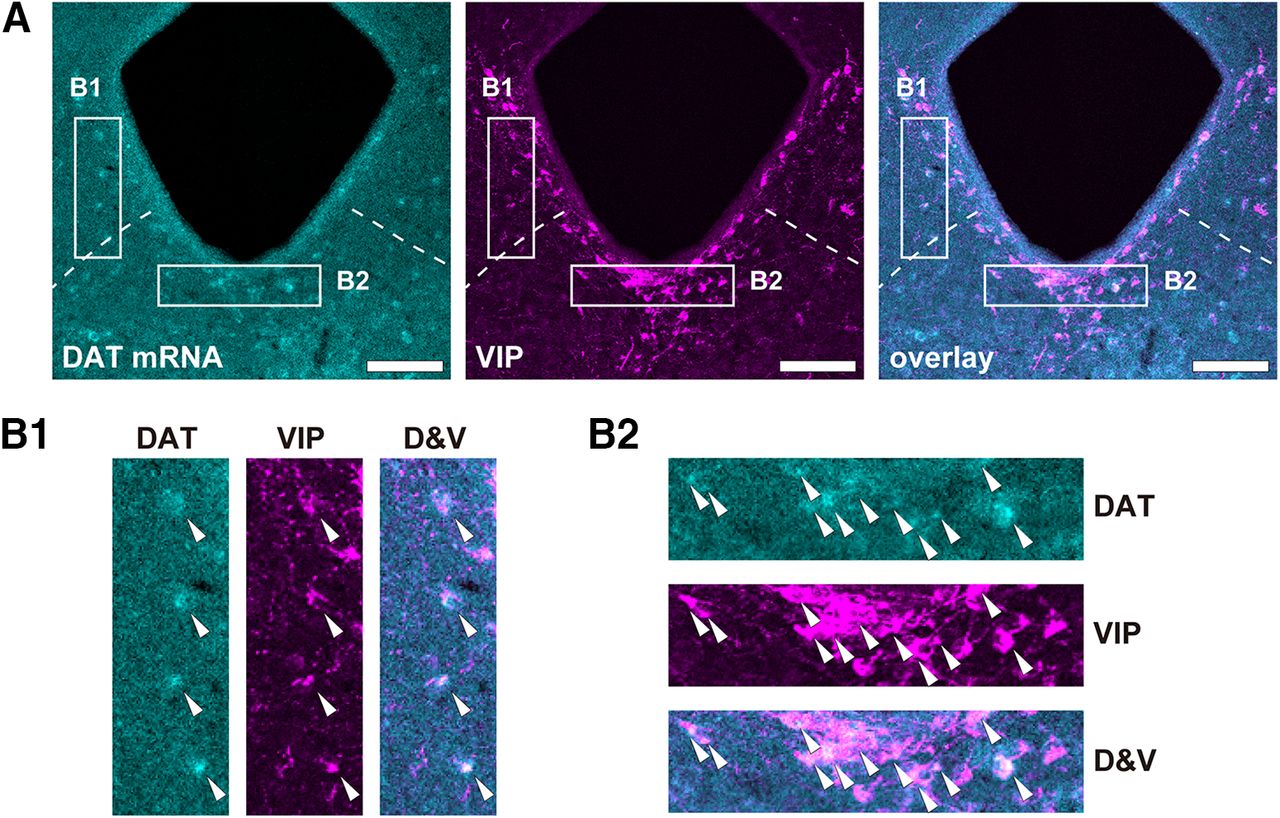
    VIPDR-PAG neurons are DAT-mRNA-positive. A, Left, DAT signal was visualized with DAT in situ hybridization (cyan). Middle, VIP signal was visualized with anti-VIP antibody (magenta). Left, Two signals were overlaid. B, B1 and B2 show high-magnification images corresponding to rectangle areas B1 and B2 in panel A. White arrow heads indicate DAT and VIP double positive cell bodies. D&V represent overlaying images of DAT and VIP signals. DAT and VIP signals were colocalized in a number of neurons.

  • Figure 3.
    • Download figure
    • Open in new tab
    • Download powerpoint
    Figure 3.

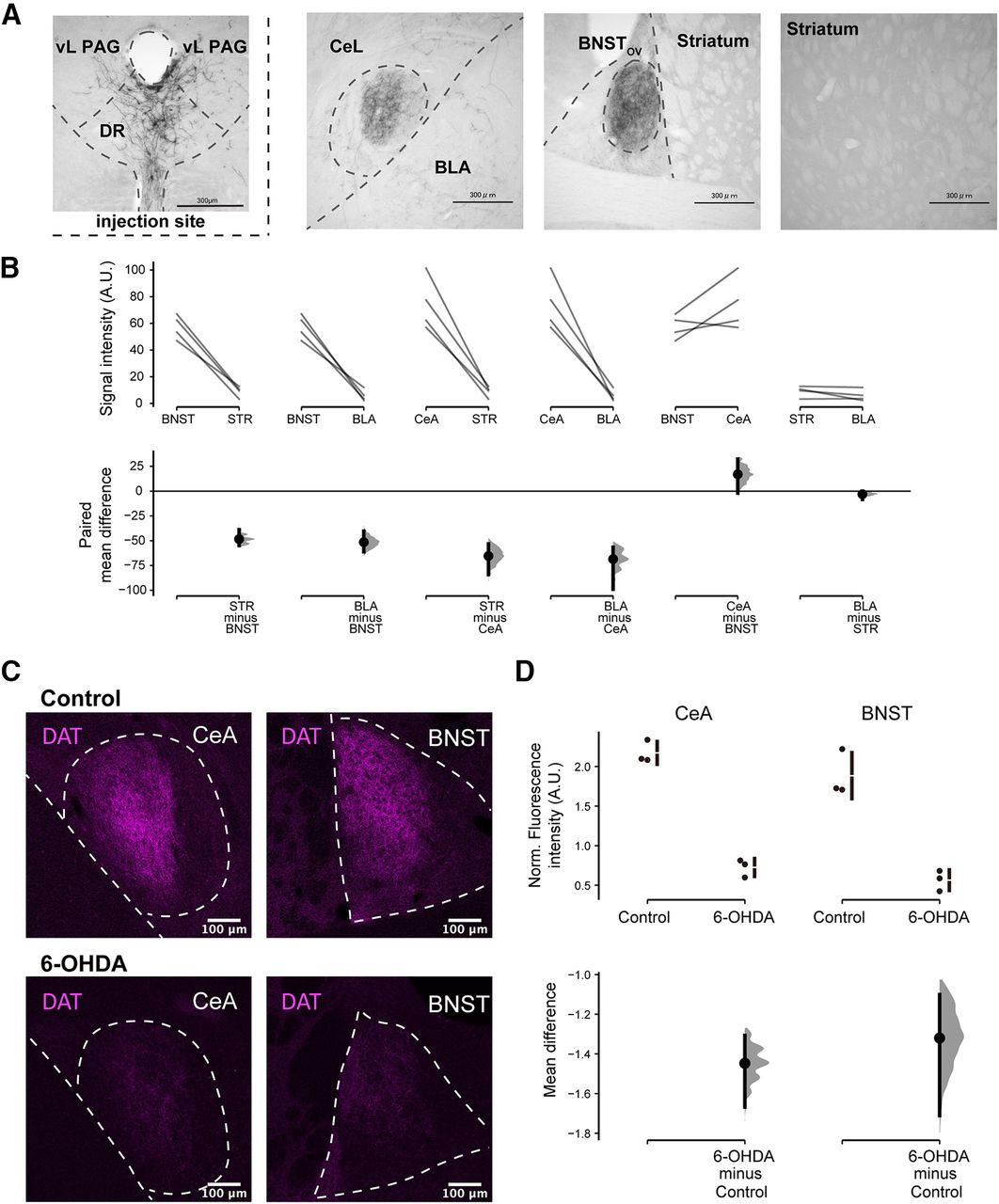
    DATDR-PAG neurons innervate exclusively onto the CeL and BNSTOV, and a vast majority of DAT fibers in these regions originated from the DR-PAG. A, Representative images of AAV5-EF1α-DIO-hChR2-EYFP injection onto the DR-PAG region of a DAT-Cre mouse. EYFP signal was visualized with anti-GFP antibody following DAB staining. Top left, Injection site of the AAV onto a DAT-Cre mouse. Many DAT+ neurons were observed in this region. Top middle left, Fiber terminals were restricted in the CeL. Top middle right, Fiber terminals were restricted in the BNSTOV. Top right, No fiber was observed in the striatum. B, Paired mean differences for six comparisons are shown in the Cumming estimation plot. Signal intensities from four DAT-Cre mice are plotted on the upper axes; each paired set of observations is connected by a line. On the lower axes, each paired mean difference is plotted as a bootstrap sampling distribution. Mean differences are depicted as dots; 95% CIs are indicated by the ends of the vertical error bars. The fiber signal intensities in the BNSTOV and CeL were significantly higher than those in other regions. C, Comparison of fiber fluorescence intensities in the CeL and BNSTOV between control and 6-OHDA-injected mice. Control, In the CeL and BNSTOV, dense DAT+ fibers were observed. 6-OHDA, In contrast, DAT+ fibers were barely observed. D, Mean differences for two comparisons are shown in the Cumming estimation plot. Signal intensities from three DAT-Cre::Ai14 mice are plotted on the upper axes; each mean difference is plotted on the lower axes as a bootstrap sampling distribution. Mean differences are depicted as dots; 95% CIs are indicated by the ends of the vertical error bars. There were statistically significant differences between control and 6-OHDA-injected mice.

  • Figure 4.
    • Download figure
    • Open in new tab
    • Download powerpoint
    Figure 4.

    Summaries of the FG injection sites. A, Representative images of the FG injections into the CeA and BNST. The green signal indicates the FG signal visualized with an anti-FG antibody. The blue background signal shows fluorescent Nissl staining with PI. B, FG-injected areas are shown in the atlas for the CeA and BNST. Bold red indicates the areas commonly covered in the majority of subjects. Dim red indicates the area covered by injection at least in one animal. Atlas figures were modified from Franklin and Paxinos (2007). The distances from the bregma are indicated at the top right of each atlas.

  • Figure 5.
    • Download figure
    • Open in new tab
    • Download powerpoint
    Figure 5.

    FG retrograde tracing revealed that DAT+/TH+ neurons similarly innervate the CeA and BNST. A, Representative fluorescent images of each marker in the DR-PAG region. Top left, FG signal was visualized with anti-FG antibody in DAT-cre::Ai14 mice (cyan). Top middle, DAT signal was visualized with anti-RFP antibody (yellow). Top right, TH signal was visualized with anti-TH antibody (magenta). Bottom left, Three signals were overlaid. Bottom left, The pie chart indicates the composition of FG+ neurons (CeA injection) in the DR-PAG region. B, Representative fluorescent images of each marker in the DR-PAG region. Top left, FG signal was visualized with anti-FG antibody in DAT-cre::Ai14 mice (cyan). Top middle, DAT signal was visualized with anti-RFP antibody (yellow). Top right, TH signal was visualized with anti-TH antibody (magenta). Bottom left, Three signals were overlaid. Bottom left, The pie chart indicates the composition of FG+ neurons (BNST injection) in the DR-PAG region.

  • Figure 6.
    • Download figure
    • Open in new tab
    • Download powerpoint
    Figure 6.

    FG retrograde tracing revealed that the DAT+/VIP+ neurons similarly innervate the CeA and BNST. A, Representative fluorescent images of each marker in the DR-PAG region. Top left, FG signal was visualized with anti-FG antibody in DAT-cre::Ai14 mice (cyan). Top middle, VIP signal was visualized with anti-VIP antibody (yellow). Top right, DAT signal was visualized with anti-DAT antibody (magenta). Bottom left, Three signals were overlaid. Bottom right, The pie chart indicates the composition of the FG+ neurons (CeA injection) in the DR-PAG region. B, Representative fluorescent images of each marker in the DR-PAG region. Top left, FG signal was visualized with anti-FG antibody in DAT-cre::Ai14 mice (cyan). Top middle, VIP signal was visualized with anti-VIP antibody (yellow). Top right, DAT signal was visualized with anti-DAT antibody (magenta). Bottom left, Three signals were overlaid. Bottom right, The pie chart indicates the composition of the FG+ neurons (BNST injection) in the DR-PAG region.

  • Figure 7.
    • Download figure
    • Open in new tab
    • Download powerpoint
    Figure 7.

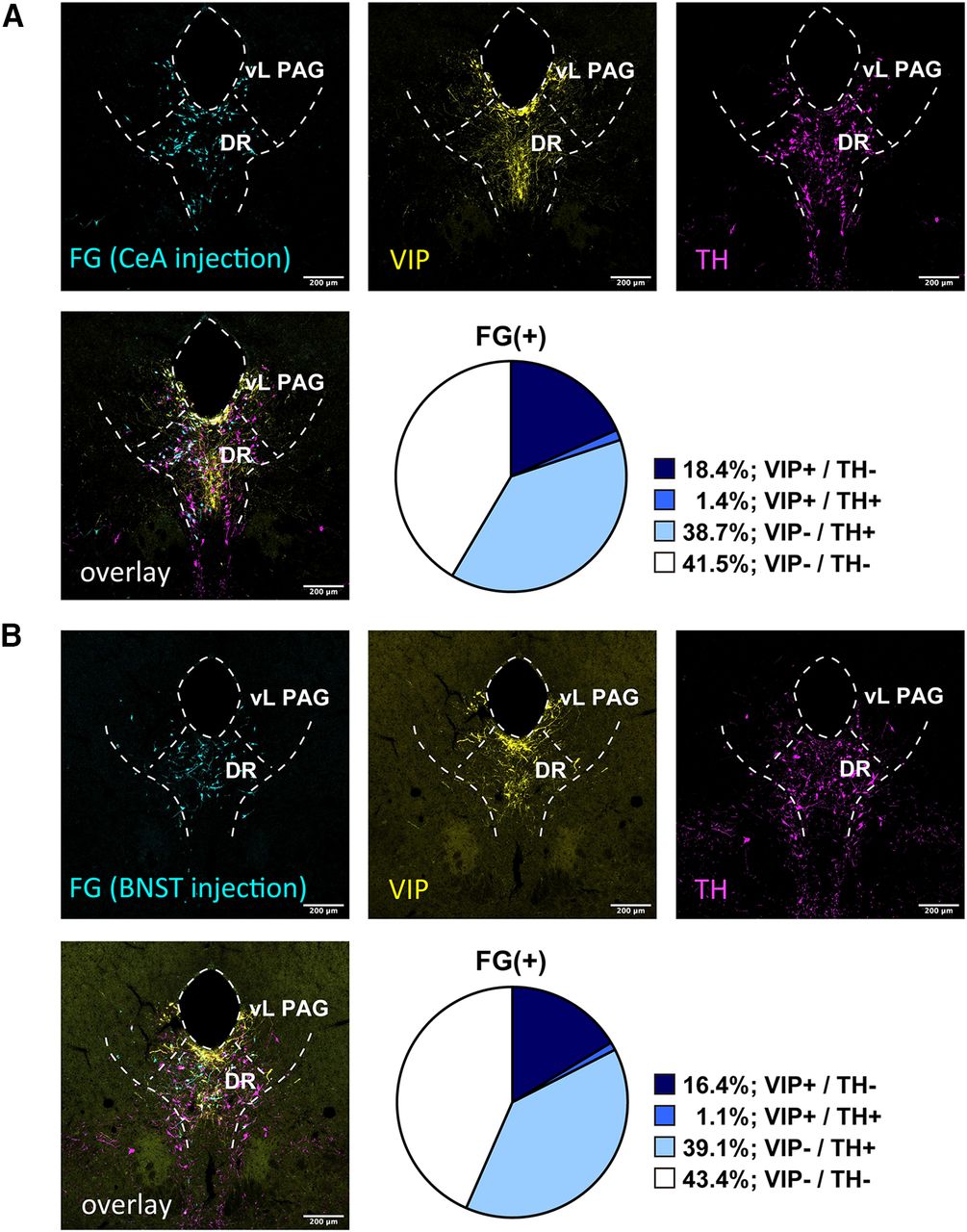
    FG retrograde tracing revealed that the TH+ or VIP+ neurons similarly innervate the CeA and BNST. A, Representative fluorescent images of each marker in the DR-PAG region. Top left, FG signal was visualized with anti-FG antibody (cyan). Top middle, VIP signal was visualized with anti-VIP antibody (yellow). Top right, TH signal was visualized with anti-TH antibody (magenta). Bottom left, Three signals were overlaid. Bottom right, The pie chart indicates the composition of the FG+ neurons (CeA injection) in the DR-PAG region. B, Representative fluorescent images of each marker in the DR-PAG region. Top left, FG signal was visualized with anti-FG antibody in DAT-cre::Ai14 mice (cyan). Top middle, VIP signal was visualized with anti-VIP antibody (yellow). Top right, TH signal was visualized with anti-TH antibody (magenta). Bottom left, Three signals were overlaid. Bottom right, The pie chart indicates the composition of the FG+ neurons (BNST injection) in the DR-PAG region.

  • Figure 8.
    • Download figure
    • Open in new tab
    • Download powerpoint
    Figure 8.

    FG retrograde tracing revealed that the VIP+/VGlut2+ neurons similarly innervate the CeA and BNST. A, Representative fluorescent images of each marker in the DR-PAG region. Top left, FG signal was visualized with anti-FG antibody in VGlut2-cre::Ai14 mice (cyan). Top middle, VIP signal was visualized with anti-VIP antibody (yellow). Top right, VGlut-2 signal was visualized with anti-RFP antibody (magenta). Bottom left, Three signals were overlaid. Bottom right, The pie chart indicates the composition of FG+/VIP+ neurons (CeA injection) in the DR-PAG region. B, Representative fluorescent images of each marker in the DR-PAG region. Top left, FG signal was visualized with anti-FG antibody in VGlut2-Cre::Ai14 mice (cyan). Top middle, VIP signal was visualized with anti-VIP antibody (yellow). Top right, VGlut2 signal was visualized with anti-RFP antibody (magenta). Bottom left, Three signals were overlaid. Bottom right, The pie chart indicates the composition of FG+/VIP+ neurons (BNST injection) in the DR-PAG region.

  • Figure 9.
    • Download figure
    • Open in new tab
    • Download powerpoint
    Figure 9.

    The extent of DAT protein expression is lower in the DATDR-PAG neurons. DR-PAG, Left, Staining of DAT neurons in a DAT-cre::Ai14 mouse. Many cell bodies and fibers are confirmed. Middle, With DAT in situ hybridization, dim cell bodies were confirmed in the DR-PAG region. Right, Immunostaining of DAT barely stained cell bodies in the DR-PAG region. VTA-SNc, In all three methods, strong DAT signals were confirmed. Each black scale bar indicates 300 μm.

Tables

  • Figures
    • View popup
    Table 1

    Combinations of antibodies in each figure showing fluorescence images are shown in the table

    FiguresCombinations
    Figure 1TH: mouse anti-TH-antibody + anti-mouse-IgG-antibody with Alexa Fluor 488
    DAT (tdTomato): rat anti-RFP-antibody + anti-rat-IgG-antibody with Alexa Fluor 594
    VIP: guinea pig anti-VIP-antibody + anti-guinea pig-IgG-antibody with Cy5
    Figure 2DAT: in situ hybridization (Fast Red TR)
    VIP: guinea pig anti-VIP-antibody + anti-guinea pig-IgG-antibody with Cy5
    Figure 5FG: rabbit anti-FG-antibody + TSA with Alexa Fluor 488
    DAT (tdTomato): rat anti-RFP-antibody + anti-rat-IgG-antibody with Alexa Fluor 594
    TH: mouse anti-TH-antibody + anti-mouse-IgG-antibody with Alexa Fluor 647
    Figure 6FG: rabbit anti-FG-antibody + TSA with Alexa Fluor 488
    DAT (tdTomato): rat anti-RFP-antibody + anti-rat-IgG-antibody with Alexa Fluor 594
    VIP: guinea pig anti-VIP-antibody + anti-guinea pig-IgG-antibody with Cy5
    Figure 7FG: rabbit anti-FG-antibody + TSA with Alexa Fluor 488
    TH: mouse anti-TH-antibody + anti-mouse-IgG-antibody with Alexa Fluor 594
    VIP: guinea pig anti-VIP-antibody + anti-guinea pig-IgG-antibody with Cy5
    Figure 8FG: rabbit anti-FG-antibody + TSA with Alexa Fluor 488
    VGlut2 (tdTomato): rat anti-RFP-antibody + anti-rat-IgG-antibody with Alexa Fluor 594
    VIP: guinea pig anti-VIP-antibody + anti-guinea pig-IgG-antibody with Cy5
    • View popup
    Table 2

    Statistical table

    Data structureType of testPower
    aNormal distributionPermuted t test followed by Holm’s correction[95.0%CI −54.8, −38.8]
    bNormal distributionPermuted t test followed by Holm’s correction[95%CI −61.0, −40.3]
    cNormal distributionPermuted t test followed by Holm’s correction[95.0%CI −84.1, −53.2]
    dNormal distributionPermuted t test followed by Holm’s correction[95.0%CI −99.0, −56.5]
    eNormal distributionPermuted t test followed by Holm’s correction[95.0%CI −1.86, 32.4]
    fNormal distributionPermuted t test followed by Holm’s correction[95.0%CI −8.39, −0.933]
    gNormal distributionPermuted t test[95.0%CI −1.67, −1.31]
    hNormal distributionPermuted t test[95.0%CI −1.71, −1.1]
Back to top

In this issue

eneuro: 9 (3)
eNeuro
Vol. 9, Issue 3
May/June 16
  • Table of Contents
  • Index by author
  • Ed Board (PDF)
Email

Thank you for sharing this eNeuro article.

NOTE: We request your email address only to inform the recipient that it was you who recommended this article, and that it is not junk mail. We do not retain these email addresses.

Enter multiple addresses on separate lines or separate them with commas.
Histochemical Characterization of the Dorsal Raphe-Periaqueductal Grey Dopamine Transporter Neurons Projecting to the Extended Amygdala
(Your Name) has forwarded a page to you from eNeuro
(Your Name) thought you would be interested in this article in eNeuro.
CAPTCHA
This question is for testing whether or not you are a human visitor and to prevent automated spam submissions.
Print
View Full Page PDF
Citation Tools
Histochemical Characterization of the Dorsal Raphe-Periaqueductal Grey Dopamine Transporter Neurons Projecting to the Extended Amygdala
Qin Zhao, Tetsufumi Ito, Chika Soko, Yoshie Hori, Takafumi Furuyama, Hiroyuki Hioki, Kohtarou Konno, Miwako Yamasaki, Masahiko Watanabe, Satoshi Ohtsuka, Munenori Ono, Nobuo Kato, Ryo Yamamoto
eNeuro 17 May 2022, 9 (3) ENEURO.0121-22.2022; DOI: 10.1523/ENEURO.0121-22.2022

Citation Manager Formats

  • BibTeX
  • Bookends
  • EasyBib
  • EndNote (tagged)
  • EndNote 8 (xml)
  • Medlars
  • Mendeley
  • Papers
  • RefWorks Tagged
  • Ref Manager
  • RIS
  • Zotero
Respond to this article
Share
Histochemical Characterization of the Dorsal Raphe-Periaqueductal Grey Dopamine Transporter Neurons Projecting to the Extended Amygdala
Qin Zhao, Tetsufumi Ito, Chika Soko, Yoshie Hori, Takafumi Furuyama, Hiroyuki Hioki, Kohtarou Konno, Miwako Yamasaki, Masahiko Watanabe, Satoshi Ohtsuka, Munenori Ono, Nobuo Kato, Ryo Yamamoto
eNeuro 17 May 2022, 9 (3) ENEURO.0121-22.2022; DOI: 10.1523/ENEURO.0121-22.2022
Twitter logo Facebook logo Mendeley logo
  • Tweet Widget
  • Facebook Like
  • Google Plus One

Jump to section

  • Article
    • Abstract
    • Significance Statement
    • Introduction
    • Materials and Methods
    • Results
    • Discussion
    • Acknowledgments
    • Footnotes
    • References
    • Synthesis
    • Author Response
  • Figures & Data
  • Info & Metrics
  • eLetters
  • PDF

Keywords

  • amygdala
  • bed nucleus of the stria terminalis
  • dopamine
  • dopamine transporter
  • dorsal raphe
  • vasoactive intestinal peptide

Responses to this article

Respond to this article

Jump to comment:

No eLetters have been published for this article.

Related Articles

Cited By...

More in this TOC Section

Research Article: New Research

  • Aperiodicity in mouse CA1 and DG power spectra
  • Transcriptional Changes Fade Prior to Long-Term Memory for Sensitization of the Aplysia Siphon-Withdrawal Reflex.
  • Numbers of granule cells and GABAergic boutons are correlated in shrunken sclerotic hippocampi of sea lions with temporal lobe epilepsy
Show more Research Article: New Research

Integrative Systems

  • Breaching the blood-brain interface: Vasoactive neurons contact capillary vessels of the brain clock in the suprachiasmatic nucleus
  • A Common Iba1 Antibody Labels Vasopressin Neurons in Mice
  • Neuronal Activity Regulating the Dauer Entry Decision in Caenorhabditis elegans
Show more Integrative Systems

Subjects

  • Integrative Systems
  • Home
  • Alerts
  • Follow SFN on BlueSky
  • Visit Society for Neuroscience on Facebook
  • Follow Society for Neuroscience on Twitter
  • Follow Society for Neuroscience on LinkedIn
  • Visit Society for Neuroscience on Youtube
  • Follow our RSS feeds

Content

  • Early Release
  • Current Issue
  • Latest Articles
  • Issue Archive
  • Blog
  • Browse by Topic

Information

  • For Authors
  • For the Media

About

  • About the Journal
  • Editorial Board
  • Privacy Notice
  • Contact
  • Feedback
(eNeuro logo)
(SfN logo)

Copyright © 2026 by the Society for Neuroscience.
eNeuro eISSN: 2373-2822

The ideas and opinions expressed in eNeuro do not necessarily reflect those of SfN or the eNeuro Editorial Board. Publication of an advertisement or other product mention in eNeuro should not be construed as an endorsement of the manufacturer’s claims. SfN does not assume any responsibility for any injury and/or damage to persons or property arising from or related to any use of any material contained in eNeuro.