Main menu

  • HOME
  • CONTENT
    • Early Release
    • Featured
    • Current Issue
    • Issue Archive
    • Blog
    • Collections
    • Podcast
  • TOPICS
    • Cognition and Behavior
    • Development
    • Disorders of the Nervous System
    • History, Teaching and Public Awareness
    • Integrative Systems
    • Neuronal Excitability
    • Novel Tools and Methods
    • Sensory and Motor Systems
  • ALERTS
  • FOR AUTHORS
  • ABOUT
    • Overview
    • Editorial Board
    • For the Media
    • Privacy Policy
    • Contact Us
    • Feedback
  • SUBMIT

User menu

Search

  • Advanced search
eNeuro
eNeuro

Advanced Search


  • HOME
  • CONTENT
    • Early Release
    • Featured
    • Current Issue
    • Issue Archive
    • Blog
    • Collections
    • Podcast
  • TOPICS
    • Cognition and Behavior
    • Development
    • Disorders of the Nervous System
    • History, Teaching and Public Awareness
    • Integrative Systems
    • Neuronal Excitability
    • Novel Tools and Methods
    • Sensory and Motor Systems
  • ALERTS
  • FOR AUTHORS
  • ABOUT
    • Overview
    • Editorial Board
    • For the Media
    • Privacy Policy
    • Contact Us
    • Feedback
  • SUBMIT
PreviousNext
Research ArticleResearch Article: New Research, Cognition and Behavior

Action Costs Rapidly and Automatically Interfere with Reward-Based Decision-Making in a Reaching Task

Emeline Pierrieau, Jean-François Lepage and Pierre-Michel Bernier
eNeuro 19 July 2021, 8 (4) ENEURO.0247-21.2021; https://doi.org/10.1523/ENEURO.0247-21.2021
Emeline Pierrieau
1Département de Physiologie, Faculté de Médecine et des Sciences de la Santé, Université de Sherbrooke, Sherbrooke, Québec J1H 5N4, Canada
  • Find this author on Google Scholar
  • Find this author on PubMed
  • Search for this author on this site
Jean-François Lepage
1Département de Physiologie, Faculté de Médecine et des Sciences de la Santé, Université de Sherbrooke, Sherbrooke, Québec J1H 5N4, Canada
2Département de Pédiatrie, Faculté de Médecine et des Sciences de la Santé, Université de Sherbrooke, Sherbrooke, Québec J1H 5N4, Canada
  • Find this author on Google Scholar
  • Find this author on PubMed
  • Search for this author on this site
Pierre-Michel Bernier
3Département de Kinanthropologie, Faculté des Sciences de l’Activité Physique, Université de Sherbrooke, Sherbrooke, Québec J1K 2R1, Canada
  • Find this author on Google Scholar
  • Find this author on PubMed
  • Search for this author on this site
  • Article
  • Figures & Data
  • Info & Metrics
  • eLetters
  • PDF
Loading

Article Figures & Data

Figures

  • Figure 1.
    • Download figure
    • Open in new tab
    • Download powerpoint
    Figure 1.

    Experimental design. A, Brown bars and musical notes indicate the four auditory cues. The black horizontal bar indicates the range of target onsets (−400 to –100 ms before go cue). The shaded red area around the go cue indicates valid movement onset interval (−150 to 150 ms). Reported times under the brown bars correspond to time differences from go cue (fourth tone). B, LC targets on positions 1 (POS1 = 60°) and 3 (POS3 = 240°) were located on the major axis of the mobility ellipse (MAJ; thick blue ellipse) whereas HC targets on positions 2 (POS2 = 150°) and 4 (POS4 = 330°) were located on the minor axis of the mobility ellipse (MIN; thin blue ellipse). Dotted lines schematically illustrate the right arm initial position, and the gray circle indicates the hand initial position. C, First row shows the four configurations of targets used in the task. Second row illustrates the control (CTRL; first and second panels), congruent (CONG; third panel), and incongruent (INCONG; fourth panel) conditions for the first configuration of targets (CONF1).

  • Figure 2.
    • Download figure
    • Open in new tab
    • Download powerpoint
    Figure 2.

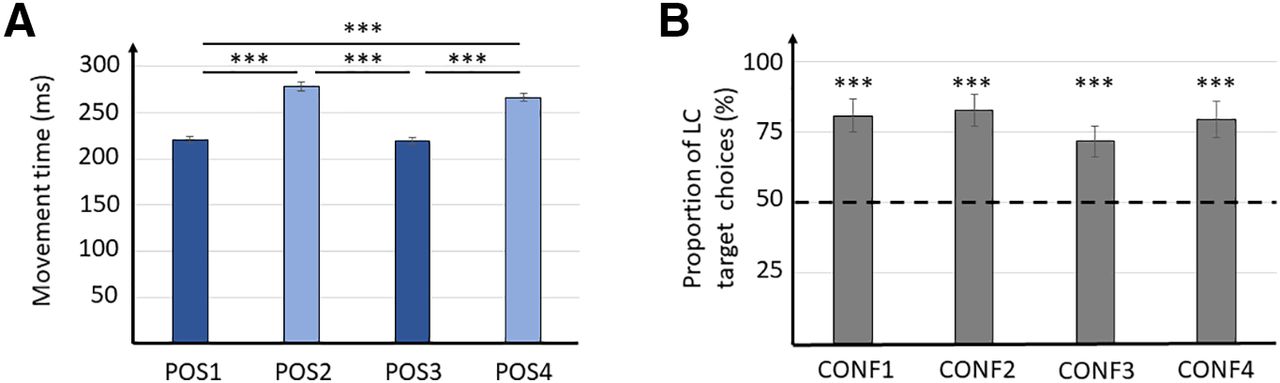
    Effects of motor costs on movements and choices without rewards. A, Average MT for each target position in 1T trials. B, Average proportion of LC target choices (targets in positions 1 and 3), for each target configuration. Values higher than 50 demonstrate a bias toward the LC target. Error bars indicate ci95 around the mean; *p < 0.05, **p < 0.01, ***p < 0.001.

  • Figure 3.
    • Download figure
    • Open in new tab
    • Download powerpoint
    Figure 3.

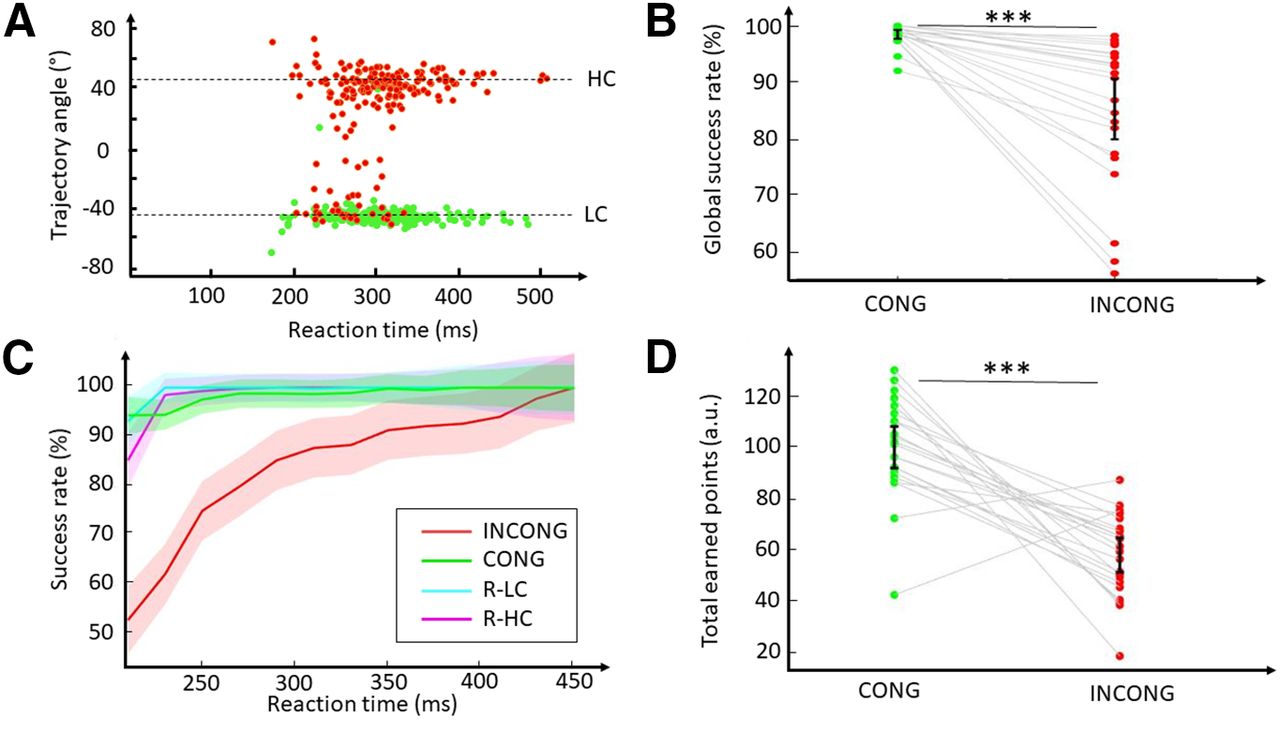
    Effects of motor costs on reward-based decision-making. A, Distribution of trajectory angles 100 ms after movement onset as a function of RT in CONG (green dots) and INCONG (red dots) conditions for a representative participant in CONF1. Dotted lines indicate the angle of the LC target and HC targets. B, Global success rates based on initial choices (proportion of trials for which the hand location 100 ms after movement onset was in the quadrant of the rewarded target) in CONG and INCONG conditions for each participant. C, Success rates as a function of RT in CONG (green line), INCONG (red line), R- LC (cyan line), and R-HC (magenta line) conditions. The shaded areas indicate ci95 around the mean. D, Total earned points during the experiment in CONG and INCONG conditions for each participant. Error bars indicate ci95 around the mean; *p < 0.05, **p < 0.01, ***p < 0.001.

  • Figure 4.
    • Download figure
    • Open in new tab
    • Download powerpoint
    Figure 4.

    Influence of target configuration on directional bias. A, Average success rates according to configurations of targets and congruence (green bars, CONG; red bars, INCONG). Error bars indicate ci95 around the mean; *p < 0.05, **p < 0.01, ***p < .001. B, Mean trajectory angle 100 ms after movement onset in INCONG condition for CONF1 (brown arrows), CONF2 (red arrows), CONF3 (orange arrows), and CONF4 (yellow arrows), and in R-HC condition for POS2 (dark purple arrows) and POS4 (light purple arrows). Concentric circles indicate RT (gray values in ms).

Back to top

In this issue

eneuro: 8 (4)
eNeuro
Vol. 8, Issue 4
July/August 2021
  • Table of Contents
  • Index by author
  • Ed Board (PDF)
Email

Thank you for sharing this eNeuro article.

NOTE: We request your email address only to inform the recipient that it was you who recommended this article, and that it is not junk mail. We do not retain these email addresses.

Enter multiple addresses on separate lines or separate them with commas.
Action Costs Rapidly and Automatically Interfere with Reward-Based Decision-Making in a Reaching Task
(Your Name) has forwarded a page to you from eNeuro
(Your Name) thought you would be interested in this article in eNeuro.
CAPTCHA
This question is for testing whether or not you are a human visitor and to prevent automated spam submissions.
Print
View Full Page PDF
Citation Tools
Action Costs Rapidly and Automatically Interfere with Reward-Based Decision-Making in a Reaching Task
Emeline Pierrieau, Jean-François Lepage, Pierre-Michel Bernier
eNeuro 19 July 2021, 8 (4) ENEURO.0247-21.2021; DOI: 10.1523/ENEURO.0247-21.2021

Citation Manager Formats

  • BibTeX
  • Bookends
  • EasyBib
  • EndNote (tagged)
  • EndNote 8 (xml)
  • Medlars
  • Mendeley
  • Papers
  • RefWorks Tagged
  • Ref Manager
  • RIS
  • Zotero
Respond to this article
Share
Action Costs Rapidly and Automatically Interfere with Reward-Based Decision-Making in a Reaching Task
Emeline Pierrieau, Jean-François Lepage, Pierre-Michel Bernier
eNeuro 19 July 2021, 8 (4) ENEURO.0247-21.2021; DOI: 10.1523/ENEURO.0247-21.2021
Twitter logo Facebook logo Mendeley logo
  • Tweet Widget
  • Facebook Like
  • Google Plus One

Jump to section

  • Article
    • Abstract
    • Significance Statement
    • Introduction
    • Materials and Methods
    • Results
    • Discussion
    • Acknowledgments
    • Footnotes
    • References
    • Synthesis
  • Figures & Data
  • Info & Metrics
  • eLetters
  • PDF

Keywords

  • action selection
  • decision-making
  • effort
  • latency
  • reaching
  • reward

Responses to this article

Respond to this article

Jump to comment:

No eLetters have been published for this article.

Related Articles

Cited By...

More in this TOC Section

Research Article: New Research

  • Aperiodicity in mouse CA1 and DG power spectra
  • Transcriptional Changes Fade Prior to Long-Term Memory for Sensitization of the Aplysia Siphon-Withdrawal Reflex.
  • Numbers of granule cells and GABAergic boutons are correlated in shrunken sclerotic hippocampi of sea lions with temporal lobe epilepsy
Show more Research Article: New Research

Cognition and Behavior

  • Is Social Media Use a Blessing or Cure for Motor Function and Skill Acquisition? An Opinion Paper
  • Transcriptional Changes Fade Prior to Long-Term Memory for Sensitization of the Aplysia Siphon-Withdrawal Reflex.
  • Short-Term Perceptual Training Modulates Neural Responses to Deepfake Speech but Does Not Improve Behavioral Discrimination
Show more Cognition and Behavior

Subjects

  • Cognition and Behavior
  • Home
  • Alerts
  • Follow SFN on BlueSky
  • Visit Society for Neuroscience on Facebook
  • Follow Society for Neuroscience on Twitter
  • Follow Society for Neuroscience on LinkedIn
  • Visit Society for Neuroscience on Youtube
  • Follow our RSS feeds

Content

  • Early Release
  • Current Issue
  • Latest Articles
  • Issue Archive
  • Blog
  • Browse by Topic

Information

  • For Authors
  • For the Media

About

  • About the Journal
  • Editorial Board
  • Privacy Notice
  • Contact
  • Feedback
(eNeuro logo)
(SfN logo)

Copyright © 2026 by the Society for Neuroscience.
eNeuro eISSN: 2373-2822

The ideas and opinions expressed in eNeuro do not necessarily reflect those of SfN or the eNeuro Editorial Board. Publication of an advertisement or other product mention in eNeuro should not be construed as an endorsement of the manufacturer’s claims. SfN does not assume any responsibility for any injury and/or damage to persons or property arising from or related to any use of any material contained in eNeuro.