Main menu

  • HOME
  • CONTENT
    • Early Release
    • Featured
    • Current Issue
    • Issue Archive
    • Blog
    • Collections
    • Podcast
  • TOPICS
    • Cognition and Behavior
    • Development
    • Disorders of the Nervous System
    • History, Teaching and Public Awareness
    • Integrative Systems
    • Neuronal Excitability
    • Novel Tools and Methods
    • Sensory and Motor Systems
  • ALERTS
  • FOR AUTHORS
  • ABOUT
    • Overview
    • Editorial Board
    • For the Media
    • Privacy Policy
    • Contact Us
    • Feedback
  • SUBMIT

User menu

Search

  • Advanced search
eNeuro
eNeuro

Advanced Search


  • HOME
  • CONTENT
    • Early Release
    • Featured
    • Current Issue
    • Issue Archive
    • Blog
    • Collections
    • Podcast
  • TOPICS
    • Cognition and Behavior
    • Development
    • Disorders of the Nervous System
    • History, Teaching and Public Awareness
    • Integrative Systems
    • Neuronal Excitability
    • Novel Tools and Methods
    • Sensory and Motor Systems
  • ALERTS
  • FOR AUTHORS
  • ABOUT
    • Overview
    • Editorial Board
    • For the Media
    • Privacy Policy
    • Contact Us
    • Feedback
  • SUBMIT
PreviousNext
Research ArticleResearch Article: Confirmation, Disorders of the Nervous System

Posttranslational Modification of Sox11 Regulates RGC Survival and Axon Regeneration

Kun-Che Chang, Minjuan Bian, Xin Xia, Ankush Madaan, Catalina Sun, Qizhao Wang, Liang Li, Michael Nahmou, Takahiko Noro, Satoshi Yokota, Joana Galvao, Alexander Kreymerman, Bogdan Tanasa, Yang Hu and Jeffrey L. Goldberg
eNeuro 13 January 2021, 8 (1) ENEURO.0358-20.2020; https://doi.org/10.1523/ENEURO.0358-20.2020
Kun-Che Chang
1Spencer Center for Vision Research, Byers Eye Institute, School of Medicine, Stanford University, Palo Alto, CA 94304
2Department of Ophthalmology, Louis J. Fox Center for Vision Restoration, University of Pittsburgh School of Medicine, Pittsburgh, Pennsylvania 15213
  • Find this author on Google Scholar
  • Find this author on PubMed
  • Search for this author on this site
  • ORCID record for Kun-Che Chang
Minjuan Bian
1Spencer Center for Vision Research, Byers Eye Institute, School of Medicine, Stanford University, Palo Alto, CA 94304
  • Find this author on Google Scholar
  • Find this author on PubMed
  • Search for this author on this site
Xin Xia
1Spencer Center for Vision Research, Byers Eye Institute, School of Medicine, Stanford University, Palo Alto, CA 94304
  • Find this author on Google Scholar
  • Find this author on PubMed
  • Search for this author on this site
  • ORCID record for Xin Xia
Ankush Madaan
1Spencer Center for Vision Research, Byers Eye Institute, School of Medicine, Stanford University, Palo Alto, CA 94304
  • Find this author on Google Scholar
  • Find this author on PubMed
  • Search for this author on this site
Catalina Sun
1Spencer Center for Vision Research, Byers Eye Institute, School of Medicine, Stanford University, Palo Alto, CA 94304
  • Find this author on Google Scholar
  • Find this author on PubMed
  • Search for this author on this site
Qizhao Wang
1Spencer Center for Vision Research, Byers Eye Institute, School of Medicine, Stanford University, Palo Alto, CA 94304
  • Find this author on Google Scholar
  • Find this author on PubMed
  • Search for this author on this site
Liang Li
1Spencer Center for Vision Research, Byers Eye Institute, School of Medicine, Stanford University, Palo Alto, CA 94304
  • Find this author on Google Scholar
  • Find this author on PubMed
  • Search for this author on this site
Michael Nahmou
1Spencer Center for Vision Research, Byers Eye Institute, School of Medicine, Stanford University, Palo Alto, CA 94304
  • Find this author on Google Scholar
  • Find this author on PubMed
  • Search for this author on this site
Takahiko Noro
1Spencer Center for Vision Research, Byers Eye Institute, School of Medicine, Stanford University, Palo Alto, CA 94304
3Department of Ophthalmology, The Jikei University School of Medicine, Tokyo 105-8461, Japan
  • Find this author on Google Scholar
  • Find this author on PubMed
  • Search for this author on this site
Satoshi Yokota
1Spencer Center for Vision Research, Byers Eye Institute, School of Medicine, Stanford University, Palo Alto, CA 94304
  • Find this author on Google Scholar
  • Find this author on PubMed
  • Search for this author on this site
  • ORCID record for Satoshi Yokota
Joana Galvao
1Spencer Center for Vision Research, Byers Eye Institute, School of Medicine, Stanford University, Palo Alto, CA 94304
  • Find this author on Google Scholar
  • Find this author on PubMed
  • Search for this author on this site
Alexander Kreymerman
1Spencer Center for Vision Research, Byers Eye Institute, School of Medicine, Stanford University, Palo Alto, CA 94304
  • Find this author on Google Scholar
  • Find this author on PubMed
  • Search for this author on this site
Bogdan Tanasa
1Spencer Center for Vision Research, Byers Eye Institute, School of Medicine, Stanford University, Palo Alto, CA 94304
  • Find this author on Google Scholar
  • Find this author on PubMed
  • Search for this author on this site
Yang Hu
1Spencer Center for Vision Research, Byers Eye Institute, School of Medicine, Stanford University, Palo Alto, CA 94304
  • Find this author on Google Scholar
  • Find this author on PubMed
  • Search for this author on this site
  • ORCID record for Yang Hu
Jeffrey L. Goldberg
1Spencer Center for Vision Research, Byers Eye Institute, School of Medicine, Stanford University, Palo Alto, CA 94304
  • Find this author on Google Scholar
  • Find this author on PubMed
  • Search for this author on this site
  • ORCID record for Jeffrey L. Goldberg
  • Article
  • Figures & Data
  • Info & Metrics
  • eLetters
  • PDF
Loading

Article Figures & Data

Figures

  • Figure 1.
    • Download figure
    • Open in new tab
    • Download powerpoint
    Figure 1.

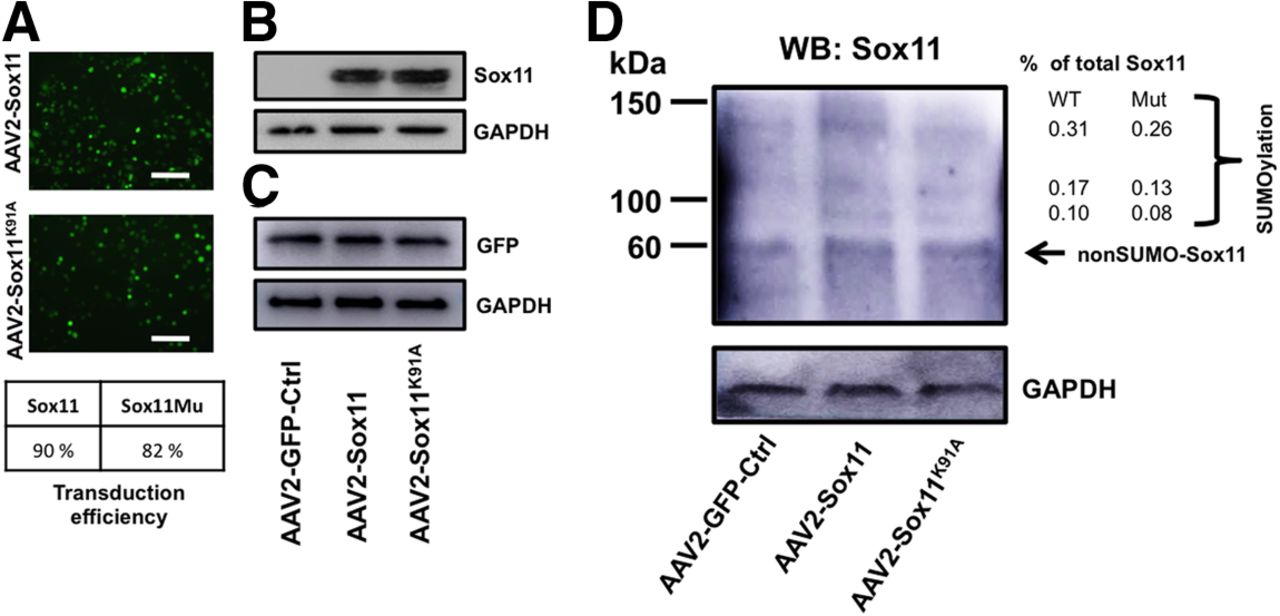
    Point mutation of Sox11 lysine 91 to alanine (Sox11K91A) attenuates expression of SUMOylated isoforms. A, B, HEK cells (2 × 105 cells/well) and (C) hippocampal neurons (106 cells/well) were infected with GFP control, Sox11, and Sox11K91A AAV2 viruses. Fluorescence imaging suggested similar expression levels between Sox11 viral vectors (A) and Sox11 and Sox11K91A protein expression were also similar when assayed by Western blotting (B, C). D, For SUMOylation detection, P2 RGCs (5 × 105 cells/well) were infected with GFP-conjugated control, Sox11, and Sox11K91A viruses. Quantification of higher molecular weight bands corresponding to total Sox11 protein was detected by Western blotting against Sox11, which detected both endogenous and mutant protein. Scale bar: 100 μm.

  • Figure 2.
    • Download figure
    • Open in new tab
    • Download powerpoint
    Figure 2.

    Sox11 and Sox11K91A decrease RGC viability and axon outgrowth in vitro. Primary RGCs were transduced with Sox11 or control AAVs as marked, cultured for 3 d, and immunostained for β-III tubulin (E7) and GFP to identified transduced neurons, and counterstained with the nuclear dye DAPI (A). Exogenous expression of either Sox11 or Sox11K91A reduced cell survival (B) and axon outgrowth (C) in primary RGCs (N ≥ 3 experimental replicates, *p < 0.05, by one-way ANOVA and post hoc t test with Tukey correction; mean ± SEM shown; scale bar: 200 μm).

  • Figure 3.
    • Download figure
    • Open in new tab
    • Download powerpoint
    Figure 3.

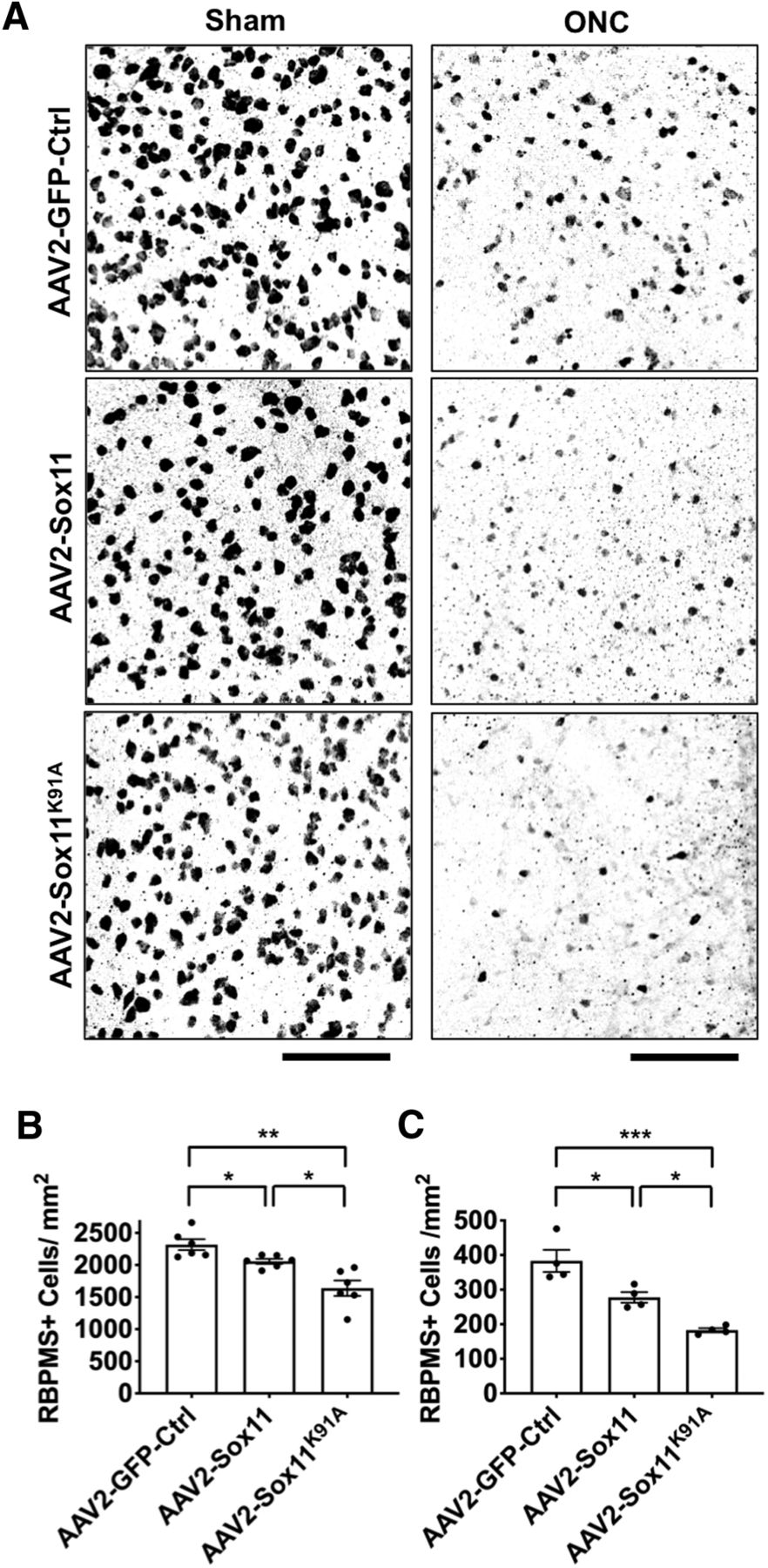
    Exogenous Sox11K91A leads to more RGC death than Sox11 in vivo. Control AAV2-GFP-Ctrl, AAV2-Sox11, or AAV2-Sox11K91A were injected intravitreally in control eyes and in eyes two weeks before optic nerve crush. Two weeks after injection in controls, or two weeks after optic nerve crush (four weeks after injection), eyes were harvested and retinas flat-mounted and immunostained against RGC-specific marker RBPMS (A). Both Sox11 and Sox11K91A significantly increased RGC death in sham (B) and optic nerve crush (C) eyes, with Sox11K91A showing significantly greater effect than wild-type Sox11 (N ≥ 4 experimental replicates, *p < 0.05, **p < 0.01, ***p < 0.001, by one-way ANOVA with post hoc t test with Tukey correction; mean ± SEM shown; scale bar: 100 μm).

  • Figure 4.
    • Download figure
    • Open in new tab
    • Download powerpoint
    Figure 4.

    Sox11K91A promotes more axon regeneration than Sox11 in vivo. Intravitreal AAV2 injection was performed as in Figure 3. Regenerating axons were visualized by CTB-555 injection anterograde labeling 2 d before euthanasia (A). Both Sox11 and Sox11K91A significantly promoted more short distance (200 and 600 μm) axon regeneration than controls, with Sox11K91A showing significantly greater effect than wild-type Sox11 (B). The arrows indicate crush sites. N ≥ 5 animals per group, * compares with AAV2-GFP-Ctrl group; # compares with AAV2-Sox11 group; *p < 0.05 versus control, **p < 0.01 versus control, #p < 0.05 versus AAV2-Sox11, by one-way ANOVA with post hoc t test with Tukey correction. Mean ± SEM shown. Scale bar: 200 μm.

  • Figure 5.
    • Download figure
    • Open in new tab
    • Download powerpoint
    Figure 5.

    Gene regulation by Sox11 and Sox11K91A in primary RGCs. A, Sox11 and Sox11K91A upregulate several signaling pathways related to neuronal and axon growth. B, A volcano plot highlighting selected genes that are more downregulated by Sox11K91A than by Sox11 (in blue, 173 genes) and selected genes that are more upregulated by Sox11K91A than by Sox11 (in red, 181 genes). C, Spp1 and Opn4 were significantly downregulated in Sox11-treated and Sox11K91A-treated groups, confirmed by qRT-PCR (N = 3, *p < 0.05, **p < 0.01; N.S., no significant difference, by one-way ANOVA with post hoc t test with Tukey correction; mean ± SEM shown).

Back to top

In this issue

eneuro: 8 (1)
eNeuro
Vol. 8, Issue 1
January/February 2021
  • Table of Contents
  • Index by author
  • Ed Board (PDF)
Email

Thank you for sharing this eNeuro article.

NOTE: We request your email address only to inform the recipient that it was you who recommended this article, and that it is not junk mail. We do not retain these email addresses.

Enter multiple addresses on separate lines or separate them with commas.
Posttranslational Modification of Sox11 Regulates RGC Survival and Axon Regeneration
(Your Name) has forwarded a page to you from eNeuro
(Your Name) thought you would be interested in this article in eNeuro.
CAPTCHA
This question is for testing whether or not you are a human visitor and to prevent automated spam submissions.
Print
View Full Page PDF
Citation Tools
Posttranslational Modification of Sox11 Regulates RGC Survival and Axon Regeneration
Kun-Che Chang, Minjuan Bian, Xin Xia, Ankush Madaan, Catalina Sun, Qizhao Wang, Liang Li, Michael Nahmou, Takahiko Noro, Satoshi Yokota, Joana Galvao, Alexander Kreymerman, Bogdan Tanasa, Yang Hu, Jeffrey L. Goldberg
eNeuro 13 January 2021, 8 (1) ENEURO.0358-20.2020; DOI: 10.1523/ENEURO.0358-20.2020

Citation Manager Formats

  • BibTeX
  • Bookends
  • EasyBib
  • EndNote (tagged)
  • EndNote 8 (xml)
  • Medlars
  • Mendeley
  • Papers
  • RefWorks Tagged
  • Ref Manager
  • RIS
  • Zotero
Respond to this article
Share
Posttranslational Modification of Sox11 Regulates RGC Survival and Axon Regeneration
Kun-Che Chang, Minjuan Bian, Xin Xia, Ankush Madaan, Catalina Sun, Qizhao Wang, Liang Li, Michael Nahmou, Takahiko Noro, Satoshi Yokota, Joana Galvao, Alexander Kreymerman, Bogdan Tanasa, Yang Hu, Jeffrey L. Goldberg
eNeuro 13 January 2021, 8 (1) ENEURO.0358-20.2020; DOI: 10.1523/ENEURO.0358-20.2020
Twitter logo Facebook logo Mendeley logo
  • Tweet Widget
  • Facebook Like
  • Google Plus One

Jump to section

  • Article
    • Abstract
    • Significance Statement
    • Introduction
    • Materials and Methods
    • Results
    • Discussion
    • Footnotes
    • References
    • Synthesis
  • Figures & Data
  • Info & Metrics
  • eLetters
  • PDF

Keywords

  • optic nerve regeneration
  • retinal ganglion cell
  • Sox11
  • SUMOylation

Responses to this article

Respond to this article

Jump to comment:

No eLetters have been published for this article.

Related Articles

Cited By...

More in this TOC Section

Research Article: Confirmation

  • C. elegans Spastin/spas-1 Is Required for Axon Regeneration and Maintenance
  • Altered Dopamine Signaling in Extinction-Deficient Mice
  • Spatially Extensive LFP Correlations Identify Slow-Wave Sleep in Marmoset Sensorimotor Cortex
Show more Research Article: Confirmation

Disorders of the Nervous System

  • A Multi-Network Approach Identifies Proteins Related to Dendritic Spines in Alzheimer's Disease
  • Epigenetic and Transcriptomic Impacts of Ethanol Vary by Brain Region and Extent of Exposure
  • Parvalbumin Neuron–Targeted Loss of Alzheimer’s Disease Risk Gene BIN1 Is Insufficient to Drive Cognitive or Network Excitability Changes
Show more Disorders of the Nervous System

Subjects

  • Disorders of the Nervous System
  • Home
  • Alerts
  • Follow SFN on BlueSky
  • Visit Society for Neuroscience on Facebook
  • Follow Society for Neuroscience on Twitter
  • Follow Society for Neuroscience on LinkedIn
  • Visit Society for Neuroscience on Youtube
  • Follow our RSS feeds

Content

  • Early Release
  • Current Issue
  • Latest Articles
  • Issue Archive
  • Blog
  • Browse by Topic

Information

  • For Authors
  • For the Media

About

  • About the Journal
  • Editorial Board
  • Privacy Notice
  • Contact
  • Feedback
(eNeuro logo)
(SfN logo)

Copyright © 2026 by the Society for Neuroscience.
eNeuro eISSN: 2373-2822

The ideas and opinions expressed in eNeuro do not necessarily reflect those of SfN or the eNeuro Editorial Board. Publication of an advertisement or other product mention in eNeuro should not be construed as an endorsement of the manufacturer’s claims. SfN does not assume any responsibility for any injury and/or damage to persons or property arising from or related to any use of any material contained in eNeuro.