
Main menu

  • HOME
  • CONTENT
    • Early Release
    • Featured
    • Current Issue
    • Issue Archive
    • Blog
    • Collections
    • Podcast
  • TOPICS
    • Cognition and Behavior
    • Development
    • Disorders of the Nervous System
    • History, Teaching and Public Awareness
    • Integrative Systems
    • Neuronal Excitability
    • Novel Tools and Methods
    • Sensory and Motor Systems
  • ALERTS
  • FOR AUTHORS
  • ABOUT
    • Overview
    • Editorial Board
    • For the Media
    • Privacy Policy
    • Contact Us
    • Feedback
  • SUBMIT

User menu

Search

  • Advanced search
eNeuro
eNeuro

Advanced Search


  • HOME
  • CONTENT
    • Early Release
    • Featured
    • Current Issue
    • Issue Archive
    • Blog
    • Collections
    • Podcast
  • TOPICS
    • Cognition and Behavior
    • Development
    • Disorders of the Nervous System
    • History, Teaching and Public Awareness
    • Integrative Systems
    • Neuronal Excitability
    • Novel Tools and Methods
    • Sensory and Motor Systems
  • ALERTS
  • FOR AUTHORS
  • ABOUT
    • Overview
    • Editorial Board
    • For the Media
    • Privacy Policy
    • Contact Us
    • Feedback
  • SUBMIT
PreviousNext
Research ArticleResearch Article: New Research, Sensory and Motor Systems

OTX2 Non-Cell Autonomous Activity Regulates Inner Retinal Function

Raoul Torero Ibad, Bilal Mazhar, Clémentine Vincent, Clémence Bernard, Julie Dégardin, Manuel Simonutti, Thomas Lamonerie, Ariel A. Di Nardo, Alain Prochiantz and Kenneth L. Moya
eNeuro 31 July 2020, 7 (5) ENEURO.0012-19.2020; https://doi.org/10.1523/ENEURO.0012-19.2020
Raoul Torero Ibad
1Centre for Interdisciplinary Research in Biology (CIRB), Collège de France, CNRS, UMR 7241, INSERM U1050, Labex MemoLife, Université PSL (Paris Sciences & Lettres), 75005 Paris, France
  • Find this author on Google Scholar
  • Find this author on PubMed
  • Search for this author on this site
Bilal Mazhar
1Centre for Interdisciplinary Research in Biology (CIRB), Collège de France, CNRS, UMR 7241, INSERM U1050, Labex MemoLife, Université PSL (Paris Sciences & Lettres), 75005 Paris, France
  • Find this author on Google Scholar
  • Find this author on PubMed
  • Search for this author on this site
Clémentine Vincent
1Centre for Interdisciplinary Research in Biology (CIRB), Collège de France, CNRS, UMR 7241, INSERM U1050, Labex MemoLife, Université PSL (Paris Sciences & Lettres), 75005 Paris, France
  • Find this author on Google Scholar
  • Find this author on PubMed
  • Search for this author on this site
Clémence Bernard
1Centre for Interdisciplinary Research in Biology (CIRB), Collège de France, CNRS, UMR 7241, INSERM U1050, Labex MemoLife, Université PSL (Paris Sciences & Lettres), 75005 Paris, France
  • Find this author on Google Scholar
  • Find this author on PubMed
  • Search for this author on this site
  • ORCID record for Clémence Bernard
Julie Dégardin
2CNRS, INSERM, Institut de la Vision, Sorbonne Université, F-75012 Paris, France
  • Find this author on Google Scholar
  • Find this author on PubMed
  • Search for this author on this site
Manuel Simonutti
2CNRS, INSERM, Institut de la Vision, Sorbonne Université, F-75012 Paris, France
  • Find this author on Google Scholar
  • Find this author on PubMed
  • Search for this author on this site
Thomas Lamonerie
3CNRS, INSERM, Institut de Biologie Valrose, Université Côte d’Azur, 06088 Nice, France
  • Find this author on Google Scholar
  • Find this author on PubMed
  • Search for this author on this site
  • ORCID record for Thomas Lamonerie
Ariel A. Di Nardo
1Centre for Interdisciplinary Research in Biology (CIRB), Collège de France, CNRS, UMR 7241, INSERM U1050, Labex MemoLife, Université PSL (Paris Sciences & Lettres), 75005 Paris, France
  • Find this author on Google Scholar
  • Find this author on PubMed
  • Search for this author on this site
  • ORCID record for Ariel A. Di Nardo
Alain Prochiantz
1Centre for Interdisciplinary Research in Biology (CIRB), Collège de France, CNRS, UMR 7241, INSERM U1050, Labex MemoLife, Université PSL (Paris Sciences & Lettres), 75005 Paris, France
4BrainEver, 75012 Paris, France
5Institute of Neurosciences, Chinese Academy of Sciences, Shanghai 200031, People’s Republic of China
  • Find this author on Google Scholar
  • Find this author on PubMed
  • Search for this author on this site
  • ORCID record for Alain Prochiantz
Kenneth L. Moya
1Centre for Interdisciplinary Research in Biology (CIRB), Collège de France, CNRS, UMR 7241, INSERM U1050, Labex MemoLife, Université PSL (Paris Sciences & Lettres), 75005 Paris, France
  • Find this author on Google Scholar
  • Find this author on PubMed
  • Search for this author on this site
  • Article
  • Figures & Data
  • Info & Metrics
  • eLetters
  • PDF
Loading

Article Figures & Data

Figures

  • Tables
  • Figure 1.
    • Download figure
    • Open in new tab
    • Download powerpoint
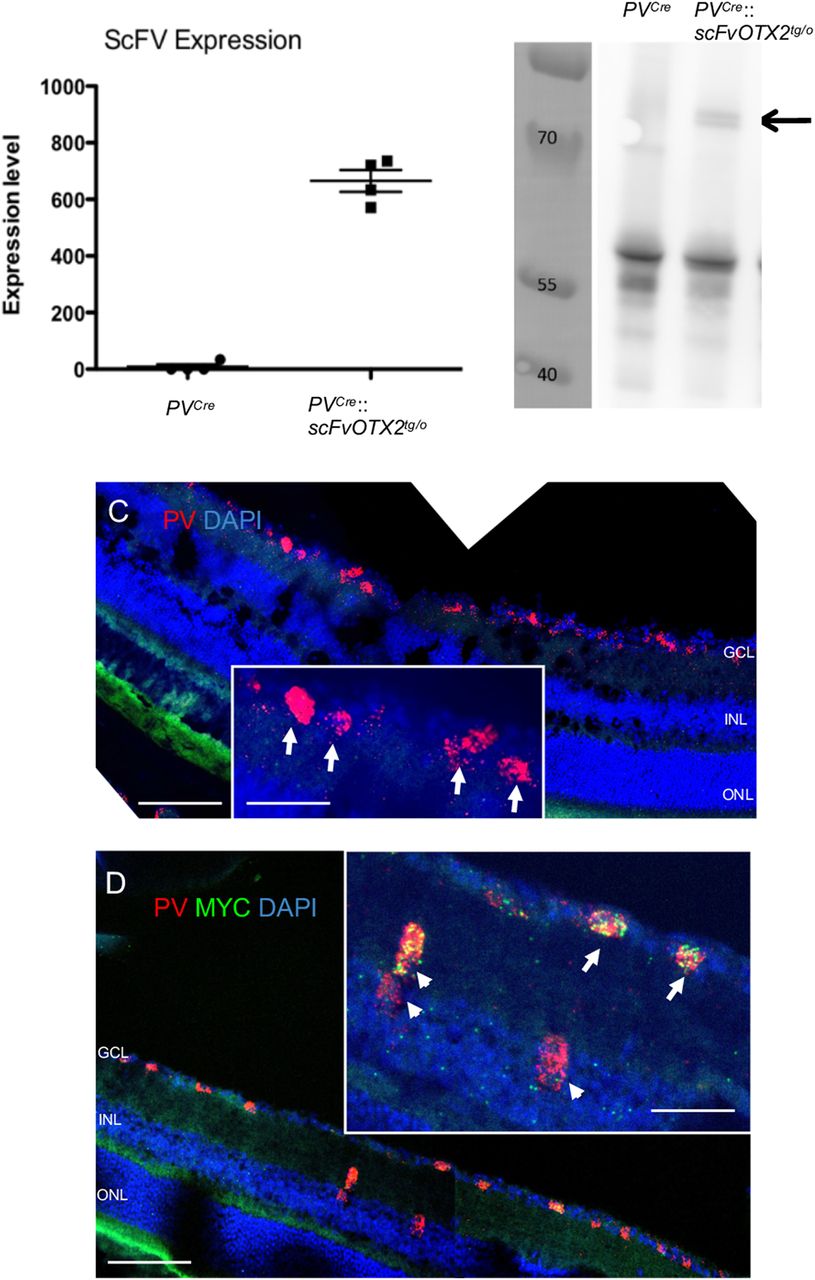
    Figure 1.

    Expression of OTX2-scFV in P30 mouse retinal tissue. A, qRT-PCR for OTX2scFV mRNA was conducted on extracts from PVCre and PVCre::scFvOTX2tg/o mice and raw ct values normalized and converted to arbitrary units. B, Retinal lysates from PVCre and PVCre::scFvOTX2tg/o mice were immunoprecipitated for GFP followed by Western blotting with an anti-MYC antibody. Molecular weight markers are in the left lane in kDa. The middle lane contains the lysate from PVCre mice. Right lane contains lysate from PVCre::scFvOTX2tg/o mice. The arrow indicates the presence of the bands at the expected migration position of the full-length OTX2scFv-GFP protein. C, In situ hybridization using RNAscope technology of PVCre retina shows PV expression (red) in the inner retina. DAPI is in blue. Inset arrows show details of PV-expressing cells in the GCL. D, In situ hybridization using RNAscope technology of PVCre::scFvOTX2tg/o retina. mRNA for PV is red, and mRNA for the myc tag of the OTX2scfv is green. Arrows indicate scFv-expressing PV cells in the GCL (i.e., displaced amacrines and/or RGCs); arrowheads indicate scFv-expressing PV cells in the innermost part of the INL in the place of amacrine cells. Scale bars: low-magnification images, 100 μm; insets, 50 μm. Values: mean ± sem.

  • Figure 2.
    • Download figure
    • Open in new tab
    • Download powerpoint
    Figure 2.

    Optomotor test monitoring visual acuity. Thirty-day-old mice were subjected to the optomotor test using an 100% contrast optotype of 0.375c/deg. PVCre and PVCre::scFvPax6tg/o mice made an average of about five head turns during the 2 min test period. PVCre::scFvOTX2tg/o mice made significantly fewer head turns revealing reduced visual acuity. **p < 0.01 or ***p < 0.001, Mann–Whitney U test, two tailed. N = 25 for PVCre, N = 12 for PVCre::scFvPax6tg/o, and N = 13 for PVCre::scFvOTX2tg/o. Values: mean ± sem.

  • Figure 3.
    • Download figure
    • Open in new tab
    • Download powerpoint
    Figure 3.

    Expression of OTX2scFv does not alter retinal organization in the P30 mouse. Top, All retinal layers organization and approximate sizes are similar in retina from mice expressing OTX2scFv and their PVCre littermates. Bottom, The number of cells in the GCL, the INL thickness, and the ONL thickness are similar between the two genotypes. Scale bar, 50 μm. N = 8 for PVCre mice and N = 6 for PVCre::scFvOTX2tg/o mice. Values: mean ± sem.

  • Figure 4.
    • Download figure
    • Open in new tab
    • Download powerpoint
    Figure 4.

    Expression of retinal cell type-specific genes in P30 mice of the two genotypes. Genes specific of RGCs, bipolar cells, amacrine cells, rods, and cones show similar expression levels in the two genotypes. Lim1 mRNA expression in horizontal cells is significantly increased in the OTX2-scFv-expressing mice. *p < 0.05, Mann–Whitney U test, two tailed. N = 4 for each genotype. Values: mean ± sem.

  • Figure 5.
    • Download figure
    • Open in new tab
    • Download powerpoint
    Figure 5.

    ERG of P30 mice expressing OTX2scFV and their PVCre littermates. A, B, Representative traces under scotopic conditions of the right eye at 3.19 cd/m2. C–F, Scotopic ERG parameters plotted against log intensity. Two-way ANOVA for repeated measures showed no significant differences based on genotype or genotype by intensity interaction (see text). N = 7 for PVCre mice and N = 9 for PVCre::scFvOTX2tg/o mice. Values: mean ± sd.

  • Figure 6.
    • Download figure
    • Open in new tab
    • Download powerpoint
    Figure 6.

    The b-wave amplitude in photopic lighting in the two genotypes of 1-month-old mice. N = 7 for PVCre mice and N = 9 for PVCre::scFvOTX2tg/o mice. Values: mean ± sem.

  • Figure 7.
    • Download figure
    • Open in new tab
    • Download powerpoint
    Figure 7.

    Inner retinal function. A, Extracted oscillatory potential traces of a PVCre mouse (left) and PVCre::scFvOTX2tg/o mouse (right). B, The amplitude of an early OP (OP2) is not altered in the PVCre::scFvOTX2tg/o mice, while the amplitude of a late OP (OP4) is significantly reduced by ∼50%. C, Representative traces of 20 Hz flickers of the left eye of mice of the two genotypes. D, The amplitude of the flicker response to 10 Hz stimulation after light adaptation is slightly increased, and at 20 Hz the response is significantly doubled in amplitude. Bottom, There was no difference in the implicit time of the flicker responses between mice expressing OTX2scFv and their PVCre littermates. ***p < 0.005, Mann–Whitney U test, two tailed. N = 7 for PVCre and N = 9 for PVCre::scFvOTX2tg/o mice. Values mean ± sem.
Tables

  • Figures
    • View popup
    Table 1

    Statistical table

    Data structureType of testPower
    Figure 2
    PVcre vs PVCre::scFvOTX2tg/o
    Not considered normal due to unequal N
    Mann–Whitney U 0.92
    Figure 4
    PVcre vs PVCre::scFvOTX2tg/o
    Data normalized
    Mann–Whitney U 0.78
    Figure 5
    PVcre vs PVCre::scFvOTX2tg/o
    a-wave latency, F (1,14) = 0.011
    a-wave amplitude, F (1,14) = 0.100
    b-wave latency, F (1,14) = 3.826
    b-wave amplitude, F (1,14) = 0.77
    Genotype × stimulus intensity interaction
    a-wave latency, F (3,42) = 0.660
    a-wave amplitude, F (3,42) = 0.913
    b-wave latency, F (3,41) = 1.915
    b-wave amplitude, F (3,42) = 0.139,
    Two-way ANOVA with repeated measuresn.s.
    n.s.
    n.s.
    n.s.
    n.s.
    n.s.
    n.s.
    n.s.
    Figure 7 OPs
    PVcre vs PVCre::scFvOTX2tg/o
    Dissimilar variance
    Figure 7D Flickers
    PVcre vs PVCre::scFvOTX2tg/o
    Dissimilar variance
    Mann–Whitney U
    Mann–Whitney U
    0.97
    0.96
Back to top

In this issue

eneuro: 7 (5)
eNeuro
Vol. 7, Issue 5
September/October 2020
  • Table of Contents
  • Index by author
Email

Thank you for sharing this eNeuro article.

NOTE: We request your email address only to inform the recipient that it was you who recommended this article, and that it is not junk mail. We do not retain these email addresses.

Enter multiple addresses on separate lines or separate them with commas.
OTX2 Non-Cell Autonomous Activity Regulates Inner Retinal Function
(Your Name) has forwarded a page to you from eNeuro
(Your Name) thought you would be interested in this article in eNeuro.
CAPTCHA
This question is for testing whether or not you are a human visitor and to prevent automated spam submissions.
Print
View Full Page PDF
Citation Tools
OTX2 Non-Cell Autonomous Activity Regulates Inner Retinal Function
Raoul Torero Ibad, Bilal Mazhar, Clémentine Vincent, Clémence Bernard, Julie Dégardin, Manuel Simonutti, Thomas Lamonerie, Ariel A. Di Nardo, Alain Prochiantz, Kenneth L. Moya
eNeuro 31 July 2020, 7 (5) ENEURO.0012-19.2020; DOI: 10.1523/ENEURO.0012-19.2020

Citation Manager Formats

  • BibTeX
  • Bookends
  • EasyBib
  • EndNote (tagged)
  • EndNote 8 (xml)
  • Medlars
  • Mendeley
  • Papers
  • RefWorks Tagged
  • Ref Manager
  • RIS
  • Zotero
Respond to this article
Share
OTX2 Non-Cell Autonomous Activity Regulates Inner Retinal Function
Raoul Torero Ibad, Bilal Mazhar, Clémentine Vincent, Clémence Bernard, Julie Dégardin, Manuel Simonutti, Thomas Lamonerie, Ariel A. Di Nardo, Alain Prochiantz, Kenneth L. Moya
eNeuro 31 July 2020, 7 (5) ENEURO.0012-19.2020; DOI: 10.1523/ENEURO.0012-19.2020
Twitter logo Facebook logo Mendeley logo
  • Tweet Widget
  • Facebook Like
  • Google Plus One

Jump to section

  • Article
    • Abstract
    • Significance Statement
    • Introduction
    • Materials and Methods
    • Results
    • Discussion
    • Acknowledgments
    • Footnotes
    • References
    • Synthesis
  • Figures & Data
  • Info & Metrics
  • eLetters
  • PDF

Keywords

  • homeoprotein non-cell autonomous
  • physiology retina
  • vision

Responses to this article

Respond to this article

Jump to comment:

No eLetters have been published for this article.

Related Articles

Cited By...

More in this TOC Section

Research Article: New Research

  • Fast spiking interneurons autonomously generate fast gamma oscillations in the medial entorhinal cortex with excitation strength tuning ING–PING transitions
  • The serotonin 1B receptor modulates striatal activity differentially based on behavioral context
  • Population-level age effects on the white matter structure subserving cognitive flexibility in the human brain
Show more Research Article: New Research

Sensory and Motor Systems

  • Fast spiking interneurons autonomously generate fast gamma oscillations in the medial entorhinal cortex with excitation strength tuning ING–PING transitions
  • The serotonin 1B receptor modulates striatal activity differentially based on behavioral context
  • Population-level age effects on the white matter structure subserving cognitive flexibility in the human brain
Show more Sensory and Motor Systems

Subjects

  • Sensory and Motor Systems
  • Home
  • Alerts
  • Follow SFN on BlueSky
  • Visit Society for Neuroscience on Facebook
  • Follow Society for Neuroscience on Twitter
  • Follow Society for Neuroscience on LinkedIn
  • Visit Society for Neuroscience on Youtube
  • Follow our RSS feeds

Content

  • Early Release
  • Current Issue
  • Latest Articles
  • Issue Archive
  • Blog
  • Browse by Topic

Information

  • For Authors
  • For the Media

About

  • About the Journal
  • Editorial Board
  • Privacy Notice
  • Contact
  • Feedback
(eNeuro logo)
(SfN logo)

Copyright © 2026 by the Society for Neuroscience.
eNeuro eISSN: 2373-2822

The ideas and opinions expressed in eNeuro do not necessarily reflect those of SfN or the eNeuro Editorial Board. Publication of an advertisement or other product mention in eNeuro should not be construed as an endorsement of the manufacturer’s claims. SfN does not assume any responsibility for any injury and/or damage to persons or property arising from or related to any use of any material contained in eNeuro.