
Main menu

  • HOME
  • CONTENT
    • Early Release
    • Featured
    • Current Issue
    • Issue Archive
    • Blog
    • Collections
    • Podcast
  • TOPICS
    • Cognition and Behavior
    • Development
    • Disorders of the Nervous System
    • History, Teaching and Public Awareness
    • Integrative Systems
    • Neuronal Excitability
    • Novel Tools and Methods
    • Sensory and Motor Systems
  • ALERTS
  • FOR AUTHORS
  • ABOUT
    • Overview
    • Editorial Board
    • For the Media
    • Privacy Policy
    • Contact Us
    • Feedback
  • SUBMIT

User menu

Search

  • Advanced search
eNeuro
eNeuro

Advanced Search


  • HOME
  • CONTENT
    • Early Release
    • Featured
    • Current Issue
    • Issue Archive
    • Blog
    • Collections
    • Podcast
  • TOPICS
    • Cognition and Behavior
    • Development
    • Disorders of the Nervous System
    • History, Teaching and Public Awareness
    • Integrative Systems
    • Neuronal Excitability
    • Novel Tools and Methods
    • Sensory and Motor Systems
  • ALERTS
  • FOR AUTHORS
  • ABOUT
    • Overview
    • Editorial Board
    • For the Media
    • Privacy Policy
    • Contact Us
    • Feedback
  • SUBMIT
PreviousNext
Review, Disorders of the Nervous System

Ubiquitin and Ubiquitin-Like Proteins in the Critical Equilibrium between Synapse Physiology and Intellectual Disability

Alessandra Folci, Filippo Mirabella and Matteo Fossati
eNeuro 27 July 2020, 7 (4) ENEURO.0137-20.2020; https://doi.org/10.1523/ENEURO.0137-20.2020
Alessandra Folci
1Humanitas Clinical and Research Center-IRCCS, via Manzoni 56, 20089, Rozzano (MI), Italy
  • Find this author on Google Scholar
  • Find this author on PubMed
  • Search for this author on this site
Filippo Mirabella
2Department of Biomedical Sciences, Humanitas University, Via Rita Levi Montalcini 4, 20090 Pieve 9 Emanuele – Milan, Italy
  • Find this author on Google Scholar
  • Find this author on PubMed
  • Search for this author on this site
Matteo Fossati
1Humanitas Clinical and Research Center-IRCCS, via Manzoni 56, 20089, Rozzano (MI), Italy
3CNR–Institute of Neuroscience, via Manzoni 56, 20089, Rozzano (MI), Italy
  • Find this author on Google Scholar
  • Find this author on PubMed
  • Search for this author on this site
  • ORCID record for Matteo Fossati
  • Article
  • Figures & Data
  • Info & Metrics
  • eLetters
  • PDF
Loading

Article Figures & Data

Figures

  • Tables
  • Figure 1.
    • Download figure
    • Open in new tab
    • Download powerpoint
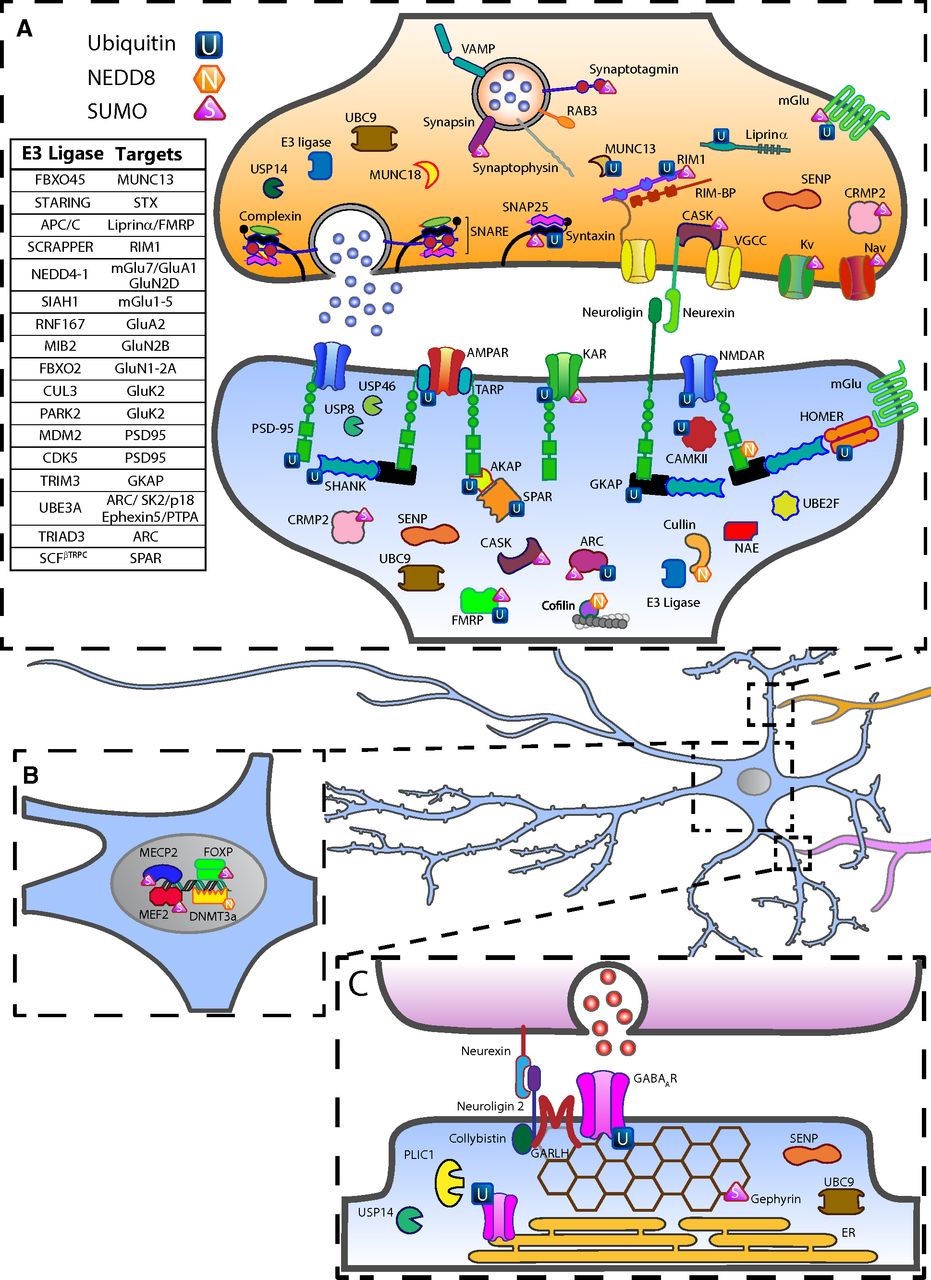
    Figure 1.

    Neuronal ubiquitination and ubiquitin-like modifications. A, C, Major components of excitatory and inhibitory synapses targeted by ubiquitin (blue squares) SUMO (purple triangles) and NEDD8 (orange hexagons) pathways. Deubiquitinating enzymes (green clamshell-like shapes) and components of the SUMO (UBC9 and SENPs) and NEDD8 machineries (NAE, UBC12, and UBE2F) are also indicated. Although NEDD8 pathway and targets are also present in the presynaptic compartment, for simplicity they are depicted in the postsynaptic region only. In A, E3 ubiquitin ligases operating at excitatory synapses and their known substrates are listed in the left table. B, Nuclear sumoylation and neddylation critical to synaptic function are indicated.

  • Figure 2.
    • Download figure
    • Open in new tab
    • Download powerpoint
    Figure 2.

    Postsynaptic control of glutamate and GABAA receptors by ubiquitination and sumoylation. UPS-dependent degradation (green arrows) of PSD-95 destabilizes surface AMPARs, resulting in enhanced receptor lateral mobility and consequently, endocytosis (box A). Ubiquitination of GluA1 and GluA2 decreases surface AMPARs through clathrin-dependent endocytosis (orange arrows). Ubiquitinated ARC is degraded via the UPS pathway. As ARC is a major regulator of AMPAR internalization, reduced ARC levels suppress AMPAR endocytosis. Conversely, sumoylated ARC triggers AMPAR internalization. Moreover, ubiquitination of intracellular GluA1-4 may also promote AMPAR sorting to the lysosomal degradation pathway (red arrows). Ubiquitination of mGlu1-5 receptors enhanced their clathrin-dependent endocytosis. Surface NMDARs are regulated by the ubiquitination pathway in a subunit-dependent manner. GluN2B undergoes a phosphorylation-dependent ubiquitination (box B), leading to UPS-dependent degradation of NMDARs. GluN2D ubiquitination enhances its degradation, although it is not clear whether it utilizes UPS-dependent or lysosomal-dependent pathways (green and red dotted arrows). Finally, ubiquitination of newly synthetized GluN1 and GluN2A results in NMDAR retrotranslocation from the ER to the cytosol and subsequent degradation through the ERAD pathway (blue arrows). Similar to GluN2D, GluK2 ubiquitination is phosphorylation-dependent and triggers its degradation through an as yet ill-defined pathway (green and red dotted arrows). In contrast, sumoylated GluK2-containing KARs are removed from the synaptic membrane via clathrin-dependent endocytosis. At inhibitory synapses, ubiquitinated γ2-containing GABAAR are sorted to the lysosomal degradation pathway, while β3-containing GABAAR are ubiquitinated in the ER and degraded through the ERAD machinery.
Tables

  • Figures
    • View popup
    Table 1

    Rare monogenic forms of ID linked to mutations of components or regulators of the ubiquitin pathway

    GeneProteinDiseaseGenetic abnormalitiesReferences
    ASXL3Component of the Polycomb repressive deubiquitination (PR-DUB) complexBainbridge–Ropers syndrome, BRS (OMIM 615485) and ASDDe novo truncating mutations in BRS and missense mutations in ASDBainbridge et al. (2013); De Rubeis et al. (2014)
    CUL4BScaffolding protein stabilizing cullin RING E3 ligaseXLID (OMIM 300304)Missense mutationsWang et al. (2013); Zou et al. (2007)
    HECW2E3 ubiquitin ligase HECW2Neurodevelopmental disorder with hypotonia, seizures, and absent language, NDHSAL (OMIM 617268)Missense mutationsHalvardson et al. (2016)
    HERC1E3 ubiquitin ligase HERC1Macrocephaly, dysmorphic facies, and psychomotor retardation, MDFPMR (OMIM 617011)Missense and frameshift mutationsAggarwal et al. (2016); Nguyen et al. (2016); Ortega-Recalde et al. (2015)
    HERC2E3 ubiquitin ligase HERC2Syndrome of ID, autism, and variable neurological deficits (OMIM 615516)Missense mutationsPuffenberger et al. (2012)
    HUWE1HECT, UBA, and WWE domain containing 1, E3 ubiquitin protein ligaseTurner type, XLID
    (OMIM 309590)
    Microduplications, missense mutationsFroyen et al. (2008); Moortgat et al. (2018)
    MAGEL2E3 ubiquitin ligase enhancerPrader–Willi syndrome, PWS (OMIM 176270) and Schaaf–Yang syndrome, SHFYNG (OMIM 615547)Interstitial deletions and maternal uniparental disomy in PWS; truncating mutations in SHFYNGTacer and Potts (2017)
    MID2Member of the TRIpartite motif (TRIM) family of RING E3 ligasesXLID (OMIM 300928)Missense mutationGeetha et al. (2014)
    OTUD6BMember of the ovarian tumor domain (OTU)-containing subfamily of deubiquitinating enzymesIntellectual developmental disorder with dysmorphic facies, seizures, and distal limb anomalies, IDDFSDA (OMIM 617452)Truncating and missense mutationsSantiago-Sim et al. (2017)
    PLAAUbiquitin binding protein phospholipase A2 activating proteinNeurodevelopmental disorder with progressive microcephaly, spasticity, and brain anomalies, NDMSBA (OMIM 617527)Missense mutationsFalik Zaccai et al. (2017); Hall et al. (2017)
    RLIMRNF12 E3 ubiquitin ligaseTonne–Kalscheuer syndrome, XLID (OMIM 300978) Missense mutationTønne et al. (2015)
    TRIM50Member of the TRIpartite motif (TRIM) family of RING E3 ligasesWilliam–Beuren syndrome, WBS (OMIM 194050)Microdeletion on chr. 7q11.23Micale et al. (2008)
    TRIP12Member of the HECT domain E3 ubiquitin ligases familyID with or without ASD (OMIM 6177520)CNVs, missense, frameshift, splicing mutationsZhang et al. (2017)
    UBE2AE2 ubiquitin conjugating enzyme E2AXLID type Nascimento
    (OMIM 300860)
    Truncating and missense mutationsBudny et al. (2010); Nascimento et al. (2006)
    UBE3BE3 ubiquitin ligase E3BBlepharophimosis-ptosis-ID syndrome, BPIDS (OMIM 244450)Truncating mutationsBasel-Vanagaite et al. (2012)
    USPX9Deubiquitinating enzyme FAF-XFemale-restricted X-linked non-syndromic mental retardation-99 (OMIM 300919)Truncating mutation and X-chr. deletionAu et al. (2017)
    • XLID: X-linked ID, CNV: copy number variation.

Back to top

In this issue

eneuro: 7 (4)
eNeuro
Vol. 7, Issue 4
July/August 2020
  • Table of Contents
  • Index by author
  • Ed Board (PDF)
Email

Thank you for sharing this eNeuro article.

NOTE: We request your email address only to inform the recipient that it was you who recommended this article, and that it is not junk mail. We do not retain these email addresses.

Enter multiple addresses on separate lines or separate them with commas.
Ubiquitin and Ubiquitin-Like Proteins in the Critical Equilibrium between Synapse Physiology and Intellectual Disability
(Your Name) has forwarded a page to you from eNeuro
(Your Name) thought you would be interested in this article in eNeuro.
CAPTCHA
This question is for testing whether or not you are a human visitor and to prevent automated spam submissions.
Print
View Full Page PDF
Citation Tools
Ubiquitin and Ubiquitin-Like Proteins in the Critical Equilibrium between Synapse Physiology and Intellectual Disability
Alessandra Folci, Filippo Mirabella, Matteo Fossati
eNeuro 27 July 2020, 7 (4) ENEURO.0137-20.2020; DOI: 10.1523/ENEURO.0137-20.2020

Citation Manager Formats

  • BibTeX
  • Bookends
  • EasyBib
  • EndNote (tagged)
  • EndNote 8 (xml)
  • Medlars
  • Mendeley
  • Papers
  • RefWorks Tagged
  • Ref Manager
  • RIS
  • Zotero
Respond to this article
Share
Ubiquitin and Ubiquitin-Like Proteins in the Critical Equilibrium between Synapse Physiology and Intellectual Disability
Alessandra Folci, Filippo Mirabella, Matteo Fossati
eNeuro 27 July 2020, 7 (4) ENEURO.0137-20.2020; DOI: 10.1523/ENEURO.0137-20.2020
Twitter logo Facebook logo Mendeley logo
  • Tweet Widget
  • Facebook Like
  • Google Plus One

Jump to section

  • Article
    • Abstract
    • Significance Statement
    • Introduction
    • Ubiquitination and UBL Pathways in Synapse Physiology
    • ID and Impairment of Ubiquitination and Sumoylation Pathways
    • Conclusions and Perspectives
    • Acknowledgments
    • Footnotes
    • References
    • Synthesis
    • Author Response
  • Figures & Data
  • Info & Metrics
  • eLetters
  • PDF

Keywords

  • intellectual disability
  • ubiquitination
  • SUMOylation
  • neddylation
  • synapse development
  • synapse function

Responses to this article

Respond to this article

Jump to comment:

No eLetters have been published for this article.

Related Articles

Cited By...

More in this TOC Section

Review

  • My 50 Year Odyssey to Develop Behavioral Methods to Let Me See Quickly How Well Kittens See
  • A Systematic Review and Meta-Analysis Assessing the Accuracy of Blood Biomarkers for the Diagnosis of Ischemic Stroke in Adult and Elderly Populations
  • Neuroscientist’s Behavioral Toolbox for Studying Episodic-Like Memory
Show more Review

Disorders of the Nervous System

  • My 50 Year Odyssey to Develop Behavioral Methods to Let Me See Quickly How Well Kittens See
  • A Systematic Review and Meta-Analysis Assessing the Accuracy of Blood Biomarkers for the Diagnosis of Ischemic Stroke in Adult and Elderly Populations
  • Neuroscientist’s Behavioral Toolbox for Studying Episodic-Like Memory
Show more Disorders of the Nervous System

Subjects

  • Disorders of the Nervous System
  • Reviews
  • Home
  • Alerts
  • Follow SFN on BlueSky
  • Visit Society for Neuroscience on Facebook
  • Follow Society for Neuroscience on Twitter
  • Follow Society for Neuroscience on LinkedIn
  • Visit Society for Neuroscience on Youtube
  • Follow our RSS feeds

Content

  • Early Release
  • Current Issue
  • Latest Articles
  • Issue Archive
  • Blog
  • Browse by Topic

Information

  • For Authors
  • For the Media

About

  • About the Journal
  • Editorial Board
  • Privacy Notice
  • Contact
  • Feedback
(eNeuro logo)
(SfN logo)

Copyright © 2025 by the Society for Neuroscience.
eNeuro eISSN: 2373-2822

The ideas and opinions expressed in eNeuro do not necessarily reflect those of SfN or the eNeuro Editorial Board. Publication of an advertisement or other product mention in eNeuro should not be construed as an endorsement of the manufacturer’s claims. SfN does not assume any responsibility for any injury and/or damage to persons or property arising from or related to any use of any material contained in eNeuro.