Main menu

  • HOME
  • CONTENT
    • Early Release
    • Featured
    • Current Issue
    • Issue Archive
    • Blog
    • Collections
    • Podcast
  • TOPICS
    • Cognition and Behavior
    • Development
    • Disorders of the Nervous System
    • History, Teaching and Public Awareness
    • Integrative Systems
    • Neuronal Excitability
    • Novel Tools and Methods
    • Sensory and Motor Systems
  • ALERTS
  • FOR AUTHORS
  • ABOUT
    • Overview
    • Editorial Board
    • For the Media
    • Privacy Policy
    • Contact Us
    • Feedback
  • SUBMIT

User menu

Search

  • Advanced search
eNeuro
eNeuro

Advanced Search


  • HOME
  • CONTENT
    • Early Release
    • Featured
    • Current Issue
    • Issue Archive
    • Blog
    • Collections
    • Podcast
  • TOPICS
    • Cognition and Behavior
    • Development
    • Disorders of the Nervous System
    • History, Teaching and Public Awareness
    • Integrative Systems
    • Neuronal Excitability
    • Novel Tools and Methods
    • Sensory and Motor Systems
  • ALERTS
  • FOR AUTHORS
  • ABOUT
    • Overview
    • Editorial Board
    • For the Media
    • Privacy Policy
    • Contact Us
    • Feedback
  • SUBMIT
PreviousNext
Research ArticleNew Research, Cognition and Behavior

Chemogenetic Inhibition of the Amygdala Modulates Emotional Behavior Expression in Infant Rhesus Monkeys

Jessica Raper, Lauren Murphy, Rebecca Richardson, Zoe Romm, Zsofia Kovacs-Balint, Christa Payne and Adriana Galvan
eNeuro 20 September 2019, 6 (5) ENEURO.0360-19.2019; https://doi.org/10.1523/ENEURO.0360-19.2019
Jessica Raper
1Yerkes National Primate Research Center, Emory University, Atlanta, Georgia 30329
2Department of Pediatrics, School of Medicine, Emory University, Atlanta, Georgia 30329
  • Find this author on Google Scholar
  • Find this author on PubMed
  • Search for this author on this site
  • ORCID record for Jessica Raper
Lauren Murphy
1Yerkes National Primate Research Center, Emory University, Atlanta, Georgia 30329
3Department of Psychology, Emory University, Atlanta, Georgia 30329
  • Find this author on Google Scholar
  • Find this author on PubMed
  • Search for this author on this site
Rebecca Richardson
1Yerkes National Primate Research Center, Emory University, Atlanta, Georgia 30329
  • Find this author on Google Scholar
  • Find this author on PubMed
  • Search for this author on this site
Zoe Romm
4Drexel University, Philadelphia, Pennsylvania 19104
  • Find this author on Google Scholar
  • Find this author on PubMed
  • Search for this author on this site
Zsofia Kovacs-Balint
1Yerkes National Primate Research Center, Emory University, Atlanta, Georgia 30329
  • Find this author on Google Scholar
  • Find this author on PubMed
  • Search for this author on this site
  • ORCID record for Zsofia Kovacs-Balint
Christa Payne
5Marcus Autism Center, Atlanta, Georgia 30329
  • Find this author on Google Scholar
  • Find this author on PubMed
  • Search for this author on this site
  • ORCID record for Christa Payne
Adriana Galvan
1Yerkes National Primate Research Center, Emory University, Atlanta, Georgia 30329
6Department of Neurology, School of Medicine, Emory University, Atlanta, Georgia 30329
  • Find this author on Google Scholar
  • Find this author on PubMed
  • Search for this author on this site
  • ORCID record for Adriana Galvan
  • Article
  • Figures & Data
  • Info & Metrics
  • eLetters
  • PDF
Loading

Article Figures & Data

Figures

  • Tables
  • Figure 1.
    • Download figure
    • Open in new tab
    • Download powerpoint
    Figure 1.

    Schematic of the study design. Two infant rhesus monkeys received bilateral injections of AAV-hM4Di DREADD into the amygdala at 9 months of age, followed by 6 months of testing with either Vehicle (Veh), CNO (10 mg/kg), or clozapine (0.1 mg/kg). Before DREADD transduction, infants were tested on the human intruder paradigm with CNO to rule out any impact of the drug on the behavior in naive animals. MRI was conducted immediately before surgery to aid with amygdala injection localization and again at 4 months postsurgery in relation to another study not reported here. Monkeys were killed at 7 months postsurgery to determine DREADD expression with histology.

  • Figure 2.
    • Download figure
    • Open in new tab
    • Download powerpoint
    Figure 2.

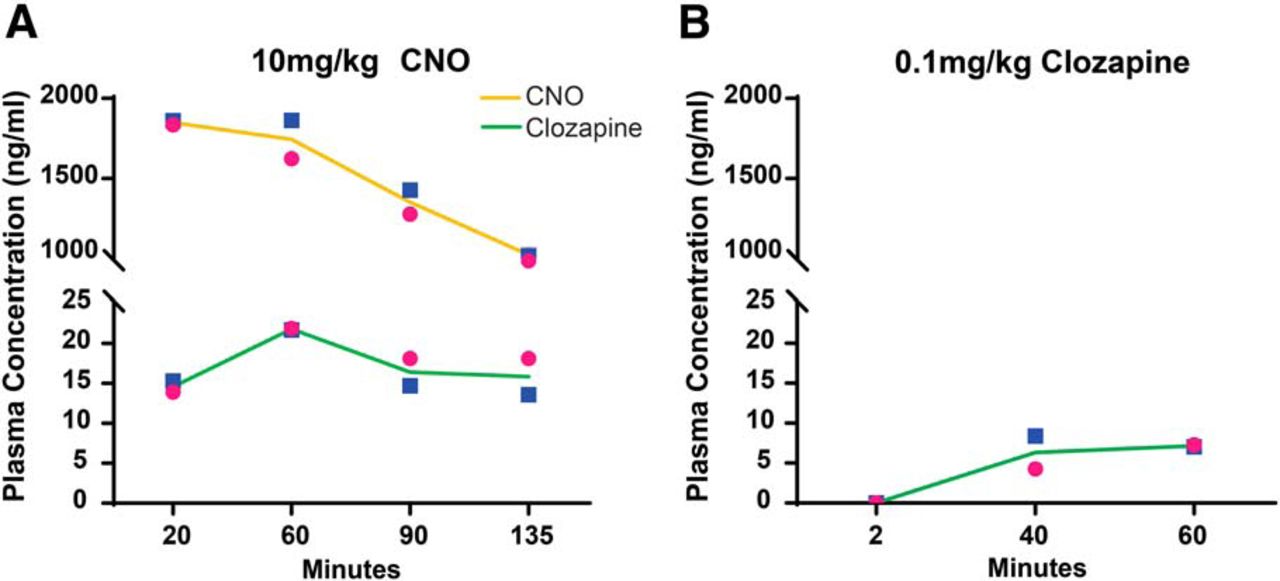
    Time–concentration profiles of CNO and clozapine in infant monkeys. A, B, Plasma concentrations of CNO (yellow line) and its metabolite clozapine (green line) following subcutaneous administration of CNO at 10 mg/kg (A) and clozapine at 0.1 mg/kg (B) in the infant male (blue square) and female (pink circle) monkeys.

  • Figure 3.
    • Download figure
    • Open in new tab
    • Download powerpoint
    Figure 3.

    In vivo neuroimaging in infant rhesus monkeys. A, B, T1-weighted MRI scan presurgery (A) and again at 4 months postsurgery (B) for the female and the male monkeys. In the left hemisphere of the female, a reduction in the amygdala was observed at 4 months postsurgery (B), which was later confirmed in the Nissl section (inset). The green dashed lines approximately outline the amygdala.

  • Figure 4.
    • Download figure
    • Open in new tab
    • Download powerpoint
    Figure 4.

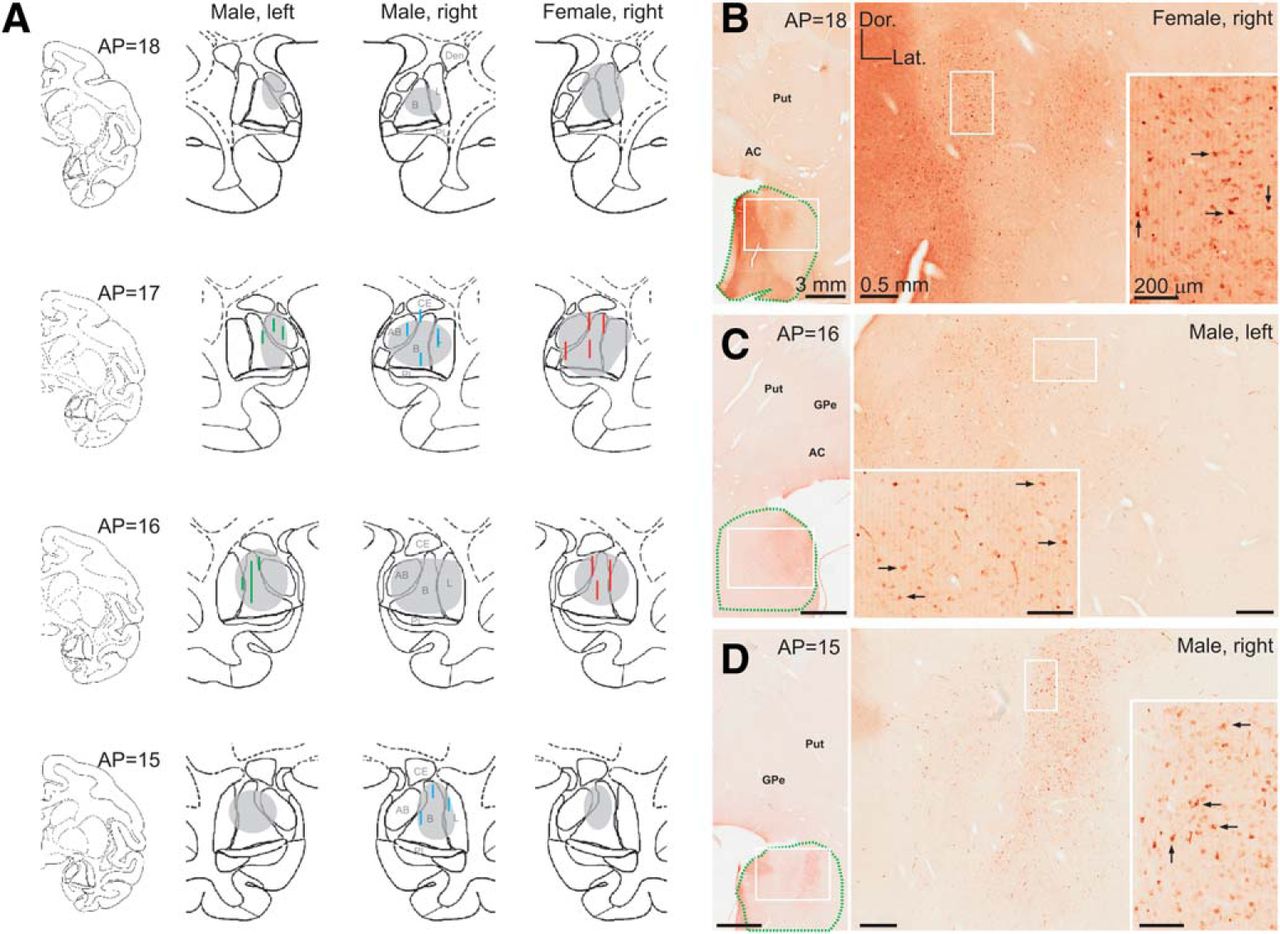
    Expression of DREADDs after virus injections in the amygdala. A, Injection tracks (blue lines, male; red lines, female) identified in Nissl stains; and DREADD expression coverage (gray outline) in the amygdala, as identified with immunoperoxidase. B–D, Examples of HA immunoperoxidase labeling in the amygdala. White rectangles indicate areas shown at higher magnification in subsequent panels. Arrows point to examples of HA(hM4Di)-positive neuronal cell bodies. In B–D, the approximate outline of the amygdala is indicated by green dashed lines. Scale bars and orientation in B apply to C and D. AP indicates the approximate anteroposterior plane from the interaural line, according to coronal drawings from a normalized infant rhesus monkey brain (J. Bachevalier, unpublished observations). AB, Anterior basal amygdala; AC, anterior commissure; B, basal amygdala; CE, central amygdala; Dor., dorsal; GPe, external segment of the globus pallidus: L, lateral amygdala; Lat., lateral; PL, paralaminar amygdala, Put, putamen.

  • Figure 5.
    • Download figure
    • Open in new tab
    • Download powerpoint
    Figure 5.

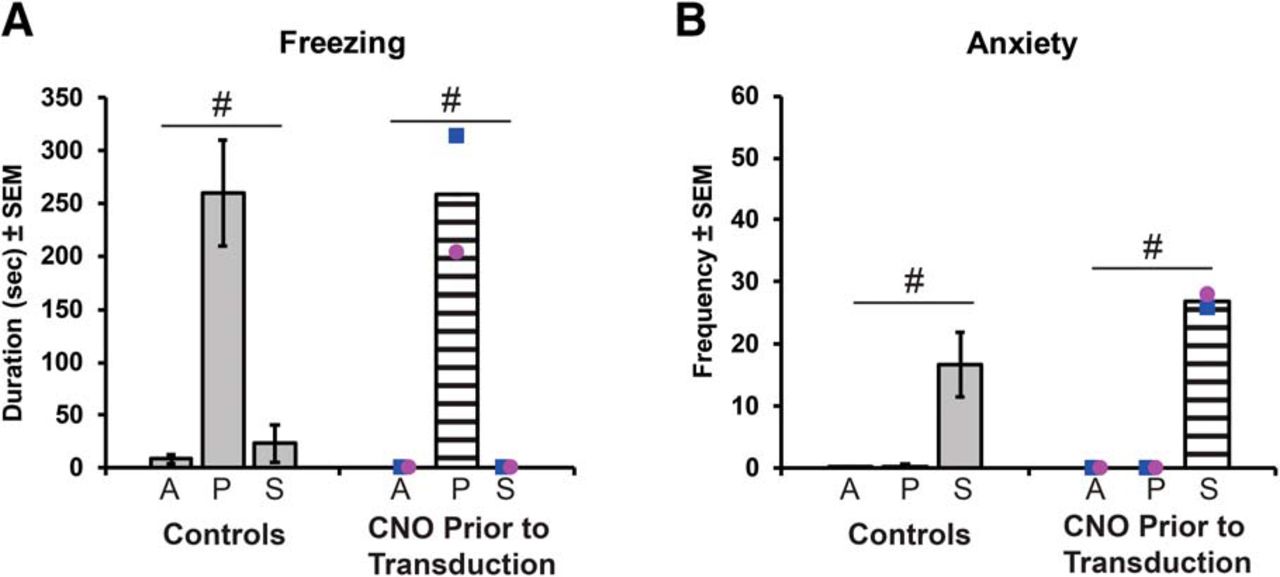
    Behavioral responses on the human intruder paradigm before DREADD transduction. A, B, Freezing (A) and anxiety (B) behaviors measured across task conditions (A, alone; P, profile; S, stare) in the infant female (pink circle) and male (blue square) monkeys before transduction (striped bar), compared with control monkeys from a previous study (historic controls, gray bars; Raper et al., 2013b). #Indicates a significant effect of condition on the task (p < 0.05).

  • Figure 6.
    • Download figure
    • Open in new tab
    • Download powerpoint
    Figure 6.

    Behavioral responses on the human intruder paradigm with and without DREADD inhibition of the amygdala. A–D, Freezing during the Profile condition (A), anxiety (B), hostility (C), and vocalizations (D) during the Stare condition after CNO or clozapine (CNO/clozapine, yellow bars) or vehicle (Veh, open bars) administration. *Indicates a significant effect of ligand (p < 0.05).

  • Figure 7.
    • Download figure
    • Open in new tab
    • Download powerpoint
    Figure 7.

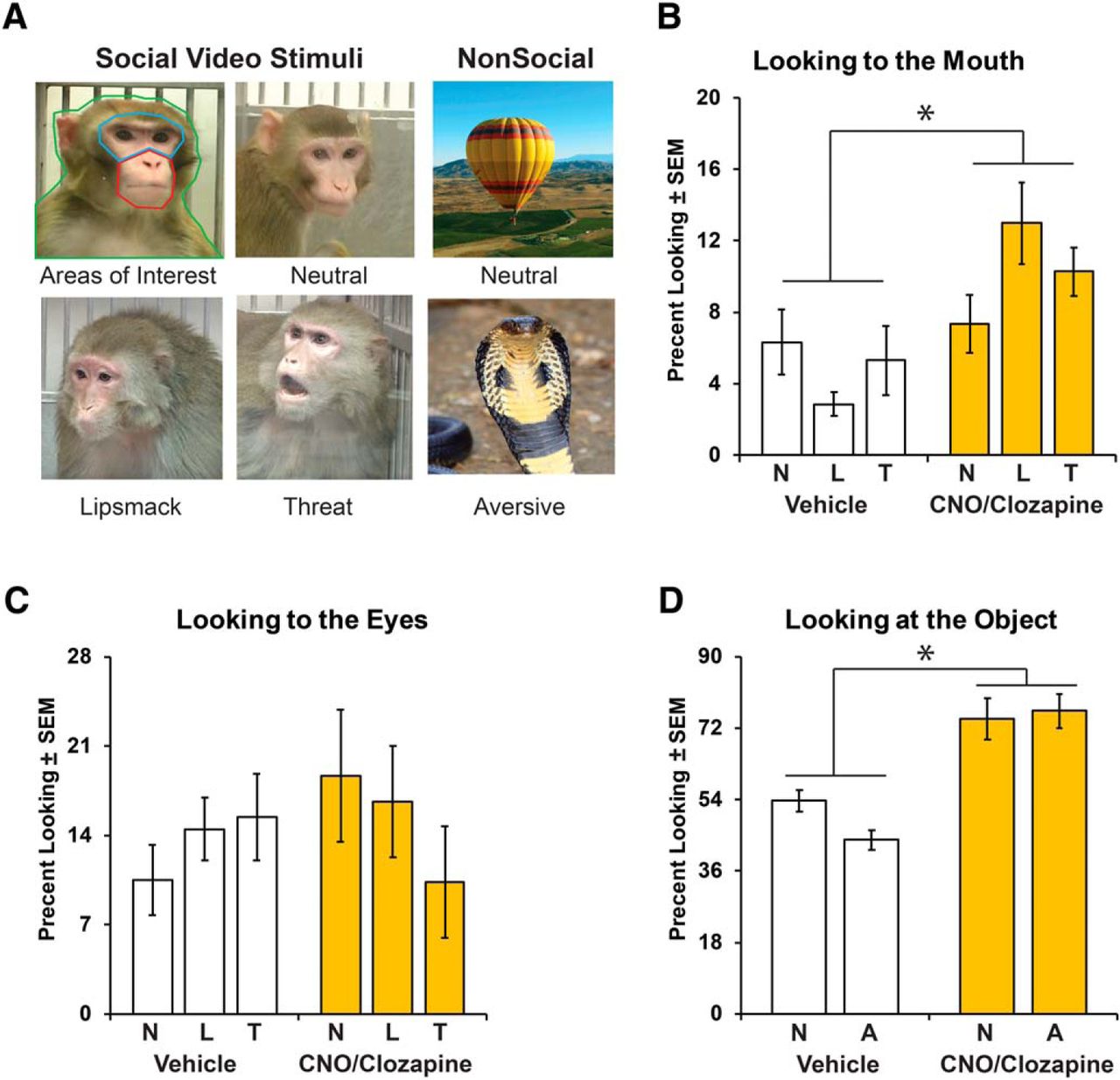
    Looking behavior during the socioemotional attention task during DREADD-mediated inhibition of the amygdala. A represents examples of the video stimuli type, as well as outlines the specific areas of interest (AOIs) mouth (red), eyes (blue), and body (green) for social stimuli. B and C illustrate the percentage looking to the mouth or eyes of neutral (N), lipsmack (L), or threatening (T) social videos. D illustrates the percentage looking at the neutral (N) or aversive (A) nonsocial object after CNO or clozapine (yellow bars) or vehicle (open bars) administration. *Indicates a significant difference from vehicle (p < 0.05).

Tables

  • Figures
    • View popup
    Table 1.

    Behavioral ethogram for human intruder

    Category and specific behaviorsMeasurementBrief descriptions
    FreezeDurationRigid, motionless posture except slight head movement
    HostileCumulative frequency
        Threat barkFrequencyLow pitch, high intensity, rasping, guttural
        ThreatFrequencyAny of the following: open mouth (no teeth exposed), head bobbing, or ear flapping
        Cage aggressionFrequencyVigorously slaps, shakes, or slams body against cage
        LungeFrequencyA quick, jerky movement toward the stimulus
    VocalizationsCumulative frequency
        CooFrequencyClear soft pitch and intensity, sounds like “ooooh”
        ScreamFrequencyHigh pitch, high-intensity screech or loud chirp
    AnxietyCumulative frequency
        ScratchFrequencyRapid scratch of body with hands or feet
        Body shakeFrequencyShake of the whole body or just head and shoulders region
        Tooth grindaFrequencyRepetitive, audible rubbing of upper and lower teeth
        YawnFrequencyOpen mouth widely, exposing teeth
    AffiliativebCumulative frequency
        LipsmackFrequencyRapid movement of pursed lips, accompanied by a smacking sound
        PresentFrequencyRigid posture (knees locked) with tail elevated and rump oriented toward the stimulus object
    FearfulbCumulative frequency
        WithdrawalFrequencyQuick, jerky motion away from the stimulus object (jump back)
        GrimaceFrequencyRefracted lips, exposed clenched teeth
    StereotypiesbCumulative duration
        PacingDurationRepetitive motor pattern around the test cage
        Motor stereotypyDurationRepetitive, abnormal voluntary or involuntary motor patterns (e.g., swinging, twirling, flipping)
    • List of all behaviors scored, how they are measured and a brief definition.

    • aBehavior for which total duration was also measured.

    • bBehavior that was rarely or never seen in the current study.

    • View popup
    Table 2.

    Individual human intruder paradigm data

    SessionFreezing (duration)Anxiety (frequency)Hostility (frequency)Vocalizations (frequency)
    orderLigandSubjectAloneProfileStareAloneProfileStareAloneProfileStareAloneProfileStare
    1CNO (prior to transduction)F
    M
    0
    0
    203.97
    313.34
    0
    0
    0
    0
    0
    0
    26
    28
    0
    0
    0
    0
    193
    151
    0
    0
    0
    0
    80
    41
    2CNOF
    M
    0
    1.63
    33.83
    170.26
    0
    0
    0
    0
    0
    0
    2
    15
    2
    0
    0
    0
    157
    158
    0
    0
    0
    0
    47
    45
    3VehicleF
    M
    0
    0
    222.58
    342.97
    0
    0
    0
    0
    0
    0
    38
    71
    8
    0
    0
    1
    148
    112
    0
    0
    0
    0
    33
    19
    4CNOF
    M
    0
    0
    40.81
    72.9
    0
    0
    0
    0
    0
    0
    7
    33
    4
    0
    1
    0
    86
    87
    0
    0
    0
    0
    0
    16
    5ClozapineF
    M
    0
    0
    53
    68.07
    0
    0
    0
    0
    0
    0
    0
    26
    1
    0
    3
    0
    147
    124
    0
    3
    0
    0
    116
    67
    6VehicleF
    M
    0
    0
    68
    250.54
    0
    0
    0
    0
    0
    0
    15
    32
    2
    8
    1
    1
    167
    62
    39
    8
    162
    0
    100
    48
    • List of behaviors scored on the human intruder paradigm and the individual values for the female (F) and male (M) infant monkeys across the 6 test sessions and ligand administered during each session.

    • View popup
    Table 3.

    Individual data social stimuli

    SessionPresentationMouthEyesBody
    orderLigandSubjectorderNeutralLipsmackThreatNeutralLipsmackThreatNeutralLipsmackThreat
    1VehicleF1
    2
    0.00
    0.96
    0.00
    4.37
    0.00
    1.84
    0.31
    19.87
    33.33
    13.85
    37.88
    19.04
    29.60
    45.25
    20.63
    24.84
    0.87
    47.21
    M1
    2
    0.00
    4.99
    0.00
    7.79
    0.00
    1.62
    3.16
    9.11
    18.90
    13.71
    28.67
    21.83
    24.66
    24.55
    44.35
    19.97
    25.72
    35.01
    2CNOF1
    2
    7.67
    4.35
    10.02
    10.80
    12.90
    11.35
    32.75
    42.77
    30.48
    22.86
    19.42
    12.21
    48.01
    44.36
    50.92
    57.28
    46.71
    49.69
    M1
    2
    0.29
    10.94
    4.53
    9.26
    9.94
    13.24
    1.75
    16.86
    8.05
    8.97
    8.27
    6.94
    28.50
    45.63
    28.42
    35.98
    19.80
    41.78
    3VehicleF1
    2
    2.13
    7.86
    2.42
    4.60
    2.87
    5.88
    9.56
    6.76
    0.14
    10.66
    21.73
    12.19
    33.28
    43.95
    25.11
    44.00
    17.54
    27.12
    M1
    2
    2.24
    8.89
    1.21
    2.28
    0.32
    9.63
    31.28
    0.00
    20.98
    3.33
    22.00
    0.00
    28.70
    44.17
    35.91
    31.07
    29.45
    28.85
    4ClozapineF1
    2
    15.21
    5.57
    18.04
    35.65
    2.18
    7.64
    30.23
    9.14
    38.21
    6.32
    7.74
    9.95
    45.38
    68.35
    36.60
    36.52
    39.91
    50.47
    M1
    2
    4.76
    10.00
    3.78
    11.87
    11.10
    13.98
    8.37
    7.57
    12.71
    6.24
    10.36
    8.11
    35.92
    33.35
    27.37
    39.65
    24.75
    25.07
    5VehicleF1
    2
    19.31
    6.82
    5.08
    3.78
    24.09
    9.74
    9.24
    15.06
    15.72
    16.62
    4.17
    3.74
    60.13
    61.65
    63.73
    61.95
    59.86
    65.18
    M1
    2
    17.23
    5.47
    0.18
    2.60
    4.52
    3.13
    20.40
    1.29
    17.36
    9.36
    13.18
    1.18
    18.91
    37.53
    23.70
    49.22
    46.12
    48.11
    • Average percentage looking at specific AOIs for the first and second presentation of social stimuli containing neutral, lipsmack, or threatening emotional valences. Individual values for the female (F) and male (M) infant monkeys across the five test sessions and ligand administered during each session of the Socioemotional Attention task.

    • View popup
    Table 4.

    Individual data nonsocial stimuli

    Object
    Session orderLigandSubjectPresentation orderNeutralAversive
    1VehicleF1
    2
    47.60
    70.63
    38.95
    70.22
    M1
    2
    28.21
    58.27
    40.17
    67.16
    2CNOF1
    2
    74.61
    87.86
    87.72
    83.51
    M1
    2
    58.56
    76.47
    90.26
    69.40
    3VehicleF1
    2
    54.10
    41.48
    25.12
    27.80
    M1
    2
    58.17
    54.98
    55.99
    36.10
    4ClozapineF1
    2
    65.32
    66.00
    75.28
    64.79
    M1
    2
    34.11
    50.30
    66.02
    73.88
    5VehicleF1
    2
    49.33
    61.40
    26.99
    37.21
    M1
    2
    68.30
    51.33
    54.82
    46.36
    • Average percentage looking for the first and second presentation of neutral and aversive nonsocial stimuli. Individual values for the female (F) and male (M) infant monkeys across the 5 test sessions and ligand administered during each session of the Socioemotional Attention task..

Back to top

In this issue

eneuro: 6 (5)
eNeuro
Vol. 6, Issue 5
September/October 2019
  • Table of Contents
  • Index by author
  • Ed Board (PDF)
Email

Thank you for sharing this eNeuro article.

NOTE: We request your email address only to inform the recipient that it was you who recommended this article, and that it is not junk mail. We do not retain these email addresses.

Enter multiple addresses on separate lines or separate them with commas.
Chemogenetic Inhibition of the Amygdala Modulates Emotional Behavior Expression in Infant Rhesus Monkeys
(Your Name) has forwarded a page to you from eNeuro
(Your Name) thought you would be interested in this article in eNeuro.
CAPTCHA
This question is for testing whether or not you are a human visitor and to prevent automated spam submissions.
Print
View Full Page PDF
Citation Tools
Chemogenetic Inhibition of the Amygdala Modulates Emotional Behavior Expression in Infant Rhesus Monkeys
Jessica Raper, Lauren Murphy, Rebecca Richardson, Zoe Romm, Zsofia Kovacs-Balint, Christa Payne, Adriana Galvan
eNeuro 20 September 2019, 6 (5) ENEURO.0360-19.2019; DOI: 10.1523/ENEURO.0360-19.2019

Citation Manager Formats

  • BibTeX
  • Bookends
  • EasyBib
  • EndNote (tagged)
  • EndNote 8 (xml)
  • Medlars
  • Mendeley
  • Papers
  • RefWorks Tagged
  • Ref Manager
  • RIS
  • Zotero
Respond to this article
Share
Chemogenetic Inhibition of the Amygdala Modulates Emotional Behavior Expression in Infant Rhesus Monkeys
Jessica Raper, Lauren Murphy, Rebecca Richardson, Zoe Romm, Zsofia Kovacs-Balint, Christa Payne, Adriana Galvan
eNeuro 20 September 2019, 6 (5) ENEURO.0360-19.2019; DOI: 10.1523/ENEURO.0360-19.2019
Twitter logo Facebook logo Mendeley logo
  • Tweet Widget
  • Facebook Like
  • Google Plus One

Jump to section

  • Article
    • Abstract
    • Significance Statement
    • Introduction
    • Materials and Methods
    • Results
    • Discussion
    • Acknowledgments
    • Footnotes
    • References
    • Synthesis
  • Figures & Data
  • Info & Metrics
  • eLetters
  • PDF

Keywords

  • attention
  • development
  • DREADDs
  • emotion
  • nonhuman primate
  • social

Responses to this article

Respond to this article

Jump to comment:

No eLetters have been published for this article.

Related Articles

Cited By...

More in this TOC Section

New Research

  • A Very Fast Time Scale of Human Motor Adaptation: Within Movement Adjustments of Internal Representations during Reaching
  • Optogenetic Activation of β-Endorphin Terminals in the Medial Preoptic Nucleus Regulates Female Sexual Receptivity
  • Hsc70 Ameliorates the Vesicle Recycling Defects Caused by Excess α-Synuclein at Synapses
Show more New Research

Cognition and Behavior

  • Pairing mouse social and aversive stimuli across sexes does not produce social aversion in females
  • In-vivo analysis of medial perforant path-evoked excitation and inhibition in dentate granule cells
  • Altered Dopamine Signaling in Extinction-Deficient Mice
Show more Cognition and Behavior

Subjects

  • Cognition and Behavior
  • Home
  • Alerts
  • Follow SFN on BlueSky
  • Visit Society for Neuroscience on Facebook
  • Follow Society for Neuroscience on Twitter
  • Follow Society for Neuroscience on LinkedIn
  • Visit Society for Neuroscience on Youtube
  • Follow our RSS feeds

Content

  • Early Release
  • Current Issue
  • Latest Articles
  • Issue Archive
  • Blog
  • Browse by Topic

Information

  • For Authors
  • For the Media

About

  • About the Journal
  • Editorial Board
  • Privacy Notice
  • Contact
  • Feedback
(eNeuro logo)
(SfN logo)

Copyright © 2025 by the Society for Neuroscience.
eNeuro eISSN: 2373-2822

The ideas and opinions expressed in eNeuro do not necessarily reflect those of SfN or the eNeuro Editorial Board. Publication of an advertisement or other product mention in eNeuro should not be construed as an endorsement of the manufacturer’s claims. SfN does not assume any responsibility for any injury and/or damage to persons or property arising from or related to any use of any material contained in eNeuro.