Article Figures & Data
Figures
- Figure 1.
Breeding strategy for generating the Shank3GCreTam mouse line. Heterozygous Shank3+/G mice from the original Shank3G mouse line were crossed with a tamoxifen-inducible CreTam transgenic mouse line to produce Shank3+/GCreTam− and Shank3+/GCreTam+ offspring. Shank3+/GCreTam− and Shank3+/GCreTam+ mice from this initial cross were bred to generate all experimental mice for this study: Shank3+/+CreTam−, Shank3+/GCreTam−, Shank3G/GCreTam−, Shank3+/+CreTam+, Shank3+/GCreTam+, and Shank3G/GCreTam+.
- Figure 3.
Tamoxifen-inducible Shank3 genetic reversal strategy. The Shank3G mutation was introduced into the WT Shank3 allele (A) by insertion of a neo-STOP cassette before WT exon 21 (B). The neo-STOP cassette was flanked by loxP sites, so that Cre-recombinase activity in the nucleus could excise the mutated Shank3G exon 21 (C), resulting in restoration of the WT Shank3+/+ gene (D) and SHANK3 expression, thereby effectively reversing the Shank3G mutation.
- Figure 4.
Optimization of tamoxifen treatment protocol in adult Shank3GCreTam+ mice. A, Quantification of Western blotting showing minimal rescue of WT SHANK3 protein expression following treatment with 4-hydroxytamoxifen (66.67 mg/kg) given once per day subcutaneously for 15 d (n = 7 for all treatment groups). B, Representative Western blotting (top) and quantification of whole-brain lysates (bottom) showing degrees of rescue of SHANK3 protein expression after varying duration of tamoxifen diet (n = 7 for all treatment groups). C, SHANK3 protein levels from whole-brain lysates in adult Shank3GCreTam− mice treated for six weeks with vehicle or tamoxifen diet (vehicle diet: Shank3+/+ n = 9, Shank3+/G n = 7, Shank3G/G n = 4; tamoxifen diet: Shank3+/+ n = 12, Shank3+/G n = 9, Shank3G/G n = 9). D, SHANK3 protein levels from whole-brain lysates in adult Shank3GCreTam+ mice treated for six weeks with vehicle diet or tamoxifen diet [vehicle diet: Shank3+/+ n = 26, Shank3+/G n = 21, Shank3G/G n = 15; tamoxifen diet: Shank3+/+ n = 23, Shank3+/G n = 15, Shank3G/G n = 18; data are normalized to the β-actin control and then to the average of WT levels with C-terminal SHANK3 antibody (JH3025)]. E, Example Southern blotting of brain tissue in CreTam+, WT and Shank3G/G homozygous mutant mice treated with vehicle or tamoxifen (TAM; Rev = band expected following cre-mediated recombination of floxed mutant; Mut = band expected for floxed mutant before cre recombination; WT = band expected in WT mice without mutant allele); *p < 0.05, **p < 0.01, ***p < 0.001, ****p < 0.0001. Error bars represent S.E.M. in this and all subsequent figures.
- Figure 5.
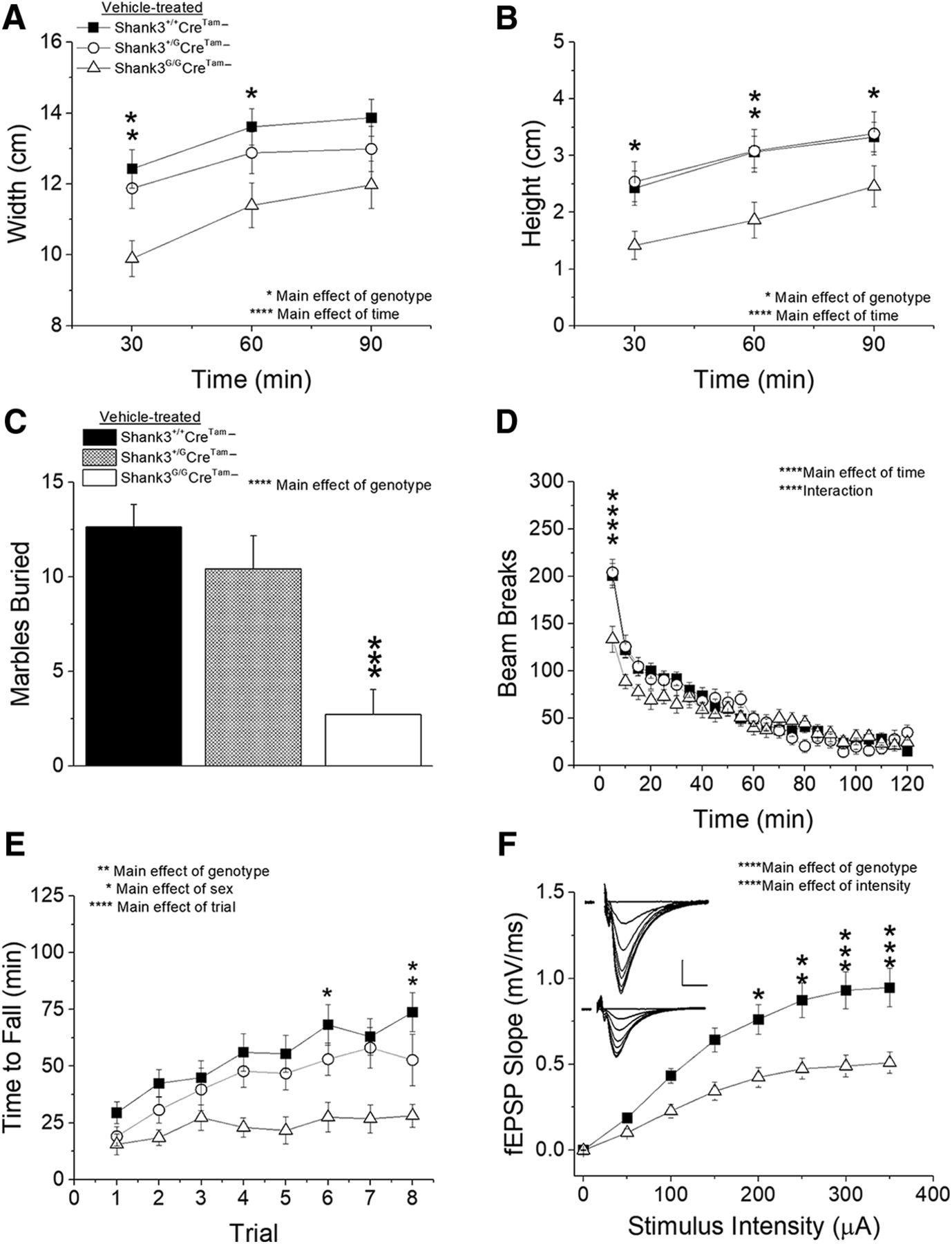
Vehicle-treated Shank3G/GCreTam− mice exhibit clear behavioral and physiologic phenotypes. Shank3G/GCreTam− mice exhibit a novelty avoidance phenotype by building smaller nests in both nest width (A) and height (B) over a 90-min period, burying fewer marbles over a 30-min period (C), and exhibiting hypoactivity within the first 5 min of the open field test (D) compared to Shank3+/+CreTam− controls. E, Rotarod testing demonstrates that motor learning and coordination are decreased in Shank3G/GCreTam− mice compared to controls. Shank3+/+ n = 27, Shank3+/G n = 18, Shank3G/G n = 19. F, Synaptic transmission in the hippocampus is impaired in Shank3G/GCreTam− mice with decreased fEPSP in response to stimulus intensity compared to Shank3+/+CreTam− mice. Inset, Average of five consecutive raw traces at stimulus intensities 0–350 μA in 50-μA steps from Shank3+/+ (top) and Shank3G/G (bottom) mice; scale bar = 0.5 mV, 5 ms. Shank3+/+ n = 10 slices from five mice, Shank3G/G n = 9 slices from three mice; *p < 0.05, **p < 0.01, ***p < 0.001, ****p < 0.0001.
- Figure 6.
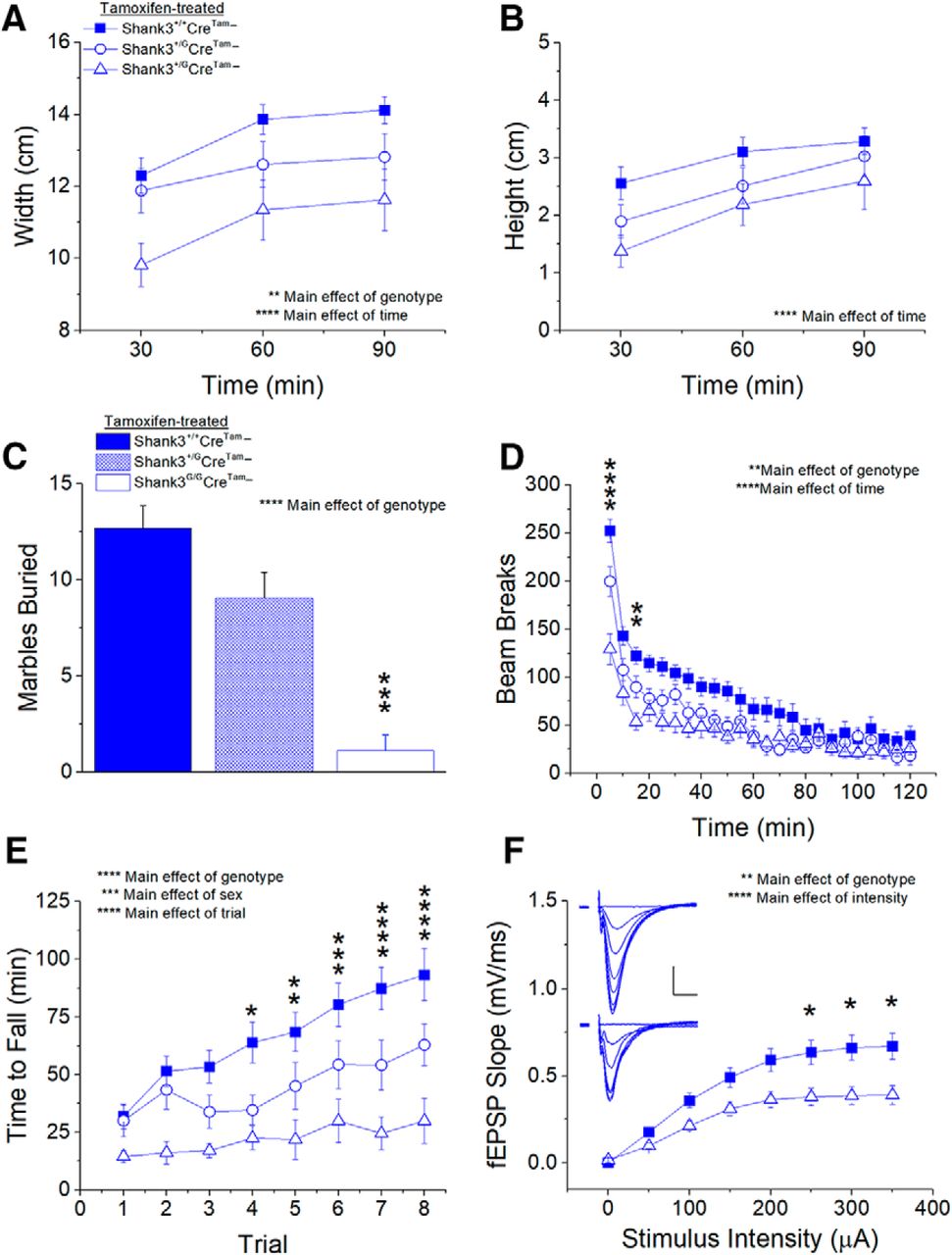
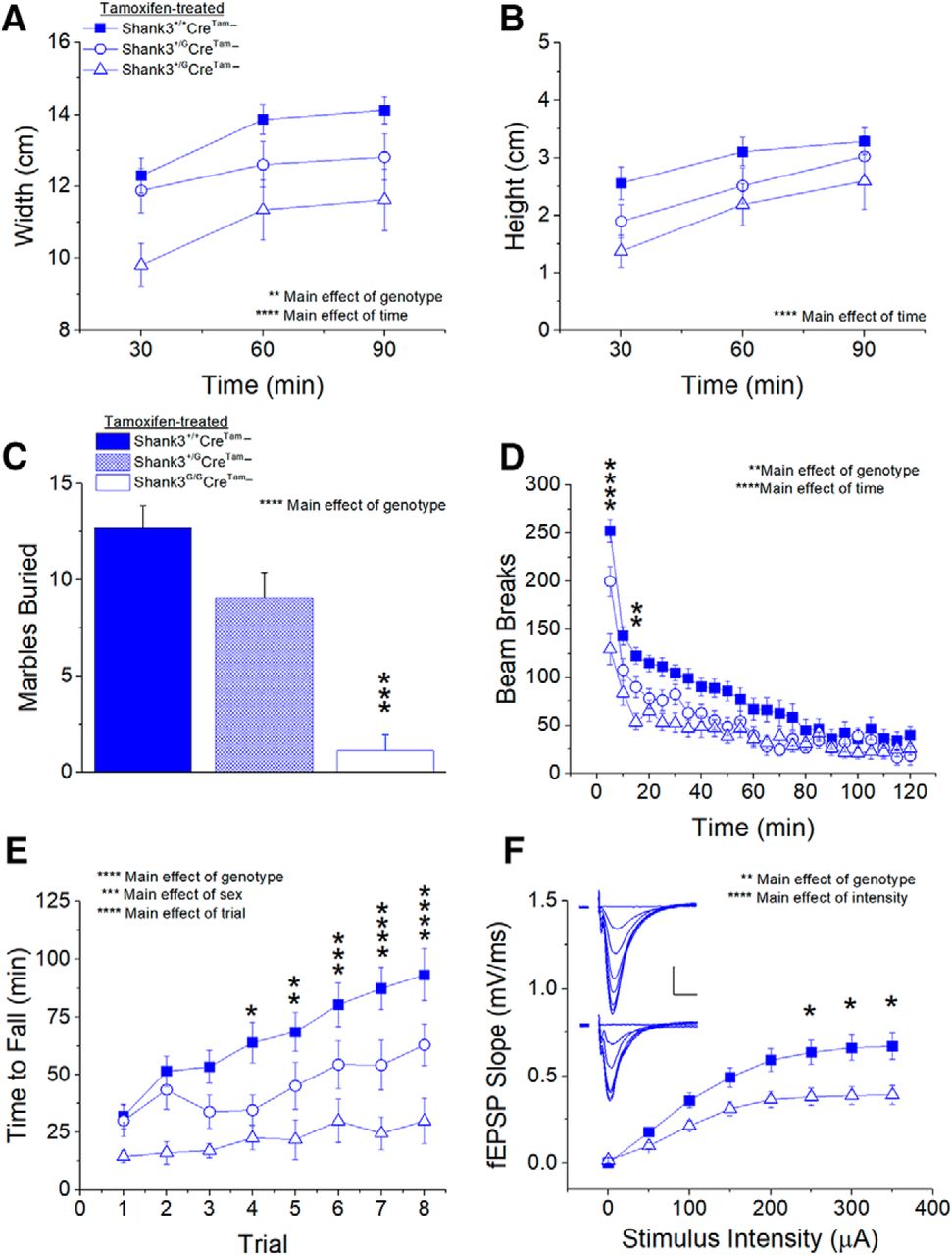
Behavioral and synaptic phenotypes in Shank3G/GCreTam− mice are not rescued by treatment with six weeks of tamoxifen diet. Nesting behavior is not rescued by tamoxifen treatment in Shank3G/GCreTam− mice with regard to nest width (A), although there is no main effect of genotype with regard to nest height (B). Marble burying (C) remains impaired in tamoxifen-treated Shank3G/GCreTam− mice with decreased number of marbles buried compared to controls. Locomotor activity also remains decreased in tamoxifen-treated Shank3G/GCreTam− mice at the start of the open field test (D). Latency to fall off the rotarod (E) remains decreased in tamoxifen-treated Shank3G/GCreTam− mice compared to controls. Shank3+/+ n = 25, Shank3+/G n = 19, Shank3G/G n = 16. F, Tamoxifen treatment does not rescue synaptic transmission in Shank3G/GCreTam− mice. Inset, Average of five consecutive traces at each stimulus intensity 0–350 μA in 50-μA steps from Shank3+/+ (top) and Shank3G/G (bottom) mice treated with six weeks of tamoxifen diet; scale bar = 0.25 mV, 5 ms. Shank3+/+ n = 22 slices from eight mice, Shank3G/G n = 20 slices from six mice; *p < 0.05, **p < 0.01, ***p < 0.001, ****p < 0.0001.
- Figure 7.
Incomplete genetic rescue of behavioral and physiologic phenotypes in tamoxifen-treated Shank3G/GCreTam+ mice. There is no main effect of genotype on nest width (A) or height (B) in tamoxifen-treated Shank3G/GCreTam+ mice, suggesting successful rescue of the Shank3G/G nest-building phenotype. C, The Shank3G/G marble-burying phenotype is not rescued in tamoxifen-treated Shank3G/GCreTam+ mice, nor is the initial hypoactivity observed in the open field test (D). Tamoxifen treatment of Shank3G/GCreTam+ mice does successfully eliminate the main effects of genotype in the time to fall from the rotarod. Shank3+/+ n = 23, Shank3+/G n = 15, Shank3G/G n = 18 (E). F, There is no main effect of genotype on fEPSP slope over a range of stimulus intensities in tamoxifen-treated Shank3+/+CreTam+ and Shank3G/GCreTam+ mice. Inset, Average of five consecutive traces at each stimulus intensity 0–350 μA in 50-μA steps from Shank3+/+ (top) and Shank3G/G (bottom) mice treated with six weeks of tamoxifen diet; scale bar = 0.25 mV, 5 ms. Shank3+/+ n = 16 slices from eight mice, Shank3G/G n = 12 slices from six mice; *p < 0.05, ***p < 0.0001, ****p < 0.00001.
- Figure 8.
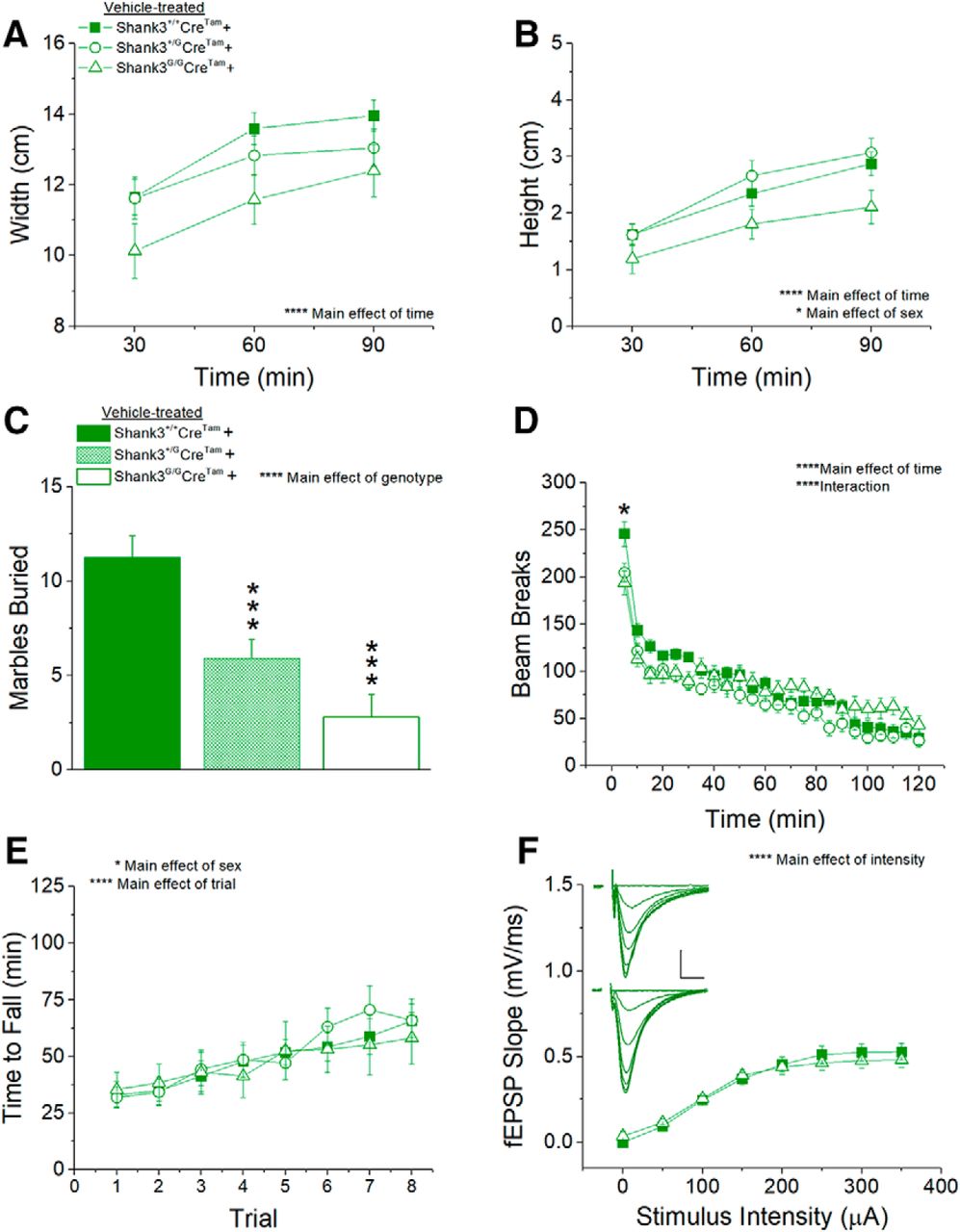
Unexpected, partial genetic “rescue” of behavioral and synaptic phenotypes in vehicle-treated Shank3G/GCreTam+ mice. The decreases in nest width (A) and height (B) in Shank3G/G mice are rescued in vehicle-treated Shank3G/GCreTam+ mice. The Shank3G/G marble-burying phenotype (C) and initial locomotor hypoactivity in the open field test (D) are not rescued in vehicle-treated Shank3G/GCreTam+ mice. E, There is no main effect of genotype in time to fall from the rotarod in vehicle-treated Shank3GCreTam+ mice. Shank3+/+ n = 26, Shank3+/G n = 21, Shank3G/G n = 15. F, There is no main effect of genotype on fEPSP slope in response to a range of stimulus intensities. Inset, Average of five consecutive traces at each stimulus intensity 0–350 μA in 50-μA steps from Shank3+/+ (top) and Shank3G/G (bottom) mice treated with vehicle diet; scale bar = 0.25 mV, 5 ms. Shank3+/+ n = 16 slices from six mice, Shank3G/G n = 16 slices from five mice; *p < 0.05, ***p < 0.0001, ****p < 0.00001.
- Figure 9.
Effect of the CreTam transgene on synaptic physiology in WT Shank3+/+ and mutant Shank3G/G mice. The CreTam transgene causes a dramatic decrease in the relationship between stimulus intensity and fEPSP slope (A) in WT Shank3+/+ mice. Inset, Average of five consecutive raw traces at each stimulus intensity from 0 to 350 μA in 50-μA steps from Shank3+/+CreTam− mice (top) and Shank3+/+CreTam+ mice (bottom); scale bar = 0.25 mV, 5 ms. Shank3+/+CreTam− n = 10 slices from four mice, Shank3+/+CreTam+ n = 16 slices from six mice. B, The relationship between stimulus intensity and fEPSP slope in mutant Shank3G/G mice is unchanged with CreTam transgene expression. Inset, Average of five consecutive raw traces at each stimulus intensity from 0 to 350 μA in 50-μA steps from Shank3G/GCreTam− mice (top) and Shank3G/GCreTam+ mice (bottom); scale bar =0.25 mV, 5 ms. Shank3G/GCreTam− n = 9 slices from three mice, Shank3G/GCreTam+ n = 16 slices from five mice; *p < 0.05, **p < 0.01, ***p < 0.001, ****p < 0.0001.




Tables
- Table 2.
Detailed statistical analysis of all behavior and electrophysiology performed in this study
Vehicle-treated Shank3GCreTam− Nest width Three-way rmANOVA Genotype F(2,58) = 4.07 *p = 0.0222 (Fig. 5A) Time F(2,116) = 19.12 *p < 0.0001 Sex F(1,58) = 0.26 p = 0.6119 Genotype × time F(4,116) = 0.67 p = 0.6162 Tukey HSD Shank3+/+CreTam− vs Shank3+/GCreTam− p = 0.5894 Shank3+/+CreTam− vs Shank3G/GCreTam− *p = 0.0089 Shank3+/GCreTam− vs Shank3G/GCreTam− p = 0.1515 Nest height Three-way rmANOVA Genotype F(2,58) = 3.38 *p = 0.0408 (Fig. 5B) Time F(2,116) = 33.32 *p < 0.0001 Sex F(1,58) = 0.01 p = 0.9336 Genotype × time F(4,116) = 0.46 p = 0.7621 Genotype × sex F(2,58) = 1.82 p = 0.1710 Tukey HSD Shank3+/+CreTam− vs Shank3+/GCreTam− p = 0.9865 Shank3+/+CreTam− vs Shank3G/GCreTam− *p = 0.0392 Shank3+/GCreTam− vs Shank3G/GCreTam− *p = 0.0473 Marble burying Two-way ANOVA Genotype F(2,58) = 12.30 *p < 0.0001 (Fig. 5C) Sex F(1,58) = 0.13 p = 0.7208 Genotype × time F(4,116) = 0.67 p = 0.6162 Tukey HSD Shank3+/+CreTam− vs Shank3+/GCreTam− p = 0.4965 Shank3+/+CreTam− vs Shank3G/GCreTam− *p = 0.0001 Shank3+/GCreTam− vs Shank3G/GCreTam− *p = 0.0017 Locomotor Three-way rmANOVA Genotype F(2,58) = 0.47 p = 0.6274 (Fig. 5D) Time F(23,1334) = 103.60 *p < 0.0001 Sex F(1,58) = 0.82 p = 0.3689 Genotype × time F(46,1334) = 3.37 *p < 0.0001 Genotype × sex F(2,58) = 0.37 p = 0.6893 Tukey HSD Shank3+/+CreTam− vs Shank3+/GCreTam− p = 0.9828 Shank3+/+CreTam− vs Shank3G/GCreTam− p = 0.5155 Shank3+/GCreTam− vs Shank3G/GCreTam− p = 0.6796 Rotarod Three-way rmANOVA Genotype F(2,58) = 5.83 *p = 0.0049 (Fig. 5E) Trial F(7,406) = 13.89 *p < 0.0001 Sex F(1,58) = 4.31 *p = 0.0424 Genotype × trial F(14,406) = 1.87 *p = 0.0282 Genotype × sex F(2,58) = 0.94 p = 0.3970 Tukey HSD Shank3+/+CreTam− vs Shank3+/GCreTam− p = 0.4183 Shank3+/+CreTam− vs Shank3G/GCreTam− *p = 0.0015 Shank3+/GCreTam− vs Shank3G/GCreTam− p = 0.4183 fEPSP slope Two-way rmANOVA Genotype F(1,17) = 102.42 *p < 0.0001 (Fig. 5F) Intensity F(7,119) = 36.51 *p < 0.0001 Genotype × intensity F(7,119) = 2.90 *p = 0.0078 Fiber volley Two-way rmANOVA Genotype F(1,8) = 5.12 p = 0.0535 Intensity F(7,56) = 69.13 *p < 0.0001 Genotype × intensity F(7,56) = 3.51 *p = 0.0034 Tamoxifen-treated Shank3GCreTam− Nest width Three-way rmANOVA Genotype F(2,54) = 5.09 *p = 0.0047 (Fig. 6A) Time F(2,108) = 23.28 *p < 0.0001 Sex F(1,54) = 0.31 p = 0.5813 Genotype × time F(4,108) = 1.12 p = 0.3527 Genotype × sex F(2,54) = 0.35 p = 0.7070 Tukey HSD Shank3+/+CreTam− vs Shank3+/GCreTam− p = 0.3842 Shank3+/+CreTam− vs Shank3G/GCreTam− *p = 0.0068 Shank3+/GCreTam− vs Shank3G/GCreTam− p = 0.1757 Nest height Three-way rmANOVA Genotype F(2,54) = 2.47 p = 0.0942 (Fig. 6B) Time F(2,108) = 39.18 *p < 0.0001 Sex F(1,54) = 0.01 p = 0.9046 Genotype × time F(4,108) = 1.07 p = 0.3753 Genotype × sex F(2,54) = 0.14 p = 0.8719 Tukey HSD Shank3+/+CreTam− vs Shank3+/GCreTam− p = 0.4260 Shank3+/+CreTam− vs Shank3G/GCreTam− p = 0.0811 Shank3+/GCreTam− vs Shank3G/GCreTam− p = 0.6415 Marble burying Two-way ANOVA Genotype F(2,54) = 22.52 *p < 0.0001 (Fig. 6C) Sex F(1,54) = 0.86 p = 0.3575 Genotype × sex F(2,54) = 0.20 p = 0.8195 Tukey HSD Shank3+/+CreTam− vs Shank3+/GCreTam− p = 0.0776 Shank3+/+CreTam− vs Shank3G/GCreTam− *p = 0.0001 Shank3+/GCreTam− vs Shank3G/GCreTam− *p = 0.0003 Locomotor Three-way rmANOVA Genotype F(2,54) = 5.20 *p = 0.0086 (Fig. 6D) Time F(23,1242) = 96.67 *p < 0.0001 Sex F(1,54) = 0.56 p = 0.4570 Genotype × time F(46,1242) = 4.55 *p < 0.0001 Genotype × sex F(2,54) = 0.11 p = 0.8928 Tukey HSD Shank3+/+CreTam− vs Shank3+/GCreTam− p = 0.0740 Shank3+/+CreTam− vs Shank3G/GCreTam− *p = 0.0097 Shank3+/GCreTam− vs Shank3G/GCreTam− p = 0.6566 Rotarod Three-way rmANOVA Genotype F(2,54) = 13.62 *p < 0.0001 (Fig. 6E) Trial F(7,378) = 16.98 *p < 0.0001 Sex F(1,54) = 17.21 *p = 0.0001 Genotype × trial F(14,378) = 2.79 *p = 0.0006 Genotype × sex F(2,54) = 2.50 p = 0.0912 Tukey HSD Shank3+/+CreTam− vs Shank3+/GCreTam− *p = 0.0253 Shank3+/+CreTam− vs Shank3G/GCreTam− *p = 0.0001 Shank3+/GCreTam− vs Shank3G/GCreTam− *p = 0.0346 fEPSP slope Two-way rmANOVA Genotype F(1,40) = 8.33 *p = 0.0063 (Fig. 6F) Intensity F(7,280) = 113.08 *p < 0.0001 Genotype × intensity F(7,280) = 9.94 *p < 0.0001 Fiber volley Two-way rmANOVA Genotype F(1,19) = 0.49 p = 0.4931 Intensity F(7,133) = 51.55 *p < 0.0001 Genotype × intensity F(7,133) = 0.69 p = 0.6768 Tamoxifen-treated Shank3GCreTam+ mice Nest width Three-way rmANOVA Genotype F(2,50) = 0.30 p = 0.7405 (Fig. 7A) Time F(2,100) = 28.50 *p < 0.0001 Sex F(1,50) = 0.62 p = 0.4336 Genotype × time F(4,100) = 1.12 p = 0.3531 Genotype × sex F(2,50) = 0.22 p = 0.8038 Tukey HSD Shank3+/+CreTam+ vs Shank3+/GCreTam+ p = 0.9947 Shank3+/+CreTam+ vs Shank3G/GCreTam+ p = 0.7240 Shank3+/GCreTam+ vs Shank3G/GCreTam+ p = 0.8221 Nest height Three-way rmANOVA Genotype F(2,50) = 0.07 p = 0.9335 (Fig. 7B) Time F(2,100) = 35.62 *p < 0.0001 Sex F(1,50) = 0.58 p = 0.4490 Genotype × time F(4,100) = 0.48 p = 0.7507 Genotype × sex F(2,50) = 0.17 p = 0.8425 Tukey HSD Shank3+/+CreTam+ vs Shank3+/GCreTam+ p = 0.9623 Shank3+/+CreTam+ vs Shank3G/GCreTam+ p = 0.9767 Shank3+/GCreTam+ vs Shank3G/GCreTam+ p = 0.9000 Marble burying Two-way ANOVA Genotype F(2,48) = 3.68 *p = 0.0326 (Fig. 7C) Sex F(1,48) = 0.00 p = 0.9634 Genotype × sex F(2,48) = 0.26 p = 0.7688 Tukey HSD Shank3+/+CreTam+ vs Shank3+/GCreTam+ p = 0.6972 Shank3+/+CreTam+ vs Shank3G/GCreTam+ *p = 0.0296 Shank3+/GCreTam+ vs Shank3G/GCreTam+ p = 0.6972 Locomotor Three-way rmANOVA Genotype F(2,50) = 2.12 p = 0.1311 (Fig. 7D) Time F(23,1150) = 99.68 *p < 0.0001 Sex F(1.50) = 0.49 p = 0.4866 Genotype × time F(46,1150) = 1.82 *p < 0.0008 Genotype × sex F(2,50) = 0.03 p = 0.9701 Tukey HSD Shank3+/+CreTam+ vs Shank3+/GCreTam+ p = 0.8310 Shank3+/+CreTam+ vs Shank3G/GCreTam+ p = 0.1097 Shank3+/GCreTam+ vs Shank3G/GCreTam+ p = 0.4023 Rotarod Three-way rmANOVA Genotype F(2,56) = 0.12 p = 0.8894 (Fig. 7E) Trial F(7,392) = 17.89 *p < 0.0001 Sex F(1,56) = 4.46 *p = 0.0392 Genotype × trial F(14,392) = 0.76 p = 0.7082 Genotype × sex F(2,56) = 0.29 p = 0.7499 Tukey HSD Shank3+/+CreTam+ vs Shank3+/GCreTam+ p = 0.9642 Shank3+/+CreTam+ vs Shank3G/GCreTam+ p = 0.9906 Shank3+/GCreTam+ vs Shank3G/GCreTam+ p = 0.9351 fEPSP slope Two-way rmANOVA Genotype F(1,26) = 0.34 p = 0.5634 (Fig. 7F) Intensity F(7,182) = 29.71 *p < 0.0001 Genotype × intensity F(7,182) = 6.30 *p < 0.0001 Fiber volley Two-way rmANOVA Genotype F(1,11) = 0.46 p = 0.5135 Intensity F(7,77) = 24.06 *p < 0.0001 Genotype × intensity F(7,77) = 0.16 p = 0.9915 Vehicle-treated Shank3GCreTam+ mice Nest width Three-way rmANOVA Genotype F(2,56) = 2.33 p = 0.1065 (Fig. 8A) Time F(2,112) = 34.73 *p < 0.0001 Sex F(1,56) = 0.44 p = 0.5100 Genotype × time F(4,112) = 0.91 p = 0.4630 Genotype × sex F(2,56) = 2.13 p = 0.1287 Tukey HSD Shank3+/+CreTam+ vs Shank3+/GCreTam+ p = 0.6704 Shank3+/+CreTam+ vs Shank3G/GCreTam+ p = 0.0637 Shank3+/GCreTam+ vs Shank3G/GCreTam+ p = 0.3149 Nest height Three-way rmANOVA Genotype F(2,56) = 2.72 p = 0.0749 (Fig. 8B) Time F(2,112) = 72.06 *p < 0.0001 Sex F(1,56) = 0.59 *p = 0.0446 Genotype × time F(4,112) = 1.32 p = 0.2687 Genotype × sex F(2,56) = 0.82 p = 0.4466 Tukey HSD Shank3+/+CreTam+ vs Shank3+/GCreTam+ p = 0.6704 Shank3+/+CreTam+ vs Shank3G/GCreTam+ p = 0.0637 Shank3+/GCreTam+ vs Shank3G/GCreTam+ p = 0.3149 Marble burying Two-way ANOVA Genotype F(2,55) = 15.78 *p < 0.0001 (Fig. 8C) Sex F(1,55) = 0.50 p = 0.4810 Genotype × sex F(2,55) = 0.12 p = 0.8874 Tukey HSD Shank3+/+CreTam+ vs Shank3+/GCreTam+ *p = 0.0005 Shank3+/+CreTam+ vs Shank3G/GCreTam+ *p = 0.0001 Shank3+/GCreTam+ vs Shank3G/GCreTam+ p = 0.3265 Locomotor Three-way rmANOVA Genotype F(2,56) = 2.48 p = 0.0926 (Fig. 8D) Time F(23,1288) = 101.49 *p < 0.0001 Sex F(1,56) = 1.98 p = 0.1644 Genotype × time F(46,1288) = 2.57 *p < 0.0001 Genotype × sex F(2,56) = 0.11 p = 0.8946 Tukey HSD Shank3+/+CreTam+ vs Shank3+/GCreTam+ p = 0.0842 Shank3+/+CreTam+ vs Shank3G/GCreTam+ p = 0.9893 Shank3+/GCreTam+ vs Shank3G/GCreTam+ p = 0.1944 Rotarod Three-way rmANOVA Genotype F(1,56) = 0.12 p = 0.8894 (Fig. 8E) Trial F(7,392) = 17.89 *p < 0.0001 Sex F(1,56) = 4.46 *p = 0.0392 Genotype × trial F(14,392) = 0.76 p = 0.7082 Genotype × sex F(2,56) = 0.29 p = 0.7499 Tukey HSD Shank3+/+CreTam+ vs Shank3+/GCreTam+ p = 0.9642 Shank3+/+CreTam+ vs Shank3G/GCreTam+ p = 0.9906 Shank3+/GCreTam+ vs Shank3G/GCreTam+ p = 0.9351 fEPSP slope Two-way rmANOVA Genotype F(1,30) = 0.26 p = 0.6130 (Fig. 8F) Intensity F(7,210) = 52.49 *p < 0.0001 Genotype × intensity F(7,210) = 0.45 p = 0.8699 Fiber volley Two-way rmANOVA Genotype F(1,15) = 1.80 p = 0.1995 Intensity F(7,105) = 155.78 *p < 0.0001 Genotype × intensity F(7,105) = 2.96 *p = 0.0072 Effect of CAG-CreTam on Shank3+/+ mice Nest height Three-way rmANOVA CAG-CreTam F(1,49) = 3.12 p = 0.0837 Time F(2,98) = 44.08 *p < 0.0001 Sex F(1,49) = 3.83 p = 0.0559 CAG-CreTam × time F(2,98) = 1.65 p = 0.1972 CAG-CreTam × sex F(2,549 = 0.19 p = 0.6674 Nest width Three-way rmANOVA CAG-CreTam F(1,49) = 0.08 p = 0.7752 Time F(2,98) = 27.22 *p < 0.0001 Sex F(1,49) = 3.37 p = 0.0725 CAG-CreTam × time F(2,98) = 1.28 p = 0.2839 CAG-CreTam × sex F(2,49) = 0.299 p = 0.5872 Marble Two-way ANOVA CAG-CreTam F(1,49) = 0.34 *p = 0.5654 Burying Sex F(1,49) = 2.93 p = 0.0934 CAG-CreTam × sex F(1,49) = 0.43 p = 0.5127 Locomotor Three-way rmANOVA Genotype F(1,49) = 16.00 *p = 0.0002 Time F(23,1127) = 110.93 *p < 0.0001 Sex F(1,49) = 2.38 p = 0.1293 CAG-CreTam × time F(23,1127) = 1.46 p = 0.0749 CAG-CreTam × sex F(1,49) = 0.19 p = 0.6626 Rotarod Three-way rmANOVA CAG-CreTam F(1,49) = 0.21 p = 0.6472 Trial F(7,343) = 19.90 *p < 0.0001 Sex F(1,49) = 1.99 p = 0.1651 CAG-CreTam × trial F(7,343) = 0.76 p = 0.6180 CAG-CreTam × sex F(1,49) = 0.79 p = 0.5973 fEPSP slope Two-way rmANOVA CAG-CreTam F(1,24) = 86.39 *p < 0.0001 (Fig. 9A) Intensity F(7,168) = 58.00 *p < 0.0001 CAG-CreTam × intensity F(7,168) = 3.60 *p = 0.0012 Fiber volley Two-way rmANOVA CAG-CreTam F(1,9) = 0.69 p = 0.4270 Intensity F(7,63) = 56.18 *p < 0.0001 CAG-CreTam × intensity F(7,63) = 2.95 *p = 0.0098 Effect of CAG-CreTam on Shank3G/ G mice Nest height Three-way rmANOVA CAG-CreTam F(1,30) = 0.33 p = 0.5693 Time F(2,60) = 21.20 *p < 0.0001 Sex F(1,30) = 1.94 p = 0.1736 CAG-CreTam × time F(2,60) = 0.38 p = 0.6865 CAG-CreTam × sex F(2,60) = 0.44 p = 0.5132 Nest width Three-way rmANOVA CAG-CreTam F(1,30) = 0.12 p = 0.7331 Time F(2,60) = 20.06 *p < 0.0001 Sex F(1,30) = 3.37 p = 0.0762 CAG-CreTam × time F(2,60) = 0.08 p = 0.9219 CAG-CreTam × sex F(2,60) = 0.02 p = 0.8884 Marble Two-way ANOVA CAG-CreTam F(1,30) = 0.00 p = 0.9828 Burying Sex F(1,30) = 0.40 p = 0.5294 CAG-CreTam × sex F(1,30) = 1.03 p = 0.3179 Locomotor Three-way rmANOVA CAG-CreTam F(1,30) = 11.83 *p = 0.0017 Time F(23,690) = 36.91 *p < 0.0001 Sex F(1,30) = 0.05 p = 0.8193 CAG-CreTam × time F(23,690) = 0.89 p = 0.6145 CAG-CreTam × sex F(1,30) = 0.18 p = 0.6777 Rotarod Three-way rmANOVA CAG-CreTam F(1,30) = 5.99 *p = 0.0205 Trial F(7,210) = 4.39 *p < 0.0001 Sex F(1,30) = 1.99 p = 0.1682 CAG-CreTam × trial F(7,210) = 1.00 p = 0.4323 CAG-CreTam × sex F(1,30) = 1.42 p = 0.2422 fEPSP slope Two-way rmANOVA CAG-CreTam F(1,23) = 0.58 p = 0.4527 (Fig. 9B) Intensity F(7,161) = 33.71 *p < 0.0001 CAG-CreTam × intensity F(7,161) = 0.173 p = 0.9904 Fiber volley CAG-CreTam F(1,8) = 0.20 p = 0.6695 Intensity F(7,56) = 28.25 *p < 0.0001 CAG-CreTam × intensity F(7,56) = 2.67 *p = 0.0184 * Significant at 0.05 level.
In this issue