Main menu

  • HOME
  • CONTENT
    • Early Release
    • Featured
    • Current Issue
    • Issue Archive
    • Blog
    • Collections
    • Podcast
  • TOPICS
    • Cognition and Behavior
    • Development
    • Disorders of the Nervous System
    • History, Teaching and Public Awareness
    • Integrative Systems
    • Neuronal Excitability
    • Novel Tools and Methods
    • Sensory and Motor Systems
  • ALERTS
  • FOR AUTHORS
  • ABOUT
    • Overview
    • Editorial Board
    • For the Media
    • Privacy Policy
    • Contact Us
    • Feedback
  • SUBMIT

User menu

Search

  • Advanced search
eNeuro
eNeuro

Advanced Search


  • HOME
  • CONTENT
    • Early Release
    • Featured
    • Current Issue
    • Issue Archive
    • Blog
    • Collections
    • Podcast
  • TOPICS
    • Cognition and Behavior
    • Development
    • Disorders of the Nervous System
    • History, Teaching and Public Awareness
    • Integrative Systems
    • Neuronal Excitability
    • Novel Tools and Methods
    • Sensory and Motor Systems
  • ALERTS
  • FOR AUTHORS
  • ABOUT
    • Overview
    • Editorial Board
    • For the Media
    • Privacy Policy
    • Contact Us
    • Feedback
  • SUBMIT
PreviousNext
Research ArticleNew Research, Cognition and Behavior

Chemogenetic Silencing of Prelimbic Cortex to Anterior Dorsomedial Striatum Projection Attenuates Operant Responding

Megan L. Shipman, Gregory C. Johnson, Mark E. Bouton and John T. Green
eNeuro 11 September 2019, 6 (5) ENEURO.0125-19.2019; https://doi.org/10.1523/ENEURO.0125-19.2019
Megan L. Shipman
1Department of Psychological Science
2Neuroscience Graduate Program, University of Vermont, Burlington, VT 05405
  • Find this author on Google Scholar
  • Find this author on PubMed
  • Search for this author on this site
Gregory C. Johnson
1Department of Psychological Science
2Neuroscience Graduate Program, University of Vermont, Burlington, VT 05405
  • Find this author on Google Scholar
  • Find this author on PubMed
  • Search for this author on this site
Mark E. Bouton
1Department of Psychological Science
  • Find this author on Google Scholar
  • Find this author on PubMed
  • Search for this author on this site
John T. Green
1Department of Psychological Science
  • Find this author on Google Scholar
  • Find this author on PubMed
  • Search for this author on this site
  • ORCID record for John T. Green
  • Article
  • Figures & Data
  • Info & Metrics
  • eLetters
  • PDF
Loading

Article Figures & Data

Figures

  • Tables
  • Figure 1.
    • Download figure
    • Open in new tab
    • Download powerpoint
    Figure 1.

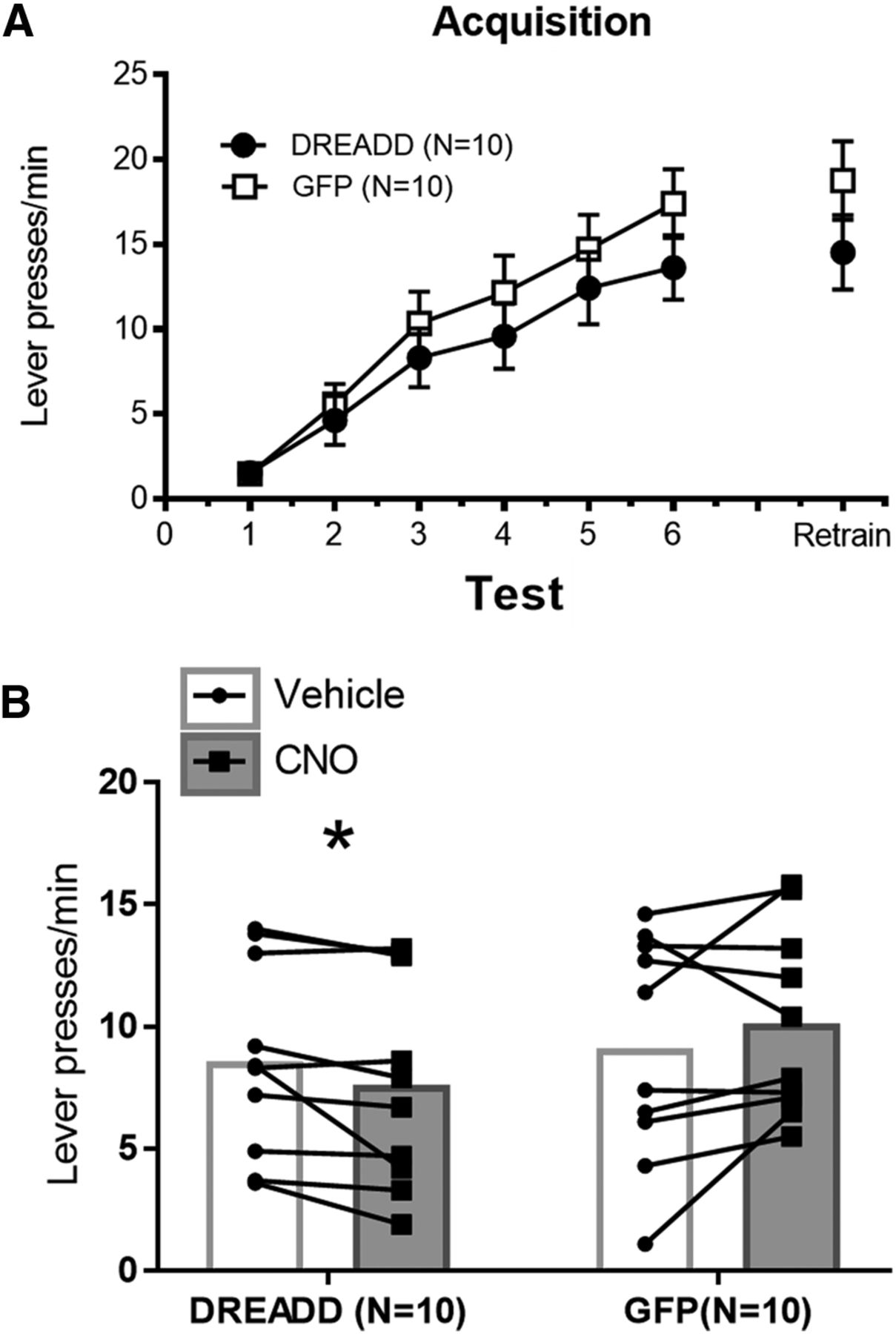
    A, Acquisition of lever-press response over six training sessions with one retraining session in between the two test sessions. Mean ± SEM. B, Test session results for rats that had received the DREADD or control (GFP) construct in the PL. CNO or vehicle was infused into the aDMS before the first test session, and rats received the opposite infusate before the second test session. Order of infusion was counterbalanced in each group; *p < 0.05.

  • Figure 2.
    • Download figure
    • Open in new tab
    • Download powerpoint
    Figure 2.

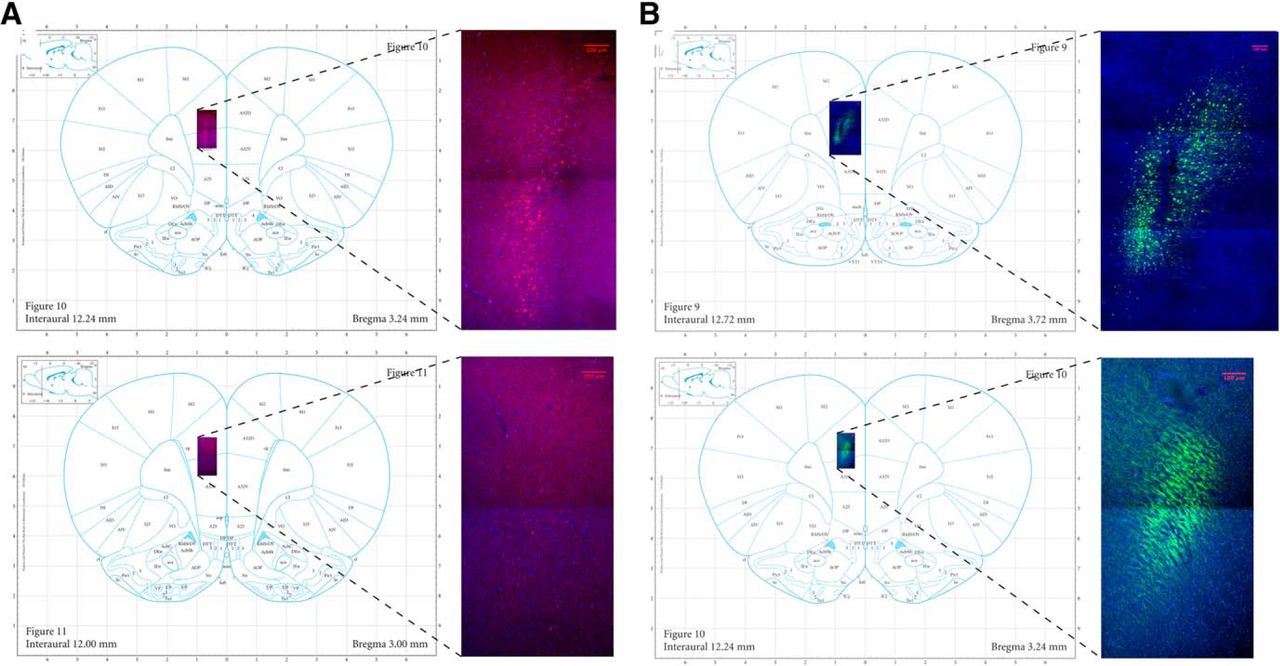
    A, Location (left panel) and representative images (right panels) of cell bodies expressing DREADDs-mCherry construct (left) or GFP control construct (right) in the PL (area 32) at 40×. Blue is DAPI nuclear stain. B, Location (left panel) and representative images (right panels) of axon terminals in aDMS expressing DREADDs-mCherry (left) or GFP (right) at 60×. Scale bars = 50 μm.

  • Figure 3.
    • Download figure
    • Open in new tab
    • Download powerpoint
    Figure 3.

    Location and representative DREADDs-mCherry (A) and GFP (B) spread in the PL (area 32) at 20×. Top panels are the infusion site and bottom panels are estimated posterior-most spread. Stitching was done with a 3% overlap in the images and each frame within the final image was 2048 × 2048 pixels. Scale bars = 100 μm.

  • Figure 4.
    • Download figure
    • Open in new tab
    • Download powerpoint
    Figure 4.

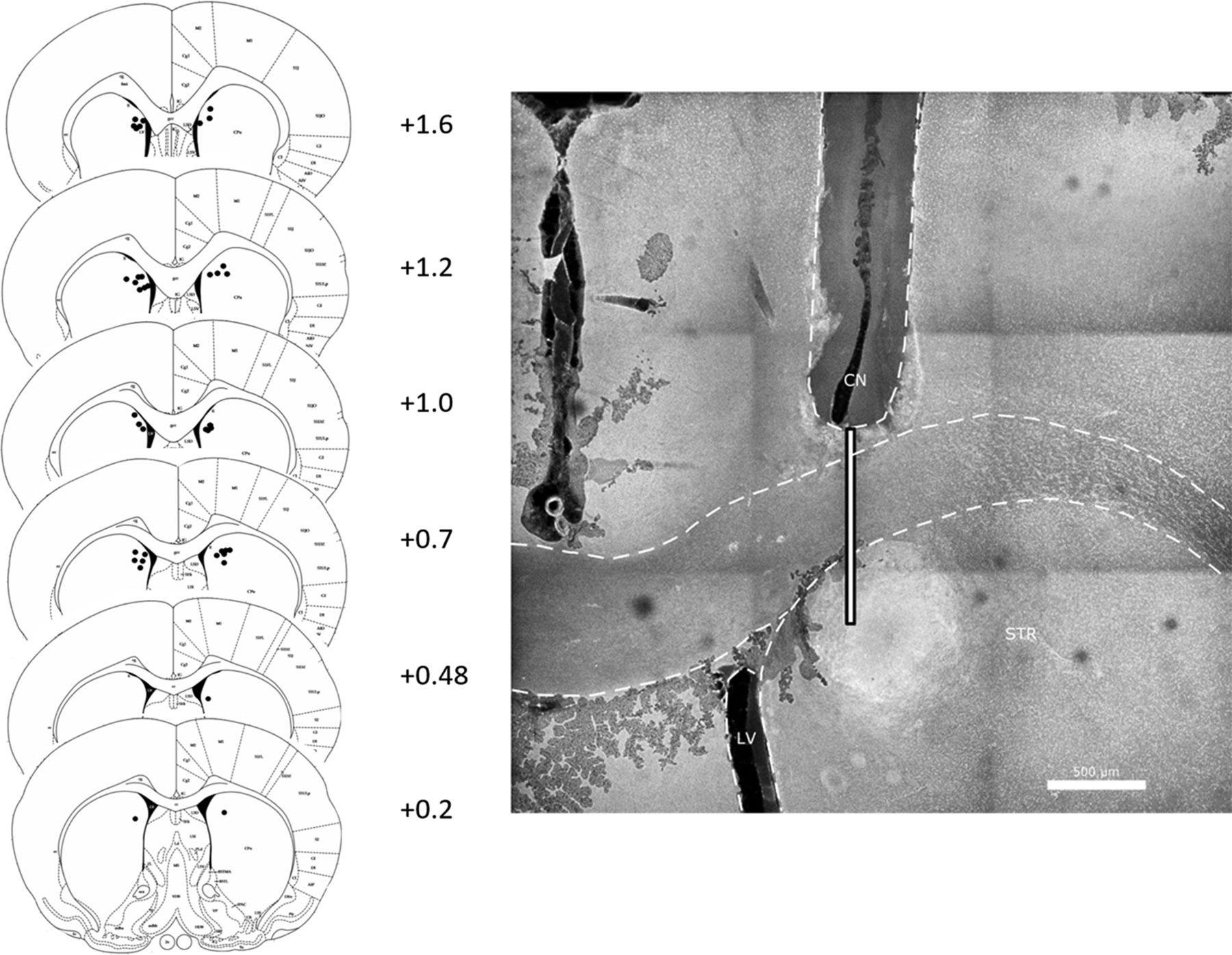
    Left panel, Infusion sites in aDMS. Numbers are anterior-posterior distance in mm from bregma. Right panel, Example cannula placement. Shown is the right hemisphere, and guide cannula (CN) track. Guide cannula tips were above the DMS. The thin white bar shows where the infusion cannula (which protruded 1 mm below the tip of the guide cannula) was. STR, striatum; LV, lateral ventricle. Scale bar = 500 μm.

  • Figure 5.
    • Download figure
    • Open in new tab
    • Download powerpoint
    Figure 5.

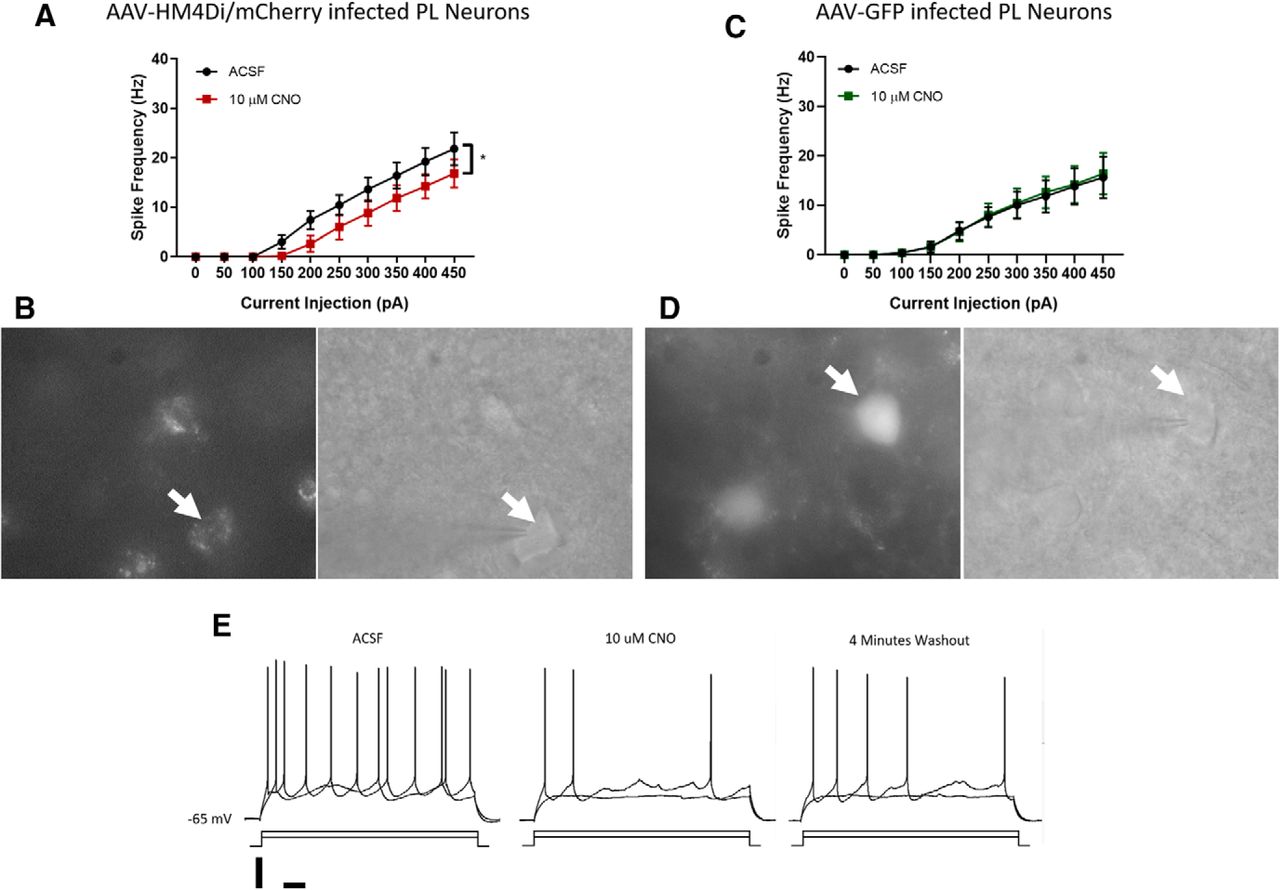
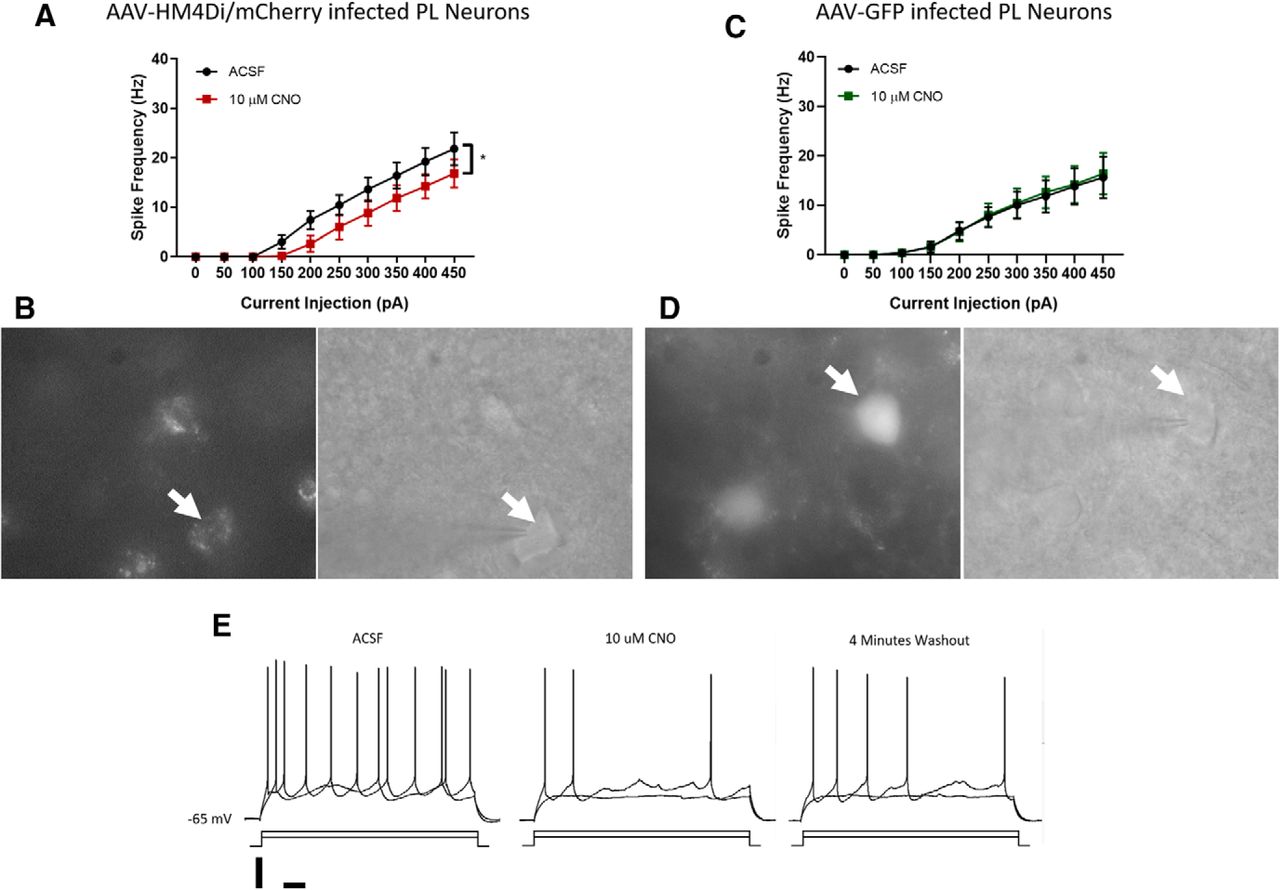
    A, Excitability curve shows spikes elicited to progressively larger current injection of DREADDs-mCherry-expressing PL pyramidal cells before and after CNO (10 μM) exposure. B, Example image of DREADDs-mCherry-expressing PL pyramidal cell in fluorescent (left) and infrared (right). C, Excitability curve shows spikes elicited to progressively larger current injection of GFP-expressing PL pyramidal cells before and after CNO (10 μM) exposure. D, Example image of GFP-expressing PL pyramidal cell in fluorescent (left) and infrared (right). E, Example trace of DREADDs-expressing PL neuron; 4 min of CNO exposure caused a reduction in spike frequency to current injection compared to baseline, while removal of CNO from the bath caused a partial recovery of spike frequency. Scale bars = 20 mV and 100 ms, and stimulation was 250 and 350 pA for 1 s.

Tables

  • Figures
    • View popup
    Table 1.

    Data structure, type of test used to analyze the data, and observed power of key results

    Data structureType of testPower (Cohen’s d)
    aNormal distributionRepeated-measures ANOVAMain effect session: 1.784
    bNormal distributionRepeated-measures ANOVAInteraction (drug × vector): 0.247
    cNormal distributionPaired samples
    t test
    Main effect drug: 0.745
    dNormal distributionPaired samples
    t test
    Not significant
    eNormal distributionRepeated-measures ANOVAMain effect CNO: 0.388
    Interaction (drug × current): 0.262
    fNormal distributionPaired samples t testsMain effects current:
    200 pA: 1.204
    250 pA: 3.095
    300 pA: 2.807
Back to top

In this issue

eneuro: 6 (5)
eNeuro
Vol. 6, Issue 5
September/October 2019
  • Table of Contents
  • Index by author
  • Ed Board (PDF)
Email

Thank you for sharing this eNeuro article.

NOTE: We request your email address only to inform the recipient that it was you who recommended this article, and that it is not junk mail. We do not retain these email addresses.

Enter multiple addresses on separate lines or separate them with commas.
Chemogenetic Silencing of Prelimbic Cortex to Anterior Dorsomedial Striatum Projection Attenuates Operant Responding
(Your Name) has forwarded a page to you from eNeuro
(Your Name) thought you would be interested in this article in eNeuro.
CAPTCHA
This question is for testing whether or not you are a human visitor and to prevent automated spam submissions.
Print
View Full Page PDF
Citation Tools
Chemogenetic Silencing of Prelimbic Cortex to Anterior Dorsomedial Striatum Projection Attenuates Operant Responding
Megan L. Shipman, Gregory C. Johnson, Mark E. Bouton, John T. Green
eNeuro 11 September 2019, 6 (5) ENEURO.0125-19.2019; DOI: 10.1523/ENEURO.0125-19.2019

Citation Manager Formats

  • BibTeX
  • Bookends
  • EasyBib
  • EndNote (tagged)
  • EndNote 8 (xml)
  • Medlars
  • Mendeley
  • Papers
  • RefWorks Tagged
  • Ref Manager
  • RIS
  • Zotero
Respond to this article
Share
Chemogenetic Silencing of Prelimbic Cortex to Anterior Dorsomedial Striatum Projection Attenuates Operant Responding
Megan L. Shipman, Gregory C. Johnson, Mark E. Bouton, John T. Green
eNeuro 11 September 2019, 6 (5) ENEURO.0125-19.2019; DOI: 10.1523/ENEURO.0125-19.2019
Twitter logo Facebook logo Mendeley logo
  • Tweet Widget
  • Facebook Like
  • Google Plus One

Jump to section

  • Article
    • Abstract
    • Significance Statement
    • Introduction
    • Materials and Methods
    • Results
    • Discussion
    • Acknowledgments
    • Footnotes
    • References
    • Synthesis
    • Author Response
  • Figures & Data
  • Info & Metrics
  • eLetters
  • PDF

Keywords

  • action
  • dorsomedial striatum
  • DREADD
  • instrumental conditioning
  • operant conditioning
  • prelimbic cortex

Responses to this article

Respond to this article

Jump to comment:

No eLetters have been published for this article.

Related Articles

Cited By...

More in this TOC Section

New Research

  • A Very Fast Time Scale of Human Motor Adaptation: Within Movement Adjustments of Internal Representations during Reaching
  • TrkB Signaling Influences Gene Expression in Cortistatin-Expressing Interneurons
  • Optogenetic Activation of β-Endorphin Terminals in the Medial Preoptic Nucleus Regulates Female Sexual Receptivity
Show more New Research

Cognition and Behavior

  • Pairing mouse social and aversive stimuli across sexes does not produce social aversion in females
  • In-vivo analysis of medial perforant path-evoked excitation and inhibition in dentate granule cells
  • Altered Dopamine Signaling in Extinction-Deficient Mice
Show more Cognition and Behavior

Subjects

  • Cognition and Behavior
  • Home
  • Alerts
  • Follow SFN on BlueSky
  • Visit Society for Neuroscience on Facebook
  • Follow Society for Neuroscience on Twitter
  • Follow Society for Neuroscience on LinkedIn
  • Visit Society for Neuroscience on Youtube
  • Follow our RSS feeds

Content

  • Early Release
  • Current Issue
  • Latest Articles
  • Issue Archive
  • Blog
  • Browse by Topic

Information

  • For Authors
  • For the Media

About

  • About the Journal
  • Editorial Board
  • Privacy Notice
  • Contact
  • Feedback
(eNeuro logo)
(SfN logo)

Copyright © 2025 by the Society for Neuroscience.
eNeuro eISSN: 2373-2822

The ideas and opinions expressed in eNeuro do not necessarily reflect those of SfN or the eNeuro Editorial Board. Publication of an advertisement or other product mention in eNeuro should not be construed as an endorsement of the manufacturer’s claims. SfN does not assume any responsibility for any injury and/or damage to persons or property arising from or related to any use of any material contained in eNeuro.