


Article Figures & Data
Figures
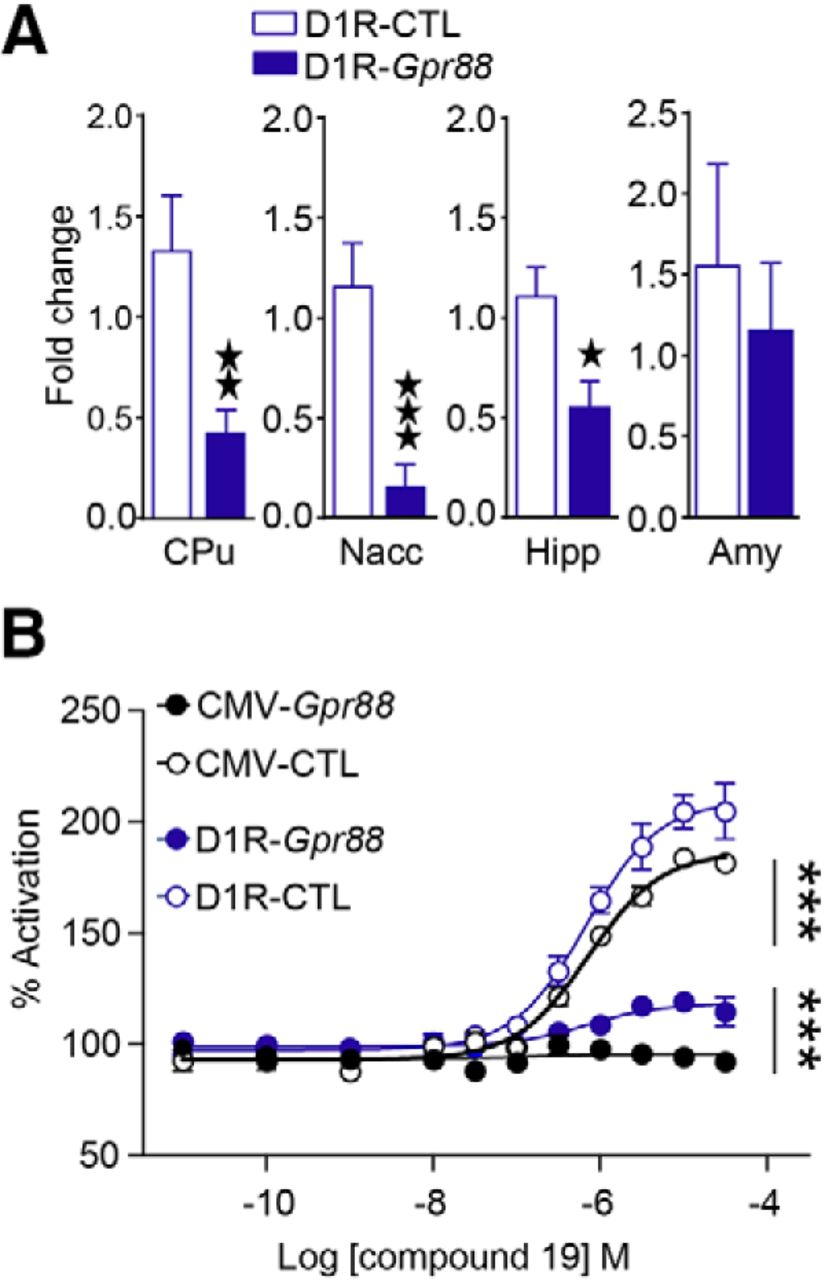
- Figure 1.
GPR88 agonist-induced activation and mRNA levels in D1R-Gpr88 mice. We measured levels of Gpr88 mRNA in D1R-CTL and D1R-Gpr88 mice (A) and show a significant reduction of GPR88 expression in the CPu, Nacc, hippocampus (Hipp), and amygdala (Amy). We also performed GPR88-mediated [35S]-GTPγS assay (B) and show that protein activation was totally and partially abolished in the striatum of CMV-Gpr88 and D1R-Gpr88 mice, respectively. Two (CMV-Gpr88 and control mice) and three (D1R-Gpr88 and control mice) membrane preparations were used per genotype. Data are presented as mean ± SEM. A, CPu: n = 9 D1R-CTL; n = 9 D1R-Gpr88; Nacc: n = 8 D1R-CTL; n = 7 D1R-Gpr88; Hipp: n = 9 D1R-CTL; n = 7 D1R-Gpr88; Amy: n = 6 D1R-CTL; n = 7 D1R-Gpr88; two black stars p < 0.01; three black stars p < 0.001 (Welch’s t test). B, n = 3 D1R-CTL; n = 3 D1R-Gpr88; n = 2 CMV-Gpr88 and n = 2 CMV-CTL. Three text stars p < 0.001 Tukey’s multiple comparisons of D1R-CTL or CMV-CTL versus D1R-Gpr88 and CMV-Gpr88 versus D1R-Gpr88.
- Figure 2.
Molecular characterization of conditional D1R-Gpr88 mice. Gpr88, Drd1a and Drd2 mRNA expression in the CPu of D1R-CTL (left panels) and D1R-Gpr88 (right panels) mice using triple fluorescent in situ hybridization (A). Gpr88 is labeled in green (FITC), Drd1a (left panels) in red (TRITC) and Drd2 (right panels) in red (Cy5). In D1R-CTL animals, Gpr88 mRNA colocalizes with both Drd2 and Drd1a mRNA. In contrast, Drd2 but not Drd1a colocalize with Gpr88 mRNA in D1R-Gpr88 mice. White and yellow arrows indicate examples of Drd1a-positive and Drd2-positive cells, respectively. DAPI staining (blue) was used to label all cells nuclei. Quantification of Gpr88/Drd2 (red) and Gpr88/Drd1a (blue) mRNA co-expression in the CPu and Nacc (B) of D1R-Gpr88 and control mice (n = 3/genotype). Colocalization of Gpr88 and Drd1a mRNA was significantly decreased in the CPu and Nacc of D1R-Gpr88 mice compared to control littermates (Sidak’s multiple comparison; p < 0.0001). Percentage of co-expression was calculated based on the total number of Gpr88-positive cells counted [(number Gpr88-expressing cells co-expressing Drd1a or Drd2 × 100)/total number of Gpr88-expressing cells]. Data are presented as mean ± SEM. B, n = 3 D1R-CTL; n = 3 D1R-Gpr88. Text stars: three stars p < 0.001 (Sidak’s multiple comparison of Gpr88/Drd1a co-expression between genotypes).
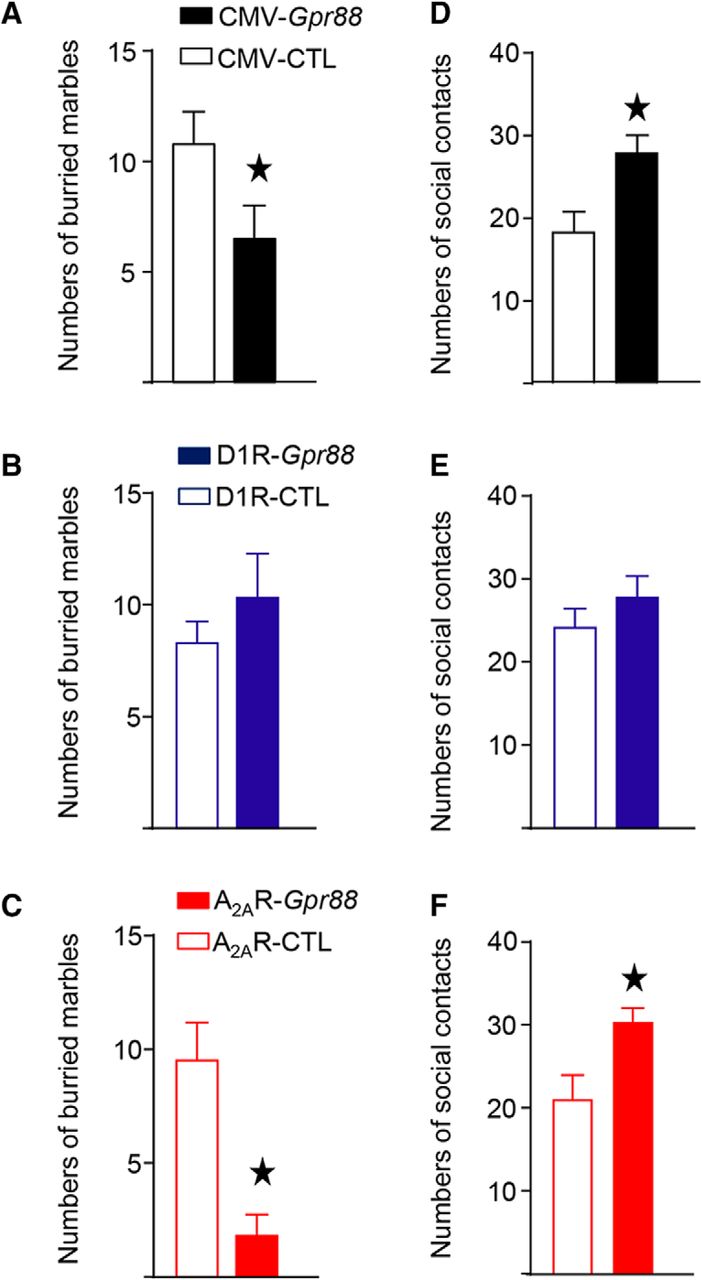
- Figure 3.
CMV-Gpr88 and A2AR-Gpr88 but not D1R-Gpr88 mice show altered defensive burying and social behavior. When placed in the presence of 20 marbles CMV-Gpr88 (A) and A2AR-Gpr88 (C) mice buried less marbles than control animals. D1R-Gpr88 mice (B) show similar numbers of buried marbles compared to control animals. To test social behaviors all mice where left in the presence of a naive wild-type congener and nose contact was counted. Once again, both CMV-Gpr88 (D) and A2AR-Gpr88 (F) mice but not D1R-Gpr88 mice (E) showed increased number of nose contacts compared to their littermates. Data are represented as mean ± SEM. A, D, n = 8 CMV-CTL, n = 10 CMV-Gpr88. B, E, N = 14 D1R-CTL, N = 10 D1R-Gpr88. C, F, n = 10 A2AR-CTL; n = 10 A2AR-Gpr88. Black stars: one star p < 0.05 (Welch’s t test).
- Figure 4.
Locomotor activity is increased in A2AR-Gpr88 mice whereas D1R-Gpr88 mice show lack of locomotor habituation. When placed individually in a dimly lit open field for 30-min daily sessions during 5 d, both CMV-Gpr88 (A) and A2AR-Gpr88 (C) but not D1R-Gpr88 (B) mice traveled a longer distance then their control littermates. D1R-Gpr88 mice, however, present similar total locomotion when compared to their control littermates (B). When comparing locomotion between the first (1) and last session (5), CMV-Gpr88 mice, in contrast to CMV-CTL, traveled a longer distance in the last compared to the first day. In contrast to their control littermates, D1R-Gpr88 mice show similar locomotion in the first and last open field session. Regardless of their hyperlocomotion, A2AR-Gpr88 mice habituated to the open field presenting decreased overall locomotion in the last test session. Line graphs show the distance traveled (cm) in 5-min bins over a 30-min session. Bar graphs show the average total distance traveled (cm) over the 30-min sessions period. Data are represented as mean ± SEM. A, n = 21 CMV-CTL; n = 21 CMV-Gpr88. B, N = 13 D1R-CTL, N = 12 D1R-Gpr88. C, n = 17 A2AR-CTL; n = 10 A2AR-Gpr88. Open stars: one star p < 0.05; two stars p < 0.01 (RM two-way ANOVA).
- Figure 5.
CMV-Gpr88 and A2AR-Gpr88 gene deletion increases stereotypies. When placed in an open field for 30 min (day 1), CMV-Gpr88 (A) and A2AR-Gpr88 (C) present increased number and duration of stereotypies. D1R-Gpr88 mice (B), however, show no difference in the number or time spent in stereotypies when compared to their control littermates. Data are represented as mean ± SEM. A, n = 21 CMV-CTL; n = 21 CMV-Gpr88. B, N = 13 D1R-CTL, N = 12 D1R-Gpr88. C, n = 17 A2AR-CTL; n = 10 A2AR-Gpr88. black stars: one star p < 0.05; two stars p < 0.01 (Student’s t test).
- Figure 6.
Motor coordination deficits in A2AR-Gpr88 mice and motor skill learning deficits in D1R-Gpr88 KO mice. Mice where tested on a rotating rod for four daily trials lasting 6 d. Overall (left panel), CMV-Gpr88 (A), D1R-Gpr88 (B), and A2AR-Gpr88 (C) mice show decreased latency to fall form the rod. When selectively analyzing the first and last training session (right panel), we observe that CMV-Gpr88 and A2AR-Gpr88 mice presented motor coordination deficits as soon as the first session which is not present in D1R-Gpr88. In the last session, however, CMV-Gpr88 and D1R-Gpr88 both present a significantly decreased time on the rod when compared to control mice, whereas A2AR-Gpr88 mice present no significant difference in the time spent on the rod when compared to their littermates. Data are represented as mean ± SEM. A, n = 21 CMV-CTL; n = 21 CMV-Gpr88. B, N = 13 D1R-CTL, N = 12 D1R-Gpr88. C, n = 17 A2AR-CTL; n = 10 A2AR-Gpr88. Open stars: one star p < 0.05; two stars p < 0.01; three stars p < 0.001 (RM two-way ANOVA). Text stars: three stars p < 0.001; one star p < 0.05 (Sidak’s multiple comparison).




Tables
ANOVA t test Assay Mouse line Number Figure Genotype effect Cell type/time/treatment Interaction RT-qPCR D1R-Gpr88 N = 9 D1R-CTL; N = 9 D1R-Gpr88 1A (CPu) t(16) = 3.01, p = 0.008 N = 8 D1R-CTL; N = 7 D1R-Gpr88 1A (Nacc) t(13) = 4.19, p = 0.001 N = 9 D1R-CTL; N = 7 D1R-Gpr88 1A (Hipp) t(14) = 2.7, p = 0.017 N = 6 D1R-CTL; N = 7 D1R-Gpr88 1A (Amy) t(11) = 0.53, p = 0. 6 [35S]-GTPgS binding CMV-Gpr88; D1R-Gpr88 N = 3 D1R-CTL, D1R-Gpr88, CMV-CTL, CMV-Gpr88 1B F(3,66) = 185.2; p < 0.0001 F(10,66) = 95.64; p < 0.0001 F(30,66) = 23.19; p < 0.0001 In situ hybridization/cell counting D1R-Gpr88 N = 3 D1R-CTL, N = 3 D1R-Gpr88 2B (CPu) F(1,134) = 0.4164; p = 0.5198 F(1,134) = 957.2; p < 0.0001 F(1,134) = 387.8; p < 0.0001 2B (Nacc) F(1,36) = 0.2597; p = 0.6134 F(1,36) = 204.3; p < 0.0001 F(1,36) = 97.83; p < 0.0001 Marble burying CMV-Gpr88 N = 9 CMV-CTL, N = 10 CMV-Gpr88 3A, left t(17) = 2.03, p = 0.059 D1R-Gpr88 N = 14 D1R-CTL, N = 10 D1R-Gpr88 3B, left t(22) = 1.002, p = 0.33 A2AR-Gpr88 N = 10 A2AR-CTL, N = 10 A2AR-Gpr88 3C, left t(18) = 4.01, p < 0.001 Nose contact in social interaction CMV-Gpr88 N = 8 CMV-CTL, N = 8 CMV-Gpr88 3D, right t(14) = 2.88, p = 0.012 D1R-Gpr88 N = 14 D1R-CTL, N = 8 D1R-Gpr88 3E, right t(20) = 2.57, p = 0.018 A2AR-Gpr88 N = 10 A2AR-CTL, N = 10 A2AR-Gpr88 3F, right t(18) = 2.06, p = 0.01 Open field (all sessions) CMV-Gpr88 N = 21 CMV-CTL, N = 21 CMV-Gpr88 4A, left F(1,40) = 4.357; p = 0.0425 F(4,180) = 4.419; p = 0.002 F(4,180) = 7.189; p < 0.0001 D1R-Gpr88 N = 13 D1R-CTL, N = 12 D1R-Gpr88 4B, left F(1,23) = 1.106; p = 0.3038 F(4,92) = 31.03; p < 0.0001 F(4,92) = 11.82; p < 0.0001 A2AR-Gpr88 N = 17 A2AR-CTL, N = 10 A2AR-Gpr88 4C, left F(1,25) = 8.004; p = 0.0091 F(4,100) = 43.28; p < 0.0001 F(4,100) = 3.939; p = 0.0052 Open field (sessions 1 and 5) CMV-Gpr88 N = 21 CMV-CTL, N = 21 CMV-Gpr88 4A, right F(1,80) = 4.93; p = 0.0292 F(1,80) = 1.25;p = 0.2679 F(1,80) = 8.94; p = 0.0037 D1R-Gpr88 N = 13 D1R-CTL, N = 12 D1R-Gpr88 4B, right F(1,46) = 0.78; p = 0.3811 F(1,46) = 26.75;p < 0.0001 F(1,46) = 11.01; p = 0.0018 A2AR-Gpr88 N = 17 A2AR-CTL, N = 10 A2AR-Gpr88 4C, right F(1,50) = 8.17; p = 0.0062 F(1,50) = 18.71; p < 0.0001 F(1,50) = 0.1479; p = 0.7021 Stereotypies CMV-Gpr88 N = 21 CMV-CTL, N = 21 CMV-Gpr88 5A Score: t(40) = 2.228; p = 0.0316Time: t(40) = 2.818; p = 0.0075 D1R-Gpr88 N = 13 D1R-CTL, N = 12 D1R-Gpr88 5B Score: t(23) = 1.156; p = 0.2594Time: t(23) = 0.7174; p = 0.4803 A2AR-Gpr88 N = 17 A2AR-CTL, N = 10 A2AR-Gpr88 5C Score: t(25) = 2.291; p = 0.0307Time: t(25) = 2.317; p = 0.0290 Rotarod (all sessions) CMV-Gpr88 N = 21 CMV-CTL, N = 21 CMV-Gpr88 6A, left F(1,40) = 17.73; p = 0.0001 F(23,920) = 13.49; p < 0.0001 F(23,920) = 3.159; p < 0.0001 D1R-Gpr88 N = 13 D1R-CTL, N = 12 D1R-Gpr88 6B, left F(1,23) = 8.759; p = 0.0070 F(23,529) = 10.09; p < 0.0001 F(23,529) = 7.607; p < 0.0001 A2AR-Gpr88 N = 17 A2AR-CTL, N = 10 A2AR-Gpr88 6C, left F(1,25) = 8.008; p = 0.0091 F(23,575) = 13.74; p < 0.0001 F(23,575) = 1.017; p = 0.4403 Rotarod (sessions 1 and 6) CMV-Gpr88 N = 21 CMV-CTL, N = 21 CMV-Gpr88 6A, right F(1,80) = 32.62; p < 0.0001 F(1,80) = 17.67 p < 0.0001 F(1,80) = 4.517; p = 0.0367 D1R-Gpr88 N = 13 D1R-CTL, N = 12 D1R-Gpr88 6B, right F(1,46) = 13.62; p = 0.0006 F(1,46) = 11.15; p = 0.0017 F(1,46) = 7.643; p = 0.0082 A2AR-Gpr88 N = 17 A2AR-CTL, N = 10 A2AR-Gpr88 6C, right F(1,50) = 8.067; p = 0.0065 F(1,50) = 16.31; p = 0.0002 F(1,50) = 1.299; p = 0.2598 - Table 2.
Summary of behavioral phenotypes observed in CMV-Gpr88, D1R-Gpr88, and A2AR-Gpr88 mice
CMV-Gpr88 D1R-Gpr88 A2AR-Gpr88 Marble burying ↓ ↔ ↓ Social interaction ↑ ↔ ↑ Open field Locomotion ↑ ↔ ↑ Habituation ↓ ↓ ↔ Stereotypies ↑ ↔ ↑ Rotarod Motor coordination ↓ ↔ ↓ Motor skill learning ↓ ↓ ↔
In this issue


