
Main menu

  • HOME
  • CONTENT
    • Early Release
    • Featured
    • Current Issue
    • Issue Archive
    • Blog
    • Collections
    • Podcast
  • TOPICS
    • Cognition and Behavior
    • Development
    • Disorders of the Nervous System
    • History, Teaching and Public Awareness
    • Integrative Systems
    • Neuronal Excitability
    • Novel Tools and Methods
    • Sensory and Motor Systems
  • ALERTS
  • FOR AUTHORS
  • ABOUT
    • Overview
    • Editorial Board
    • For the Media
    • Privacy Policy
    • Contact Us
    • Feedback
  • SUBMIT

User menu

Search

  • Advanced search
eNeuro
eNeuro

Advanced Search


  • HOME
  • CONTENT
    • Early Release
    • Featured
    • Current Issue
    • Issue Archive
    • Blog
    • Collections
    • Podcast
  • TOPICS
    • Cognition and Behavior
    • Development
    • Disorders of the Nervous System
    • History, Teaching and Public Awareness
    • Integrative Systems
    • Neuronal Excitability
    • Novel Tools and Methods
    • Sensory and Motor Systems
  • ALERTS
  • FOR AUTHORS
  • ABOUT
    • Overview
    • Editorial Board
    • For the Media
    • Privacy Policy
    • Contact Us
    • Feedback
  • SUBMIT
PreviousNext
Research ArticleNew Research, Cognition and Behavior

Contribution of FEF to Attentional Periodicity during Visual Search: A TMS Study

Laura Dugué, Alexy-Assaf Beck, Philippe Marque and Rufin VanRullen
eNeuro 7 June 2019, 6 (3) ENEURO.0357-18.2019; https://doi.org/10.1523/ENEURO.0357-18.2019
Laura Dugué
1Centre National de la Recherche Scientifique (CNRS), Unité Mixte de Recherche 8002, 75006 Paris, France
2Université Paris Descartes, Sorbonne Paris Cité, Integrative Neuroscience and Cognition Center, 75006 Paris, France
  • Find this author on Google Scholar
  • Find this author on PubMed
  • Search for this author on this site
  • ORCID record for Laura Dugué
Alexy-Assaf Beck
3Psychological Sciences Research Institute and Institute of Neuroscience, Université de Louvain, B-1348 Louvain-la-Neuve, Belgique
  • Find this author on Google Scholar
  • Find this author on PubMed
  • Search for this author on this site
Philippe Marque
4Médecine Physique et de Réadaption, 31059 Toulouse, France
  • Find this author on Google Scholar
  • Find this author on PubMed
  • Search for this author on this site
Rufin VanRullen
5CNRS, Unité Mixte de Recherche 5549, Faculté de Médecine de Purpan, 31052 Toulouse, France
6Université de Toulouse, Centre de Recherche Cerveau et Cognition, Université Paul Sabatier, 31052 Toulouse, France
  • Find this author on Google Scholar
  • Find this author on PubMed
  • Search for this author on this site
  • ORCID record for Rufin VanRullen
  • Article
  • Figures & Data
  • Info & Metrics
  • eLetters
  • PDF
Loading

Article Figures & Data

Figures

  • Tables
  • Figure 1.
    • Download figure
    • Open in new tab
    • Download powerpoint
    Figure 1.

    Experimental protocol. While participants performed a visual search (finding a T letter among L’s), they were stimulated over the right-FEF or the Vertex (control) with a double-pulse of TMS (25 ms interval) applied at random delays between 50 and 450 ms (50 ms increments) after the search array onset.

  • Figure 2.
    • Download figure
    • Open in new tab
    • Download powerpoint
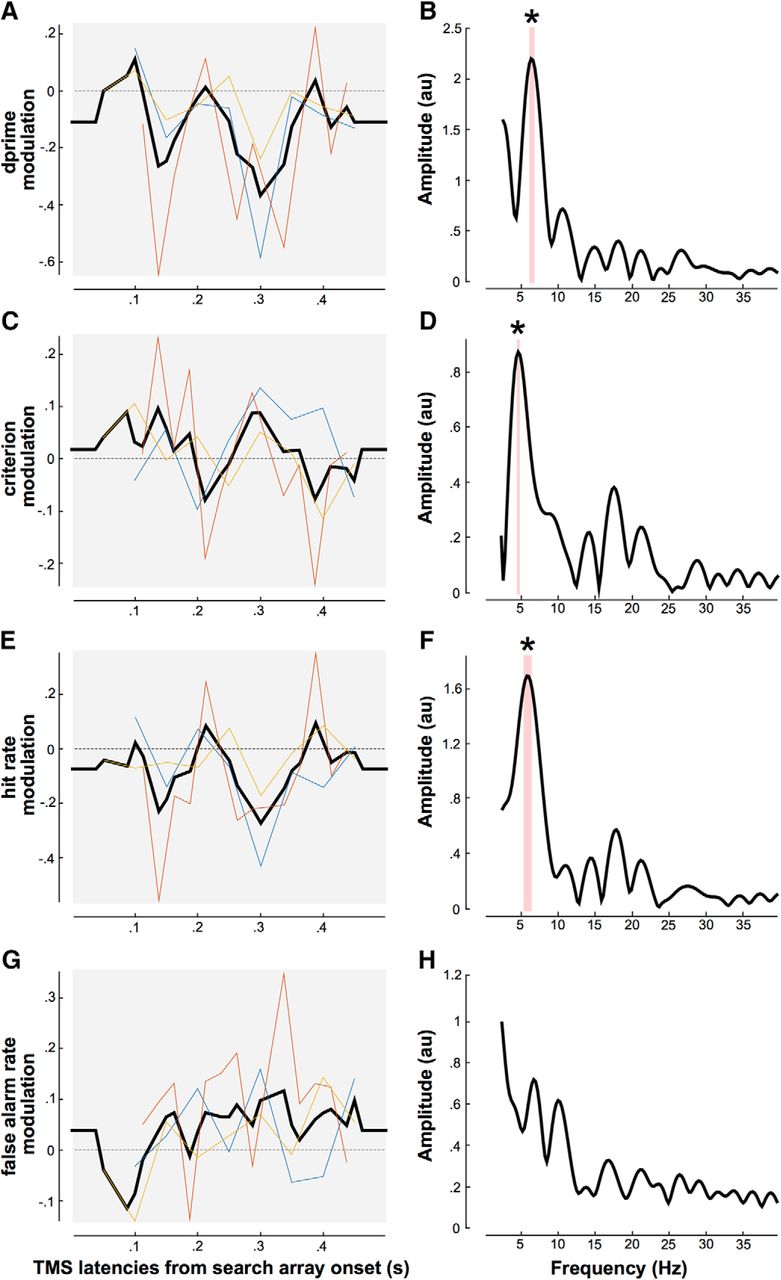
    Figure 2.

    TMS modulates attentional search periodically. A, D′ modulations (test–control condition) are represented as a function of TMS latencies from the search array onset. The color lines represent each individual study [yellow, current FEF study; blue, first V1 study (Dugué et al., 2011); red, second V1 study (Dugué et al., 2015a)]. The black line is the average across all three studies. B, Amplitude spectrum obtained by FFT decomposition of the averaged data across the three studies. The red shaded area represents the significant spectral components and the *peak at 6.3 Hz (p < 0.05). C, E, G, represent criterion, hit rates, and false-alarm rates modulations, respectively (same representation as in A). D, F, H, represent their corresponding amplitude spectra. The red shaded area represents the significant spectral components and the *peaks at 6 Hz and 18 Hz for criterion and 5.8 Hz for hit rates (p < 0.05).

  • Figure 3.
    • Download figure
    • Open in new tab
    • Download powerpoint
    Figure 3.

    Attentional periodicity in V1 and FEF. For each study, the graphs in the left column represent the amplitude spectra obtained by FFT decomposition of the averaged performance (as per hit rates modulation; see Materials and Methods) across participants. Note the distinct frequency axis in the middle, because of the increased time resolution (and corresponding Nyquist frequency) in that study. The bottom, dashed black line represents the amplitude spectrum of the surrogate distribution. The red shaded area represents the significant spectral components and the *peaks at 6 Hz and 18 Hz for the second V1 study and 6.5 Hz for the FEF study (p < 0.05). The right column represents the phase distribution of the peak frequency across participants. P values are obtained from Rayleigh test for non-uniform distribution of circular data.

Tables

  • Figures
    • View popup
    Table 1.

    TMS studies investigating the role of attention during difficult, visual search tasks

    Stimulation parameters
    StudyBehavioral manipulationTest regionControlType of stimulationStimulation intensitynConclusions
    Ashbridge (1997)Feature: color
    Conjunction:
    color-orientation
    R-PCNo-TMSSingle-pulse at 11 possible delays (from 0 to 200 ms)80% MSI5R-PC involved in conjunction but not feature tasks
    Walsh et al. (1998)Conjunction:
    color-orientation
    R-PCNo-TMSSingle-pulse at 11 possible delays (from 0 to 200 ms)80% MSI3R-PC involved in novel but not learned conjunction tasks
    Juan and Walsh (2003)Feature: color
    Conjunction:
    color-orientation
    V1/V2No-TMS10 Hz for 500 ms and
    Double-pulse (40 or 100 ms interval) at 6 possible delays
    65% MSI8, 6, & 6V1 involved at late delays (feedback) during conjunction but not feature tasks
    Muggleton et al. (2003)Feature: color
    Conjunction:
    color-orientation
    R-FEF
    L-FEF
    Vertex
    V5
    10 Hz for 500 ms65% MSI5FEF is involved in visual selection, in the absence of saccade
    Ellison et al. (2004)Feature: orientation
    Conjunction:
    color-orientation
    R-PPC
    R-STG
    SHAM on R-PPC or R-STGR-PPC: 10 Hz for 500 ms
    R-STG: 4 Hz for 500 ms
    65% MSI5R-PPC involved in conjunction and R-STG in feature
    O’Shea et al. (2004)Conjunction:
    color-orientation
    R-FEFVertex
    V5
    Double-pulse (40 ms interval) at 5 possible delays (from 0 to 120 ms), 40 ms before mask onsetFEF & Vertex: 65% MSI
    V5: 110% phosphene threshold
    12FEF is involved in visual discrimination, in the absence of saccade
    Fuggetta et al. (2006)Conjunction:
    color-orientation
    R-PPCVertexSingle-pulse 100 ms after stimulus onset85% MSI on average7R-PPC involved in conjunction task
    Ellison et al. (2007)Conjunction:
    color-orientation and
    motion-orientation
    R-PPC
    R-V5
    SHAM on R-PPC or
    R-V5
    10 Hz for 500 ms65% MSI7R-PPC involved in color-orientation
    R-V5 in motion-orientation
    Kalla et al. (2008)Conjunction:
    color-orientation
    R-FEF
    R-PPC
    No-TMSDouble-pulse (40 ms interval) at 5 possible delays (from 0 to 200 ms)60% MSI9R-FEF involved earlier than R-PPC in conjunction tasks
    Muggleton et al. (2008)Feature: color
    Conjunction:
    color-orientation
    R-AG
    L-AG
    Vertex
    No-TMS
    10 Hz for 500 ms65% MSI8R-AG but not L-AG involved in conjunction but not feature tasks
    Schindler et al. (2008)Feature: orientation
    Conjunction:
    color-orientation
    R-PPC
    R-STG
    SHAM on R-PPC or R-STGR-PPC: 10 Hz for 500 ms
    R-STG: 4 Hz for 500 ms
    65% MSI5R-STG processes the left part of the search array presented contralateral
    R-PPC involved for left visual field when full-fields array
    Kalla et al. (2009)Feature: color
    Conjunction:
    color-orientation
    DLPFCVertex
    V5
    TBS: 50 Hz bursts at 5 Hz40% MSI12DLPCF involved in conjunction but not feature tasks
    Dugué et al. (2011)Conjunction:
    L vs T and L vs +
    V1/V2Stimulus at non-retinotopic locationDouble-pulse (25 ms interval) at 8 possible delays (from 100 to 450 ms)55% MSI11V1 involved at late delays (feedback) during conjunction but not feature tasks
    Lane et al. (2011)Feature:
    shape
    Conjunction:
    color-orientation
    R-PPCSHAM on R-PPC10 Hz for 500 ms65% MSI12R-PPC involved in conjunction and feature tasks when participants have to point to the target, but only conjunction when button press response
    Muggleton et al. (2011)Conjunction:
    color-orientation
    R-FEF
    L-PPC
    No-TMS10 Hz for 500 ms60% MSI8L-PPC involved when manual motor response required
    Dugué et al. (2015a)Conjunction:
    L vs T and L vs +
    V1/V2Stimulus at non-retinotopic locationDouble-pulse: one at 312.5 ms and one 13 possible delays (from 112.5 to 437.5 ms)55% MSI10V1 involved periodically during conjunction but not feature tasks (∼6 Hz)
    Yan et al. (2016)Feature:
    color
    Conjunction:
    orientation of triangles
    R-DLPFC
    R-PPC
    Vertex on another group of participantsDouble-pulse (100 ms interval) 200 ms before search array onset51% MSI on average16DLPFC is involved in the conjunction search, while the PPC is involved in the feature search
    Present studyConjunction:
    L vs T
    R-FEFVertexDouble-pulse (25 ms interval) at 9 possible delays (from 50 to 450 ms)52% MSI on average21FEF involved periodically during a conjunction task (∼6 Hz)
    • For each study we report the behavioral manipulation, the stimulation parameters: tested region (R, Right; L, Left; V5, MT area; PC, parietal cortex; PPC, posterior parietal cortex; AG, angular gyrus, part of the PPC; STG, superior temporal gyrus; DLPFC, dorsolateral prefrontal cortex, right hemisphere), control condition, type of stimulation (TBS, theta burst stimulation; note: otherwise mentioned, the reference is the onset of the visual stimuli) and the intensity of the stimulation (MSI, maximum output stimulation intensity of the TMS machine), the amount of participants for which data were analyzed (n), and finally, the authors’ conclusions.

Back to top

In this issue

eneuro: 6 (3)
eNeuro
Vol. 6, Issue 3
May/June 2019
  • Table of Contents
  • Index by author
  • Ed Board (PDF)
Email

Thank you for sharing this eNeuro article.

NOTE: We request your email address only to inform the recipient that it was you who recommended this article, and that it is not junk mail. We do not retain these email addresses.

Enter multiple addresses on separate lines or separate them with commas.
Contribution of FEF to Attentional Periodicity during Visual Search: A TMS Study
(Your Name) has forwarded a page to you from eNeuro
(Your Name) thought you would be interested in this article in eNeuro.
CAPTCHA
This question is for testing whether or not you are a human visitor and to prevent automated spam submissions.
Print
View Full Page PDF
Citation Tools
Contribution of FEF to Attentional Periodicity during Visual Search: A TMS Study
Laura Dugué, Alexy-Assaf Beck, Philippe Marque, Rufin VanRullen
eNeuro 7 June 2019, 6 (3) ENEURO.0357-18.2019; DOI: 10.1523/ENEURO.0357-18.2019

Citation Manager Formats

  • BibTeX
  • Bookends
  • EasyBib
  • EndNote (tagged)
  • EndNote 8 (xml)
  • Medlars
  • Mendeley
  • Papers
  • RefWorks Tagged
  • Ref Manager
  • RIS
  • Zotero
Respond to this article
Share
Contribution of FEF to Attentional Periodicity during Visual Search: A TMS Study
Laura Dugué, Alexy-Assaf Beck, Philippe Marque, Rufin VanRullen
eNeuro 7 June 2019, 6 (3) ENEURO.0357-18.2019; DOI: 10.1523/ENEURO.0357-18.2019
Twitter logo Facebook logo Mendeley logo
  • Tweet Widget
  • Facebook Like
  • Google Plus One

Jump to section

  • Article
    • Abstract
    • Significance Statement
    • Introduction
    • Materials and Methods
    • Results
    • Discussion
    • Footnotes
    • References
    • Synthesis
  • Figures & Data
  • Info & Metrics
  • eLetters
  • PDF

Keywords

  • FEF
  • periodicity
  • theta
  • TMS
  • V1
  • visual search

Responses to this article

Respond to this article

Jump to comment:

No eLetters have been published for this article.

Related Articles

Cited By...

More in this TOC Section

New Research

  • A Very Fast Time Scale of Human Motor Adaptation: Within Movement Adjustments of Internal Representations during Reaching
  • TrkB Signaling Influences Gene Expression in Cortistatin-Expressing Interneurons
  • Optogenetic Activation of β-Endorphin Terminals in the Medial Preoptic Nucleus Regulates Female Sexual Receptivity
Show more New Research

Cognition and Behavior

  • Disrupting motor cortical regional activity during motor sequence skill training impairs human motor visuomotor skill acquisition and learning that is not sequence-specific
  • Whole-Brain Mapping of Neuronal Activity Associated with Vocal Socialization Behaviors in Adult Mice
  • Effect of Functionally Selective Dopamine D1 Receptor Agonists on Complex Cognitive Processes in a Rodent Touchscreen Operant Chamber Task
Show more Cognition and Behavior

Subjects

  • Cognition and Behavior
  • Home
  • Alerts
  • Follow SFN on BlueSky
  • Visit Society for Neuroscience on Facebook
  • Follow Society for Neuroscience on Twitter
  • Follow Society for Neuroscience on LinkedIn
  • Visit Society for Neuroscience on Youtube
  • Follow our RSS feeds

Content

  • Early Release
  • Current Issue
  • Latest Articles
  • Issue Archive
  • Blog
  • Browse by Topic

Information

  • For Authors
  • For the Media

About

  • About the Journal
  • Editorial Board
  • Privacy Notice
  • Contact
  • Feedback
(eNeuro logo)
(SfN logo)

Copyright © 2026 by the Society for Neuroscience.
eNeuro eISSN: 2373-2822

The ideas and opinions expressed in eNeuro do not necessarily reflect those of SfN or the eNeuro Editorial Board. Publication of an advertisement or other product mention in eNeuro should not be construed as an endorsement of the manufacturer’s claims. SfN does not assume any responsibility for any injury and/or damage to persons or property arising from or related to any use of any material contained in eNeuro.