Main menu

  • HOME
  • CONTENT
    • Early Release
    • Featured
    • Current Issue
    • Issue Archive
    • Blog
    • Collections
    • Podcast
  • TOPICS
    • Cognition and Behavior
    • Development
    • Disorders of the Nervous System
    • History, Teaching and Public Awareness
    • Integrative Systems
    • Neuronal Excitability
    • Novel Tools and Methods
    • Sensory and Motor Systems
  • ALERTS
  • FOR AUTHORS
  • ABOUT
    • Overview
    • Editorial Board
    • For the Media
    • Privacy Policy
    • Contact Us
    • Feedback
  • SUBMIT

User menu

Search

  • Advanced search
eNeuro
eNeuro

Advanced Search


  • HOME
  • CONTENT
    • Early Release
    • Featured
    • Current Issue
    • Issue Archive
    • Blog
    • Collections
    • Podcast
  • TOPICS
    • Cognition and Behavior
    • Development
    • Disorders of the Nervous System
    • History, Teaching and Public Awareness
    • Integrative Systems
    • Neuronal Excitability
    • Novel Tools and Methods
    • Sensory and Motor Systems
  • ALERTS
  • FOR AUTHORS
  • ABOUT
    • Overview
    • Editorial Board
    • For the Media
    • Privacy Policy
    • Contact Us
    • Feedback
  • SUBMIT
PreviousNext
Research ArticleNew Research, Disorders of the Nervous System

Chronic Alcohol Drinking Slows Brain Development in Adolescent and Young Adult Nonhuman Primates

Tatiana A. Shnitko, Zheng Liu, Xiaojie Wang, Kathleen A. Grant and Christopher D. Kroenke
eNeuro 1 April 2019, 6 (2) ENEURO.0044-19.2019; https://doi.org/10.1523/ENEURO.0044-19.2019
Tatiana A. Shnitko
1Division of Neuroscience, Oregon National Primate Research Center, Beaverton, Oregon 97006
2Advanced Imaging Research Center, Oregon Health & Science University, Portland, Oregon 97239
  • Find this author on Google Scholar
  • Find this author on PubMed
  • Search for this author on this site
  • ORCID record for Tatiana A. Shnitko
Zheng Liu
1Division of Neuroscience, Oregon National Primate Research Center, Beaverton, Oregon 97006
2Advanced Imaging Research Center, Oregon Health & Science University, Portland, Oregon 97239
  • Find this author on Google Scholar
  • Find this author on PubMed
  • Search for this author on this site
Xiaojie Wang
1Division of Neuroscience, Oregon National Primate Research Center, Beaverton, Oregon 97006
2Advanced Imaging Research Center, Oregon Health & Science University, Portland, Oregon 97239
  • Find this author on Google Scholar
  • Find this author on PubMed
  • Search for this author on this site
  • ORCID record for Xiaojie Wang
Kathleen A. Grant
1Division of Neuroscience, Oregon National Primate Research Center, Beaverton, Oregon 97006
3Department of Behavioral Neuroscience, Oregon Health & Science University, Portland, Oregon 97239
  • Find this author on Google Scholar
  • Find this author on PubMed
  • Search for this author on this site
  • ORCID record for Kathleen A. Grant
Christopher D. Kroenke
1Division of Neuroscience, Oregon National Primate Research Center, Beaverton, Oregon 97006
2Advanced Imaging Research Center, Oregon Health & Science University, Portland, Oregon 97239
3Department of Behavioral Neuroscience, Oregon Health & Science University, Portland, Oregon 97239
  • Find this author on Google Scholar
  • Find this author on PubMed
  • Search for this author on this site
  • ORCID record for Christopher D. Kroenke
  • Article
  • Figures & Data
  • Info & Metrics
  • eLetters
  • PDF
Loading

Article Figures & Data

Figures

  • Tables
  • Figure 1.
    • Download figure
    • Open in new tab
    • Download powerpoint
    Figure 1.

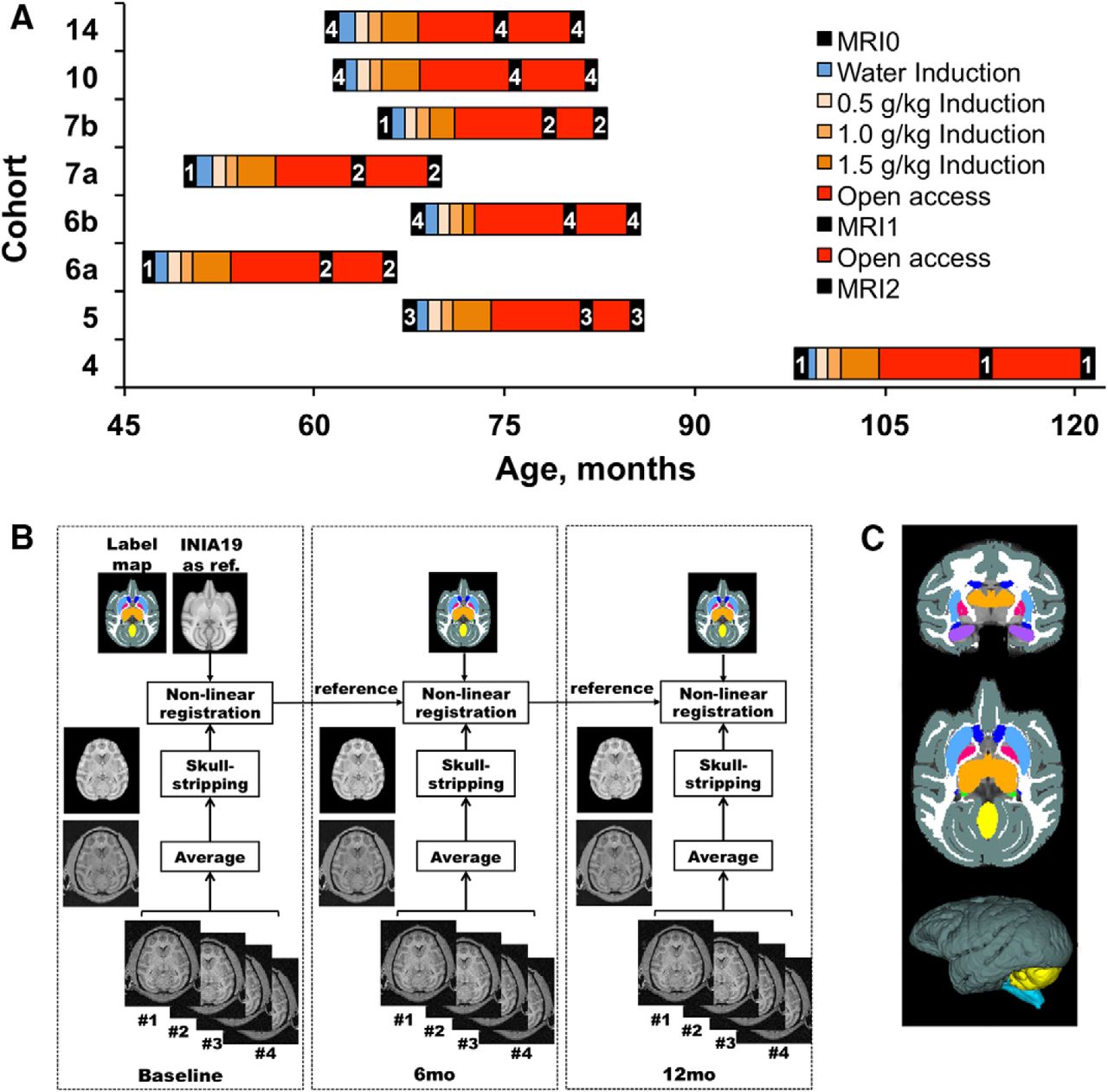
    A–C, Schematic representations of experimental timeline (A) and MRI data processing (B, C). A, The timelines of the experiment are shown for each of eight cohorts of subjects admitted to and completed the study at different periods from 2008 to 2017. As indicated in the legend, the black squares represent an MRI sessions in the timeline of the experiment, and the numbers within them indicate an MRI protocol used at the time. B, The MR image processing is described in detail in the text (see Materials and Methods). C, Representation of the brain map of the monkey used for segmentation of ROIs in individual subjects (top, coronal; middle, axial; bottom, 3D image showing cortical surface, the cerebellum, and brainstem). The ROIs were labeled in INIA19 template brain.

  • Figure 2.
    • Download figure
    • Open in new tab
    • Download powerpoint
    Figure 2.

    Age-dependent brain growth in the nonhuman primates. A–C, Plots of individual brain volume changes across age in CTR (n = 16), NHD (n = 19), and HD (n = 26) NHPs. The VB of each subject was measured three times, as depicted by empty circles. An individual regression line is drawn across the three VB values for each subject. D, Average VB-by-age linear regression estimated for CTRs, NHDs, and HDs with 95% confidence interval depicted by the shaded area around the line. E, Correlation between age-dependent brain growth (βi) and individual daily ethanol intake averaged across 12 months of drinking. The βi value is based on the slope of the individual regression line, as shown in A–C. The ethanol intake is estimated based on daily consumption of 4% (w/v) ethanol solution averaged across ∼372 drinking sessions with the exception of the induction period (rs = 0-0.41, p < 0.01).

  • Figure 3.
    • Download figure
    • Open in new tab
    • Download powerpoint
    Figure 3.

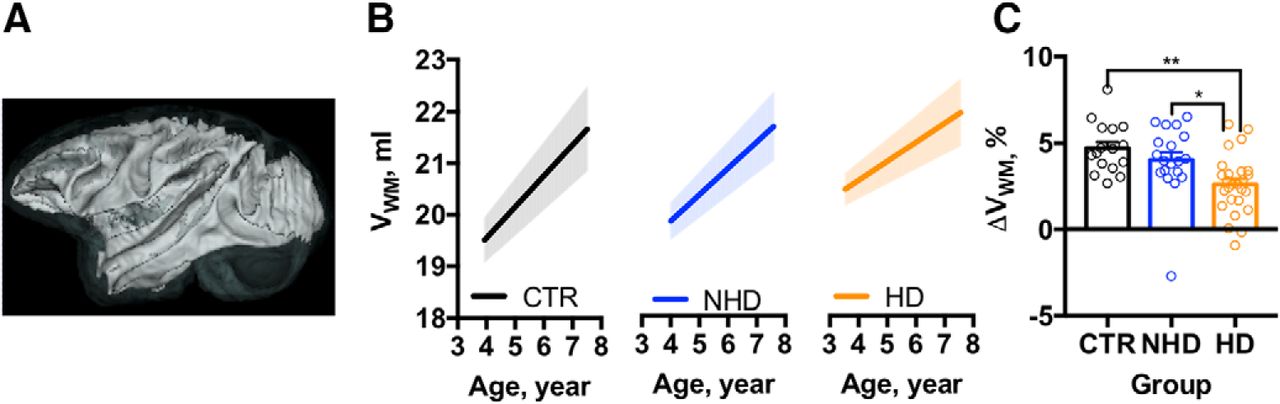
    Heavy ethanol intake reduces the rate of the white matter growth in NHP brain. A, 3D representation of the cortical white matter in the brain. B, The estimated rate of white matter growth in the control, non-heavy-drinking, and heavy-drinking NHPs. The shadows above and below the regression lines depict the 95% confidence interval. C, The effect of chronic ethanol use on the average change in white matter volume occurred in three groups of subjects from baseline until the end of ethanol/water self-administration. The dots represent change in the volume measured in individual monkeys. Asterisks show the results of Bonferroni post hoc test, where p values adjusted for the multiple comparisons were **p < 0.01 and *p < 0.05.

  • Figure 4.
    • Download figure
    • Open in new tab
    • Download powerpoint
    Figure 4.

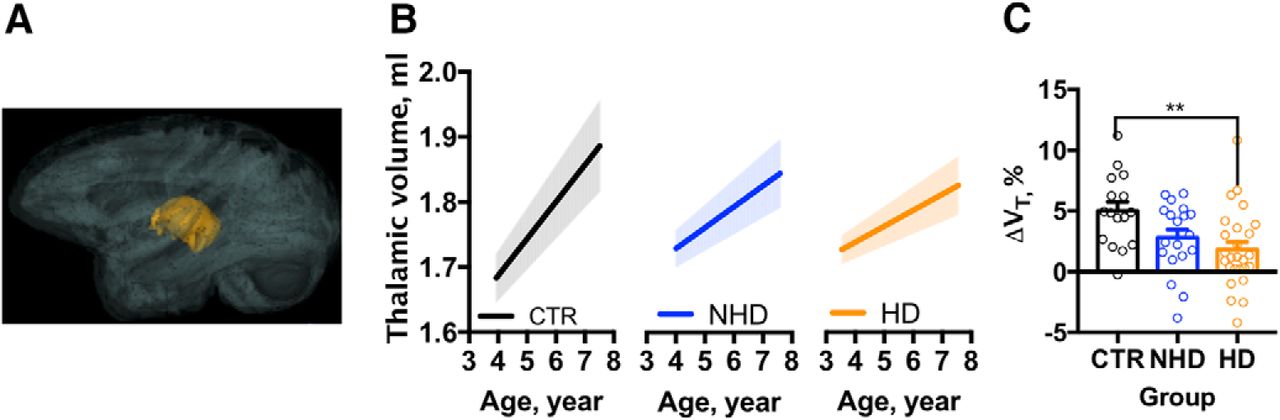
    Ethanol drinking attenuates thalamic growth in adolescent/early adult NHP. A, 3D representation of the thalamus in the brain. B, The estimated rate of the thalamic growth in the control, non-heavy-drinking, and heavy-drinking NHPs. The shadows above and below the regression lines depict 95% confidence interval. C, The effect of chronic ethanol use on the average change of thalamic volume occurred in three groups of subjects from baseline until the end of ethanol/water self-administration. The dots represent change in the volume measured in individual monkeys. Asterisks show the results of a Bonferroni post hoc test, where p values adjusted for the multiple comparisons were **p < 0.01.

Tables

  • Figures
    • View popup
    Table 1:

    Protocols of MR image acquisition

    ProtocolMRI systemRF coilTR (ms)TE (ms)TI (ms)Voxel size (mm)Flip angle
    1TrioQuadrature knee25004.3811000.5 × 0.5 × 0.512
    2TimTrioQuadrature knee (Tim)25003.8611000.5 × 0.5 × 0.512
    3Trio8-Channel knee array25004.3811000.5 × 0.5 × 0.512
    4TrioTim15-Channel knee array25003.8611000.5 × 0.5 × 0.512
    • RF, Radiofrequency. As indicated in the table, the ONPRC MRI system was upgraded throughout the study and different RF coils were used to enhance the signal-to-noise ratio. The parameters of MR image acquisition were adjusted accordingly.

    • View popup
    Table 2:

    Data sample characteristics

    Age (SD), yearEthanol Intake (SE), g/kg/d
    MRICTRNHDHDCTRNHDHD
    14.7 (0.6)5.1 (0.6)4.8 (0.8)0.00.00.0
    25.8 (0.6)6.2 (0.6)5.9 (0.7)0.01.8 (0.5)3.3 (0.8)
    36.3 (0.6)6.6 (0.6)6.4 (0.7)0.02.1 (0.4)3.6 (0.8)
    • One-way ANOVA revealed no significant difference in age at the beginning of the study (MRI 1) among three groups of subjects (F(2,60) = 1.3, p = 0.28). Repeated-measures ANOVA revealed significant effects of MRI (2 vs 3: F(1,43) = 11.3, p < 0.01) and group (NHD vs HD: F(1,43) = 67.9, p < 0.0001) on ethanol intake with no significant interaction (F(1,43) = 0.06, p = 0.8).

    • View popup
    Table 3:

    Tests of fixed effects in LMM 3.1

    GroupaAgeaInteraction
    ROIaFPFpFp
    WM4.4<0.05405.2<0.000019.6<0.00001
    Thalamus3.7<0.05108.8<0.000018.2<0.00001
    Globus pallidus1.60.2148.4<0.000013.7<0.05
    Brainstem1.10.3700.7<0.000013.9<0.05
    Cerebellum1.60.2120.5<0.0000110.4
    Amygdala1.60.212.7<0.013.2<0.05
    Cortex1.90.211.4<0.012.20.1
    Putamen0.80.410.8<0.011.90.2
    Caudate2.30.10.70.40.70.5
    Hippocampus1.80.20.20.62.30.1
    • The table includes the results of the test for fixed effects used in the LMM3.1: age, group, and age × group interaction. Note that the volume of a single ROI was used as a dependent variable in LMM3.1.

    • aThe degrees of freedom for the numerator and denominator are 1 and 123 (age), 2 and 96 (group), and 2 and 123 (interaction), respectively. Note that only p values <0.005 were considered significant (adjustment for 10 ROIs included in the analysis).

    • View popup
    Table 4:

    Estimates of fixed effects in LMM 1

    ROIβSEp95% CI
    Cerebellum0.140.01<0.000010.12–0.17
    Globus pallidus0.0120.001<0.000010.009–0.1
    Brainstem0.160.006<0.000010.15–0.018
    • The table includes the parameters of estimates of fixed effects obtained in the LMM1 with random intercept and fixed effect of age on V of listed ROIs. The rate of volume change is expressed as milliliters per year.

    • View popup
    Table 5:

    Estimates of fixed effects in LMM 3

    CTRNHDHD
    ROIβSEp95% CIβ´SEAdjusted p95% CIβ´SEAdjusted p95% CI
    WM0.60.050<0.000010.5-0.7−0.070.060.44−0.2 to 0.04−0.250.06<0.00001−0.4 to −0.13
    Thalamus0.060.007<0.000010.04-0.07−0.020.01<0.01−0.4 to −0.01−0.030.01<0.00001−0.05 to −0.02
    • The table includes the results obtained with the LMM 3.1 with random intercept and fixed effect of age, group, and their interaction on V of the ROIs. β´ = βNHD or HD-βCTR. The rate of volume change is expressed as milliliters per year. Average estimated age-dependent growth trajectories obtained in the NHD and HD groups were compared with those of the CTR group, with t test and p values adjusted accordingly.

Back to top

In this issue

eneuro: 6 (2)
eNeuro
Vol. 6, Issue 2
March/April 2019
  • Table of Contents
  • Index by author
  • Ed Board (PDF)
Email

Thank you for sharing this eNeuro article.

NOTE: We request your email address only to inform the recipient that it was you who recommended this article, and that it is not junk mail. We do not retain these email addresses.

Enter multiple addresses on separate lines or separate them with commas.
Chronic Alcohol Drinking Slows Brain Development in Adolescent and Young Adult Nonhuman Primates
(Your Name) has forwarded a page to you from eNeuro
(Your Name) thought you would be interested in this article in eNeuro.
CAPTCHA
This question is for testing whether or not you are a human visitor and to prevent automated spam submissions.
Print
View Full Page PDF
Citation Tools
Chronic Alcohol Drinking Slows Brain Development in Adolescent and Young Adult Nonhuman Primates
Tatiana A. Shnitko, Zheng Liu, Xiaojie Wang, Kathleen A. Grant, Christopher D. Kroenke
eNeuro 1 April 2019, 6 (2) ENEURO.0044-19.2019; DOI: 10.1523/ENEURO.0044-19.2019

Citation Manager Formats

  • BibTeX
  • Bookends
  • EasyBib
  • EndNote (tagged)
  • EndNote 8 (xml)
  • Medlars
  • Mendeley
  • Papers
  • RefWorks Tagged
  • Ref Manager
  • RIS
  • Zotero
Respond to this article
Share
Chronic Alcohol Drinking Slows Brain Development in Adolescent and Young Adult Nonhuman Primates
Tatiana A. Shnitko, Zheng Liu, Xiaojie Wang, Kathleen A. Grant, Christopher D. Kroenke
eNeuro 1 April 2019, 6 (2) ENEURO.0044-19.2019; DOI: 10.1523/ENEURO.0044-19.2019
Twitter logo Facebook logo Mendeley logo
  • Tweet Widget
  • Facebook Like
  • Google Plus One

Jump to section

  • Article
    • Abstract
    • Significance Statement
    • Introduction
    • Materials and Methods
    • Results
    • Discussion
    • Footnotes
    • References
    • Synthesis
  • Figures & Data
  • Info & Metrics
  • eLetters
  • PDF

Keywords

  • underage drinking
  • brain growth
  • magnetic resonance imaging
  • thalamus
  • white matter
  • ethanol
  • self administration

Responses to this article

Respond to this article

Jump to comment:

No eLetters have been published for this article.

Related Articles

Cited By...

More in this TOC Section

New Research

  • A Very Fast Time Scale of Human Motor Adaptation: Within Movement Adjustments of Internal Representations during Reaching
  • Optogenetic Activation of β-Endorphin Terminals in the Medial Preoptic Nucleus Regulates Female Sexual Receptivity
  • Hsc70 Ameliorates the Vesicle Recycling Defects Caused by Excess α-Synuclein at Synapses
Show more New Research

Disorders of the Nervous System

  • Numbers of granule cells and GABAergic boutons are correlated in shrunken sclerotic hippocampi of sea lions with temporal lobe epilepsy
  • Investigating the Role of Cortical Microglia in a Mouse Model of Viral Infection-Induced Seizures
  • Functional-Structural Coupling: Brain Reorganization in Presbycusis Is Related to Cognitive Impairment
Show more Disorders of the Nervous System

Subjects

  • Disorders of the Nervous System
  • Home
  • Alerts
  • Follow SFN on BlueSky
  • Visit Society for Neuroscience on Facebook
  • Follow Society for Neuroscience on Twitter
  • Follow Society for Neuroscience on LinkedIn
  • Visit Society for Neuroscience on Youtube
  • Follow our RSS feeds

Content

  • Early Release
  • Current Issue
  • Latest Articles
  • Issue Archive
  • Blog
  • Browse by Topic

Information

  • For Authors
  • For the Media

About

  • About the Journal
  • Editorial Board
  • Privacy Notice
  • Contact
  • Feedback
(eNeuro logo)
(SfN logo)

Copyright © 2026 by the Society for Neuroscience.
eNeuro eISSN: 2373-2822

The ideas and opinions expressed in eNeuro do not necessarily reflect those of SfN or the eNeuro Editorial Board. Publication of an advertisement or other product mention in eNeuro should not be construed as an endorsement of the manufacturer’s claims. SfN does not assume any responsibility for any injury and/or damage to persons or property arising from or related to any use of any material contained in eNeuro.