Main menu

  • HOME
  • CONTENT
    • Early Release
    • Featured
    • Current Issue
    • Issue Archive
    • Blog
    • Collections
    • Podcast
  • TOPICS
    • Cognition and Behavior
    • Development
    • Disorders of the Nervous System
    • History, Teaching and Public Awareness
    • Integrative Systems
    • Neuronal Excitability
    • Novel Tools and Methods
    • Sensory and Motor Systems
  • ALERTS
  • FOR AUTHORS
  • ABOUT
    • Overview
    • Editorial Board
    • For the Media
    • Privacy Policy
    • Contact Us
    • Feedback
  • SUBMIT

User menu

Search

  • Advanced search
eNeuro
eNeuro

Advanced Search


  • HOME
  • CONTENT
    • Early Release
    • Featured
    • Current Issue
    • Issue Archive
    • Blog
    • Collections
    • Podcast
  • TOPICS
    • Cognition and Behavior
    • Development
    • Disorders of the Nervous System
    • History, Teaching and Public Awareness
    • Integrative Systems
    • Neuronal Excitability
    • Novel Tools and Methods
    • Sensory and Motor Systems
  • ALERTS
  • FOR AUTHORS
  • ABOUT
    • Overview
    • Editorial Board
    • For the Media
    • Privacy Policy
    • Contact Us
    • Feedback
  • SUBMIT
PreviousNext
Research ArticleNew Research, Cognition and Behavior

Electrophysiological Correlates of Absolute Pitch in a Passive Auditory Oddball Paradigm: a Direct Replication Attempt

Marielle Greber, Lars Rogenmoser, Stefan Elmer and Lutz Jäncke
eNeuro 7 December 2018, 5 (6) ENEURO.0333-18.2018; https://doi.org/10.1523/ENEURO.0333-18.2018
Marielle Greber
1Division Neuropsychology, Department of Psychology, University of Zurich, CH-8050 Zurich, Switzerland
  • Find this author on Google Scholar
  • Find this author on PubMed
  • Search for this author on this site
  • ORCID record for Marielle Greber
Lars Rogenmoser
2Laboratory of Integrative Neuroscience and Cognition, Department of Neuroscience, Georgetown University Medical Center, Washington, DC 20007
  • Find this author on Google Scholar
  • Find this author on PubMed
  • Search for this author on this site
  • ORCID record for Lars Rogenmoser
Stefan Elmer
1Division Neuropsychology, Department of Psychology, University of Zurich, CH-8050 Zurich, Switzerland
  • Find this author on Google Scholar
  • Find this author on PubMed
  • Search for this author on this site
  • ORCID record for Stefan Elmer
Lutz Jäncke
1Division Neuropsychology, Department of Psychology, University of Zurich, CH-8050 Zurich, Switzerland
3 University Research Priority Program (URPP), Dynamics of Healthy Aging, University of Zurich, CH-8050 Zurich, Switzerland
4Department of Special Education, King Abdulaziz University, Jeddah 21589, Kingdom of Saudi Arabia
  • Find this author on Google Scholar
  • Find this author on PubMed
  • Search for this author on this site
  • ORCID record for Lutz Jäncke
  • Article
  • Figures & Data
  • Info & Metrics
  • eLetters
  • PDF
Loading

Article Figures & Data

Figures

  • Tables
  • Figure 1.
    • Download figure
    • Open in new tab
    • Download powerpoint
    Figure 1.

    Grand averages of the difference waves (deviant ERP minus standard ERP). ERPs from the fronto-central pooling of electrodes were averaged over all participants for each deviation condition. The lines represent the means, the shaded areas indicate 95% within-subject confidence intervals. Darker colors illustrate larger deviation magnitudes. In block A (standard tone 440 Hz), amplitudes increase with larger deviation magnitude. In block C (standard tone 264 Hz), no such clear relationship can be observed.

  • Figure 2.
    • Download figure
    • Open in new tab
    • Download powerpoint
    Figure 2.

    Grand averages of the difference waves (deviant minus standard) for AP (in red) and non-AP (in blue) musicians. Deviation magnitude increases from top to bottom. The lines represent the group means, the shaded areas represent the 95% between-subject confidence interval.

  • Figure 3.
    • Download figure
    • Open in new tab
    • Download powerpoint
    Figure 3.

    Voltage distributions over the scalp for the MMN and P3a for each group and each deviant in block A (standard tone 440 Hz) and block C (standard tone 264 Hz). Topographies are shown at the time point of the peak according to the grand average of the specific deviation condition and group. Deviation magnitude increases from left to right. Both MMN and P3a are maximally expressed at fronto-central electrode sites.

  • Figure 4.
    • Download figure
    • Open in new tab
    • Download powerpoint
    Figure 4.

    Performance in the pitch-labeling test for AP and non-AP musicians. Octave errors were treated as correct answers, resulting in a chance level of 8.33% (dashed line). AP musicians are depicted in red, non-AP musicians in blue. AP musicians performed significantly better than non-AP musicians (t(101.75) = 13.77, p < 0.001, d = 2.70).

  • Figure 5.
    • Download figure
    • Open in new tab
    • Download powerpoint
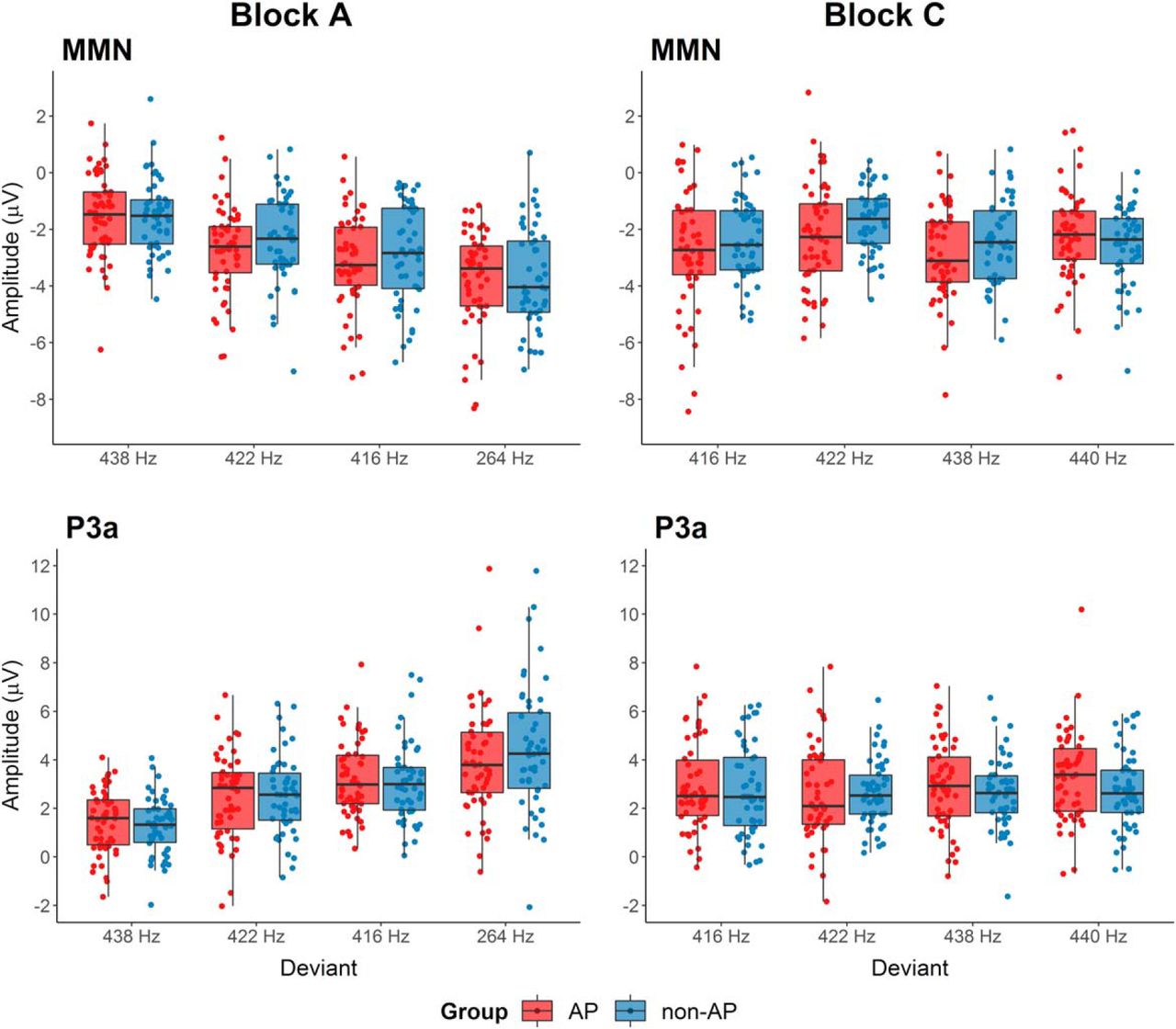
    Figure 5.

    MMN and P3a amplitudes of musicians with AP and without AP (non-AP) for all deviation conditions in block A (standard tone 440 Hz) and block C (standard tone 264 Hz). Deviants are ordered from left to right according to increasing deviation magnitude. Amplitudes of AP musicians are shown in red, amplitudes of non-AP musicians are shown in blue.

Tables

  • Figures
    • View popup
    Table 1.

    Demographics and musical experience

    AP
    musicians
    (n = 54)
    Non-AP
    musicians
    (n = 50)
    Sex
     Female
     Male
        
    27
    27
        
    24
    26
    Age (years)26.67 (5.49)25.30 (4.51)
    Handedness
     Right-handed
     Left-handed
     Both-handed
        
    47
    4
    3
        
    45
    4
    1
    Intelligence (MWT-B)a27.69 (5.10)29.06 (4.68)
    Age of onset of musical training (years)5.93 (2.39)6.48 (2.46)
    Lifetime cumulative training (h)b1.66 (1.22)1.36 (0.96)
    Musical aptitude (AMMA)a66.11 (6.31)63.22 (6.86)
    Pitch-labeling test (%)76.41 (19.55)24.31 (19.01)
    • Continuous measures are given as mean (SDs in parentheses). MWT-B, Mehrfachwahl-Wortschatz-Intelligenztest; AMMA, Advanced Measures of Music Audiation.

    • ↵a Raw scores.

    • ↵b Units are given in 1 × 10⁴.

    • View popup
    Table 2.

    Study design

    Standard toneDeviant tones
    Block A440 Hz438 Hz422 Hz416 Hz264 Hz
    Block C264 Hz416 Hz422 Hz438 Hz440 Hz
    • Deviant tones are listed from left to right according to increasing deviation magnitude.

Back to top

In this issue

eneuro: 5 (6)
eNeuro
Vol. 5, Issue 6
November/December 2018
  • Table of Contents
  • Index by author
Email

Thank you for sharing this eNeuro article.

NOTE: We request your email address only to inform the recipient that it was you who recommended this article, and that it is not junk mail. We do not retain these email addresses.

Enter multiple addresses on separate lines or separate them with commas.
Electrophysiological Correlates of Absolute Pitch in a Passive Auditory Oddball Paradigm: a Direct Replication Attempt
(Your Name) has forwarded a page to you from eNeuro
(Your Name) thought you would be interested in this article in eNeuro.
CAPTCHA
This question is for testing whether or not you are a human visitor and to prevent automated spam submissions.
Print
View Full Page PDF
Citation Tools
Electrophysiological Correlates of Absolute Pitch in a Passive Auditory Oddball Paradigm: a Direct Replication Attempt
Marielle Greber, Lars Rogenmoser, Stefan Elmer, Lutz Jäncke
eNeuro 7 December 2018, 5 (6) ENEURO.0333-18.2018; DOI: 10.1523/ENEURO.0333-18.2018

Citation Manager Formats

  • BibTeX
  • Bookends
  • EasyBib
  • EndNote (tagged)
  • EndNote 8 (xml)
  • Medlars
  • Mendeley
  • Papers
  • RefWorks Tagged
  • Ref Manager
  • RIS
  • Zotero
Respond to this article
Share
Electrophysiological Correlates of Absolute Pitch in a Passive Auditory Oddball Paradigm: a Direct Replication Attempt
Marielle Greber, Lars Rogenmoser, Stefan Elmer, Lutz Jäncke
eNeuro 7 December 2018, 5 (6) ENEURO.0333-18.2018; DOI: 10.1523/ENEURO.0333-18.2018
Twitter logo Facebook logo Mendeley logo
  • Tweet Widget
  • Facebook Like
  • Google Plus One

Jump to section

  • Article
    • Abstract
    • Significance Statement
    • Introduction
    • Materials and Methods
    • Results
    • Discussion
    • Acknowledgments
    • Footnotes
    • References
    • Synthesis
  • Figures & Data
  • Info & Metrics
  • eLetters
  • PDF

Keywords

  • Absolute Pitch
  • auditory
  • ERP
  • MMN
  • P3a
  • replication

Responses to this article

Respond to this article

Jump to comment:

No eLetters have been published for this article.

Related Articles

Cited By...

More in this TOC Section

New Research

  • A Very Fast Time Scale of Human Motor Adaptation: Within Movement Adjustments of Internal Representations during Reaching
  • Optogenetic Activation of β-Endorphin Terminals in the Medial Preoptic Nucleus Regulates Female Sexual Receptivity
  • Hsc70 Ameliorates the Vesicle Recycling Defects Caused by Excess α-Synuclein at Synapses
Show more New Research

Cognition and Behavior

  • Whole-Brain Mapping of Neuronal Activity Associated with Vocal Socialization Behaviors in Adult Mice
  • Disrupting motor cortical regional activity during motor sequence skill training impairs human motor visuomotor skill acquisition and learning that is not sequence-specific
  • Effect of Functionally Selective Dopamine D1 Receptor Agonists on Complex Cognitive Processes in a Rodent Touchscreen Operant Chamber Task
Show more Cognition and Behavior

Subjects

  • Cognition and Behavior
  • Home
  • Alerts
  • Follow SFN on BlueSky
  • Visit Society for Neuroscience on Facebook
  • Follow Society for Neuroscience on Twitter
  • Follow Society for Neuroscience on LinkedIn
  • Visit Society for Neuroscience on Youtube
  • Follow our RSS feeds

Content

  • Early Release
  • Current Issue
  • Latest Articles
  • Issue Archive
  • Blog
  • Browse by Topic

Information

  • For Authors
  • For the Media

About

  • About the Journal
  • Editorial Board
  • Privacy Notice
  • Contact
  • Feedback
(eNeuro logo)
(SfN logo)

Copyright © 2026 by the Society for Neuroscience.
eNeuro eISSN: 2373-2822

The ideas and opinions expressed in eNeuro do not necessarily reflect those of SfN or the eNeuro Editorial Board. Publication of an advertisement or other product mention in eNeuro should not be construed as an endorsement of the manufacturer’s claims. SfN does not assume any responsibility for any injury and/or damage to persons or property arising from or related to any use of any material contained in eNeuro.