Article Figures & Data
Figures
- Fig. 1.
Example of a typical ABR recording from an adult owl. Shown is an average response to 300 stimuli at 2 kHz, 51 dB SPL. Only wave I was analyzed. Amplitude was defined as the difference between the first positive (AmpMax) and following negative (AmpMin) peak. Latency was defined as the latency of the first positive peak (Tmax).
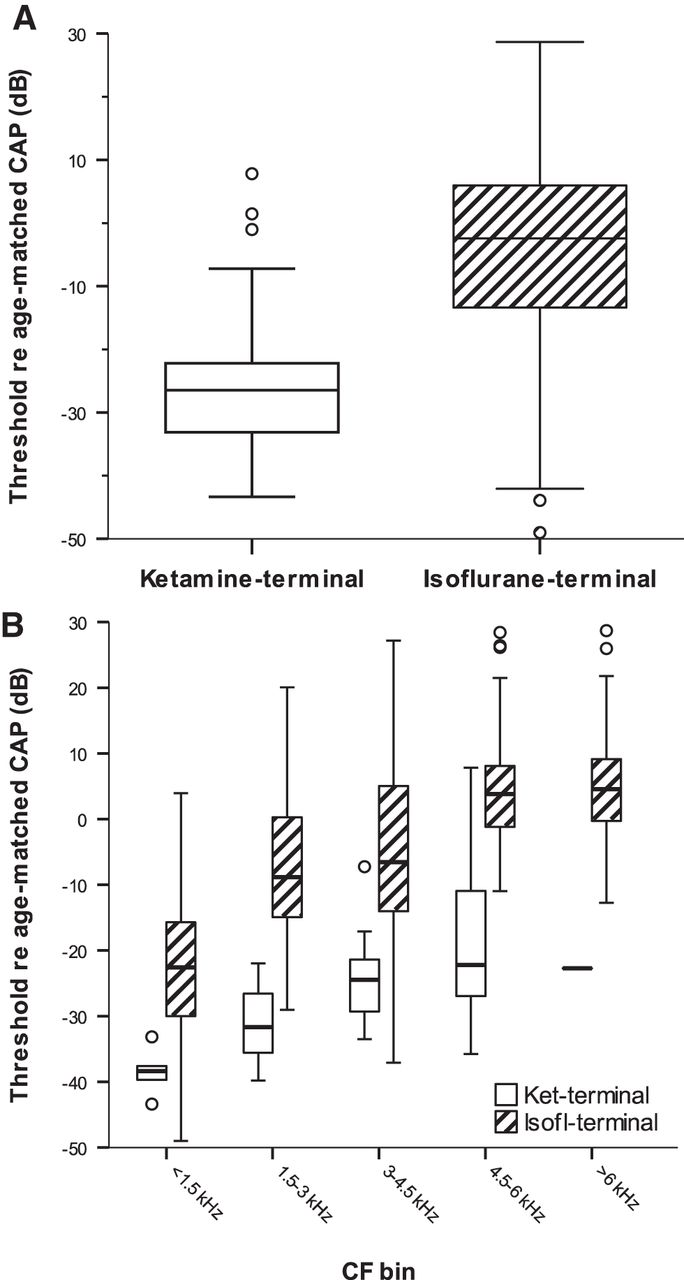
- Fig. 2.
Auditory nerve single-unit thresholds were severely elevated under isoflurane. A, Box plot showing thresholds (normalized to the age-matched CAP) for auditory nerve fibers recorded under ketamine/xylazine and isoflurane, respectively. B, The same data, separated into 1.5-kHz-wide CF bands, for the two anesthetic conditions. Empty boxes represent data for the ketamine-terminal conditions, and hatched boxes represent data for the isoflurane-terminal condition. Note that thresholds under isoflurane were significantly higher. Boxes and whiskers indicate the interquartile ranges and 1.5 times the interquartile ranges, respectively. Horizontal lines within boxes indicate medians, and circular symbols indicate outliers that lie beyond 1.5 times the interquartile range.
- Fig. 3.
CAP thresholds were severely elevated under isoflurane. CAP threshold audiogram of an individual aged P32, under isoflurane anesthesia (solid line). For comparison, the average CAP audiogram for P32 owls under ketamine/xylazine anesthesia is also shown (dashed line; after Köppl and Nickel, 2007).
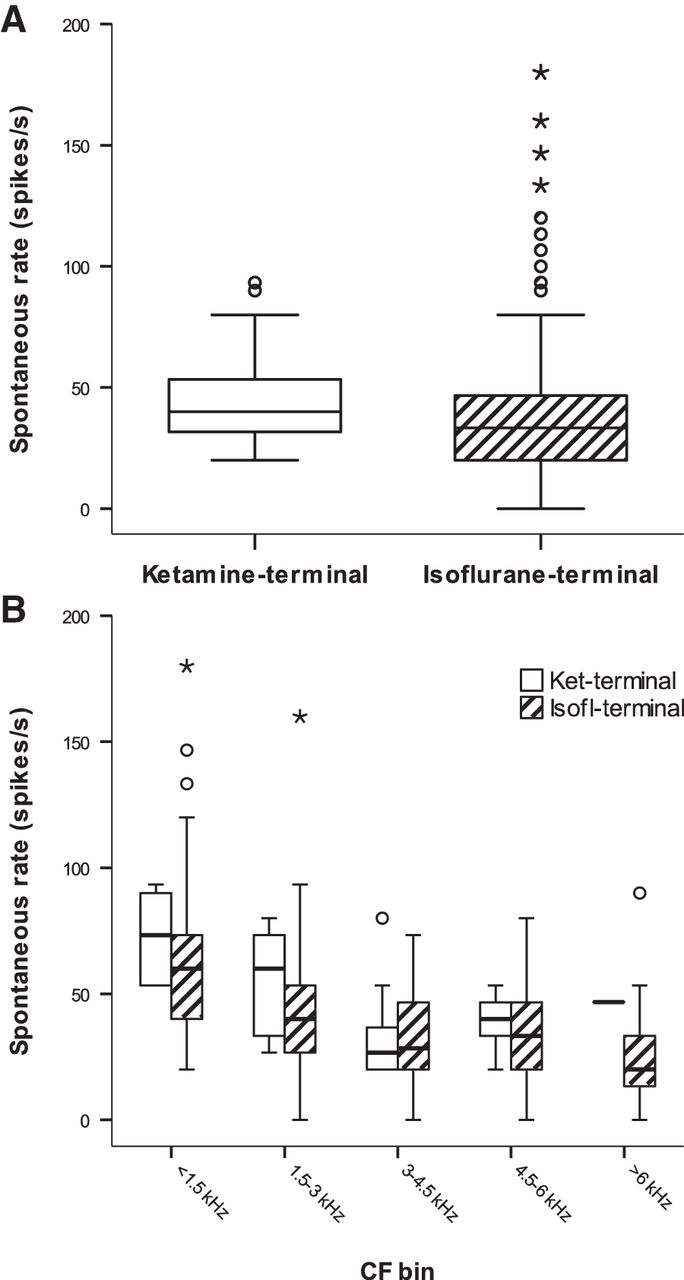
- Fig. 4.
Auditory nerve spontaneous discharge rates were mildly depressed by isoflurane. A, Box plot showing overall spontaneous discharge rates for auditory nerve fibers recorded under ketamine/xylazine and isoflurane, respectively. The rates under isoflurane were significantly lower. B, The same data, separated into 1.5-kHz-wide CF bands, for the two anesthetic conditions. Empty boxes represent data for the ketamine-terminal conditions, and hatched boxes represent data for the isoflurane-terminal condition. Boxes and whiskers indicate the interquartile ranges and 1.5 times the interquartile ranges, respectively. Horizontal lines within boxes indicate medians, and circular symbols and stars indicate outliers that lie beyond 1.5 times (circles) or beyond 3 times (stars) the interquartile range.
- Fig. 5.
ABR thresholds were elevated under gas anesthesia. A, Box plot showing ABR thresholds as a function of frequency, for the same four adult individuals, tested with different anesthetic protocols in successive experiments. B, The same data, with thresholds now normalized to the values at the respective frequency for the ketamine-ABR condition; as a visual reference, the dashed line indicates the reference condition. Note that the minor variation across frequencies was not significant (Table 1, References 27 and 28). Therefore, C then shows an overall comparison between anesthetic conditions. Thresholds for either the isoflurane-ABR or sevoflurane-ABR condition were significantly higher than thresholds for the ketamine-ABR condition (Table 1, References 24 and 25). Thresholds for the ketamine-ABR condition are shown as empty boxes, for the isoflurane-ABR condition as hatched boxes, and for the sevoflurane-ABR condition as gray boxes. Boxes and whiskers indicate the interquartile ranges and 1.5 times the interquartile ranges, respectively. Horizontal lines within boxes indicate medians. There were no outliers beyond 1.5 times the interquartile ranges.
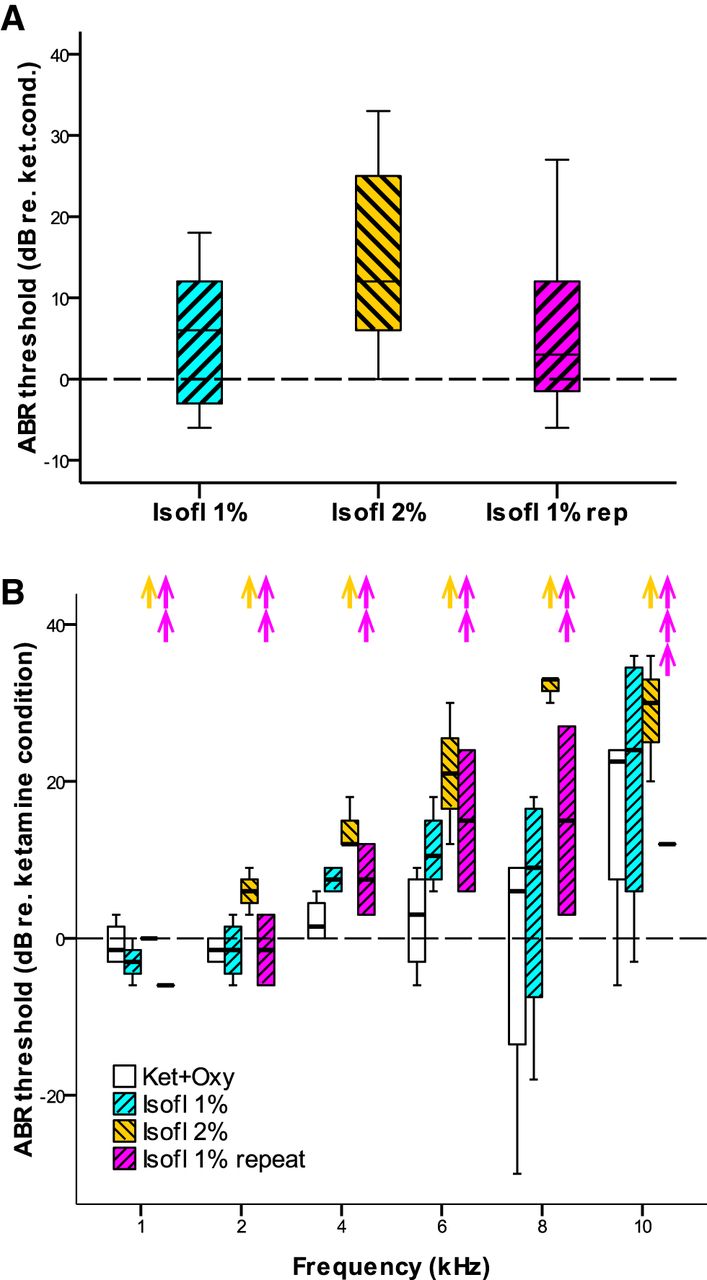
- Fig. 6.
A, Isoflurane dose dependence of ABR thresholds. Box plot showing thresholds for different isoflurane concentrations tested sequentially in ABR-terminal experiments. Thresholds under 2% isoflurane were significantly elevated relative to those under both 1% conditions (Table 1, References 32–35). B, Gradual threshold deterioration with time in terminal ABR experiments. Shown are ABR thresholds normalized to the values for the initial ketamine/xylazine condition (animal breathing air unaided), separated according to frequency, for all conditions tested sequentially. Note that the number of data points contributing to each box now varies; upward arrows indicate data that dropped out because the threshold exceeded the limit of the sound system and thus could not be determined. Note also that high frequencies appear to be affected more. Thresholds obtained under ketamine + artificial oxygen respiration are shown as empty boxes, for the 1% isoflurane condition as hatched blue boxes, for the 2% isoflurane condition as hatched yellow boxes, and for the repeated 1% isoflurane condition as hatched magenta boxes. Boxes and whiskers indicate the interquartile ranges and 1.5 times the interquartile ranges, respectively. Horizontal lines within boxes indicate medians. There were no outliers beyond 1.5 times the interquartile ranges.





Tables
Reference number Data structure Parameter tested Type of test p value Figure 1 Two independent samples:
ketamine-terminal (n = 57)
isoflurane-terminal (n = 351)Single-unit threshold (relative to age-matched CAP audiograms) Mann–Whitney <0.001 2A 2 Two independent samples:
ketamine-terminal (n = 5)
isoflurane-terminal (n = 49)Single-unit threshold (relative to age-matched CAP audiograms)
CF <1.5 kHzMann–Whitney 0.004 2B 3 Two independent samples:
ketamine-terminal (n = 14)
isoflurane-terminal (n = 76)Single-unit threshold (relative to age-matched CAP audiograms)
CF 1.5–3 kHzMann–Whitney <0.001 2B 4 Two independent samples:
ketamine-terminal (n = 20)
isoflurane-terminal (n = 89)Single-unit threshold (relative to age-matched CAP audiograms)
CF 3–4.5 kHzMann–Whitney <0.001 2B 5 Two independent samples:
ketamine-terminal (n = 17)
isoflurane-terminal (n = 86)Single-unit threshold (relative to age-matched CAP audiograms)
CF 4.5–6 kHzMann–Whitney <0.001 2B 6 Five independent samples (age groups):
P11 to P14 (n = 99)
P17 (n = 35)
P21 to 32 (n = 87)
P35 to P40 (n = 17)
P51 to P86 (n = 38)Single-unit spontaneous discharge rate Kruskal–Wallis <0.001 7 Two independent samples:
P11 to P14 (n = 99)
P17 (n = 35)Single-unit spontaneous discharge rate Mann–Whitney Bonferroni corrected <0.001 8 Two independent samples:
P11to P14 (n = 99)
P21 to P32 (n = 87)Single-unit spontaneous discharge rate Mann–Whitney Bonferroni corrected 0.001 9 Two independent samples:
P11 to P14 (n = 99)
P35 to P40 (n = 17)Single-unit spontaneous discharge rate Mann–Whitney Bonferroni corrected 0.003 10 Two independent samples:
P11 to P14 (n = 99)
P51 to P86 (n = 38)Single-unit spontaneous discharge rate Mann–Whitney Bonferroni corrected 0.002 11 Two independent samples:
P17 (n = 35)
P21 to P32 (n = 87)Single-unit spontaneous discharge rate Mann–Whitney Bonferroni corrected 0.346 12 Two independent samples:
P17 (n = 35)
P35 to P40 (n = 17)Single-unit spontaneous discharge rate Mann–Whitney Bonferroni corrected 0.992 13 Two independent samples:
P17 (n = 35)
P51 to P86 (n = 38)Single-unit spontaneous discharge rate Mann–Whitney Bonferroni corrected 0.614 14 Two independent samples:
P21 to 32 (n = 87)
P35 to P40 (n = 17)Single-unit spontaneous discharge rate Mann–Whitney Bonferroni corrected 0.467 15 Two independent samples:
P21 to P32 (n = 87)
P51 to P86 (n = 38)Single-unit spontaneous discharge rate Mann–Whitney Bonferroni corrected 0.718 16 Two independent samples:
P35 to P40 (n = 17)
P51 to P86 (n = 38)Single-unit spontaneous discharge rate Mann–Whitney Bonferroni corrected 0.826 17 Two independent samples:
ketamine-terminal (n = 56)
isoflurane-terminal (n = 260)Single-unit spontaneous discharge rate, all ages ≥P17 Mann–Whitney 0.005 4A 18 Two independent samples:
ketamine-terminal (n = 5)
isoflurane-terminal (n = 29)Single-unit spontaneous discharge rate, all ages ≥P17 and CF <1.5 kHz Mann–Whitney 0.575 4B 19 Two independent samples:
ketamine-terminal (n = 14)
isoflurane-terminal (n = 30)Single-unit spontaneous discharge rate, all ages ≥P17 and CF 1.5–3 kHz Mann–Whitney 0.035 4B 20 Two independent samples:
ketamine-terminal (n = 19)
isoflurane-terminal (n = 62)Single-unit spontaneous discharge rate, all ages ≥P17 and CF 3–4.5 kHz Mann–Whitney 0.858 4B 21 Two independent samples:
ketamine-terminal (n = 17)
isoflurane-terminal (n = 88)Single-unit spontaneous discharge rate, all ages ≥P17 and CF 4.5–6 kHz Mann–Whitney 0.264 4B 22 Two independent samples:
ketamine-terminal (n = 53)
isoflurane-terminal (n = 327)Single-unit Q10 dB Mann–Whitney 0.098 23 Three dependent samples (n = 24):
ketamine-ABR
isoflurane-ABR
sevoflurane-ABRABR threshold Friedman <0.001 5 24 Two dependent samples (n = 24):
ketamine-ABR
isoflurane-ABRABR threshold Wilcoxon
Bonferroni corrected<0.001 5 25 Two dependent samples (n = 24):
ketamine-ABR
sevoflurane-ABRABR threshold Wilcoxon
Bonferroni corrected<0.001 5 26 Two dependent samples (n = 24):
isoflurane-ABR
sevoflurane-ABRABR threshold Wilcoxon
Bonferroni corrected0.076 5 27 Six independent samples:
1/2/4/6/8/10 kHz
(n = 4 each)ABR threshold difference: isoflurane-ABR−ketamine-ABR condition Kruskal–Wallis 0.406 5B 28 Six independent samples:
1/2/4/6/8/10 kHz
(n = 4 each)ABR threshold difference: sevoflurane-ABR−ketamine-ABR condition Kruskal–Wallis 0.472 5B 29 Three dependent samples (n = 16):
ketamine-ABR
isoflurane-ABR
sevoflurane-ABRABR amplitudes 10 dB above threshold Friedman 0.068 30 Three dependent samples (n = 16):
ketamine-ABR
isoflurane-ABR
sevoflurane-ABRABR latencies 10 dB above threshold Friedman 0.646 31 Two dependent samples (n = 24):
ABR-terminal, ketamine
ABR-terminal, ketamine + oxygenABR threshold Wilcoxon 0.163 32 Three dependent samples (n = 11):
ABR-terminal, 1% isoflurane
ABR-terminal, 2% isoflurane
ABR-terminal, 1% isoflurane repeatABR threshold Friedman <0.001 6A 33 Two dependent samples (n = 11):
ABR-terminal, 1% isoflurane
ABR-terminal, 2% isofluraneABR threshold Wilcoxon
Bonferroni corrected0.003 6A 34 Two dependent samples (n = 11):
ABR-terminal, 2% isoflurane
ABR-terminal, 1% isoflurane repeatABR threshold Wilcoxon
Bonferroni corrected0.003 6A 35 Two dependent samples (n = 11):
ABR-terminal, 1% isoflurane
ABR-terminal, 1% isoflurane repeatABR threshold Wilcoxon
Bonferroni corrected0.262 6A 36 Two dependent samples (n = 24):
ABR-terminal, ketamine + oxygen
ABR-terminal, 1% isofluraneABR threshold Wilcoxon 0.004 37 Two dependent samples (n = 24):
isoflurane-ABR (normalized compared with ketamine)
ABR-terminal, 1% isoflurane (normalized compared with ketamine)ABR threshold Wilcoxon <0.001 Column 1 shows the serial number used to refer to specific tests throughout the article. Column 2 defines the samples, and column 3 the tested parameter. Column 4 lists the specific nonparametric test used, and column 5 shows the resulting p value, which is highlighted in bold type if the null hypothesis was rejected. Note that the criterion p value was 0.01, or lower if a Bonferroni correction was applied, as indicated in Column 4. Finally, column 6 refers to the relevant figure, if applicable.
In this issue