Main menu

  • HOME
  • CONTENT
    • Early Release
    • Featured
    • Current Issue
    • Issue Archive
    • Blog
    • Collections
    • Podcast
  • TOPICS
    • Cognition and Behavior
    • Development
    • Disorders of the Nervous System
    • History, Teaching and Public Awareness
    • Integrative Systems
    • Neuronal Excitability
    • Novel Tools and Methods
    • Sensory and Motor Systems
  • ALERTS
  • FOR AUTHORS
  • ABOUT
    • Overview
    • Editorial Board
    • For the Media
    • Privacy Policy
    • Contact Us
    • Feedback
  • SUBMIT

User menu

Search

  • Advanced search
eNeuro
eNeuro

Advanced Search


  • HOME
  • CONTENT
    • Early Release
    • Featured
    • Current Issue
    • Issue Archive
    • Blog
    • Collections
    • Podcast
  • TOPICS
    • Cognition and Behavior
    • Development
    • Disorders of the Nervous System
    • History, Teaching and Public Awareness
    • Integrative Systems
    • Neuronal Excitability
    • Novel Tools and Methods
    • Sensory and Motor Systems
  • ALERTS
  • FOR AUTHORS
  • ABOUT
    • Overview
    • Editorial Board
    • For the Media
    • Privacy Policy
    • Contact Us
    • Feedback
  • SUBMIT
PreviousNext
Research ArticleMethods/New Tools, Novel Tools and Methods

Aberrant Cortical Activity in Multiple GCaMP6-Expressing Transgenic Mouse Lines

Nicholas A. Steinmetz, Christina Buetfering, Jerome Lecoq, Christian R. Lee, Andrew J. Peters, Elina A. K. Jacobs, Philip Coen, Douglas R. Ollerenshaw, Matthew T. Valley, Saskia E. J. de Vries, Marina Garrett, Jun Zhuang, Peter A. Groblewski, Sahar Manavi, Jesse Miles, Casey White, Eric Lee, Fiona Griffin, Joshua D. Larkin, Kate Roll, Sissy Cross, Thuyanh V. Nguyen, Rachael Larsen, Julie Pendergraft, Tanya Daigle, Bosiljka Tasic, Carol L. Thompson, Jack Waters, Shawn Olsen, David J. Margolis, Hongkui Zeng, Michael Hausser, Matteo Carandini and Kenneth D. Harris
eNeuro 4 September 2017, 4 (5) ENEURO.0207-17.2017; https://doi.org/10.1523/ENEURO.0207-17.2017
Nicholas A. Steinmetz
1UCL Institute of Neurology, University College London, London, UK
2UCL Institute of Ophthalmology, University College London, London, UK
  • Find this author on Google Scholar
  • Find this author on PubMed
  • Search for this author on this site
  • ORCID record for Nicholas A. Steinmetz
Christina Buetfering
3Department of Neuroscience, Physiology, and Pharmacology, University College London, London, UK
4Wolfson Institute for Biomedical Research, University College London, London, UK
  • Find this author on Google Scholar
  • Find this author on PubMed
  • Search for this author on this site
Jerome Lecoq
5 Allen Institute for Brain Science, Seattle, WA
  • Find this author on Google Scholar
  • Find this author on PubMed
  • Search for this author on this site
  • ORCID record for Jerome Lecoq
Christian R. Lee
6Department of Cell Biology and Neuroscience, Rutgers, the State University of New Jersey, Piscataway, NJ
  • Find this author on Google Scholar
  • Find this author on PubMed
  • Search for this author on this site
  • ORCID record for Christian R. Lee
Andrew J. Peters
2UCL Institute of Ophthalmology, University College London, London, UK
  • Find this author on Google Scholar
  • Find this author on PubMed
  • Search for this author on this site
  • ORCID record for Andrew J. Peters
Elina A. K. Jacobs
1UCL Institute of Neurology, University College London, London, UK
  • Find this author on Google Scholar
  • Find this author on PubMed
  • Search for this author on this site
  • ORCID record for Elina A. K. Jacobs
Philip Coen
1UCL Institute of Neurology, University College London, London, UK
  • Find this author on Google Scholar
  • Find this author on PubMed
  • Search for this author on this site
  • ORCID record for Philip Coen
Douglas R. Ollerenshaw
5 Allen Institute for Brain Science, Seattle, WA
  • Find this author on Google Scholar
  • Find this author on PubMed
  • Search for this author on this site
  • ORCID record for Douglas R. Ollerenshaw
Matthew T. Valley
5 Allen Institute for Brain Science, Seattle, WA
  • Find this author on Google Scholar
  • Find this author on PubMed
  • Search for this author on this site
  • ORCID record for Matthew T. Valley
Saskia E. J. de Vries
5 Allen Institute for Brain Science, Seattle, WA
  • Find this author on Google Scholar
  • Find this author on PubMed
  • Search for this author on this site
  • ORCID record for Saskia E. J. de Vries
Marina Garrett
5 Allen Institute for Brain Science, Seattle, WA
  • Find this author on Google Scholar
  • Find this author on PubMed
  • Search for this author on this site
  • ORCID record for Marina Garrett
Jun Zhuang
5 Allen Institute for Brain Science, Seattle, WA
  • Find this author on Google Scholar
  • Find this author on PubMed
  • Search for this author on this site
  • ORCID record for Jun Zhuang
Peter A. Groblewski
5 Allen Institute for Brain Science, Seattle, WA
  • Find this author on Google Scholar
  • Find this author on PubMed
  • Search for this author on this site
Sahar Manavi
5 Allen Institute for Brain Science, Seattle, WA
  • Find this author on Google Scholar
  • Find this author on PubMed
  • Search for this author on this site
Jesse Miles
5 Allen Institute for Brain Science, Seattle, WA
  • Find this author on Google Scholar
  • Find this author on PubMed
  • Search for this author on this site
Casey White
5 Allen Institute for Brain Science, Seattle, WA
  • Find this author on Google Scholar
  • Find this author on PubMed
  • Search for this author on this site
Eric Lee
5 Allen Institute for Brain Science, Seattle, WA
  • Find this author on Google Scholar
  • Find this author on PubMed
  • Search for this author on this site
  • ORCID record for Eric Lee
Fiona Griffin
5 Allen Institute for Brain Science, Seattle, WA
  • Find this author on Google Scholar
  • Find this author on PubMed
  • Search for this author on this site
Joshua D. Larkin
5 Allen Institute for Brain Science, Seattle, WA
  • Find this author on Google Scholar
  • Find this author on PubMed
  • Search for this author on this site
  • ORCID record for Joshua D. Larkin
Kate Roll
5 Allen Institute for Brain Science, Seattle, WA
  • Find this author on Google Scholar
  • Find this author on PubMed
  • Search for this author on this site
Sissy Cross
5 Allen Institute for Brain Science, Seattle, WA
  • Find this author on Google Scholar
  • Find this author on PubMed
  • Search for this author on this site
Thuyanh V. Nguyen
5 Allen Institute for Brain Science, Seattle, WA
  • Find this author on Google Scholar
  • Find this author on PubMed
  • Search for this author on this site
Rachael Larsen
5 Allen Institute for Brain Science, Seattle, WA
  • Find this author on Google Scholar
  • Find this author on PubMed
  • Search for this author on this site
Julie Pendergraft
5 Allen Institute for Brain Science, Seattle, WA
  • Find this author on Google Scholar
  • Find this author on PubMed
  • Search for this author on this site
  • ORCID record for Julie Pendergraft
Tanya Daigle
5 Allen Institute for Brain Science, Seattle, WA
  • Find this author on Google Scholar
  • Find this author on PubMed
  • Search for this author on this site
Bosiljka Tasic
5 Allen Institute for Brain Science, Seattle, WA
  • Find this author on Google Scholar
  • Find this author on PubMed
  • Search for this author on this site
  • ORCID record for Bosiljka Tasic
Carol L. Thompson
5 Allen Institute for Brain Science, Seattle, WA
  • Find this author on Google Scholar
  • Find this author on PubMed
  • Search for this author on this site
Jack Waters
5 Allen Institute for Brain Science, Seattle, WA
  • Find this author on Google Scholar
  • Find this author on PubMed
  • Search for this author on this site
  • ORCID record for Jack Waters
Shawn Olsen
5 Allen Institute for Brain Science, Seattle, WA
  • Find this author on Google Scholar
  • Find this author on PubMed
  • Search for this author on this site
David J. Margolis
6Department of Cell Biology and Neuroscience, Rutgers, the State University of New Jersey, Piscataway, NJ
  • Find this author on Google Scholar
  • Find this author on PubMed
  • Search for this author on this site
  • ORCID record for David J. Margolis
Hongkui Zeng
5 Allen Institute for Brain Science, Seattle, WA
  • Find this author on Google Scholar
  • Find this author on PubMed
  • Search for this author on this site
  • ORCID record for Hongkui Zeng
Michael Hausser
3Department of Neuroscience, Physiology, and Pharmacology, University College London, London, UK
4Wolfson Institute for Biomedical Research, University College London, London, UK
  • Find this author on Google Scholar
  • Find this author on PubMed
  • Search for this author on this site
Matteo Carandini
2UCL Institute of Ophthalmology, University College London, London, UK
  • Find this author on Google Scholar
  • Find this author on PubMed
  • Search for this author on this site
  • ORCID record for Matteo Carandini
Kenneth D. Harris
1UCL Institute of Neurology, University College London, London, UK
3Department of Neuroscience, Physiology, and Pharmacology, University College London, London, UK
  • Find this author on Google Scholar
  • Find this author on PubMed
  • Search for this author on this site
  • ORCID record for Kenneth D. Harris
  • Article
  • Figures & Data
  • Info & Metrics
  • eLetters
  • PDF
Loading

Article Figures & Data

Figures

  • Tables
  • Movies
  • Extended Data
  • Figure 1.
    • Download figure
    • Open in new tab
    • Download powerpoint
    Figure 1.

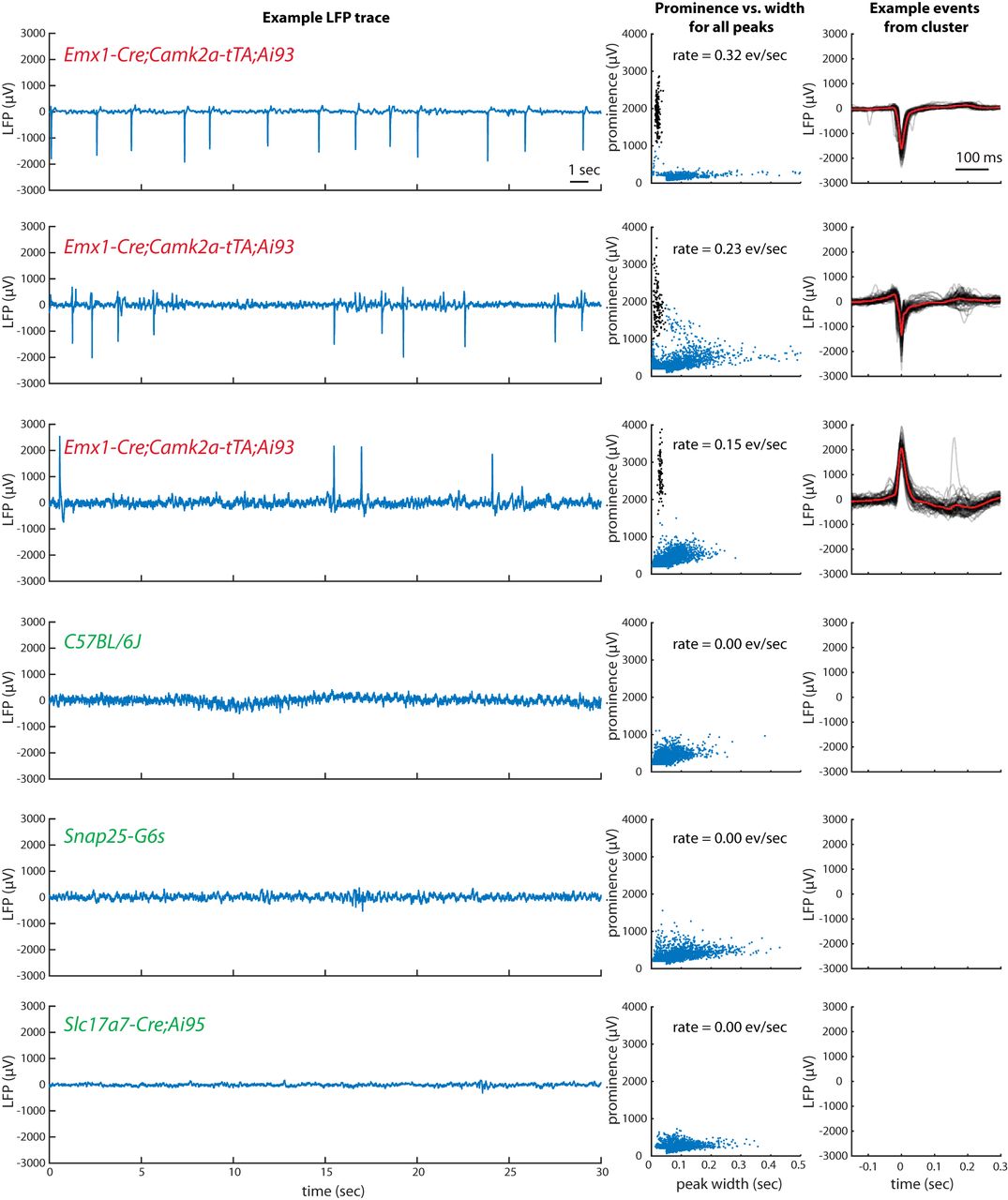
    Epileptiform electrical activity in frontal cortex of some GCaMP6-expressing mice but not others. Left, each row contains an example segment of raw LFP data from each of six mice, with genotype identified in colored text. Middle, a plot of the prominence versus width of all peaks (see Methods) in the full LFP traces. Points highlighted in black were identified as a distinct cluster and included in the computation of event rate and the example events plotted at right. Right, 50 example events (gray) and the mean of all events (red). For the recording in row C, positive peaks rather than negative were analyzed.

  • Figure 2.
    • Download figure
    • Open in new tab
    • Download powerpoint
    Figure 2.

    Comparison of events observed in LFP and widefield calcium imaging in the same mouse. Format as in Fig. 1. The two LFP recordings were made simultaneously with each other, but not simultaneously with the widefield imaging. In the frontal LFP recording, the two clusters in prominence versus width arise because of the double-peaked shape of the events in this mouse at this site: for some events, the width includes only the first peak; for some, it includes both.

  • Figure 3.
    • Download figure
    • Open in new tab
    • Download powerpoint
    Figure 3.

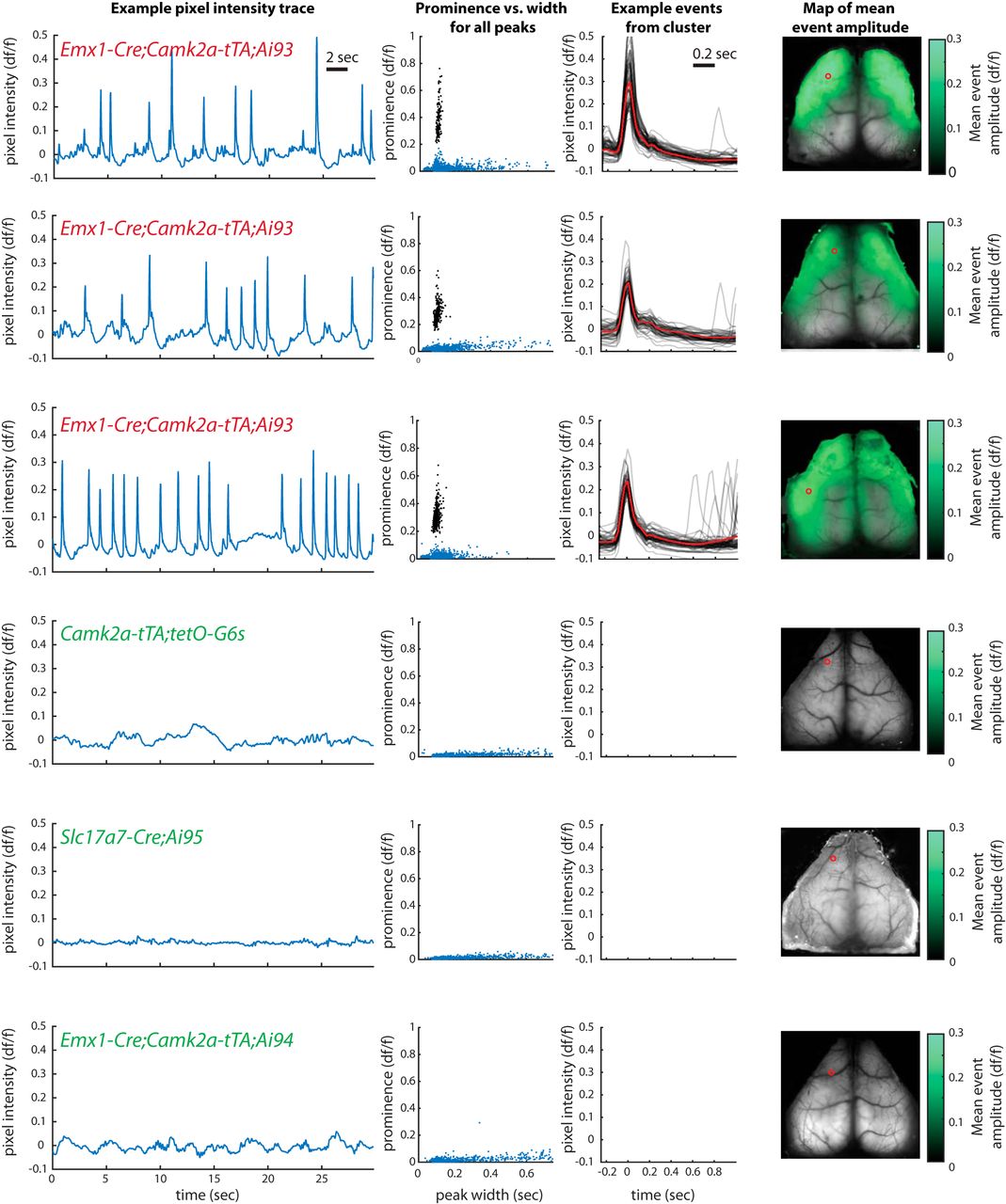
    Incidence and spatial extent of epileptiform events observed in widefield calcium imaging. Format as in Fig. 1. The intensity trace and detected peaks come from the pixel indicated by the red circle on the brain image at right. Green coloration in the rightmost panel, overlaid on the mean image of the brain, represents the amplitude of the mean event at each point across the brain. See Videos 1, 2, and 3 for examples.

  • Figure 4.
    • Download figure
    • Open in new tab
    • Download powerpoint
    Figure 4.

    Germline Cre recombination results in widespread GCaMP expression. A, B, Native GCaMP6 fluorescence obtained using two-photon serial tomography from two Rbp4-Cre/wt;Camk2a-tTA/wt;Ai93 STOP+/Ai93 STOP+ mice, showing expression of GCaMP only in restricted populations of L5 cortical neurons and moderate expression in hippocampus. C, D, Similar images with matched intensity scale but from a Rbp4-Cre/wt;Camk2a-tTA/wt;Ai93 STOP+/Ai93 STOPdel mouse that had germline Cre recombination, showing high, widespread expression across cortex and hippocampus.

  • Figure 5.
    • Download figure
    • Open in new tab
    • Download powerpoint
    Figure 5.

    Epileptiform events observed in LFP, two-photon calcium imaging, and widefield calcium imaging in one individual mouse, but not simultaneously. Format as in Fig. 1. The genotype of the mouse was Emx1-Cre;Camk2a-tTA;Ai94 (expressing GCaMP6s). Two-photon trace was generated as the mean intensity of each frame across the entire field of view; widefield trace was generated as the mean within an ROI approximating the two-photon field of view.

  • Figure 6.
    • Download figure
    • Open in new tab
    • Download powerpoint
    Figure 6.

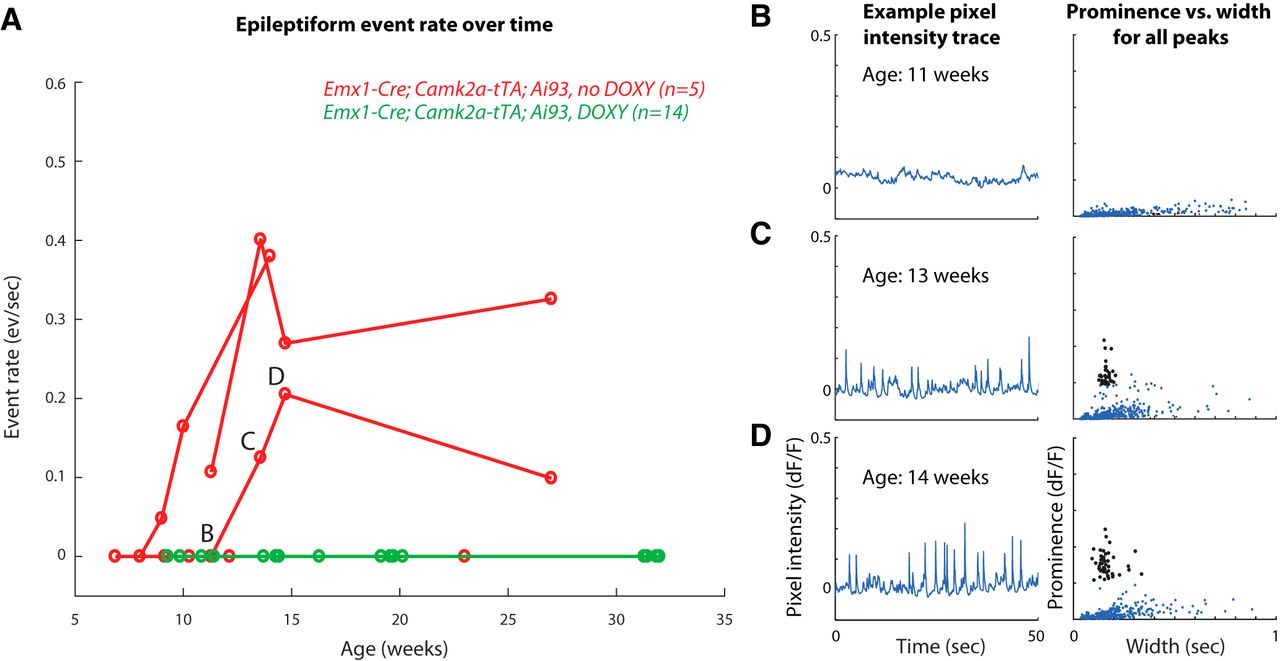
    Epileptiform events fail to develop over time in mice treated with doxycycline until age 7 weeks. A, Measured rates of epileptiform events in untreated (red) and doxycycline treated (green) mice by age at time of measurement. Connected points indicate observations from the same mouse. All doxycycline-treated mice failed to develop events over the measured time period. Note that the mice represented in this figure are a small subset of all measured mice, and we do not intend to claim that the time courses followed here are representative of all mice developing events. B, C, and D refer to the measurements corresponding to the figure panels at right. B–D, Example traces and prominence versus width plots for an example untreated mouse showing development of events between 11 and 14 weeks.
Tables

  • Figures
  • Movies
  • Extended Data
    • View popup
    Table 1.

    Incidence of epileptiform events in electrophysiological recordings of local field potentials in cortex

    GenotypeIncidence of events (mice)
    Emx1-Cre;Camk2a-tTA;Ai934/4
    Emx1-Cre;Camk2a-tTA;Ai941/1 a
    Slc17a7-Cre;Ai950/1
    Camk2a-tTA;tetO-G6s0/2
    Snap25-G6s0/1
    Pvalb-Cre;Ai320/2
    wildtype (C57BL/6J)0/4
    • Each count represents one mouse recorded electrophysiologically.

    • aThe Emx1-Cre;Camk2a-tTA;Ai94 mouse was selected for electrophysiology on the basis of epileptiform events observed in imaging.

    • View popup
    Table 2.

    Incidence of epileptiform events as observed with widefield calcium imaging

    Institute/laboratoryCre genotypetTA genotypeGCaMP genotypeIncidence of events in any size imaging window (mice)Incidence of events in full-hemisphere imaging (mice)
    High incidence
    Carandini/Harris, UCLEmx1Camk2aAi9311/1111/11
    Allen InstituteEmx1Camk2aAi939/185/7
    Margolis, RutgersEmx1Camk2aAi933/33/3
    Margolis, RutgersEmx1Rosa26Ai937/77/7
    Häusser, UCLEmx1-KessCamk2aAi937/12–
    Low incidence
    Allen InstituteSlc17a7Camk2aAi931/51/5
    Allen InstituteCux2Camk2aAi931/7–
    Carandini/Harris, UCLEmx1Camk2aAi941/40/3
    No events observed
    Allen InstituteRbp4Camk2aAi930/11–
    Allen InstituteRorbCamk2aAi930/3–
    Allen InstituteScnn1aCamk2aAi930/7–
    Häusser, UCLEmx1-KessCamk2a*Ai930/11–
    Carandini/Harris, UCLSlc17a7Ai950/70/7
    Allen InstituteEmx1Ai950/10/1
    Allen InstituteEmx1Ai960/30/3
    Carandini/Harris, UCLCamk2atetO-G6s0/90/9
    Allen InstituteCamk2atetO-G6s0/6–
    Carandini/Harris, UCLSnap25-G6s0/40/4
    Allen InstituteSnap25-G6s0/2–
    Margolis, RutgersGP4.30/20/2
    • Epileptiform events were judged to occur by manually inspecting raw imaging videos, traces, and prominence-versus-width plots for peaks of the traces, as shown in Fig. 3. See Methods for details of mouse lines and imaging preparations. All mice in this table had either intact Cre conditionality or unknown conditionality. Camk2a* indicates that these mice were treated with doxycycline until 7 weeks (see below). See Table 2-1 for further details on these observations.

    • View popup
    Table 3.

    Effects of germline Cre recombination on incidence of epileptiform events

    Cre genotypetTA genotypeGCaMP genotypeIncidence with germline Cre recombinationIncidence without germline Cre recombination
    Emx1Camk2aAi939/1030/44
    Ntsr1Camk2aAi935/9
    Rbp4Camk2aAi934/40/11
    RorbCamk2aAi935/80/3
    • “With germline Cre recombination”, mice that had lost Cre conditionality; “without”, mice that were normal, i.e. expressed GCaMP only in subsets of neurons according to the Cre driver line used. In this table, all mice were imaged with widefield calcium imaging of any size window.

Movies

  • Figures
  • Tables
  • Extended Data
  • Movie 1.

    Emx1-Cre;Camk2a-tTA;Ai93 mouse. A, The fluorescence signal imaged across the dorsal surface of the mouse brain (df/f). B, at top, velocity of a rubber wheel under the forepaws of the mouse; below, traces of df/f over time from the four identified pixels (matching color points in the first panel). Red points indicate detected epileptiform events. C, Two videos of the mouse. All movies play at half real time. Note that df/f scaling differs between movies for clarity of visualization. For further details of methodology, see Methods of widefield imaging at Carandini/Harris Laboratory.

  • Movie 2.

    Emx1-Cre;Camk2a-tTA;Ai93 mouse. A, The fluorescence signal imaged across the dorsal surface of the mouse brain (df/f). B, at top, velocity of a rubber wheel under the forepaws of the mouse; below, traces of df/f over time from the four identified pixels (matching color points in the first panel). Red points indicate detected epileptiform events. C, Two videos of the mouse. All movies play at half real time. Note that df/f scaling differs between movies for clarity of visualization. For further details of methodology, see Methods of widefield imaging at Carandini/Harris Laboratory.

  • Movie 3.

    Slc17a7-Cre;Ai95 mouse. A, The fluorescence signal imaged across the dorsal surface of the mouse brain (df/f). B, at top, velocity of a rubber wheel under the forepaws of the mouse; below, traces of df/f over time from the four identified pixels (matching color points in the first panel). Red points indicate detected epileptiform events. C, Two videos of the mouse. All movies play at half real time. Note that df/f scaling differs between movies for clarity of visualization. For further details of methodology, see Methods of widefield imaging at Carandini/Harris Laboratory.

Extended Data

  • Figures
  • Tables
  • Movies
  • Table 2-1

    Details for all examined mice. The genotype for each transgene is indicated, alleles separated by a slash, with “wt” for wildtype. –, unknown information; NA, not applicable (e.g., for germline Cre-mediated recombination status of transgenes that cannot be subject to Cre-mediated recombination). Germline Cre recombination status is given as all alleles have intact LSL cassette (STOP+); all alleles have recombined LSL (STOPdel+); or one allele recombined and one intact (STOP+/STOPdel+; see Methods). Ages indicate the oldest age observed when no epileptiform events were reported or the youngest age at which epileptiform events were observed when they were. Download Table 2.1, XLS file.

Back to top

In this issue

eneuro: 4 (5)
eNeuro
Vol. 4, Issue 5
September/October 2017
  • Table of Contents
  • Index by author
Email

Thank you for sharing this eNeuro article.

NOTE: We request your email address only to inform the recipient that it was you who recommended this article, and that it is not junk mail. We do not retain these email addresses.

Enter multiple addresses on separate lines or separate them with commas.
Aberrant Cortical Activity in Multiple GCaMP6-Expressing Transgenic Mouse Lines
(Your Name) has forwarded a page to you from eNeuro
(Your Name) thought you would be interested in this article in eNeuro.
CAPTCHA
This question is for testing whether or not you are a human visitor and to prevent automated spam submissions.
Print
View Full Page PDF
Citation Tools
Aberrant Cortical Activity in Multiple GCaMP6-Expressing Transgenic Mouse Lines
Nicholas A. Steinmetz, Christina Buetfering, Jerome Lecoq, Christian R. Lee, Andrew J. Peters, Elina A. K. Jacobs, Philip Coen, Douglas R. Ollerenshaw, Matthew T. Valley, Saskia E. J. de Vries, Marina Garrett, Jun Zhuang, Peter A. Groblewski, Sahar Manavi, Jesse Miles, Casey White, Eric Lee, Fiona Griffin, Joshua D. Larkin, Kate Roll, Sissy Cross, Thuyanh V. Nguyen, Rachael Larsen, Julie Pendergraft, Tanya Daigle, Bosiljka Tasic, Carol L. Thompson, Jack Waters, Shawn Olsen, David J. Margolis, Hongkui Zeng, Michael Hausser, Matteo Carandini, Kenneth D. Harris
eNeuro 4 September 2017, 4 (5) ENEURO.0207-17.2017; DOI: 10.1523/ENEURO.0207-17.2017

Citation Manager Formats

  • BibTeX
  • Bookends
  • EasyBib
  • EndNote (tagged)
  • EndNote 8 (xml)
  • Medlars
  • Mendeley
  • Papers
  • RefWorks Tagged
  • Ref Manager
  • RIS
  • Zotero
Respond to this article
Share
Aberrant Cortical Activity in Multiple GCaMP6-Expressing Transgenic Mouse Lines
Nicholas A. Steinmetz, Christina Buetfering, Jerome Lecoq, Christian R. Lee, Andrew J. Peters, Elina A. K. Jacobs, Philip Coen, Douglas R. Ollerenshaw, Matthew T. Valley, Saskia E. J. de Vries, Marina Garrett, Jun Zhuang, Peter A. Groblewski, Sahar Manavi, Jesse Miles, Casey White, Eric Lee, Fiona Griffin, Joshua D. Larkin, Kate Roll, Sissy Cross, Thuyanh V. Nguyen, Rachael Larsen, Julie Pendergraft, Tanya Daigle, Bosiljka Tasic, Carol L. Thompson, Jack Waters, Shawn Olsen, David J. Margolis, Hongkui Zeng, Michael Hausser, Matteo Carandini, Kenneth D. Harris
eNeuro 4 September 2017, 4 (5) ENEURO.0207-17.2017; DOI: 10.1523/ENEURO.0207-17.2017
Twitter logo Facebook logo Mendeley logo
  • Tweet Widget
  • Facebook Like
  • Google Plus One

Jump to section

  • Article
    • Abstract
    • Significance Statement
    • Introduction
    • Materials and Methods
    • Results
    • Discussion
    • Acknowledgments
    • Footnotes
    • References
    • Synthesis
  • Figures & Data
  • Info & Metrics
  • eLetters
  • PDF

Keywords

  • cortex
  • epilepsy
  • GCaMP
  • transgenic

Responses to this article

Respond to this article

Jump to comment:

No eLetters have been published for this article.

Related Articles

Cited By...

More in this TOC Section

Methods/New Tools

  • Superficial Bound of the Depth Limit of Two-Photon Imaging in Mouse Brain
  • A Toolbox of Criteria for Distinguishing Cajal–Retzius Cells from Other Neuronal Types in the Postnatal Mouse Hippocampus
  • Assessment of Spontaneous Neuronal Activity In Vitro Using Multi-Well Multi-Electrode Arrays: Implications for Assay Development
Show more Methods/New Tools

Novel Tools and Methods

  • Superficial Bound of the Depth Limit of Two-Photon Imaging in Mouse Brain
  • A Toolbox of Criteria for Distinguishing Cajal–Retzius Cells from Other Neuronal Types in the Postnatal Mouse Hippocampus
  • Assessment of Spontaneous Neuronal Activity In Vitro Using Multi-Well Multi-Electrode Arrays: Implications for Assay Development
Show more Novel Tools and Methods

Subjects

  • Novel Tools and Methods
  • Home
  • Alerts
  • Follow SFN on BlueSky
  • Visit Society for Neuroscience on Facebook
  • Follow Society for Neuroscience on Twitter
  • Follow Society for Neuroscience on LinkedIn
  • Visit Society for Neuroscience on Youtube
  • Follow our RSS feeds

Content

  • Early Release
  • Current Issue
  • Latest Articles
  • Issue Archive
  • Blog
  • Browse by Topic

Information

  • For Authors
  • For the Media

About

  • About the Journal
  • Editorial Board
  • Privacy Notice
  • Contact
  • Feedback
(eNeuro logo)
(SfN logo)

Copyright © 2026 by the Society for Neuroscience.
eNeuro eISSN: 2373-2822

The ideas and opinions expressed in eNeuro do not necessarily reflect those of SfN or the eNeuro Editorial Board. Publication of an advertisement or other product mention in eNeuro should not be construed as an endorsement of the manufacturer’s claims. SfN does not assume any responsibility for any injury and/or damage to persons or property arising from or related to any use of any material contained in eNeuro.