Main menu

  • HOME
  • CONTENT
    • Early Release
    • Featured
    • Current Issue
    • Issue Archive
    • Blog
    • Collections
    • Podcast
  • TOPICS
    • Cognition and Behavior
    • Development
    • Disorders of the Nervous System
    • History, Teaching and Public Awareness
    • Integrative Systems
    • Neuronal Excitability
    • Novel Tools and Methods
    • Sensory and Motor Systems
  • ALERTS
  • FOR AUTHORS
  • ABOUT
    • Overview
    • Editorial Board
    • For the Media
    • Privacy Policy
    • Contact Us
    • Feedback
  • SUBMIT

User menu

Search

  • Advanced search
eNeuro
eNeuro

Advanced Search


  • HOME
  • CONTENT
    • Early Release
    • Featured
    • Current Issue
    • Issue Archive
    • Blog
    • Collections
    • Podcast
  • TOPICS
    • Cognition and Behavior
    • Development
    • Disorders of the Nervous System
    • History, Teaching and Public Awareness
    • Integrative Systems
    • Neuronal Excitability
    • Novel Tools and Methods
    • Sensory and Motor Systems
  • ALERTS
  • FOR AUTHORS
  • ABOUT
    • Overview
    • Editorial Board
    • For the Media
    • Privacy Policy
    • Contact Us
    • Feedback
  • SUBMIT
PreviousNext
Review, Cognition and Behavior

Beyond the Status Quo: A Role for Beta Oscillations in Endogenous Content (Re)Activation

Bernhard Spitzer and Saskia Haegens
eNeuro 21 July 2017, 4 (4) ENEURO.0170-17.2017; https://doi.org/10.1523/ENEURO.0170-17.2017
Bernhard Spitzer
1Department of Experimental Psychology, University of Oxford, Oxford OX1 3UD, United Kingdom
  • Find this author on Google Scholar
  • Find this author on PubMed
  • Search for this author on this site
Saskia Haegens
2Department of Neurological Surgery, Columbia University College of Physicians and Surgeons, New York, NY 10032
3Centre for Cognitive Neuroimaging, Donders Institute for Brain, Cognition and Behaviour, Radboud University Nijmegen, Nijmegen 6500 HB, The Netherlands
  • Find this author on Google Scholar
  • Find this author on PubMed
  • Search for this author on this site
  • ORCID record for Saskia Haegens
  • Article
  • Figures & Data
  • Info & Metrics
  • eLetters
  • PDF
Loading

Article Figures & Data

Figures

  • Figure 1.
    • Download figure
    • Open in new tab
    • Download powerpoint
    Figure 1.

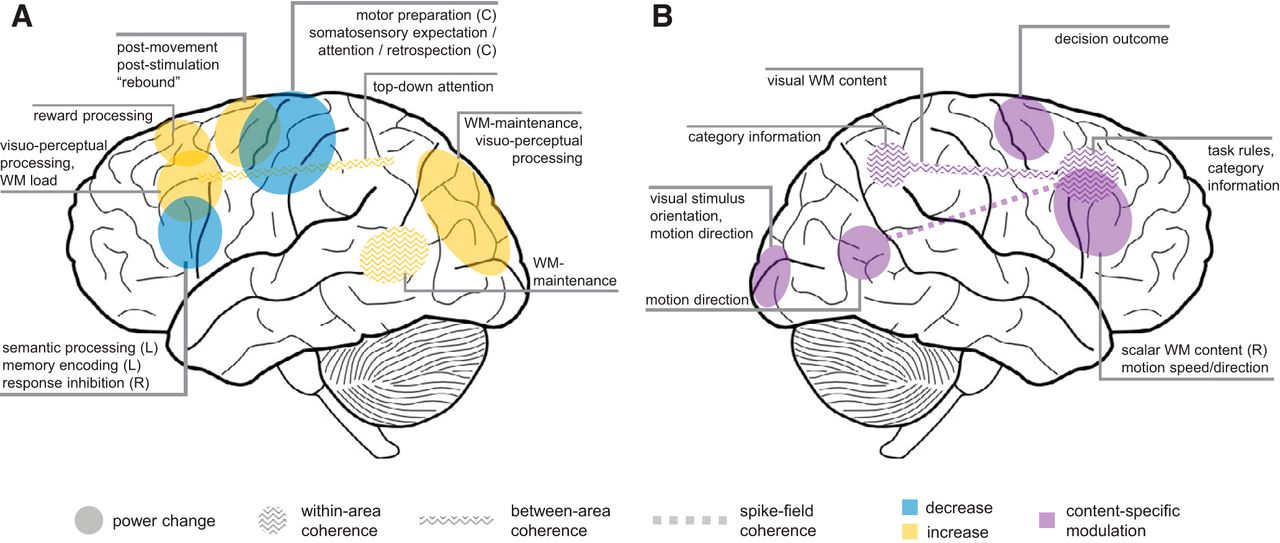
    Beyond motor control. Schematic overview of oscillatory beta-band effects across cortex. A, Overall beta activity changes (in-/decreases) associated with different cognitive functions (NB, nonexhaustive schematic). B, Content-specific modulations of beta-band activity; see text for details. For convenience, findings from human- and nonhuman primate studies are illustrated on a common template. Unless specified (L, left; R, right; C, contralateral), effects were not systematically lateralized.

  • Figure 2.
    • Download figure
    • Open in new tab
    • Download powerpoint
    Figure 2.

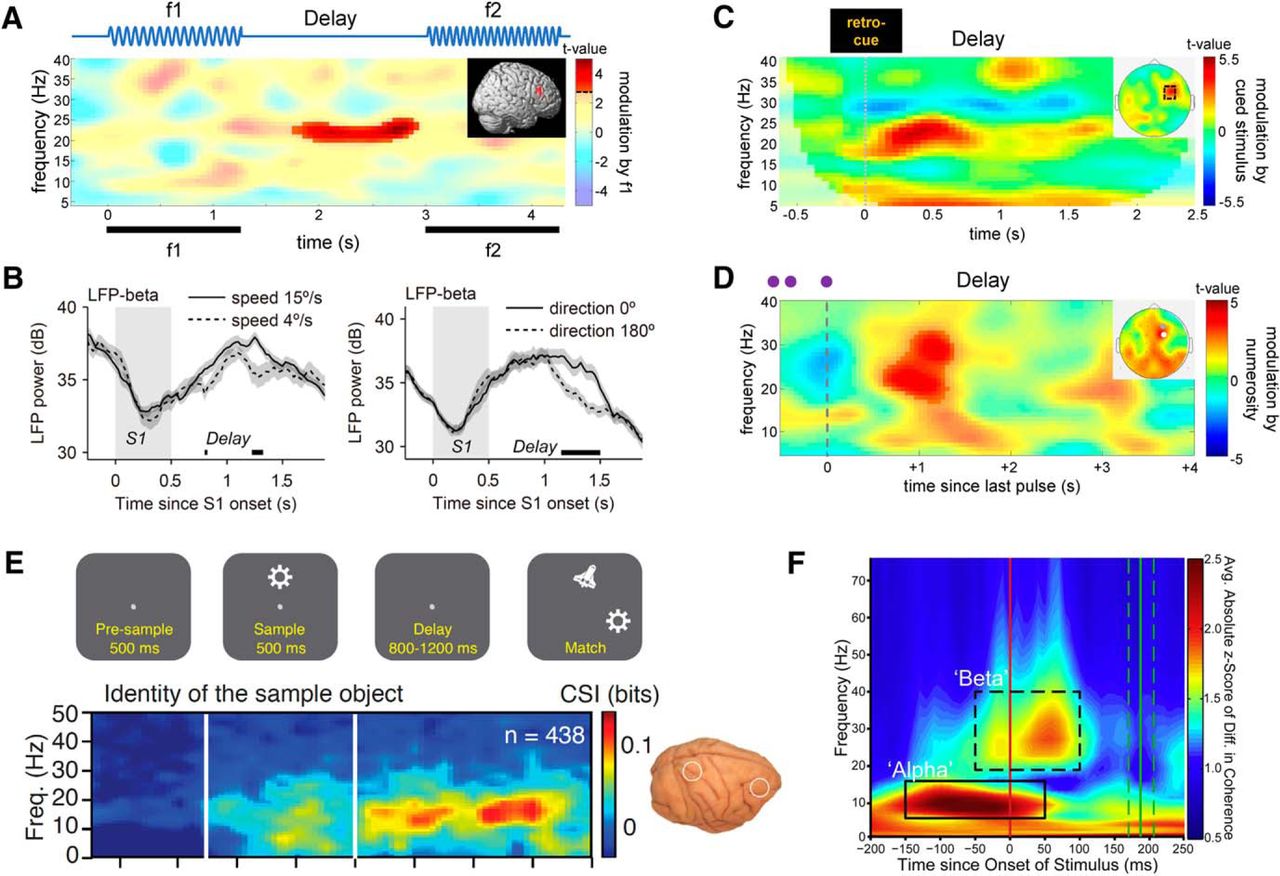
    Content-specific beta activity during WM processing. A, During WM maintenance of vibrotactile frequency information, prefrontal EEG beta power is parametrically modulated by the frequency of the to-be-maintained stimulus (f1). Adapted with permission from Spitzer et al. (2010). B, Similar beta power modulations were found in LFP recordings in monkey PFC during WM maintenance of visual motion information. Adapted with permission from Wimmer et al. (2016). Note that in standard delay tasks, beta modulations occurred mostly late in the WM delay period. C, In contrast, when participants were retro-cued to focus on a given WM content for further maintenance, beta was modulated early after the cue. Adapted with permission from Spitzer and Blankenburg (2011). D, Similar transient modulations were observed during WM processing of the approximate number of previously presented inputs (three to eight pulses in rapid sequence, illustrated in purple). Adapted with permission from Spitzer et al. (2014a). E, Content-specific fronto-parietal beta-synchronization during WM maintenance of visual object information in monkeys. As in A–D, these effects were absent during stimulus encoding. Adapted with permission from Salazar et al. (2012). Reprinted with permission from AAAS. F, Rule-dependent beta-synchronization in monkey PFC at the time of the to-be-evaluated stimulus (see also Fig. 4C). Adapted with permission from Buschman et al. (2012). Reprinted with permission from Elsevier.

  • Figure 3.
    • Download figure
    • Open in new tab
    • Download powerpoint
    Figure 3.

    Content-specific beta activity during decision making. A, Source reconstruction showing lateralized, effector-selective beta activity (left- vs right-hand response) before button press, in human subjects performing a visual motion detection task (left panel). Time courses of lateralized beta activity in motor cortex indicate accumulative updating of the motor plan as a decision evolves (right panel). Adapted with permission from Donner et al. (2009). Reprinted with permission from Elsevier. B, Beta power modulation in monkey medial premotor cortex before motor response in vibrotactile discrimination task reflects binary decision outcome, also on error trials. Spectra on the right are averaged over the time window indicated by dashed box in the left panel, per stimulus class (sorted by f2-f1 difference), for correct and incorrect trials separately. Adapted with permission from Haegens et al. (2011b). C, Remarkably similar observation as in B, in human EEG recordings using the same paradigm. Adapted with permission from Herding et al. (2016). © 2016 by the Massachusetts Institute of Technology, published by the MIT Press.

  • Figure 4.
    • Download figure
    • Open in new tab
    • Download powerpoint
    Figure 4.

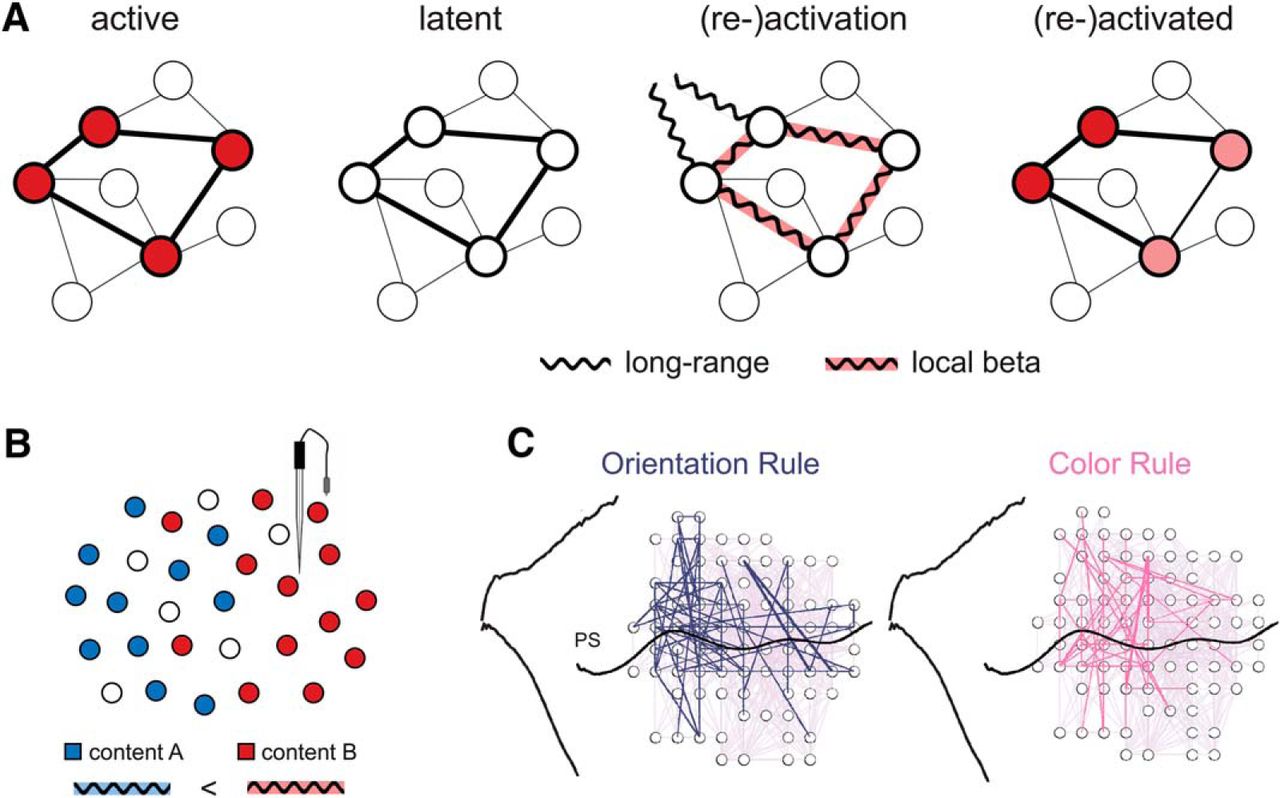
    A framework for content-specific beta activity. A, Content-specific beta-synchronization as endogenously driven transition from latent to active cortical representation. Left, Active cortical representations (e.g., of currently perceived, task-relevant information) are characterized by spiking activity (symbolized in red) in content-specific neuronal ensembles. Second from left, In the absence of perceptual input and/or attentional prioritization, information can be retained in latent memory representations, without spiking activity in the content-specific ensemble, e.g., in patterns of synaptic weights. Second from right, Endogenously driven (re)activation of a content-coding ensemble is characterized by a brief period of beta-synchronization, involving both local and long-range (top-down) interactions (see text for details). Right, (Re)activated content representations may again be characterized by spiking ensemble activity, similar (but not necessarily exactly identical) to representations of just perceived information (compare with left). B, Local beta activity appears content specific when population-level recordings register the synchronization of individual subpopulations (symbolized in blue and red) with differential sensitivity (e.g., red > blue, by spatial proximity to recording site). C, Transient network-level beta coherence in monkey PFC during application of different task rules (Fig. 2F, dashed rectangle). Adapted with permission from Buschman et al. (2012). Reprinted with permission from Elsevier.
Back to top

In this issue

eneuro: 4 (4)
eNeuro
Vol. 4, Issue 4
July/August 2017
  • Table of Contents
  • Index by author
Email

Thank you for sharing this eNeuro article.

NOTE: We request your email address only to inform the recipient that it was you who recommended this article, and that it is not junk mail. We do not retain these email addresses.

Enter multiple addresses on separate lines or separate them with commas.
Beyond the Status Quo: A Role for Beta Oscillations in Endogenous Content (Re)Activation
(Your Name) has forwarded a page to you from eNeuro
(Your Name) thought you would be interested in this article in eNeuro.
CAPTCHA
This question is for testing whether or not you are a human visitor and to prevent automated spam submissions.
Print
View Full Page PDF
Citation Tools
Beyond the Status Quo: A Role for Beta Oscillations in Endogenous Content (Re)Activation
Bernhard Spitzer, Saskia Haegens
eNeuro 21 July 2017, 4 (4) ENEURO.0170-17.2017; DOI: 10.1523/ENEURO.0170-17.2017

Citation Manager Formats

  • BibTeX
  • Bookends
  • EasyBib
  • EndNote (tagged)
  • EndNote 8 (xml)
  • Medlars
  • Mendeley
  • Papers
  • RefWorks Tagged
  • Ref Manager
  • RIS
  • Zotero
Respond to this article
Share
Beyond the Status Quo: A Role for Beta Oscillations in Endogenous Content (Re)Activation
Bernhard Spitzer, Saskia Haegens
eNeuro 21 July 2017, 4 (4) ENEURO.0170-17.2017; DOI: 10.1523/ENEURO.0170-17.2017
Twitter logo Facebook logo Mendeley logo
  • Tweet Widget
  • Facebook Like
  • Google Plus One

Jump to section

  • Article
    • Abstract
    • Significance Statement
    • Introduction
    • Beta-band oscillations in WM
    • Beta-band oscillations in decision making
    • A role for beta oscillations in endogenous content (re)activation
    • Conclusion
    • Acknowledgments
    • Footnotes
    • References
    • Synthesis
  • Figures & Data
  • Info & Metrics
  • eLetters
  • PDF

Keywords

  • beta rhythm
  • decision making
  • network interactions
  • neural oscillations
  • top-down control
  • working memory

Responses to this article

Respond to this article

Jump to comment:

No eLetters have been published for this article.

Related Articles

Cited By...

More in this TOC Section

Review

  • Open Data In Neurophysiology: Advancements, Solutions & Challenges
  • My 50 Year Odyssey to Develop Behavioral Methods to Let Me See Quickly How Well Kittens See
  • A Systematic Review and Meta-Analysis Assessing the Accuracy of Blood Biomarkers for the Diagnosis of Ischemic Stroke in Adult and Elderly Populations
Show more Review

Cognition and Behavior

  • Is Social Media Use a Blessing or Cure for Motor Function and Skill Acquisition? An Opinion Paper
  • Transcriptional Changes Fade Prior to Long-Term Memory for Sensitization of the Aplysia Siphon-Withdrawal Reflex.
  • Short-Term Perceptual Training Modulates Neural Responses to Deepfake Speech but Does Not Improve Behavioral Discrimination
Show more Cognition and Behavior

Subjects

  • Cognition and Behavior
  • Reviews
  • Home
  • Alerts
  • Follow SFN on BlueSky
  • Visit Society for Neuroscience on Facebook
  • Follow Society for Neuroscience on Twitter
  • Follow Society for Neuroscience on LinkedIn
  • Visit Society for Neuroscience on Youtube
  • Follow our RSS feeds

Content

  • Early Release
  • Current Issue
  • Latest Articles
  • Issue Archive
  • Blog
  • Browse by Topic

Information

  • For Authors
  • For the Media

About

  • About the Journal
  • Editorial Board
  • Privacy Notice
  • Contact
  • Feedback
(eNeuro logo)
(SfN logo)

Copyright © 2026 by the Society for Neuroscience.
eNeuro eISSN: 2373-2822

The ideas and opinions expressed in eNeuro do not necessarily reflect those of SfN or the eNeuro Editorial Board. Publication of an advertisement or other product mention in eNeuro should not be construed as an endorsement of the manufacturer’s claims. SfN does not assume any responsibility for any injury and/or damage to persons or property arising from or related to any use of any material contained in eNeuro.