Main menu

  • HOME
  • CONTENT
    • Early Release
    • Featured
    • Current Issue
    • Issue Archive
    • Blog
    • Collections
    • Podcast
  • TOPICS
    • Cognition and Behavior
    • Development
    • Disorders of the Nervous System
    • History, Teaching and Public Awareness
    • Integrative Systems
    • Neuronal Excitability
    • Novel Tools and Methods
    • Sensory and Motor Systems
  • ALERTS
  • FOR AUTHORS
  • ABOUT
    • Overview
    • Editorial Board
    • For the Media
    • Privacy Policy
    • Contact Us
    • Feedback
  • SUBMIT

User menu

Search

  • Advanced search
eNeuro
eNeuro

Advanced Search


  • HOME
  • CONTENT
    • Early Release
    • Featured
    • Current Issue
    • Issue Archive
    • Blog
    • Collections
    • Podcast
  • TOPICS
    • Cognition and Behavior
    • Development
    • Disorders of the Nervous System
    • History, Teaching and Public Awareness
    • Integrative Systems
    • Neuronal Excitability
    • Novel Tools and Methods
    • Sensory and Motor Systems
  • ALERTS
  • FOR AUTHORS
  • ABOUT
    • Overview
    • Editorial Board
    • For the Media
    • Privacy Policy
    • Contact Us
    • Feedback
  • SUBMIT
PreviousNext
Research ArticleNew Research, Cognition and Behavior

Nucleus Accumbens Shell Dopamine Preferentially Tracks Information Related to Outcome Value of Reward

Deirdre A. Sackett, Michael P. Saddoris and Regina M. Carelli
eNeuro 26 May 2017, 4 (3) ENEURO.0058-17.2017; https://doi.org/10.1523/ENEURO.0058-17.2017
Deirdre A. Sackett
1Department of Psychology and Neuroscience, University of North Carolina, Chapel Hill, NC 27599
  • Find this author on Google Scholar
  • Find this author on PubMed
  • Search for this author on this site
  • ORCID record for Deirdre A. Sackett
Michael P. Saddoris
2Department of Psychology and Neuroscience, University of Colorado Boulder, Boulder, CO 80309
  • Find this author on Google Scholar
  • Find this author on PubMed
  • Search for this author on this site
  • ORCID record for Michael P. Saddoris
Regina M. Carelli
1Department of Psychology and Neuroscience, University of North Carolina, Chapel Hill, NC 27599
  • Find this author on Google Scholar
  • Find this author on PubMed
  • Search for this author on this site
  • Article
  • Figures & Data
  • Info & Metrics
  • eLetters
  • PDF
Loading

Article Figures & Data

Figures

  • Tables
  • Fig. 1.
    • Download figure
    • Open in new tab
    • Download powerpoint
    Fig. 1.

    Magnitude-based decision-making task and behavior. A, Schematic of behavioral task. Left, during forced choice high-magnitude trials, one cue light was illuminated for 5 s followed by extension of both levers. Presses on the correct lever resulted in two sucrose pellets. Presses on the nonsignaled lever were counted as errors, resulting in termination of the houselight for the remainder of the trial period, with no reward delivery. Middle, on forced choice low-magnitude trials, the other cue light was illuminated for 5 s followed by extension of both levers. If the correct lever was chosen, one sucrose pellet was delivered. Presses on the nonsignaled lever were counted as errors and were unrewarded. Right, during free choice trials, both cue lights illuminated for 5 s followed by extension of both levers. Responses were rewarded based on the contingency of the lever chosen. B, Percentage of correct reinforced responses during high- and low-magnitude forced choice trials. C, Percentage of total errors on forced choice trials. D, Responses during free choice trials indicate that rats significantly preferred the high-magnitude (compared with low-magnitude) option. Data are mean ± SEM. *, p < 0.01.

  • Fig. 2.
    • Download figure
    • Open in new tab
    • Download powerpoint
    Fig. 2.

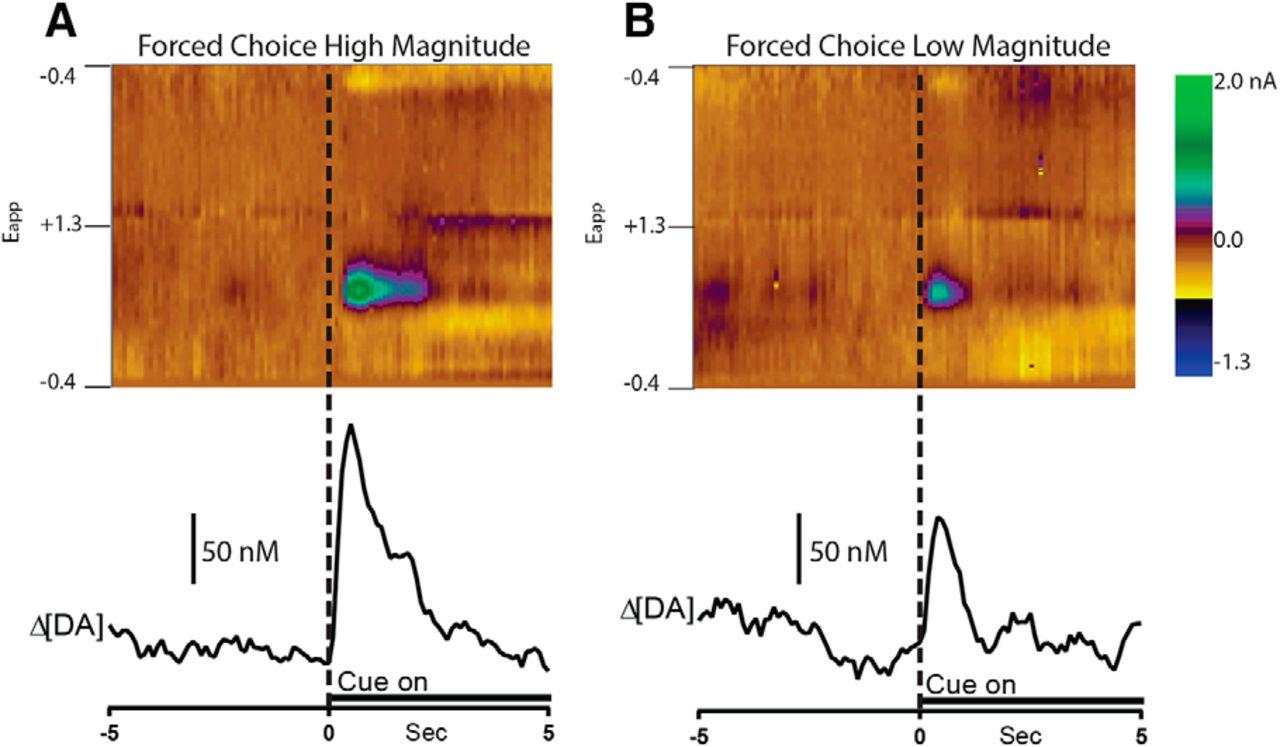
    Example of differential dopamine release dynamics to the cue signaling high and low forced choice trials. Two-dimensional color representations of cyclic voltammetric data collected for 10 s around forced high-magnitude (A) and forced low-magnitude (B) trials in the NAc shell for a single representative animal. The ordinate is the applied voltage (Eapp) and the abscissa is time (s). Differential dopamine concentration [DA] determined via principal component analysis is plotted below the color plots.

  • Fig. 3.
    • Download figure
    • Open in new tab
    • Download powerpoint
    Fig. 3.

    Dopamine release dynamics in the NAc shell and core during the magnitude based decision-making task. A, Average dopamine release in the shell across all rats and trial types. B, Average dopamine release in the core across all rats and trial types. Dashed line at time 0 indicates cue period in A and B.

  • Fig. 4.
    • Download figure
    • Open in new tab
    • Download powerpoint
    Fig. 4.

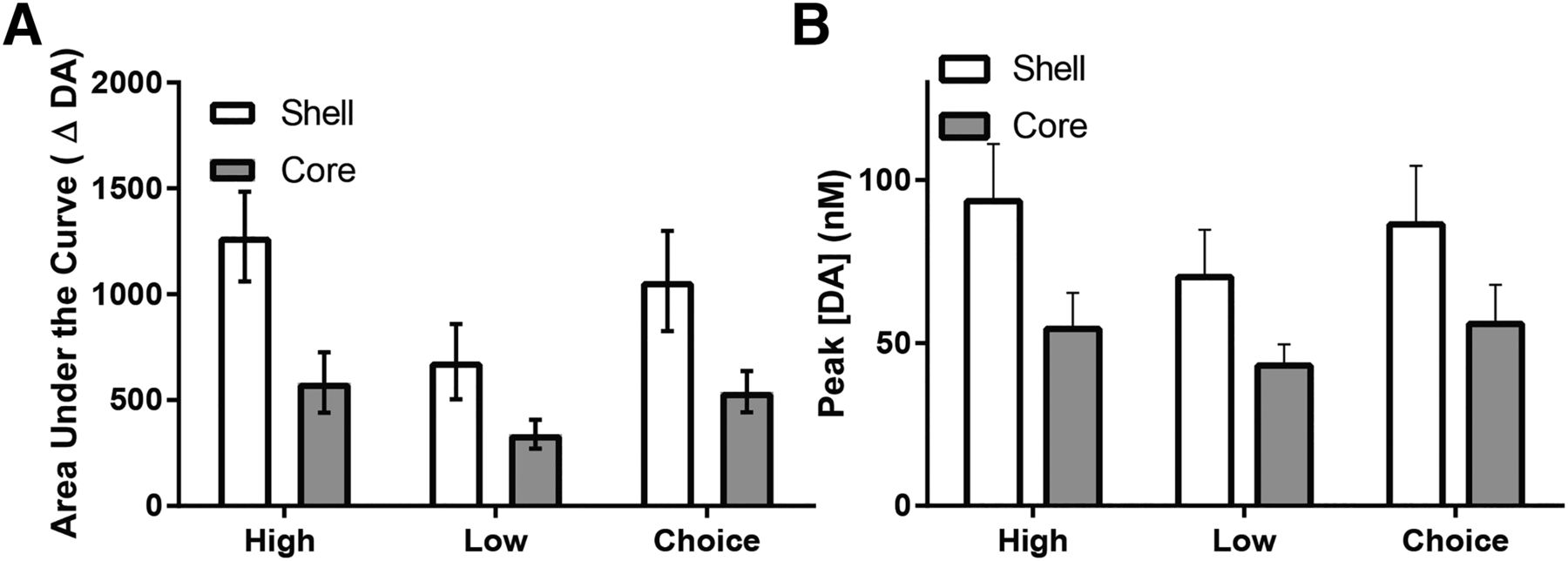
    Cue-evoked dopamine release dynamics in the NAc shell and core. A, Area under the curve analysis across both the shell and core during forced high, forced low, and free choice trials. B, Peak dopamine concentration [DA] across all rats in the shell and core during forced high, forced low, and free choice trials. All data are mean ± SEM. *, p < 0.05.

  • Fig. 5.
    • Download figure
    • Open in new tab
    • Download powerpoint
    Fig. 5.

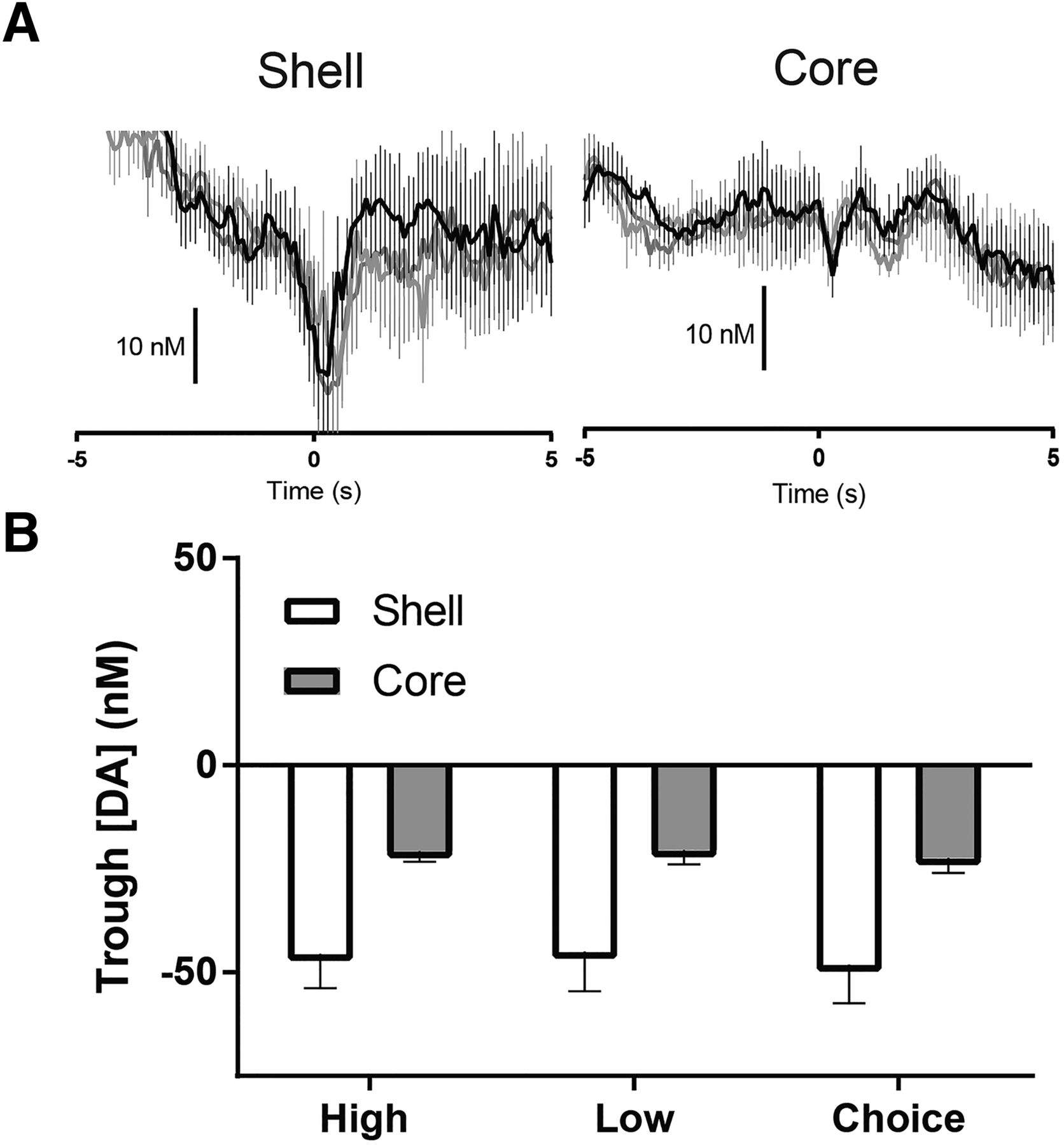
    Dopamine release dynamics relative to the lever press response during the task. A, Dopamine release dynamics in the NAc shell and core aligned to lever press response (onset at time 0) across forced high, forced low, and free choice trials. B, Trough dopamine concentration [DA] across all rats in the shell and core during forced high (black lines), forced low (light gray lines), and free choice (dark gray lines) trials. All data are mean ± SEM. *, p < 0.05.

  • Fig. 6.
    • Download figure
    • Open in new tab
    • Download powerpoint
    Fig. 6.

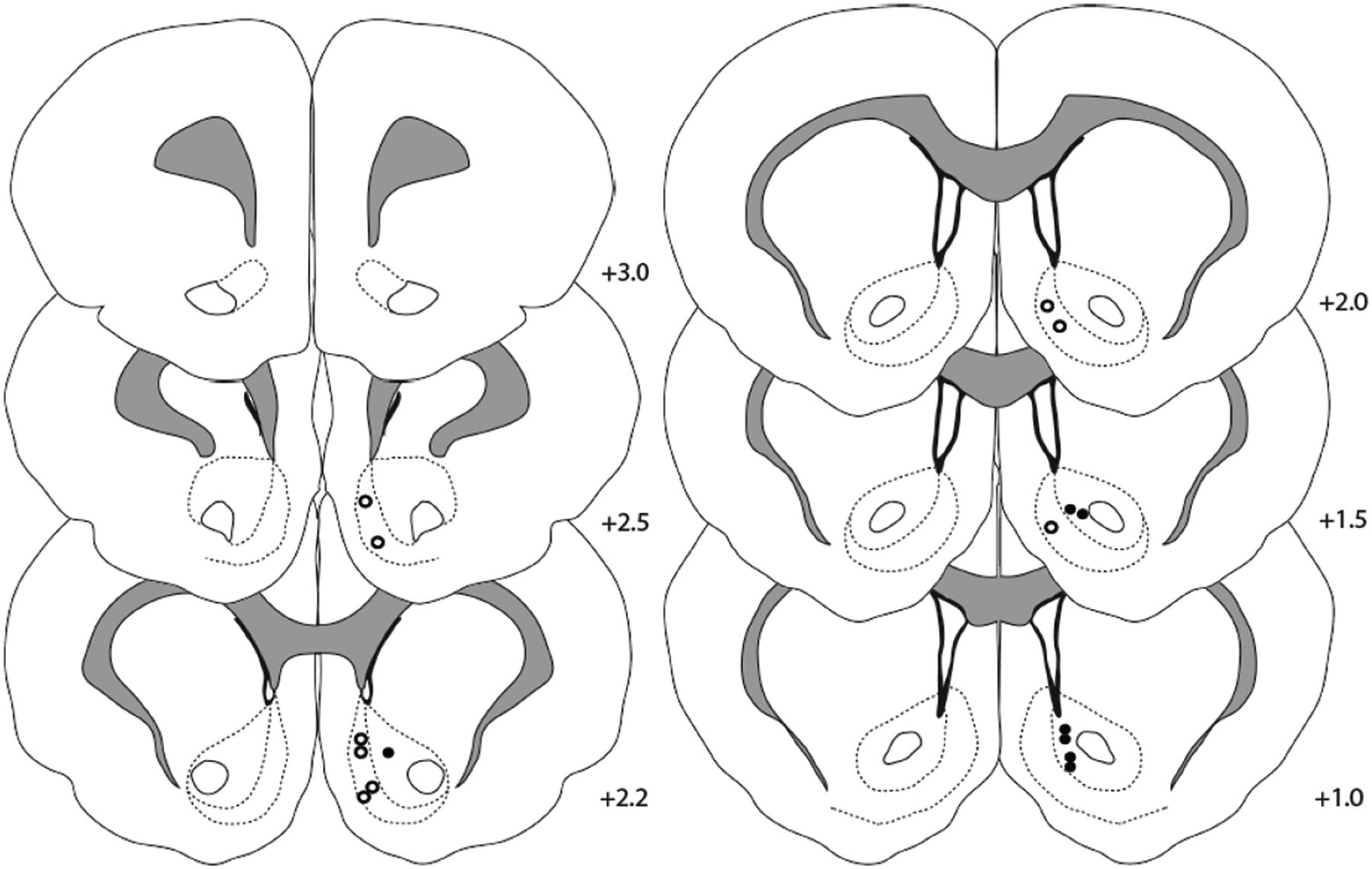
    Histologic confirmation of carbon-fiber microelectrodes tips in the NAc shell (n = 8, white circles) or core (n = 7, black circles).

Tables

  • Figures
    • View popup
    Table 1.

    Statistical analyses

    LocationFig.Data structureType of testStatistical valuep-value
    a1BNormal distribution, 2-tailedPaired t testt14 = 3.726<0.01
    b1CNormal distribution, 2-tailedPaired t testt14 = 3.769<0.01
    c1DNormal distribution, 2-tailedPaired t testt14 = 13.90<0.001
    d3AOne factor (time)One-way ANOVAF5,35 = 3.214<0.05
    Fisher’s LSDHigh
    Low
    Choice
    <0.05
    >0.05
    <0.05
    Normal distribution, 2-tailedPaired t testt5 = 1.779>0.05
    Normal distribution, 2-tailedPaired t testt7 = 0.3043>0.05
    e3B1-Way ANOVAF5,30 = 0.6477>0.05
    Normal distribution, 2-tailedPaired t testt4 = 1.006>0.05
    Normal distribution, 2-tailedPaired t testt5 = 0.6448>0.05
    f4ATwo factors (trial type, region)2-way ANOVATrial type: F2,26 = 14.40
    Region: F1,13 = 5.124
    Interaction: F2,26 = 2.371
    <0.0001
    <0.05
    0.1133
    Bonferroni’sHigh vs. low
    High vs. choice
    Choice vs. low
    <0.05
    >0.05
    <0.05
    g4BTwo factors (trial type, region)2-way ANOVATrial type: F2,26 = 7.584
    Region: F1,14 = 2.738
    Interaction: F2,14 = 0.857
    <0.01
    0.1219
    0.4362
    Bonferroni’sHigh vs. low
    High vs. choice
    Choice vs. low
    <0.05
    >0.05
    <0.05
    h5BTwo factors (trial type, region)2-way ANOVATrial type: F2,24 = 0.42
    Region: F1,12 = 5.744
    Interaction: F2,24 = 0.026
    0.6617
    <0.05
    0.9748
Back to top

In this issue

eneuro: 4 (3)
eNeuro
Vol. 4, Issue 3
May/June 2017
  • Table of Contents
  • Index by author
Email

Thank you for sharing this eNeuro article.

NOTE: We request your email address only to inform the recipient that it was you who recommended this article, and that it is not junk mail. We do not retain these email addresses.

Enter multiple addresses on separate lines or separate them with commas.
Nucleus Accumbens Shell Dopamine Preferentially Tracks Information Related to Outcome Value of Reward
(Your Name) has forwarded a page to you from eNeuro
(Your Name) thought you would be interested in this article in eNeuro.
CAPTCHA
This question is for testing whether or not you are a human visitor and to prevent automated spam submissions.
Print
View Full Page PDF
Citation Tools
Nucleus Accumbens Shell Dopamine Preferentially Tracks Information Related to Outcome Value of Reward
Deirdre A. Sackett, Michael P. Saddoris, Regina M. Carelli
eNeuro 26 May 2017, 4 (3) ENEURO.0058-17.2017; DOI: 10.1523/ENEURO.0058-17.2017

Citation Manager Formats

  • BibTeX
  • Bookends
  • EasyBib
  • EndNote (tagged)
  • EndNote 8 (xml)
  • Medlars
  • Mendeley
  • Papers
  • RefWorks Tagged
  • Ref Manager
  • RIS
  • Zotero
Respond to this article
Share
Nucleus Accumbens Shell Dopamine Preferentially Tracks Information Related to Outcome Value of Reward
Deirdre A. Sackett, Michael P. Saddoris, Regina M. Carelli
eNeuro 26 May 2017, 4 (3) ENEURO.0058-17.2017; DOI: 10.1523/ENEURO.0058-17.2017
Twitter logo Facebook logo Mendeley logo
  • Tweet Widget
  • Facebook Like
  • Google Plus One

Jump to section

  • Article
    • Abstract
    • Significance Statement
    • Introduction
    • Materials and Methods
    • Results
    • Discussion
    • Acknowledgments
    • Footnotes
    • References
    • Synthesis
  • Figures & Data
  • Info & Metrics
  • eLetters
  • PDF

Keywords

  • Accumbens
  • behavior
  • decision making
  • dopamine
  • electrochemistry
  • reward

Responses to this article

Respond to this article

Jump to comment:

No eLetters have been published for this article.

Related Articles

Cited By...

More in this TOC Section

New Research

  • A Very Fast Time Scale of Human Motor Adaptation: Within Movement Adjustments of Internal Representations during Reaching
  • TrkB Signaling Influences Gene Expression in Cortistatin-Expressing Interneurons
  • Optogenetic Activation of β-Endorphin Terminals in the Medial Preoptic Nucleus Regulates Female Sexual Receptivity
Show more New Research

Cognition and Behavior

  • Neck Vascular Biomechanical Dysfunction Precedes Brain Biochemical Alterations in a Murine Model of Alzheimer’s Disease
  • Spontaneous oscillatory activity in episodic timing: an EEG replication study and its limitations
  • Neural Signatures of Engagement and Event Segmentation during Story Listening in Background Noise
Show more Cognition and Behavior

Subjects

  • Cognition and Behavior
  • Home
  • Alerts
  • Follow SFN on BlueSky
  • Visit Society for Neuroscience on Facebook
  • Follow Society for Neuroscience on Twitter
  • Follow Society for Neuroscience on LinkedIn
  • Visit Society for Neuroscience on Youtube
  • Follow our RSS feeds

Content

  • Early Release
  • Current Issue
  • Latest Articles
  • Issue Archive
  • Blog
  • Browse by Topic

Information

  • For Authors
  • For the Media

About

  • About the Journal
  • Editorial Board
  • Privacy Notice
  • Contact
  • Feedback
(eNeuro logo)
(SfN logo)

Copyright © 2026 by the Society for Neuroscience.
eNeuro eISSN: 2373-2822

The ideas and opinions expressed in eNeuro do not necessarily reflect those of SfN or the eNeuro Editorial Board. Publication of an advertisement or other product mention in eNeuro should not be construed as an endorsement of the manufacturer’s claims. SfN does not assume any responsibility for any injury and/or damage to persons or property arising from or related to any use of any material contained in eNeuro.