
Main menu

  • HOME
  • CONTENT
    • Early Release
    • Featured
    • Current Issue
    • Issue Archive
    • Blog
    • Collections
    • Podcast
  • TOPICS
    • Cognition and Behavior
    • Development
    • Disorders of the Nervous System
    • History, Teaching and Public Awareness
    • Integrative Systems
    • Neuronal Excitability
    • Novel Tools and Methods
    • Sensory and Motor Systems
  • ALERTS
  • FOR AUTHORS
  • ABOUT
    • Overview
    • Editorial Board
    • For the Media
    • Privacy Policy
    • Contact Us
    • Feedback
  • SUBMIT

User menu

Search

  • Advanced search
eNeuro
eNeuro

Advanced Search


  • HOME
  • CONTENT
    • Early Release
    • Featured
    • Current Issue
    • Issue Archive
    • Blog
    • Collections
    • Podcast
  • TOPICS
    • Cognition and Behavior
    • Development
    • Disorders of the Nervous System
    • History, Teaching and Public Awareness
    • Integrative Systems
    • Neuronal Excitability
    • Novel Tools and Methods
    • Sensory and Motor Systems
  • ALERTS
  • FOR AUTHORS
  • ABOUT
    • Overview
    • Editorial Board
    • For the Media
    • Privacy Policy
    • Contact Us
    • Feedback
  • SUBMIT
PreviousNext
Research ArticleNew Research, Sensory and Motor Systems

Parallel Specification of Visuomotor Feedback Gains during Bimanual Reaching to Independent Goals

Anouk J. de Brouwer, Tayler Jarvis, Jason P. Gallivan and J. Randall Flanagan
eNeuro 3 March 2017, 4 (2) ENEURO.0026-17.2017; https://doi.org/10.1523/ENEURO.0026-17.2017
Anouk J. de Brouwer
1Centre for Neuroscience Studies, Queen’s University, Kingston, Ontario, Canada
  • Find this author on Google Scholar
  • Find this author on PubMed
  • Search for this author on this site
  • ORCID record for Anouk J. de Brouwer
Tayler Jarvis
2Department of Psychology, Queen’s University, Kingston, Ontario, Canada
  • Find this author on Google Scholar
  • Find this author on PubMed
  • Search for this author on this site
  • ORCID record for Tayler Jarvis
Jason P. Gallivan
1Centre for Neuroscience Studies, Queen’s University, Kingston, Ontario, Canada
2Department of Psychology, Queen’s University, Kingston, Ontario, Canada
3Department of Biomedical and Molecular Sciences, Queen’s University, Kingston, Ontario, Canada
  • Find this author on Google Scholar
  • Find this author on PubMed
  • Search for this author on this site
J. Randall Flanagan
1Centre for Neuroscience Studies, Queen’s University, Kingston, Ontario, Canada
2Department of Psychology, Queen’s University, Kingston, Ontario, Canada
  • Find this author on Google Scholar
  • Find this author on PubMed
  • Search for this author on this site
  • ORCID record for J. Randall Flanagan
  • Article
  • Figures & Data
  • Info & Metrics
  • eLetters
  • PDF
Loading

Article Figures & Data

Figures

  • Tables
  • Figure 1.
    • Download figure
    • Open in new tab
    • Download powerpoint
    Figure 1.

    Experimental methods. (A) Experimental setup. Participants performed reaching movements in the horizontal plane while holding on to the handles of the robotic manipulandum. (B) Example bimanual nonchannel trial of experiment 1. Participants were instructed to fixate on the left or right reach target. Reach targets could be both narrow (in blue) or wide (in red). On a subset of trials, one of the hand cursors was visually displaced to the left or right after it passed under a visual occluder, requiring a correction of the movement trajectory. (C) Cursor paths from an example participant in response to a leftward (in green), zero (in gray), and rightward (in blue) shift of the left-hand cursor during bimanual reaching to narrow targets in nonchannel trials. (D) Same as C, but with reaching to wide targets (orange, leftward cursor shift; gray, no cursor shift; red, rightward cursor shift). (E) Example bimanual force channel trial of experiment 1. Participants’ hand movements were constrained along a straight line from start to target position, allowing us to measure the forces applied into the virtual wall of the channel (depicted by the black dashed lines). In cursor perturbation trials, the cursor automatically moved back to this line 250 ms after the perturbation. (F) Example bimanual force channel trial of experiment 2. Participants were instructed to fixate on a central fixation target. On a subset of trials, a single or both hand cursors were visually displaced to the left or right.

  • Figure 2.
    • Download figure
    • Open in new tab
    • Download powerpoint
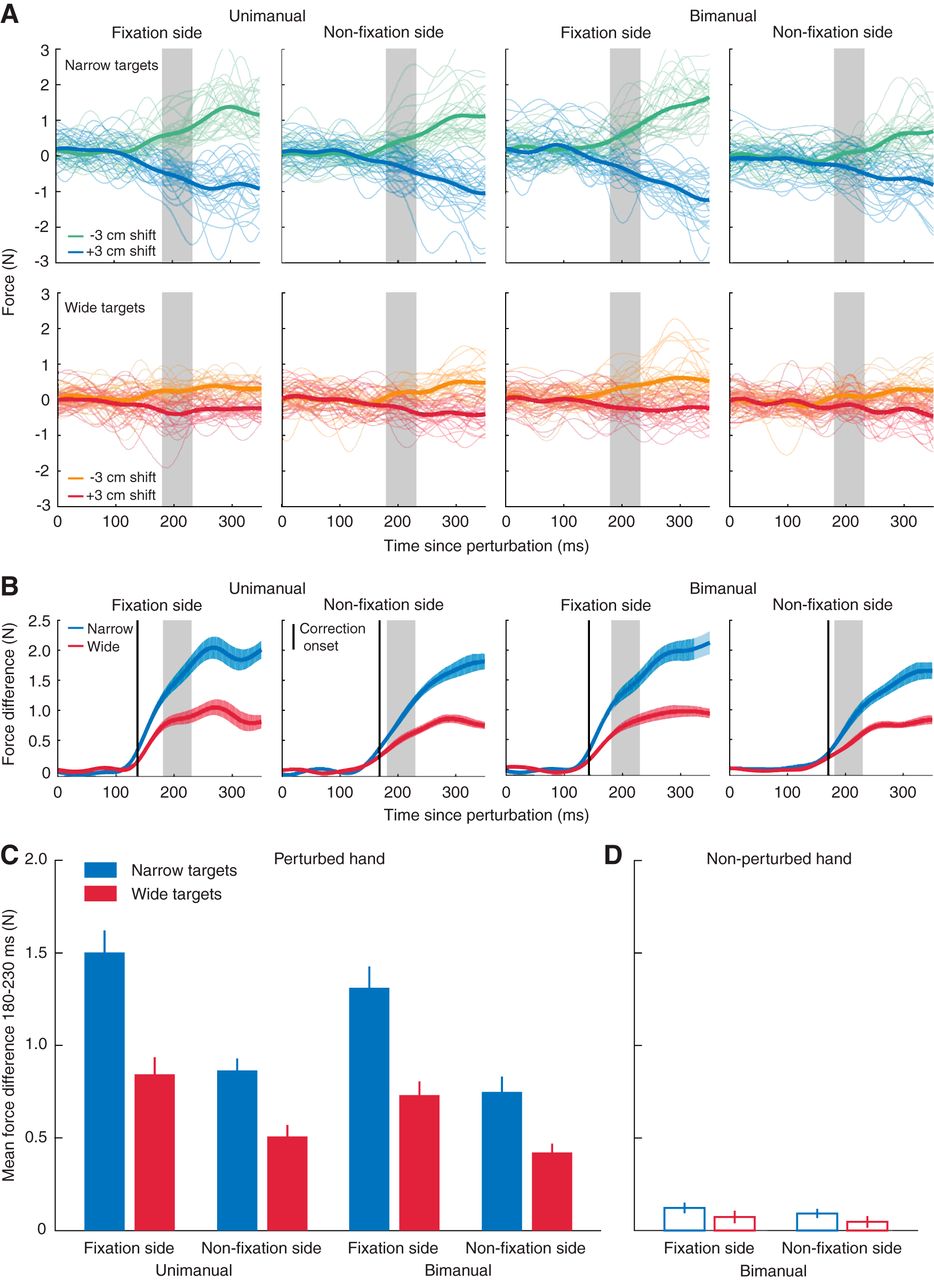
    Figure 2.

    Visuomotor responses in experiment 1. (A) Raw forces measured in channel trials in response to a leftward (–3 cm; in green and orange) and rightward (3 cm; in blue and red) displacement of the visual cursor during reaches to narrow (top row) and wide targets (bottom row) of the same example participant as in Fig. 1. (B) Difference in force responses to leftward and rightward cursor perturbations during reaches to narrow (in blue) and wide targets (in red), averaged across participants. Blue and red shaded areas indicate ±1 SEM. The black vertical line indicates the average onset of the corrective response (see Methods). The gray shaded area indicates the 180- to 230-ms interval across which the force differences were averaged to obtain a single measure of the strength of the response. (C) Mean force differences averaged across the 180- to 230-ms interval following the cursor perturbation. Error bars represent ±1 SEM. (D) Mean force differences at the nonperturbed hand in bimanual conditions.

  • Figure 3.
    • Download figure
    • Open in new tab
    • Download powerpoint
    Figure 3.

    Visuomotor responses in experiment 2. Bars represent the mean force differences at a single hand averaged across the 180- to 230-ms interval following the cursor perturbation. Error bars represent ±1 SEM. Target sizes in parentheses indicate the size of the target of the other hand.

Tables

  • Figures
    • View popup
    Table 1.

    Statistical analysis

    ExperimentVariableStatistical testFactor or comparisonTest values
    1Corrective force differences2 × 2×2 repeated-measures ANOVATWFSHTW×FIXTW×HFIX×HF(1,13) = 173.0, p < 0.001, OP = 1.0F(1,13) = 59.0, p < 0.001, OP = 1.0F(1,13) = 17.6, p = 0.001, OP = 0.97F(1,13) = 33.4, p < 0.001, OP = 1.0F(1,13) = 1.5, p = 0.238, OP = 0.21F(1,13) = 1.4, p = 0.262, OP = 0.19
    1Ratio of corrective force differences2 × 2 repeated-measures ANOVAFIXHFIX×HF(1,13) < 0.1, p = 0.976, OP = 0.05F(1,13) = 0.1, p = 0.746, OP = 0.06F(1,13) = 0.27, p = 0.611, OP = 0.08
    1Corrective force differences at nonperturbed handOne-sample t-tests (corrected α = 0.0125)nt+fixnt+nfixwt+fixwt+nfixt(13) = 4.2, p = 0.001, CI [0.06–0.19]t(13) = 3.7, p = 0.003, CI [0.04–0.15]t(13) = 2.2, p = 0.050, CI [<0.0001–0.15]t(13) = 1.5, p = 0.157, CI [–0.02 to 0.11]
    1Correction onsets (t-test method)2 × 2 repeated-measures ANOVAFIXHFIX×HF(1,13) = 120.4, p < 0.001, OP = 1.0F(1,13) = 2.1, p = 0.166, OP = 0.27F(1,13) = 0.23, p = 0.643, OP = 0.07
    1Correction onsets (extrapolation method)2 × 2 repeated-measures ANOVAFIXHFIX×HF(1,13) = 70.9, p < 0.001, OP = 1.0F(1,13) = 2.9, p = 0.113, OP = 0.35F(1,13) = 1.0, p = 0.344, OP = 0.15
    1Gaze position2 × 2×2 repeated-measures ANOVATWFSHTW×FIXTW×HFIX×HF(1,13) = 14.8, p = 0.002, OP = 0.94F(1,13) = 4.0, p = 0.067, OP = 0.46F(1,13) = 43.9, p < 0.001, OP = 1.0F(1,13) = 16.1, p = 0.001, OP = 0.96F(1,13) = 17.2, p = 0.001, OP = 0.97F(1,13) = 0.09, p = 0.766, OP = 0.06
    2Corrective force differences2 × 2×2 repeated-measures ANOVATWTW-OPCTW×TW-OTW×PCTW-O×PCF(1,13) = 99.9, p < 0.001, OP = 1.0F(1,13) = 10.4, p = 0.007, OP = 0.85F(2,26) = 9.7, p = 0.001, OP = 0.97F(1,13) = 19.6, p = 0.001, OP = 0.98F(2,26) = 1.9, p = 0.170, OP = 0.36F(2,26) = 0.5, p = 0.620, OP = 0.12
    2Corrective force differencesPlanned comparisonsnt(nt) vs. nt(wt)wt(nt) vs. wt(wt)p = 0.211, OP = 0.23p < 0.001, OP = 0.99
    2Corrective force differencesPairwise comparisonssp vs. dp-ssp vs. dp-odp-s vs. dp-op = 0.001, CI [0.06–0.18]p = 0.161, CI [–0.03 to 0.18]p = 0.002, CI [0.08–0.31]
    2Correction onsets (t-test method)One-way ANOVAPCF(2,26) = 0.8, p = 0.441, OP = 0.18
    2Correction onsets (extrapolation method)One-way ANOVAPCF(2,26) = 0.2, p = 0.856, OP = 0.072
    2Corrective force differences at nonperturbed handOne-sample t-tests (corrected α = 0.0125)nt(nt)+spnt(wt)+spwt(nt)+spwt(wt)+spt(13) = –0.29, p = 0.775, CI [–0.10 to 0.08]t(13) = –0.30, p = 0.767, CI [–0.14 to 0.10]t(13) = –0.23, p = 0.821, CI [–0.13 to 0.10]t(13) = 2.2, p = 0.051, CI [–0.0002 to 0.15]
    • OP, observed power; CI, 95% confidence interval; TW, target width; TW-O, target width, other hand; FS , fixation side; H, hands; PC, perturbation condition; nt/wt, narrow/wide target; fix/nfix, fixation/nonfixation side; sp/dp-s/dp-o, single/double-same/double-opposite perturbation.

Back to top

In this issue

eneuro: 4 (2)
eNeuro
Vol. 4, Issue 2
March/April 2017
  • Table of Contents
  • Index by author
Email

Thank you for sharing this eNeuro article.

NOTE: We request your email address only to inform the recipient that it was you who recommended this article, and that it is not junk mail. We do not retain these email addresses.

Enter multiple addresses on separate lines or separate them with commas.
Parallel Specification of Visuomotor Feedback Gains during Bimanual Reaching to Independent Goals
(Your Name) has forwarded a page to you from eNeuro
(Your Name) thought you would be interested in this article in eNeuro.
CAPTCHA
This question is for testing whether or not you are a human visitor and to prevent automated spam submissions.
Print
View Full Page PDF
Citation Tools
Parallel Specification of Visuomotor Feedback Gains during Bimanual Reaching to Independent Goals
Anouk J. de Brouwer, Tayler Jarvis, Jason P. Gallivan, J. Randall Flanagan
eNeuro 3 March 2017, 4 (2) ENEURO.0026-17.2017; DOI: 10.1523/ENEURO.0026-17.2017

Citation Manager Formats

  • BibTeX
  • Bookends
  • EasyBib
  • EndNote (tagged)
  • EndNote 8 (xml)
  • Medlars
  • Mendeley
  • Papers
  • RefWorks Tagged
  • Ref Manager
  • RIS
  • Zotero
Respond to this article
Share
Parallel Specification of Visuomotor Feedback Gains during Bimanual Reaching to Independent Goals
Anouk J. de Brouwer, Tayler Jarvis, Jason P. Gallivan, J. Randall Flanagan
eNeuro 3 March 2017, 4 (2) ENEURO.0026-17.2017; DOI: 10.1523/ENEURO.0026-17.2017
Twitter logo Facebook logo Mendeley logo
  • Tweet Widget
  • Facebook Like
  • Google Plus One

Jump to section

  • Article
    • Abstract
    • Significance Statement
    • Introduction
    • Materials and Methods
    • Results
    • Discussion
    • Summary
    • Acknowledgments
    • Footnotes
    • References
    • Synthesis
  • Figures & Data
  • Info & Metrics
  • eLetters
  • PDF

Keywords

  • motor control
  • online corrections
  • vision
  • visual perturbations

Responses to this article

Respond to this article

Jump to comment:

No eLetters have been published for this article.

Related Articles

Cited By...

More in this TOC Section

New Research

  • A Very Fast Time Scale of Human Motor Adaptation: Within Movement Adjustments of Internal Representations during Reaching
  • TrkB Signaling Influences Gene Expression in Cortistatin-Expressing Interneurons
  • Optogenetic Activation of β-Endorphin Terminals in the Medial Preoptic Nucleus Regulates Female Sexual Receptivity
Show more New Research

Sensory and Motor Systems

  • What is the difference between an impulsive and a timed anticipatory movement ?
  • Odor Experience Stabilizes Glomerular Output Representations in Two Mouse Models of Autism
  • Neural Response Attenuates with Decreasing Inter-Onset Intervals Between Sounds in a Natural Soundscape
Show more Sensory and Motor Systems

Subjects

  • Sensory and Motor Systems
  • Home
  • Alerts
  • Follow SFN on BlueSky
  • Visit Society for Neuroscience on Facebook
  • Follow Society for Neuroscience on Twitter
  • Follow Society for Neuroscience on LinkedIn
  • Visit Society for Neuroscience on Youtube
  • Follow our RSS feeds

Content

  • Early Release
  • Current Issue
  • Latest Articles
  • Issue Archive
  • Blog
  • Browse by Topic

Information

  • For Authors
  • For the Media

About

  • About the Journal
  • Editorial Board
  • Privacy Notice
  • Contact
  • Feedback
(eNeuro logo)
(SfN logo)

Copyright © 2025 by the Society for Neuroscience.
eNeuro eISSN: 2373-2822

The ideas and opinions expressed in eNeuro do not necessarily reflect those of SfN or the eNeuro Editorial Board. Publication of an advertisement or other product mention in eNeuro should not be construed as an endorsement of the manufacturer’s claims. SfN does not assume any responsibility for any injury and/or damage to persons or property arising from or related to any use of any material contained in eNeuro.