Main menu

  • HOME
  • CONTENT
    • Early Release
    • Featured
    • Current Issue
    • Issue Archive
    • Blog
    • Collections
    • Podcast
  • TOPICS
    • Cognition and Behavior
    • Development
    • Disorders of the Nervous System
    • History, Teaching and Public Awareness
    • Integrative Systems
    • Neuronal Excitability
    • Novel Tools and Methods
    • Sensory and Motor Systems
  • ALERTS
  • FOR AUTHORS
  • ABOUT
    • Overview
    • Editorial Board
    • For the Media
    • Privacy Policy
    • Contact Us
    • Feedback
  • SUBMIT

User menu

Search

  • Advanced search
eNeuro
eNeuro

Advanced Search


  • HOME
  • CONTENT
    • Early Release
    • Featured
    • Current Issue
    • Issue Archive
    • Blog
    • Collections
    • Podcast
  • TOPICS
    • Cognition and Behavior
    • Development
    • Disorders of the Nervous System
    • History, Teaching and Public Awareness
    • Integrative Systems
    • Neuronal Excitability
    • Novel Tools and Methods
    • Sensory and Motor Systems
  • ALERTS
  • FOR AUTHORS
  • ABOUT
    • Overview
    • Editorial Board
    • For the Media
    • Privacy Policy
    • Contact Us
    • Feedback
  • SUBMIT
PreviousNext
Research ArticleMethods, History, Teaching, and Public Awareness

Neuronify: An Educational Simulator for Neural Circuits

Svenn-Arne Dragly, Milad Hobbi Mobarhan, Andreas Våvang Solbrå, Simen Tennøe, Anders Hafreager, Anders Malthe-Sørenssen, Marianne Fyhn, Torkel Hafting and Gaute T. Einevoll
eNeuro 9 March 2017, 4 (2) ENEURO.0022-17.2017; https://doi.org/10.1523/ENEURO.0022-17.2017
Svenn-Arne Dragly
1Centre for Integrative Neuroplasticity, University of Oslo, 0316 Oslo, Norway
2Department of Physics, University of Oslo, 0316 Oslo, Norway
  • Find this author on Google Scholar
  • Find this author on PubMed
  • Search for this author on this site
  • ORCID record for Svenn-Arne Dragly
Milad Hobbi Mobarhan
1Centre for Integrative Neuroplasticity, University of Oslo, 0316 Oslo, Norway
3Department of Biosciences, University of Oslo, 0316 Oslo, Norway
  • Find this author on Google Scholar
  • Find this author on PubMed
  • Search for this author on this site
  • ORCID record for Milad Hobbi Mobarhan
Andreas Våvang Solbrå
1Centre for Integrative Neuroplasticity, University of Oslo, 0316 Oslo, Norway
2Department of Physics, University of Oslo, 0316 Oslo, Norway
  • Find this author on Google Scholar
  • Find this author on PubMed
  • Search for this author on this site
  • ORCID record for Andreas Våvang Solbrå
Simen Tennøe
1Centre for Integrative Neuroplasticity, University of Oslo, 0316 Oslo, Norway
4Department of Informatics, University of Oslo, 0316 Oslo, Norway
  • Find this author on Google Scholar
  • Find this author on PubMed
  • Search for this author on this site
  • ORCID record for Simen Tennøe
Anders Hafreager
1Centre for Integrative Neuroplasticity, University of Oslo, 0316 Oslo, Norway
2Department of Physics, University of Oslo, 0316 Oslo, Norway
  • Find this author on Google Scholar
  • Find this author on PubMed
  • Search for this author on this site
Anders Malthe-Sørenssen
1Centre for Integrative Neuroplasticity, University of Oslo, 0316 Oslo, Norway
2Department of Physics, University of Oslo, 0316 Oslo, Norway
  • Find this author on Google Scholar
  • Find this author on PubMed
  • Search for this author on this site
Marianne Fyhn
1Centre for Integrative Neuroplasticity, University of Oslo, 0316 Oslo, Norway
3Department of Biosciences, University of Oslo, 0316 Oslo, Norway
  • Find this author on Google Scholar
  • Find this author on PubMed
  • Search for this author on this site
Torkel Hafting
1Centre for Integrative Neuroplasticity, University of Oslo, 0316 Oslo, Norway
5Institute of Basic Medical Sciences, University of Oslo, 0316 Oslo, Norway
  • Find this author on Google Scholar
  • Find this author on PubMed
  • Search for this author on this site
  • ORCID record for Torkel Hafting
Gaute T. Einevoll
1Centre for Integrative Neuroplasticity, University of Oslo, 0316 Oslo, Norway
2Department of Physics, University of Oslo, 0316 Oslo, Norway
6Faculty of Science and Technology, Norwegian University of Life Sciences, 1432 Ås, Norway
  • Find this author on Google Scholar
  • Find this author on PubMed
  • Search for this author on this site
  • ORCID record for Gaute T. Einevoll
  • Article
  • Figures & Data
  • Info & Metrics
  • eLetters
  • PDF
Loading

Article Figures & Data

Figures

  • Figure 1.
    • Download figure
    • Open in new tab
    • Download powerpoint
    Figure 1.

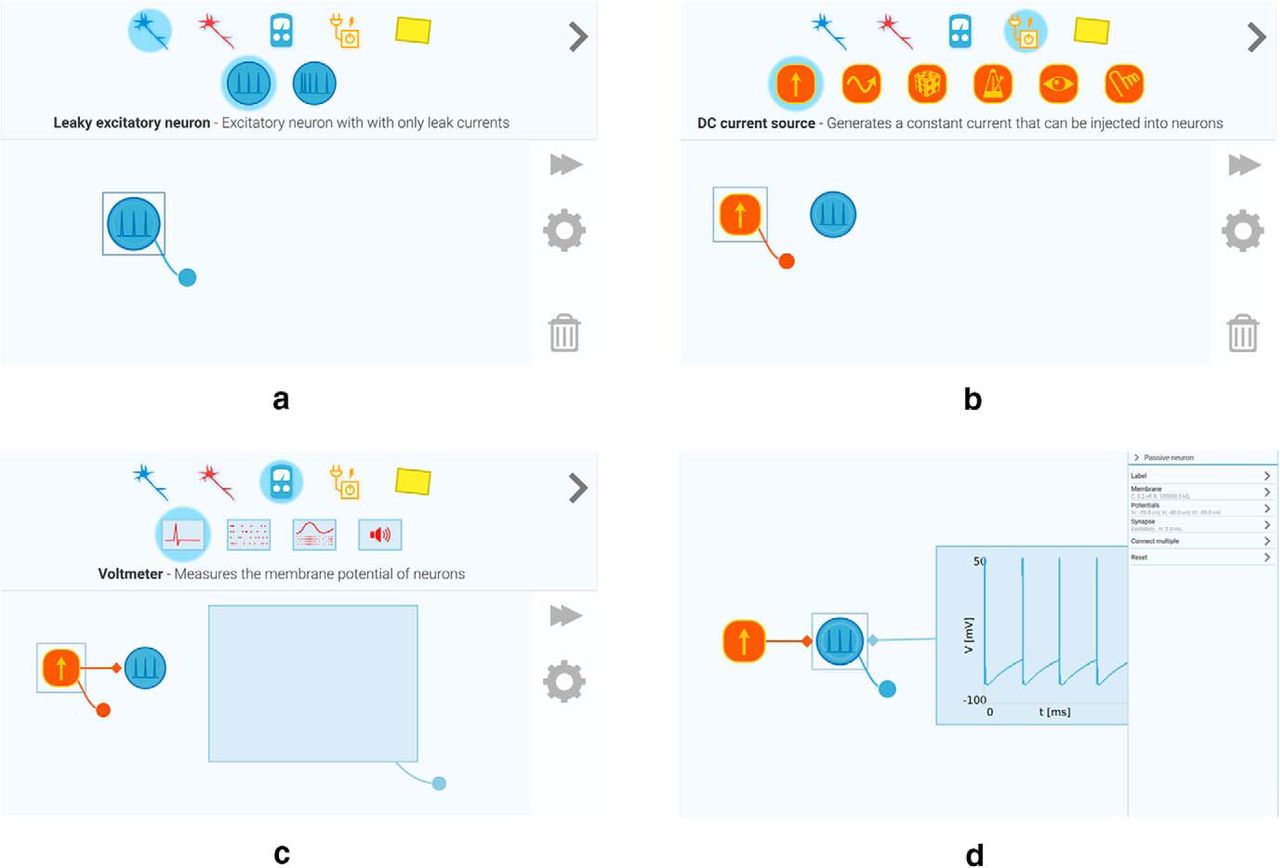
    Step-by-step illustration of how to build a simple neural circuit in Neuronify. A, A neuron is added to the canvas by dragging it from the creation menu. B, A DC current source is added and connected to the neuron by dragging the DC current source connection handle onto the neuron. C, A voltmeter is added and connected to the neuron by dragging the voltmeter connection handle onto the neuron. D, The properties of neurons and other items can be changed in the properties panel.

  • Figure 2.
    • Download figure
    • Open in new tab
    • Download powerpoint
    Figure 2.

    Neuronify workspace. Here, a simulation has been loaded where two touch input sensors are connected to one excitatory neuron (A) and one inhibitory neuron (B). Neuron C is connected to a voltmeter that plots the membrane potential as described by the integrate-and-fire model. This network can be used to illustrate how neuron B can inhibit neuron C so that when neuron A fires shortly after, A may not be able to excite neuron C beyond its threshold potential. Activating neuron A results in a spike in neuron C (first spike in the figure). However, if neuron B is activated first and then neuron A shortly after, neuron C is not excited beyond its threshold potential. To the right we see the toolbar that overlays the workspace and at the bottom we see the playback controls.

  • Figure 3.
    • Download figure
    • Open in new tab
    • Download powerpoint
    Figure 3.

    Menus in Neuronify. A, Main menu. B, Creation menu. C, Playback controls. D, Properties panel.

  • Figure 4.
    • Download figure
    • Open in new tab
    • Download powerpoint
    Figure 4.

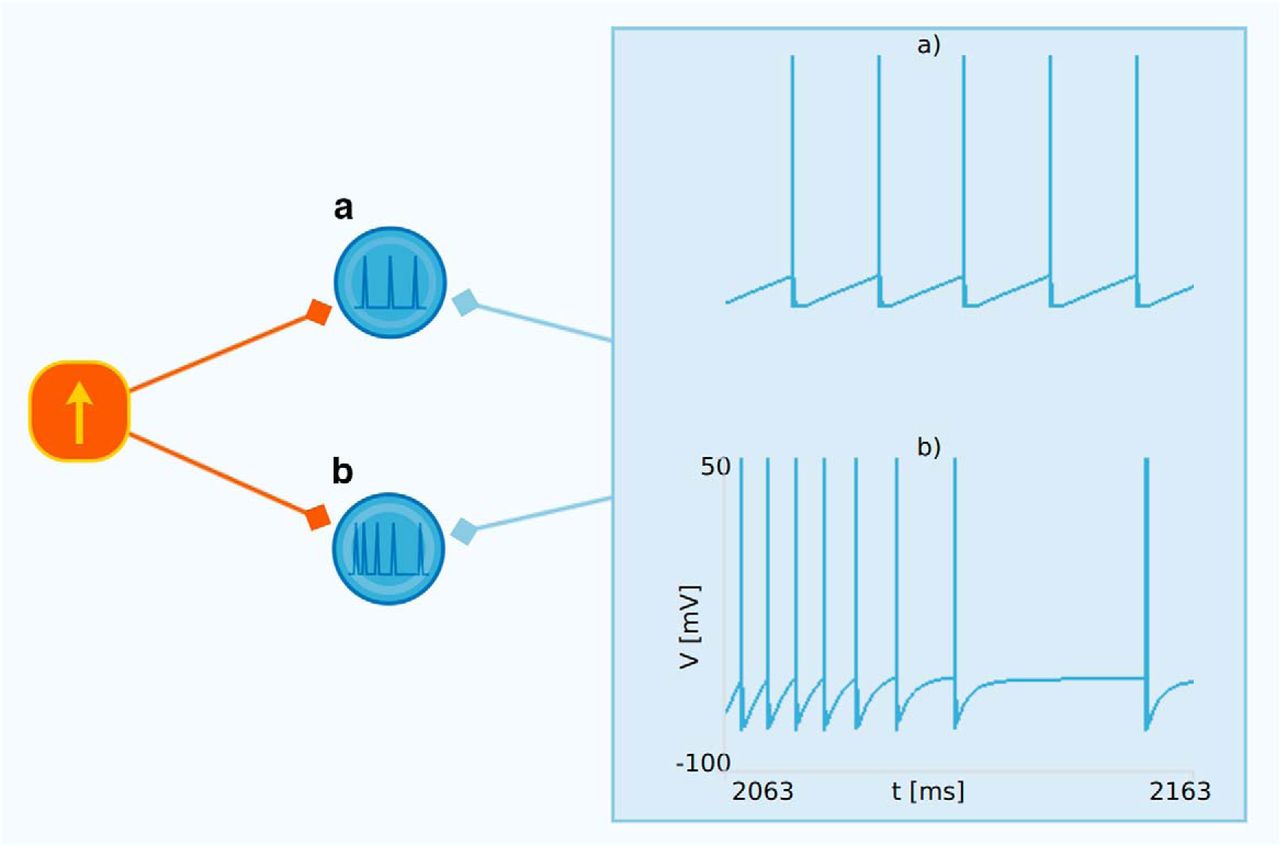
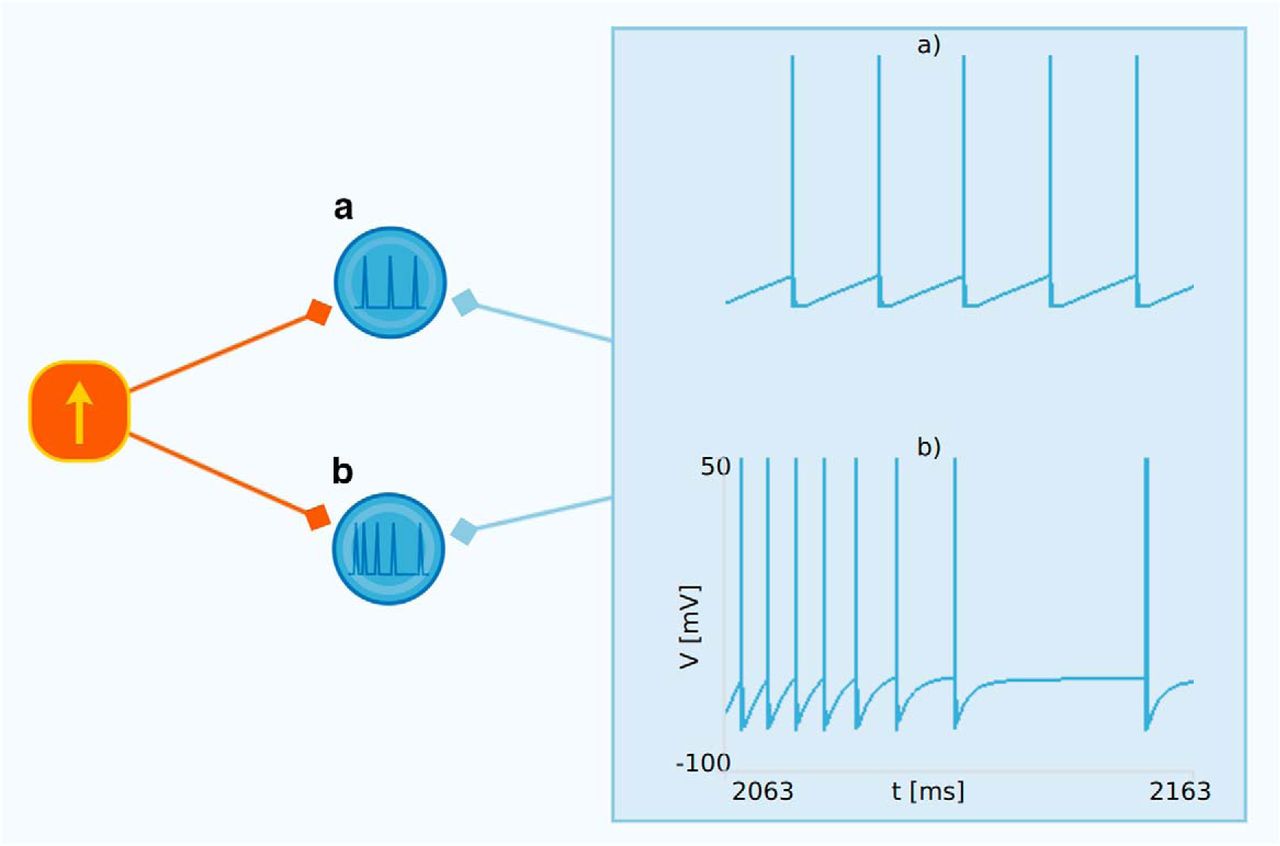
    A, Leaky integrate-and-fire neuron. The membrane potential of a leaky neuron is shown as plotted by the voltmeter item. As can be seen, the membrane potential increases until it reaches its threshold value and is immediately reset to the initial potential. The spike itself is overlayed as a vertical line for illustrative purposes and is not explicitly included in the dynamics of the membrane potential. B, Adaptive leaky integrate-and-fire neuron. The membrane potential of an adaptive neuron as plotted by the voltmeter item. This neuron receives input from the same DC current source. The interval between each spike of the adaptive neuron increases due to the an additional hyperpolarizing current, which grows for each spike and decays between the spikes.

  • Figure 5.
    • Download figure
    • Open in new tab
    • Download powerpoint
    Figure 5.

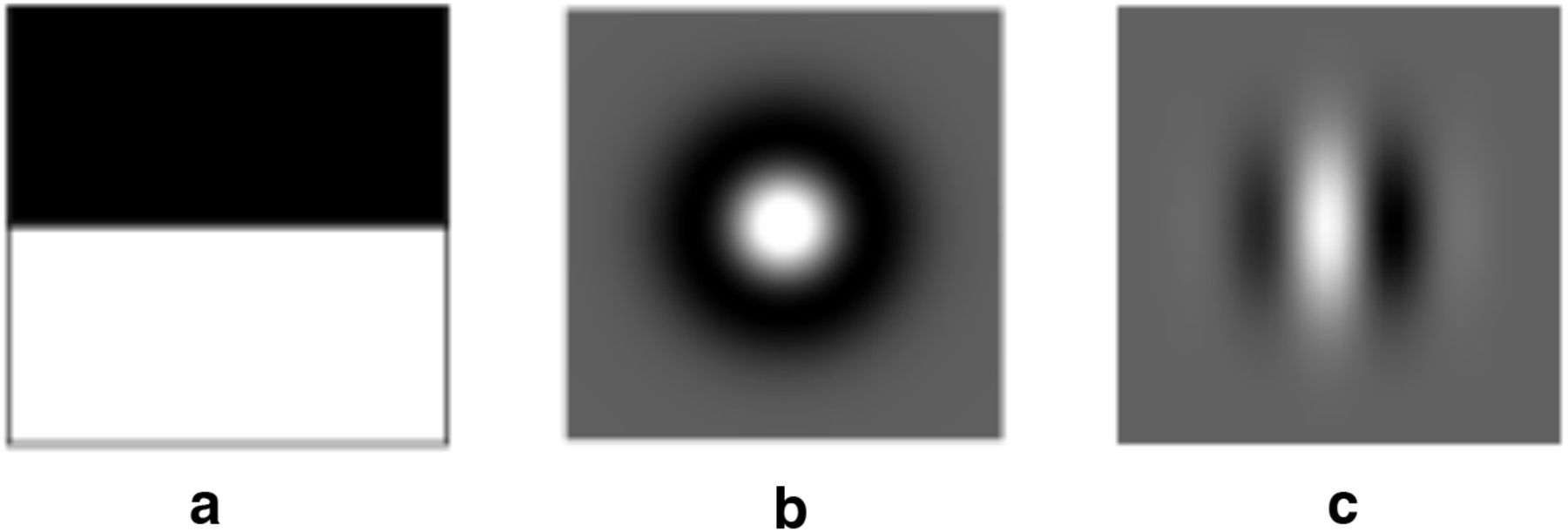
    Illustration of receptive fields implemented in the visual input item in Neuronify. The user may choose between these and use them in combination with input from the camera on their device to simulate a neuron with a visual receptive field. A, Rectangular edge-detecting receptive field. B, Circular center-surround receptive field. C, Orientation-selective receptive field.

  • Figure 6.
    • Download figure
    • Open in new tab
    • Download powerpoint
    Figure 6.

    Example of how Neuronify can be used to create interactive illustrations for neuroscience courses. This is a reproduction of figure 8.5 in Sterratt et al., 2011. The example shows how different levels of current injection into a neuron model results in different firing rates. Note that this example uses an artificial resting potential of 0 mV.

  • Figure 7.
    • Download figure
    • Open in new tab
    • Download powerpoint
    Figure 7.

    Example illustrating integration of synaptic inputs. In the upper circuit, the output neuron only receives input from a single presynaptic neuron. This input alone is not sufficient to make the output neuron spike. In the lower circuit, the output neuron instead receives input from three presynaptic neurons. This makes the neuron fire, thus illustrating how a neuron effectively integrates the synaptic input it receives to produce spikes. In the app, this example uses touch sensors instead of a current source for a more interactive illustration of this behavior.

  • Figure 8.
    • Download figure
    • Open in new tab
    • Download powerpoint
    Figure 8.

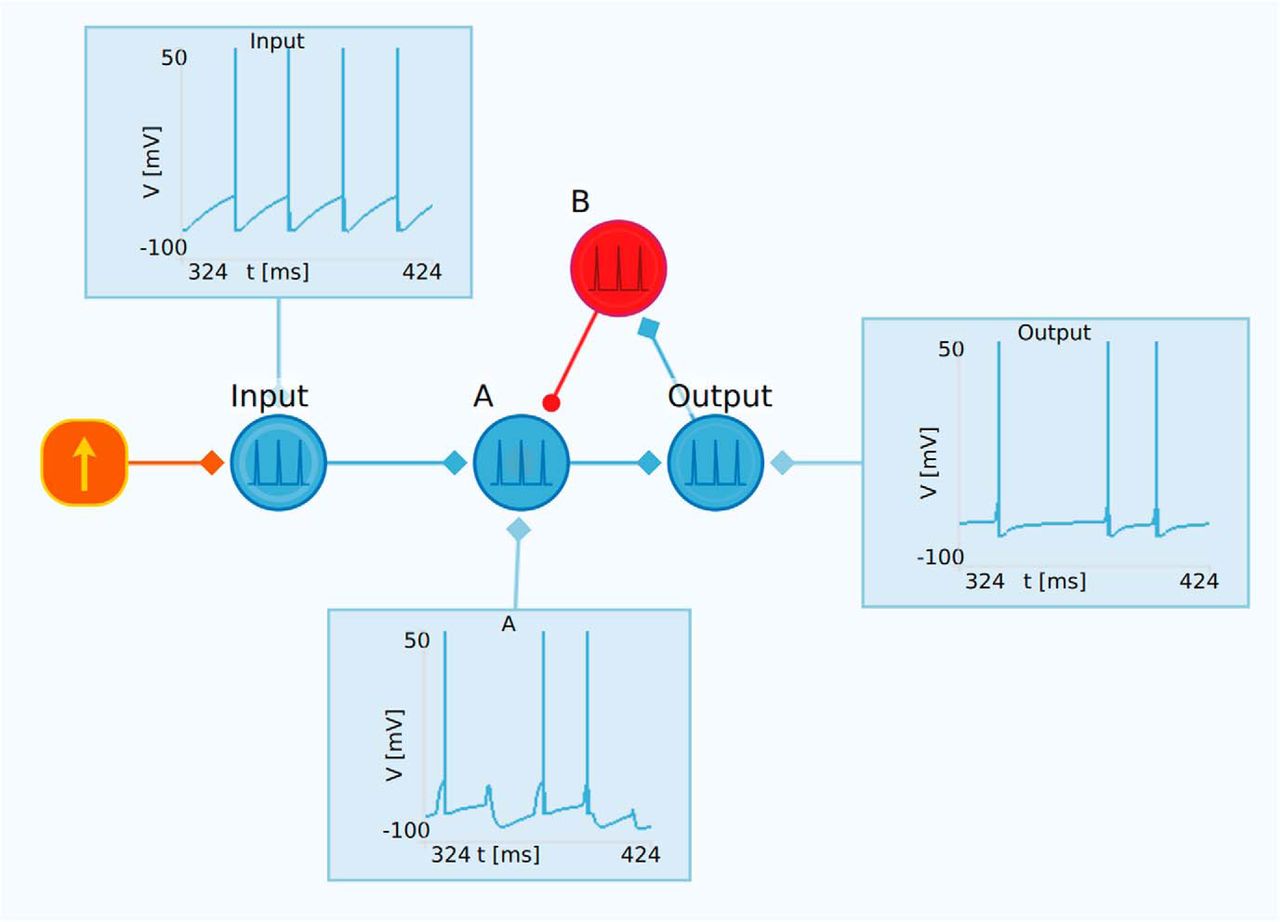
    Example of gain control with feedback inhibition. The input neuron receives a constant direct current input and is connected to neuron A, which in turn is connected to the output neuron. The output neuron is further connected to the inhibitory neuron B. Neuron B inhibits neuron A, which in total results in feedback inhibition, i.e., reduced activity in the output neuron compared with the input neuron.

  • Figure 9.
    • Download figure
    • Open in new tab
    • Download powerpoint
    Figure 9.

    Example of direction-selective network. This example illustrates a direction-selective feedforward network based on one-sided lateral inhibitory connections. The upper row of touch inputs are connected to the input neurons. These are both connected to the relay neurons and the inhibitory neurons. Each inhibitory neuron inhibit the relay neuron positioned immediately to the right in the network. The relay neurons are connected to the output neuron. The effect of the inhibition is that the network only responds to input where the touch sensors are pressed sequentially from right to left but not in the opposite direction.

Back to top

In this issue

eneuro: 4 (2)
eNeuro
Vol. 4, Issue 2
March/April 2017
  • Table of Contents
  • Index by author
Email

Thank you for sharing this eNeuro article.

NOTE: We request your email address only to inform the recipient that it was you who recommended this article, and that it is not junk mail. We do not retain these email addresses.

Enter multiple addresses on separate lines or separate them with commas.
Neuronify: An Educational Simulator for Neural Circuits
(Your Name) has forwarded a page to you from eNeuro
(Your Name) thought you would be interested in this article in eNeuro.
CAPTCHA
This question is for testing whether or not you are a human visitor and to prevent automated spam submissions.
Print
View Full Page PDF
Citation Tools
Neuronify: An Educational Simulator for Neural Circuits
Svenn-Arne Dragly, Milad Hobbi Mobarhan, Andreas Våvang Solbrå, Simen Tennøe, Anders Hafreager, Anders Malthe-Sørenssen, Marianne Fyhn, Torkel Hafting, Gaute T. Einevoll
eNeuro 9 March 2017, 4 (2) ENEURO.0022-17.2017; DOI: 10.1523/ENEURO.0022-17.2017

Citation Manager Formats

  • BibTeX
  • Bookends
  • EasyBib
  • EndNote (tagged)
  • EndNote 8 (xml)
  • Medlars
  • Mendeley
  • Papers
  • RefWorks Tagged
  • Ref Manager
  • RIS
  • Zotero
Respond to this article
Share
Neuronify: An Educational Simulator for Neural Circuits
Svenn-Arne Dragly, Milad Hobbi Mobarhan, Andreas Våvang Solbrå, Simen Tennøe, Anders Hafreager, Anders Malthe-Sørenssen, Marianne Fyhn, Torkel Hafting, Gaute T. Einevoll
eNeuro 9 March 2017, 4 (2) ENEURO.0022-17.2017; DOI: 10.1523/ENEURO.0022-17.2017
Twitter logo Facebook logo Mendeley logo
  • Tweet Widget
  • Facebook Like
  • Google Plus One

Jump to section

  • Article
    • Abstract
    • Significance Statement
    • Introduction
    • Materials and Methods
    • Results
    • Discussion
    • Acknowledgments
    • Footnotes
    • References
    • Synthesis
  • Figures & Data
  • Info & Metrics
  • eLetters
  • PDF

Keywords

  • APP
  • modeling
  • neural networks
  • software
  • teaching

Responses to this article

Respond to this article

Jump to comment:

No eLetters have been published for this article.

Related Articles

Cited By...

More in this TOC Section

Methods

  • Filter-Based Phase Shifts Distort Neuronal Timing Information
  • Quantifying Repetitive Transmission at Chemical Synapses: A Generative-Model Approach
Show more Methods

History, Teaching, and Public Awareness

  • Filter-Based Phase Shifts Distort Neuronal Timing Information
  • Quantifying Repetitive Transmission at Chemical Synapses: A Generative-Model Approach
  • A Bioscience Educators’ Purpose in a Modern World
Show more History, Teaching, and Public Awareness

Subjects

  • History, Teaching, and Public Awareness
  • Home
  • Alerts
  • Follow SFN on BlueSky
  • Visit Society for Neuroscience on Facebook
  • Follow Society for Neuroscience on Twitter
  • Follow Society for Neuroscience on LinkedIn
  • Visit Society for Neuroscience on Youtube
  • Follow our RSS feeds

Content

  • Early Release
  • Current Issue
  • Latest Articles
  • Issue Archive
  • Blog
  • Browse by Topic

Information

  • For Authors
  • For the Media

About

  • About the Journal
  • Editorial Board
  • Privacy Notice
  • Contact
  • Feedback
(eNeuro logo)
(SfN logo)

Copyright © 2025 by the Society for Neuroscience.
eNeuro eISSN: 2373-2822

The ideas and opinions expressed in eNeuro do not necessarily reflect those of SfN or the eNeuro Editorial Board. Publication of an advertisement or other product mention in eNeuro should not be construed as an endorsement of the manufacturer’s claims. SfN does not assume any responsibility for any injury and/or damage to persons or property arising from or related to any use of any material contained in eNeuro.