
Main menu

  • HOME
  • CONTENT
    • Early Release
    • Featured
    • Current Issue
    • Issue Archive
    • Blog
    • Collections
    • Podcast
  • TOPICS
    • Cognition and Behavior
    • Development
    • Disorders of the Nervous System
    • History, Teaching and Public Awareness
    • Integrative Systems
    • Neuronal Excitability
    • Novel Tools and Methods
    • Sensory and Motor Systems
  • ALERTS
  • FOR AUTHORS
  • ABOUT
    • Overview
    • Editorial Board
    • For the Media
    • Privacy Policy
    • Contact Us
    • Feedback
  • SUBMIT

User menu

Search

  • Advanced search
eNeuro
eNeuro

Advanced Search


  • HOME
  • CONTENT
    • Early Release
    • Featured
    • Current Issue
    • Issue Archive
    • Blog
    • Collections
    • Podcast
  • TOPICS
    • Cognition and Behavior
    • Development
    • Disorders of the Nervous System
    • History, Teaching and Public Awareness
    • Integrative Systems
    • Neuronal Excitability
    • Novel Tools and Methods
    • Sensory and Motor Systems
  • ALERTS
  • FOR AUTHORS
  • ABOUT
    • Overview
    • Editorial Board
    • For the Media
    • Privacy Policy
    • Contact Us
    • Feedback
  • SUBMIT
PreviousNext
Research ArticleNew Research, Novel Tools and Methods

Osteopontin Is a Blood Biomarker for Microglial Activation and Brain Injury in Experimental Hypoxic-Ischemic Encephalopathy

Yikun Li, Eric B. Dammer, Xiaohui Zhang-Brotzge, Scott Chen, Duc M. Duong, Nicholas T. Seyfried, Chia-Yi Kuan and Yu-Yo Sun
eNeuro 4 January 2017, 4 (1) ENEURO.0253-16.2016; https://doi.org/10.1523/ENEURO.0253-16.2016
Yikun Li
1Department of Pediatrics, Emory University School of Medicine, and Children’s Healthcare of Atlanta, Atlanta, GA 30322
  • Find this author on Google Scholar
  • Find this author on PubMed
  • Search for this author on this site
  • ORCID record for Yikun Li
Eric B. Dammer
2Department of Biochemistry, Emory University School of Medicine, Atlanta, GA 30322
  • Find this author on Google Scholar
  • Find this author on PubMed
  • Search for this author on this site
  • ORCID record for Eric B. Dammer
Xiaohui Zhang-Brotzge
1Department of Pediatrics, Emory University School of Medicine, and Children’s Healthcare of Atlanta, Atlanta, GA 30322
  • Find this author on Google Scholar
  • Find this author on PubMed
  • Search for this author on this site
  • ORCID record for Xiaohui Zhang-Brotzge
Scott Chen
1Department of Pediatrics, Emory University School of Medicine, and Children’s Healthcare of Atlanta, Atlanta, GA 30322
  • Find this author on Google Scholar
  • Find this author on PubMed
  • Search for this author on this site
  • ORCID record for Scott Chen
Duc M. Duong
2Department of Biochemistry, Emory University School of Medicine, Atlanta, GA 30322
  • Find this author on Google Scholar
  • Find this author on PubMed
  • Search for this author on this site
  • ORCID record for Duc M. Duong
Nicholas T. Seyfried
2Department of Biochemistry, Emory University School of Medicine, Atlanta, GA 30322
  • Find this author on Google Scholar
  • Find this author on PubMed
  • Search for this author on this site
Chia-Yi Kuan
1Department of Pediatrics, Emory University School of Medicine, and Children’s Healthcare of Atlanta, Atlanta, GA 30322
  • Find this author on Google Scholar
  • Find this author on PubMed
  • Search for this author on this site
Yu-Yo Sun
1Department of Pediatrics, Emory University School of Medicine, and Children’s Healthcare of Atlanta, Atlanta, GA 30322
  • Find this author on Google Scholar
  • Find this author on PubMed
  • Search for this author on this site
  • Article
  • Figures & Data
  • Info & Metrics
  • eLetters
  • PDF
Loading

Article Figures & Data

Figures

  • Tables
  • Figure 1.
    • Download figure
    • Open in new tab
    • Download powerpoint
    Figure 1.

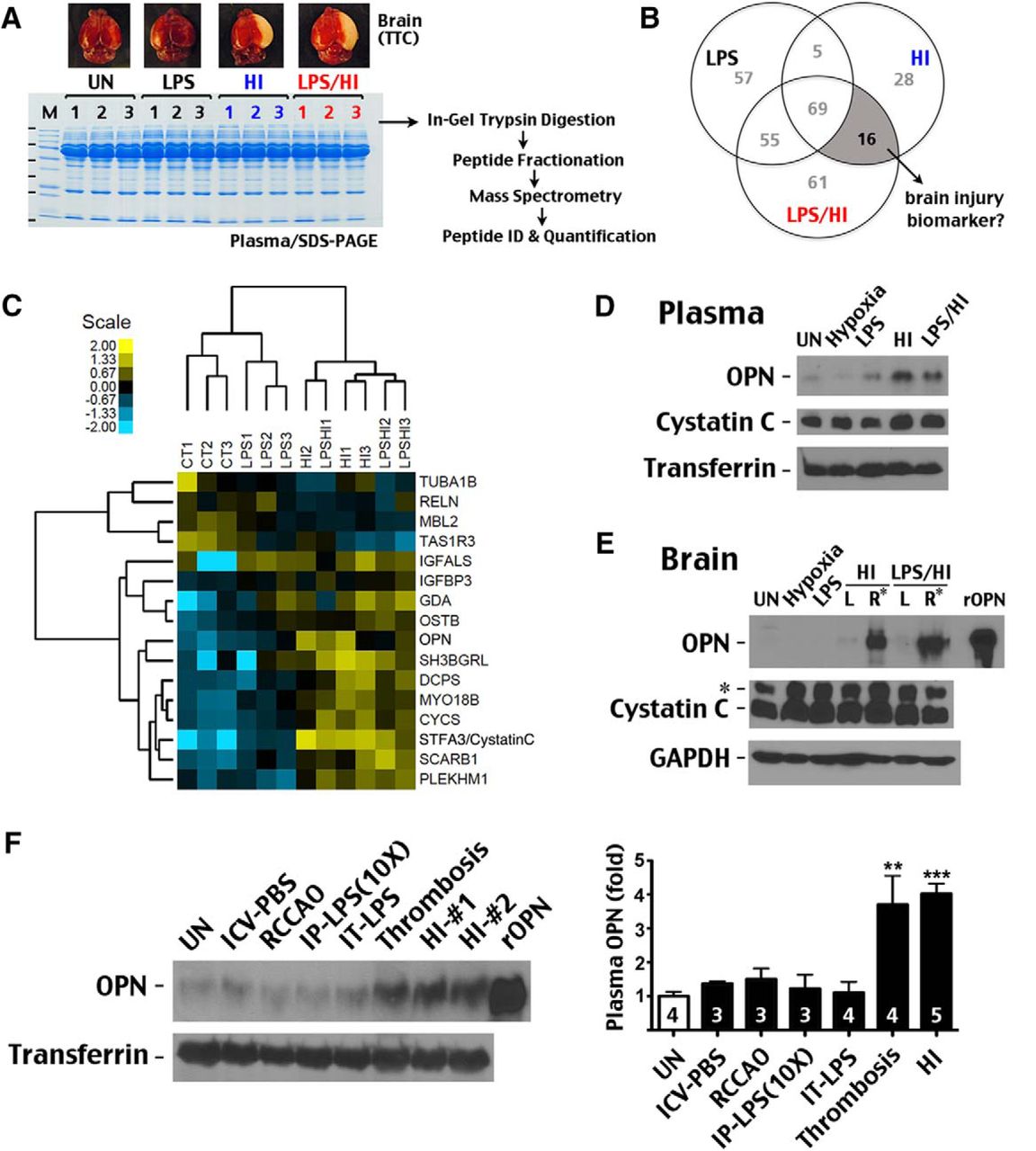
    Proteomic analysis of plasma biomarkers for murine neonatal HI brain injury. A, Plasma proteins collected from unchallenged (UN), low-dose LPS (0.3 mg/kg, IP)-exposed, and HI- or LPS/HI-injured P11 mice were separated by SDS-PAGE and analyzed as depicted (n = 3 for each). Also shown are representative tetrazolium chloride–stained brains in each group, showing cerebral infarction (pale color) in only HI- or LPS/HI-injured animals. B, Venn diagram showing the number of unique proteins in the depicted conditions compared with the unchallenged animals. C, Heatmap and hierarchical clustering of the 12 examined animals based on the signal intensity of HI- and LPS/HI-associated proteins. Shown is the log2 scale of fold change. D, E, Immunoblot showing specific OPN induction in plasma and the ipsilateral hemisphere (right, R*) of mice after HI or LPS/HI insult. In contrast, although cystatin C showed increased plasma levels after HI and LPS/HI injury, it was not elevated in the brain after these injuries. *, Nonspecific anti–cystatin C band in the brain. rOPN, recombinant mouse OPN used as positive control. F, Immunoblotting showing that cerebral stroke (thrombosis) also induced high levels of plasma OPN, whereas ICV injection of phosphate saline (ICV-PBS), unilateral carotid artery ligation (RCCAO), i.p. injection of 3 mg/kg LPS (IP-LPS[10×]), and intratracheal application of 0/3 mg/kg LPS (IT-LPS) lacked this effect. The numbers of mouse pups examined in each condition are indicated. **, p < 0.01; ***, p < 0.001 by t-test compared with unchallenged animals.

  • Figure 2.
    • Download figure
    • Open in new tab
    • Download powerpoint
    Figure 2.

    Source and specificity of plasma OPN as a biomarker. A, RT-PCR showed that HI triggered a 20- to 30-fold increase of Opn mRNA in the brain of P10 mice and P7 rats at 24-h recovery, but only insignificant changes in PBMCs (n = 4–5 for each group). B, Immunolabeling showed widespread OPN expression by Iba1+ microglia and occasional expression in NG2+ glial progenitors, but rare expression in GFAP+ astrocytes after HI injury (n > 4). Scale bar: 40 μm. C, Application of LPS (1 ng/ml) to microglial SM826 cells in vitro led to induction of OPN protein. D, Similarly, ICV injection of LPS (1 μg) induced Opn mRNA in brain as well as plasma OPN protein at 24-h recovery.

  • Figure 3.
    • Download figure
    • Open in new tab
    • Download powerpoint
    Figure 3.

    Sensitivity and prognostic value of plasma OPN as a biomarker for HI brain injury. A, B, Comparison of OPN and two other candidate biomarkers (MMP-9 and GFAP) in brain and blood after HI and LPS/HI injury. In brain extracts, elevation of MMP-9 or OPN expression and multiple GFAP bands were all observed after injury, but in plasma, only OPN induction was detectable at 24 h post-insult. C, D, Multiplex ELISA was used to compare brain and plasma OPN or MMP-9 levels in P10 mice after HI. Plasma OPN levels showed strong correlation with brain OPN (r = 0.82) and brain MMP-9 levels (r = 0.75, n = 10) 24 h after HI injury. E, HI-injured P7 rats were used to assess the time course of plasma OPN induction after HI injury (n = 5). Strong (>5-fold) induction of plasma OPN occurred only 24 h post-HI. *, Nonspecific signal or hyperphosphorylated OPN. F, Comparison of plasma OPN levels at 48 h post-HI to severity of brain injury at 7 d. Shown are representative subjects for the low and high plasma OPN groups. *, HI-injured hemisphere. G, Quantification showed significant elevation of plasma OPN levels in the severe damage group compared with unchallenged mice (n = 5 and 6 per group for mild and severe brain injury, respectively; p = 0.048 by t-test).
Tables

  • Figures
    • View popup
    Table 1.

    Plasma proteins that are uniquely associated with HI and LPS/HI brain injury at 24-h recovery

    SymbolDescription (all in Mus musculus)Peptide feature countsCT/CT log2(ratio)CT/CT SD, n = 3LPS/CT log2(ratio)LPS/CT SD, n = 9HI/CT log2(ratio)HI/CT SD, n = 9LPS/HI/CT log2(ratio)LPS/HI/CT SD, n = 9
    TUBA1BTubulin alpha-1B chain58–0.60.33–0.780.5–0.940.47–1.110.41
    RELNReelin precursor180.010.22–0.570.35–0.960.27–1.050.14
    MBL2Mannos-binding protein C precursor860.230.28–0.510.43–1.170.3–1.550.3
    TAS1R3Taste receptor type 1 member 3 precursor5–0.350.17–0.770.43–1.220.53–1.380.56
    IGFALSInsulin-like growth factor-binding protein complex acid labile subunit precursor171–0.110.26–0.560.18–1.780.34–2.060.31
    IGFBP3Insulin-like growth factor-binding protein 3 precursor27–0.190.160.130.16–0.920.25–1.280.35
    GDAGuanine deaminase150.250.360.620.341.030.451.050.49
    OSTBOrganic solute transporter subunit beta80.420.140.790.290.90.311.050.33
    OPNOsteopontin110.120.40.690.281.680.61.310.43
    STFA3Stefin-3 (cystatin C)14–0.480.990.620.682.630.711.670.6
    MYO18BMyosin XVIIIb2–0.250.150.80.251.510.311.30.2
    SH3BGRLSH3 domain-binding glutamic acid-rich like protein30.331.21–0.091.981.860.841.70.76
    DCPSm7GpppX diphosphatase120.20.350.340.451.550.611.470.32
    PLEKHM1Pleckstrin homology domain-containing family M member 12–0.050.49–0.120.450.920.421.060.44
    CYCSCytochrome c, somatic50–0.350.140.640.211.590.231.440.28
    SCARB1Scavenger receptor class B member 1 isoform 12–0.250.10.710.251.30.41.750.46
    • Plasma proteins associated with HI and LPS/HI brain injury at 24-h recovery in P10 mice. Proteomics detection and statistical analysis were performed as described in the text. Sixteen high-confidence proteins changing in this category with ≥2 MS/MS-identified peptide feature counts used for quantitation across the 12 samples are reported.

Back to top

In this issue

eneuro: 4 (1)
eNeuro
Vol. 4, Issue 1
January/February 2017
  • Table of Contents
  • Index by author
Email

Thank you for sharing this eNeuro article.

NOTE: We request your email address only to inform the recipient that it was you who recommended this article, and that it is not junk mail. We do not retain these email addresses.

Enter multiple addresses on separate lines or separate them with commas.
Osteopontin Is a Blood Biomarker for Microglial Activation and Brain Injury in Experimental Hypoxic-Ischemic Encephalopathy
(Your Name) has forwarded a page to you from eNeuro
(Your Name) thought you would be interested in this article in eNeuro.
CAPTCHA
This question is for testing whether or not you are a human visitor and to prevent automated spam submissions.
Print
View Full Page PDF
Citation Tools
Osteopontin Is a Blood Biomarker for Microglial Activation and Brain Injury in Experimental Hypoxic-Ischemic Encephalopathy
Yikun Li, Eric B. Dammer, Xiaohui Zhang-Brotzge, Scott Chen, Duc M. Duong, Nicholas T. Seyfried, Chia-Yi Kuan, Yu-Yo Sun
eNeuro 4 January 2017, 4 (1) ENEURO.0253-16.2016; DOI: 10.1523/ENEURO.0253-16.2016

Citation Manager Formats

  • BibTeX
  • Bookends
  • EasyBib
  • EndNote (tagged)
  • EndNote 8 (xml)
  • Medlars
  • Mendeley
  • Papers
  • RefWorks Tagged
  • Ref Manager
  • RIS
  • Zotero
Respond to this article
Share
Osteopontin Is a Blood Biomarker for Microglial Activation and Brain Injury in Experimental Hypoxic-Ischemic Encephalopathy
Yikun Li, Eric B. Dammer, Xiaohui Zhang-Brotzge, Scott Chen, Duc M. Duong, Nicholas T. Seyfried, Chia-Yi Kuan, Yu-Yo Sun
eNeuro 4 January 2017, 4 (1) ENEURO.0253-16.2016; DOI: 10.1523/ENEURO.0253-16.2016
Twitter logo Facebook logo Mendeley logo
  • Tweet Widget
  • Facebook Like
  • Google Plus One

Jump to section

  • Article
    • Abstract
    • Significance Statement
    • Introduction
    • Materials and Methods
    • Results
    • Discussion
    • Footnotes
    • References
    • Synthesis
  • Figures & Data
  • Info & Metrics
  • eLetters
  • PDF

Keywords

  • HIE
  • hypoxia-ischemia
  • LC-MS/MS

Responses to this article

Respond to this article

Jump to comment:

No eLetters have been published for this article.

Related Articles

Cited By...

More in this TOC Section

New Research

  • A Very Fast Time Scale of Human Motor Adaptation: Within Movement Adjustments of Internal Representations during Reaching
  • Optogenetic Activation of β-Endorphin Terminals in the Medial Preoptic Nucleus Regulates Female Sexual Receptivity
  • Hsc70 Ameliorates the Vesicle Recycling Defects Caused by Excess α-Synuclein at Synapses
Show more New Research

Novel Tools and Methods

  • Reliable Single-trial Detection of Saccade-related Lambda Responses with Independent Component Analysis
  • Using Simulations to Explore Sampling Distributions: An Antidote to Hasty and Extravagant Inferences
  • Establishment of an Infrared-Camera-Based Home-Cage Tracking System Goblotrop
Show more Novel Tools and Methods

Subjects

  • Novel Tools and Methods
  • Home
  • Alerts
  • Follow SFN on BlueSky
  • Visit Society for Neuroscience on Facebook
  • Follow Society for Neuroscience on Twitter
  • Follow Society for Neuroscience on LinkedIn
  • Visit Society for Neuroscience on Youtube
  • Follow our RSS feeds

Content

  • Early Release
  • Current Issue
  • Latest Articles
  • Issue Archive
  • Blog
  • Browse by Topic

Information

  • For Authors
  • For the Media

About

  • About the Journal
  • Editorial Board
  • Privacy Notice
  • Contact
  • Feedback
(eNeuro logo)
(SfN logo)

Copyright © 2025 by the Society for Neuroscience.
eNeuro eISSN: 2373-2822

The ideas and opinions expressed in eNeuro do not necessarily reflect those of SfN or the eNeuro Editorial Board. Publication of an advertisement or other product mention in eNeuro should not be construed as an endorsement of the manufacturer’s claims. SfN does not assume any responsibility for any injury and/or damage to persons or property arising from or related to any use of any material contained in eNeuro.