Main menu

  • HOME
  • CONTENT
    • Early Release
    • Featured
    • Current Issue
    • Issue Archive
    • Blog
    • Collections
    • Podcast
  • TOPICS
    • Cognition and Behavior
    • Development
    • Disorders of the Nervous System
    • History, Teaching and Public Awareness
    • Integrative Systems
    • Neuronal Excitability
    • Novel Tools and Methods
    • Sensory and Motor Systems
  • ALERTS
  • FOR AUTHORS
  • ABOUT
    • Overview
    • Editorial Board
    • For the Media
    • Privacy Policy
    • Contact Us
    • Feedback
  • SUBMIT

User menu

Search

  • Advanced search
eNeuro
eNeuro

Advanced Search


  • HOME
  • CONTENT
    • Early Release
    • Featured
    • Current Issue
    • Issue Archive
    • Blog
    • Collections
    • Podcast
  • TOPICS
    • Cognition and Behavior
    • Development
    • Disorders of the Nervous System
    • History, Teaching and Public Awareness
    • Integrative Systems
    • Neuronal Excitability
    • Novel Tools and Methods
    • Sensory and Motor Systems
  • ALERTS
  • FOR AUTHORS
  • ABOUT
    • Overview
    • Editorial Board
    • For the Media
    • Privacy Policy
    • Contact Us
    • Feedback
  • SUBMIT
PreviousNext
Research ArticleNew Research, Sensory and Motor Systems

Synergism and Combinatorial Coding for Binary Odor Mixture Perception in Drosophila

Srikanya Kundu, Anindya Ganguly, Tuhin Subhra Chakraborty, Arun Kumar and Obaid Siddiqi
eNeuro 11 August 2016, 3 (4) ENEURO.0056-14.2016; https://doi.org/10.1523/ENEURO.0056-14.2016
Srikanya Kundu
National Centre for Biological Sciences, Tata Institute of Fundamental Research, GKVK Campus, Bangalore 560065, India
  • Find this author on Google Scholar
  • Find this author on PubMed
  • Search for this author on this site
  • ORCID record for Srikanya Kundu
Anindya Ganguly
National Centre for Biological Sciences, Tata Institute of Fundamental Research, GKVK Campus, Bangalore 560065, India
  • Find this author on Google Scholar
  • Find this author on PubMed
  • Search for this author on this site
  • ORCID record for Anindya Ganguly
Tuhin Subhra Chakraborty
National Centre for Biological Sciences, Tata Institute of Fundamental Research, GKVK Campus, Bangalore 560065, India
  • Find this author on Google Scholar
  • Find this author on PubMed
  • Search for this author on this site
Arun Kumar
National Centre for Biological Sciences, Tata Institute of Fundamental Research, GKVK Campus, Bangalore 560065, India
  • Find this author on Google Scholar
  • Find this author on PubMed
  • Search for this author on this site
  • ORCID record for Arun Kumar
Obaid Siddiqi
National Centre for Biological Sciences, Tata Institute of Fundamental Research, GKVK Campus, Bangalore 560065, India
  • Find this author on Google Scholar
  • Find this author on PubMed
  • Search for this author on this site
  • Article
  • Figures & Data
  • Info & Metrics
  • eLetters
  • PDF
Loading

Article Figures & Data

Figures

  • Figure1
    • Download figure
    • Open in new tab
    • Download powerpoint
  • Figure 1.
    • Download figure
    • Open in new tab
    • Download powerpoint
    Figure 1.

    In vivo extracellular single-unit recording from ab2. A, Schematic diagram of the recording set up. Trace shows two olfactory sensory neurons expressing Or59b and Or85a, labeled as “A” and “B,” distinguished by larger- and smaller-amplitude spikes, respectively. B, Dose–response curves of individual ligands. C, Representative traces and corresponding PSTHs in response to 500 ms (marked as blue) stimulation by acetone (10−3), 2,3-butanedione (10−7), and their binary odor mixture. The binary mixture of acetone (10−3) and 2,3-butanedione (10−7) had an enhanced response magnitude (i.e., firing frequency as well as prolonged response, marked as green, sustained for longer time). D, The total duration of the odor response for the binary mixture is 6.8 s and was sustained longer than its individual component responses, 1.1 and 0.76 s, respectively, for acetone and 2,3-butanedione. On the other hand the linear regression of response decay was significantly lower for binary mixture than it's individual component alone. E, The dose–response curve of the binary mixture did not follow the typical sigmoidal pattern. For each dilution set of acetone (10−4/10−3/10−2), the odor mixture-evoked firing rate steeply increases up to a certain dilution of 2,3-butanedione and formed a sharp peak at 10−8/10−7/10−6, respectively. F, Bar graph shows that the observed response of the binary mixture of acetone and 2,3-butanedione was significantly higher than the expected additive response. Responses were compared in paired-sample t test. Error bars represent the SEM; ***p = 0.001. N = 30.

  • Figure 2.
    • Download figure
    • Open in new tab
    • Download powerpoint
    Figure 2.

    Extracellular recording and their corresponding PSTH in response to serial dilution of acetone, 2,3-butanedione, and their binary mixture from ab2. A, Representative traces of Or59b-expressing neuron responses toward serial dilutions from 10−3 to 10−9 of acetone, 2,3-butanedione, and the binary mixture of serial dilution of 2,3-butanedione with 10−3 dilution of acetone. Both acetone and 2,3-butanedione alone showed concentration-dependent increased firing frequencies. The odor-evoked responses of the binary mixture were not linear. The maximum response magnitude observed at a 10−7 dilution of 2,3-butanedione when presented with acetone (10−3). B, The linear regression of the odor-evoked response of 2,3-butanedione (10−3) alone is significantly (p > 0.001) faster than that of the binary odor mixture of acetone (10−4) and 2,3 butanedione(10−8). The duration of odor stimulation was 500 ms, marked in blue, and the total response duration was marked in green. The solid blue line indicates the linear regression.

  • Figure 3.
    • Download figure
    • Open in new tab
    • Download powerpoint
    Figure 3.

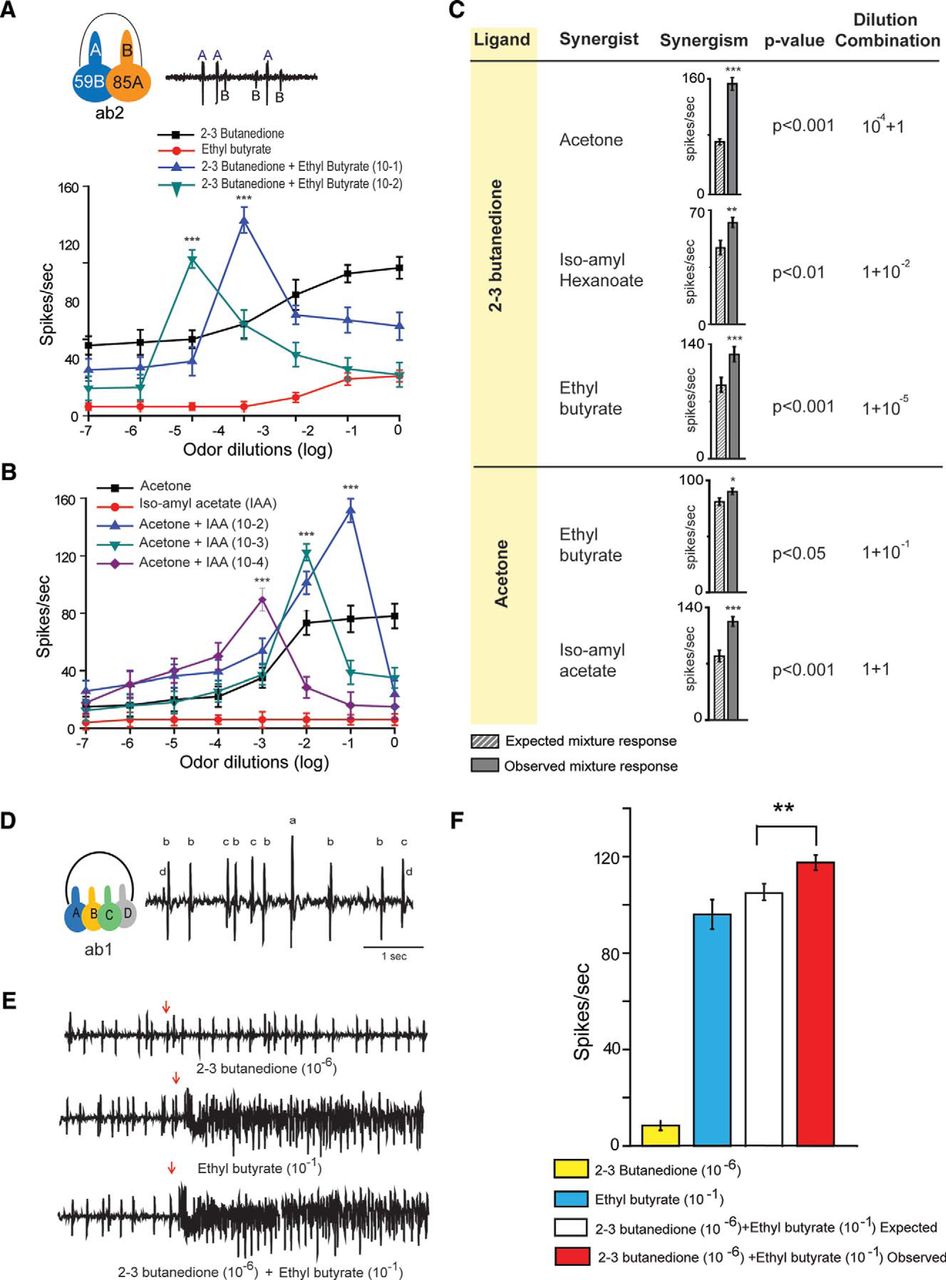
    Synergistic responses in ab2A and ab1B. A, B, Extracellular recording from Or59b-expressing neurons showed synergistic interaction between 2,3-butanedione with ethyl butyrate (A) and acetone with iso-amyl acetate (B). Iso-amyl acetate did not evoke any response to Or59b-expressing neurons, but in a binary mixture with acetone, synergism was observed (B). The peak responses of these two binary odor combinations observed at 1:10−5 and 1:1 dilution combinations of 2,3-butanedione and ethyl butyrate, and acetone and iso amyl acetate, respectively (A, B). C, The list of binary mixture combinations that exhibit synergism in ab2. A paired t test reveals that the observed synergistic peaks were always significantly greater than the expected additive response of their corresponding mixture components. N = 30. D, Trace showing the spontaneous firing of a typical ab1 sensillum. Spikes obtained from different neuronal types within the sensillum have been marked accordingly. E, Representative traces for the responses elicited by 2,3-butanedione (10−8), ethyl butyrate (10−1), and the binary mixture of the aforementioned chemicals recorded from ab1 sensillum. F, Bar graphs showing the quantification of average electrophysiological responses elicited from ab1B neuron by 2,3-butanedione (10−8), ethyl butyrate (10−1), and a mixture of the aforementioned chemicals. N = 12. Error bars represent the SEM. *p = 0.5, **p = 0.01, ***p = 0.001.

  • Figure 4.
    • Download figure
    • Open in new tab
    • Download powerpoint
    Figure 4.

    The binary mixture of acetone and 2,3-butanedione evokes a synergistic response in the behavior of a fly. A, The schematic representation of the single-fly behavioral setup. B, Representative traces from a single-fly response to acetone (10−3), 2,3-butanedione (10−7), and the binary mixture of 2,3-butanedione (10−7) and acetone (10−3). C, The response of the fly toward the binary mixture of acetone (10−3) and 2,3-butanedione (10−7) was significantly higher (one-way ANOVA, R2 = 0.57) than the individual odorants. D, The population fly tracks of 30 flies indicate that flies spent more time at the odor arm of the binary mixture than their corresponding mixture components. E, The behavior of the fly over serial dilutions of 2,3-butanedione with acetone (10−4/10−3). At a specific dilution, combinations of the two odorants exhibited higher responses by the fly (R2 = 0.62 and R2 = 0.583). F, The peak RI observed for the binary mixture of 2,3-butanedione (10−7) and acetone (10−3) is significantly greater in paired t test than the expected additive response of acetone (10−3) and 2,3-butanedione (10−7) alone. Error bars represent the SEM. ***p = 0.001.

  • Figure 5.
    • Download figure
    • Open in new tab
    • Download powerpoint
    Figure 5.

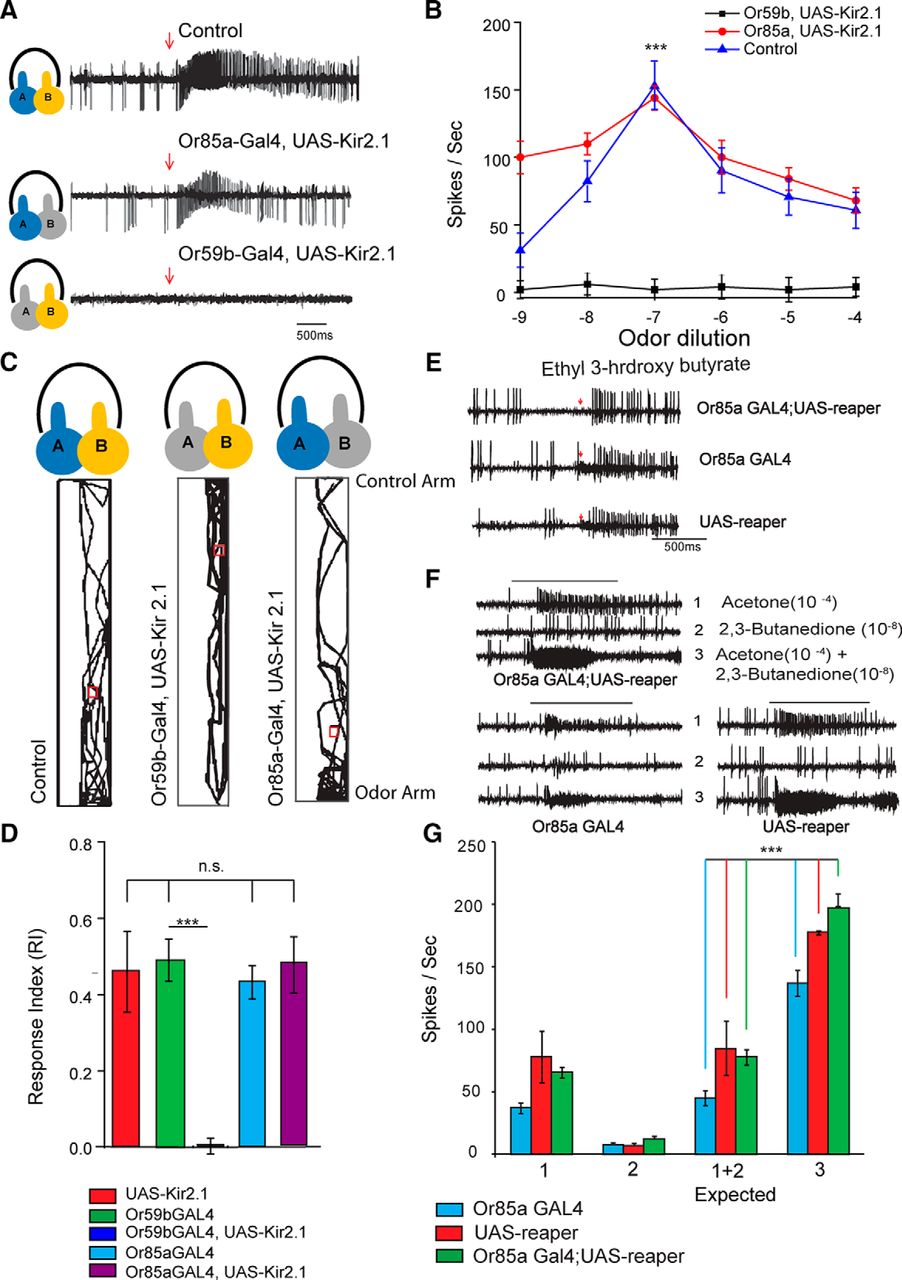
    The synergism response toward a binary mixture is specific to the receptor. A, B, Representative traces and dose–response curves show the response profile toward the binary mixture of acetone (10−3) and 2,3-butanedione (10−7). Both the control and flies where Kir 2.1 was expressed in Or85a-expressing neurons exhibited a synergistic response to the binary mixture. C, D, Expressing Kir 2.1 in Or59b-expressing neurons abolished synergism (N = 30). D, Flies with silenced Or59b-expressing neurons showed less of a response toward the binary mixture (ANOVA, R2 = 0.725). Gal4 and UAS-Kir2.1 controls maintained their synergistic phenomenon. E, Representative traces for the responses elicited by ethyl 3-hydroxy butyrate from the ab2 sensilla from flies of three different genotypes compared with Or85aGal4,UAS-rpr and the UAS and Gal4 controls (N = 20). The larger spikes are from ab2A, whereas the smaller spikes are from ab2B. In Or85aGal4,UAS rpr, the ab2B spikes are absent, confirming cell death owing to reaper expression. The Gal4 and UAS control lines show a normal increase in ab2B spikes in response (indicated by arrows) to ethyl 3-hydroxy butyrate, confirming that there were not any background effects. F, Representative traces obtained from ab2 sensillum of flies of two different genotypes, Or85aGal4,UAS-rpr and the UAS control, following stimulation by 2,3-butanedione (10−8), acetone (10−4), and a mixture of these two odors. G, Bar graphs showing the quantification of average electrophysiological responses elicited from ab2A neurons of flies of three different genotypes (Or85aGal4,UAS-rpr, and the UAS and Gal4 controls) by 2,3 butanedione (10−7), acetone (10−3), a calculated summation of these two responses, and a response elicited by a mixture of these two odors. N = 6. Error bar represents the SEM. **p = 0.01, ***p = 0.001.
Back to top

In this issue

eneuro: 3 (4)
eNeuro
Vol. 3, Issue 4
July/August 2016
  • Table of Contents
  • Index by author
Email

Thank you for sharing this eNeuro article.

NOTE: We request your email address only to inform the recipient that it was you who recommended this article, and that it is not junk mail. We do not retain these email addresses.

Enter multiple addresses on separate lines or separate them with commas.
Synergism and Combinatorial Coding for Binary Odor Mixture Perception in Drosophila
(Your Name) has forwarded a page to you from eNeuro
(Your Name) thought you would be interested in this article in eNeuro.
CAPTCHA
This question is for testing whether or not you are a human visitor and to prevent automated spam submissions.
Print
View Full Page PDF
Citation Tools
Synergism and Combinatorial Coding for Binary Odor Mixture Perception in Drosophila
Srikanya Kundu, Anindya Ganguly, Tuhin Subhra Chakraborty, Arun Kumar, Obaid Siddiqi
eNeuro 11 August 2016, 3 (4) ENEURO.0056-14.2016; DOI: 10.1523/ENEURO.0056-14.2016

Citation Manager Formats

  • BibTeX
  • Bookends
  • EasyBib
  • EndNote (tagged)
  • EndNote 8 (xml)
  • Medlars
  • Mendeley
  • Papers
  • RefWorks Tagged
  • Ref Manager
  • RIS
  • Zotero
Respond to this article
Share
Synergism and Combinatorial Coding for Binary Odor Mixture Perception in Drosophila
Srikanya Kundu, Anindya Ganguly, Tuhin Subhra Chakraborty, Arun Kumar, Obaid Siddiqi
eNeuro 11 August 2016, 3 (4) ENEURO.0056-14.2016; DOI: 10.1523/ENEURO.0056-14.2016
Twitter logo Facebook logo Mendeley logo
  • Tweet Widget
  • Facebook Like
  • Google Plus One

Jump to section

  • Article
    • Visual Abstract
    • Abstract
    • Significance Statement
    • Introduction
    • Materials and Methods
    • Results
    • Discussion
    • Acknowledgments
    • Footnotes
    • References
    • Synthesis
  • Figures & Data
  • Info & Metrics
  • eLetters
  • PDF

Keywords

  • behavior
  • Binary Mixture
  • Drosophila melanogaster
  • Neuronal Coding
  • Receptor Specificity
  • Synergism

Responses to this article

Respond to this article

Jump to comment:

No eLetters have been published for this article.

Related Articles

Cited By...

More in this TOC Section

New Research

  • A Very Fast Time Scale of Human Motor Adaptation: Within Movement Adjustments of Internal Representations during Reaching
  • Optogenetic Activation of β-Endorphin Terminals in the Medial Preoptic Nucleus Regulates Female Sexual Receptivity
  • Hsc70 Ameliorates the Vesicle Recycling Defects Caused by Excess α-Synuclein at Synapses
Show more New Research

Sensory and Motor Systems

  • Microglial morphological complexity in the piriform cortex is associated with olfactory aversion following chronic stress
  • Neural and Behavioral Correlates of Pure Tone and Narrowband Noise Processing in Rats: A Tradeoff between Discrimination and Sensitivity
  • Cortically Mediated Muscle Responses to Balance Perturbations Increase with Perturbation Magnitude in Older Adults with and without Parkinson's Disease
Show more Sensory and Motor Systems

Subjects

  • Sensory and Motor Systems
  • Home
  • Alerts
  • Follow SFN on BlueSky
  • Visit Society for Neuroscience on Facebook
  • Follow Society for Neuroscience on Twitter
  • Follow Society for Neuroscience on LinkedIn
  • Visit Society for Neuroscience on Youtube
  • Follow our RSS feeds

Content

  • Early Release
  • Current Issue
  • Latest Articles
  • Issue Archive
  • Blog
  • Browse by Topic

Information

  • For Authors
  • For the Media

About

  • About the Journal
  • Editorial Board
  • Privacy Notice
  • Contact
  • Feedback
(eNeuro logo)
(SfN logo)

Copyright © 2026 by the Society for Neuroscience.
eNeuro eISSN: 2373-2822

The ideas and opinions expressed in eNeuro do not necessarily reflect those of SfN or the eNeuro Editorial Board. Publication of an advertisement or other product mention in eNeuro should not be construed as an endorsement of the manufacturer’s claims. SfN does not assume any responsibility for any injury and/or damage to persons or property arising from or related to any use of any material contained in eNeuro.