Main menu

  • HOME
  • CONTENT
    • Early Release
    • Featured
    • Current Issue
    • Issue Archive
    • Blog
    • Collections
    • Podcast
  • TOPICS
    • Cognition and Behavior
    • Development
    • Disorders of the Nervous System
    • History, Teaching and Public Awareness
    • Integrative Systems
    • Neuronal Excitability
    • Novel Tools and Methods
    • Sensory and Motor Systems
  • ALERTS
  • FOR AUTHORS
  • ABOUT
    • Overview
    • Editorial Board
    • For the Media
    • Privacy Policy
    • Contact Us
    • Feedback
  • SUBMIT

User menu

Search

  • Advanced search
eNeuro
eNeuro

Advanced Search


  • HOME
  • CONTENT
    • Early Release
    • Featured
    • Current Issue
    • Issue Archive
    • Blog
    • Collections
    • Podcast
  • TOPICS
    • Cognition and Behavior
    • Development
    • Disorders of the Nervous System
    • History, Teaching and Public Awareness
    • Integrative Systems
    • Neuronal Excitability
    • Novel Tools and Methods
    • Sensory and Motor Systems
  • ALERTS
  • FOR AUTHORS
  • ABOUT
    • Overview
    • Editorial Board
    • For the Media
    • Privacy Policy
    • Contact Us
    • Feedback
  • SUBMIT
PreviousNext
Research ArticleNew Research, Integrative Systems

Social Stress Engages Neurochemically-Distinct Afferents to the Rat Locus Coeruleus Depending on Coping Strategy

Beverly A. S. Reyes, Gerard Zitnik, Celia Foster, Elisabeth J. Van Bockstaele and Rita J. Valentino
eNeuro 1 November 2015, 2 (6) ENEURO.0042-15.2015; https://doi.org/10.1523/ENEURO.0042-15.2015
Beverly A. S. Reyes
1Department of Pharmacology and Physiology, College of Medicine, Drexel University, Philadelphia, Pennsylvania 19102
  • Find this author on Google Scholar
  • Find this author on PubMed
  • Search for this author on this site
Gerard Zitnik
2Department of Anesthesiology and Critical Care Medicine, The Children’s Hospital of Philadelphia, Philadelphia, Pennsylvania 19104
  • Find this author on Google Scholar
  • Find this author on PubMed
  • Search for this author on this site
Celia Foster
1Department of Pharmacology and Physiology, College of Medicine, Drexel University, Philadelphia, Pennsylvania 19102
  • Find this author on Google Scholar
  • Find this author on PubMed
  • Search for this author on this site
Elisabeth J. Van Bockstaele
1Department of Pharmacology and Physiology, College of Medicine, Drexel University, Philadelphia, Pennsylvania 19102
  • Find this author on Google Scholar
  • Find this author on PubMed
  • Search for this author on this site
Rita J. Valentino
2Department of Anesthesiology and Critical Care Medicine, The Children’s Hospital of Philadelphia, Philadelphia, Pennsylvania 19104
  • Find this author on Google Scholar
  • Find this author on PubMed
  • Search for this author on this site
  • Article
  • Figures & Data
  • Info & Metrics
  • eLetters
  • PDF
Loading

Article Figures & Data

Figures

  • Tables
  • Figure1
    • Download figure
    • Open in new tab
    • Download powerpoint
  • Figure 1.
    • Download figure
    • Open in new tab
    • Download powerpoint
    Figure 1.

    FG injection and retrograde labeling. Ai–Ci, Schematic diagrams adapted from the Rat Brain Atlas (Paxinos and Watson, 1998) showing the anteroposterior levels of the representative injection site (A) and retrograde labeling (B,C). Aii, Bright-field photomicrograph showing a representative FG injection within the rat LC. Bii–Cii, Bright-field photomicrographs of representative retrograde labeling in the nucleus PGi (Bii at ∼Plate 67; Paxinos and Watson, 1998) and CNA (Cii at ∼Plate 26; Paxinos and Watson, 1998) following FG injection into the LC. The arrows indicate immunoperoxidase labeled cells. Scale bars: A, 50 μm; B, C, 25 μm.

  • Figure 2.
    • Download figure
    • Open in new tab
    • Download powerpoint
    Figure 2.

    Activation of locus coeruleus-projecting enkephalin neurons in the nucleus PGi. A, Scatterplot showing the percentage of FG-c-fos-labeled neurons that were also immunolabeled for ENK for individual control, SL, and LL rats. Lines through the points indicate the group mean. B, Representative immunofluorescence photomicrograph from a long latency rat showing c-fos profiles (blue), FG labeling (green), ENK-immunoreactivity (red), and triple-labeled neurons (yellow). Arrows point to single-labeled neurons and arrowheads point to triple-labeled neurons. Scale bar, 10 μm. C, High-magnification photomicrographs illustrating activated LC-projecting ENK neurons in the PGi of a LL rat. FG, c-fos, and ENK panels show single labeling for the retrograde tracer, FG (green), c-fos immunoreactivity (blue), and ENK immunoreactivity (red), respectively. The merged image shows all labels. Thin arrows point to the same triple-labeled neuron in all images. Scale bar, 10 μm.

  • Figure 3.
    • Download figure
    • Open in new tab
    • Download powerpoint
    Figure 3.

    Activation of LC-projecting corticotropin-releasing factor neurons in the CNA. A, Scatterplot showing the percentage of FG-c-fos-labeled neurons that were also immunolabeled for CRF for individual control, SL, and LL rats. Lines through the points indicate the group mean. B, Representative immunofluorescence photomicrograph from a SL rat showing c-fos profiles (blue), FG labeling (green), CRF-immunoreactivity (red), and triple-labeled neurons (yellow). Arrows point to single-labeled neurons and arrowheads point to triple-labeled neurons. Scale bar, 10 μm. C, High-magnification photomicrographs illustrating activated LC-projecting CRF neurons in the CNA of a SL rat. FG, c-fos, and CRF panels show single labeling for the retrograde tracer, FG (green), c-fos immunoreactivity (blue), and CRF immunoreactivity (red), respectively. The merged image shows all labels. Thin arrows point to the same triple-labeled neuron in all images. Scale bar, 10 μm.

  • Figure 4:
    • Download figure
    • Open in new tab
    • Download powerpoint
    Figure 4:

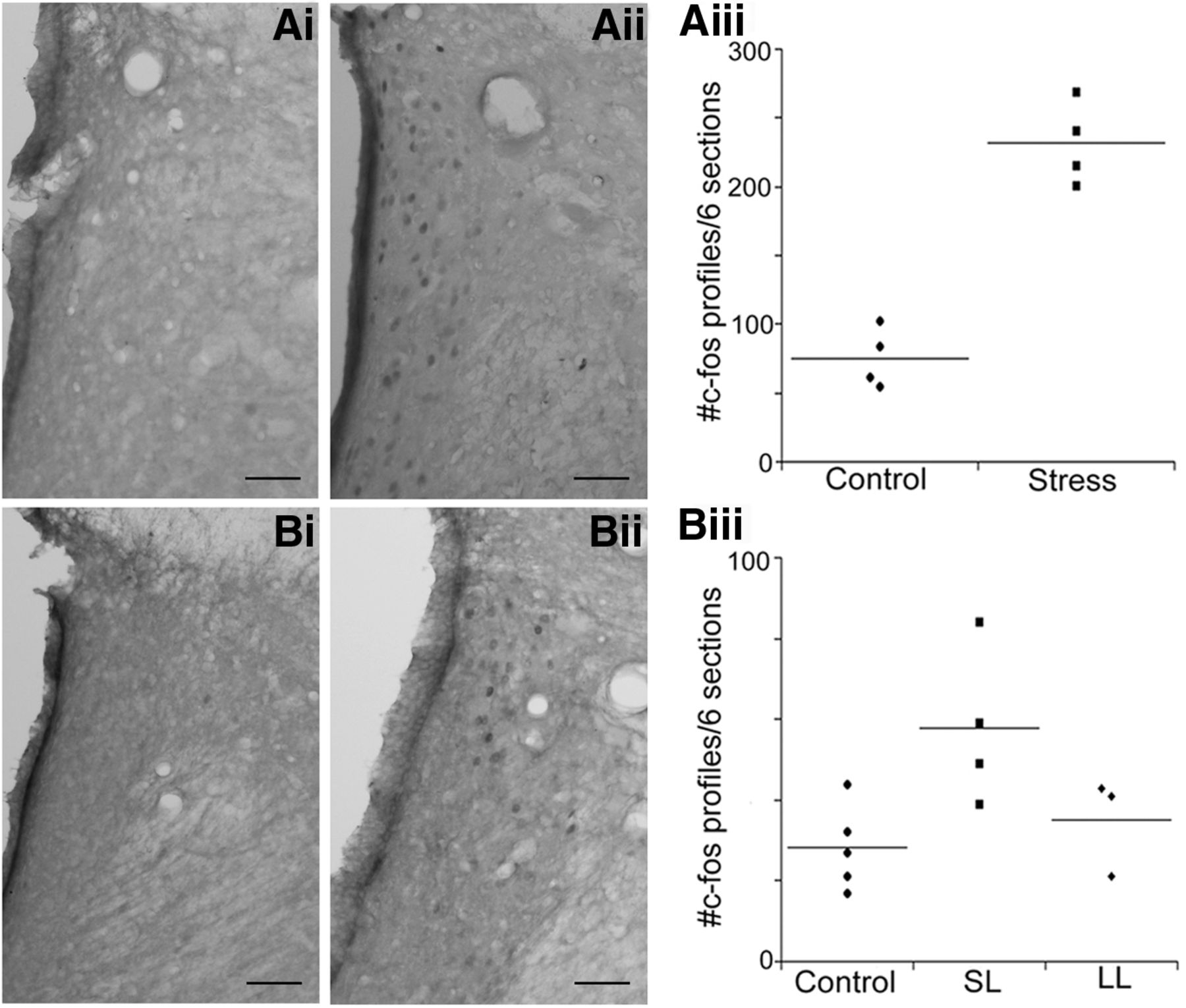
    Activation of LC neurons by a single or repeated exposure to resident–intruder stress. Ai, Aii, Representative sections from rats exposed to a single control manipulation (Ai) and a single resident–intruder stress (Aii). Aiii, Scatterplot showing the number of c-fos profiles in the LC after a single stress or control manipulation for individual control and stressed rats. Lines through the points indicate the group mean. Bi, Bii, Representative sections from a control rat exposed to five repeated manipulations (Bi) and an SL rat exposed to five repeated resident–intruder exposures (Bii). Biii, Scatterplot showing the number of c-fos profiles in the LC after the fifth stress or control manipulation for individual control, SL, and LL rats. Lines through the points indicate the group mean.

  • Figure 5.
    • Download figure
    • Open in new tab
    • Download powerpoint
    Figure 5.

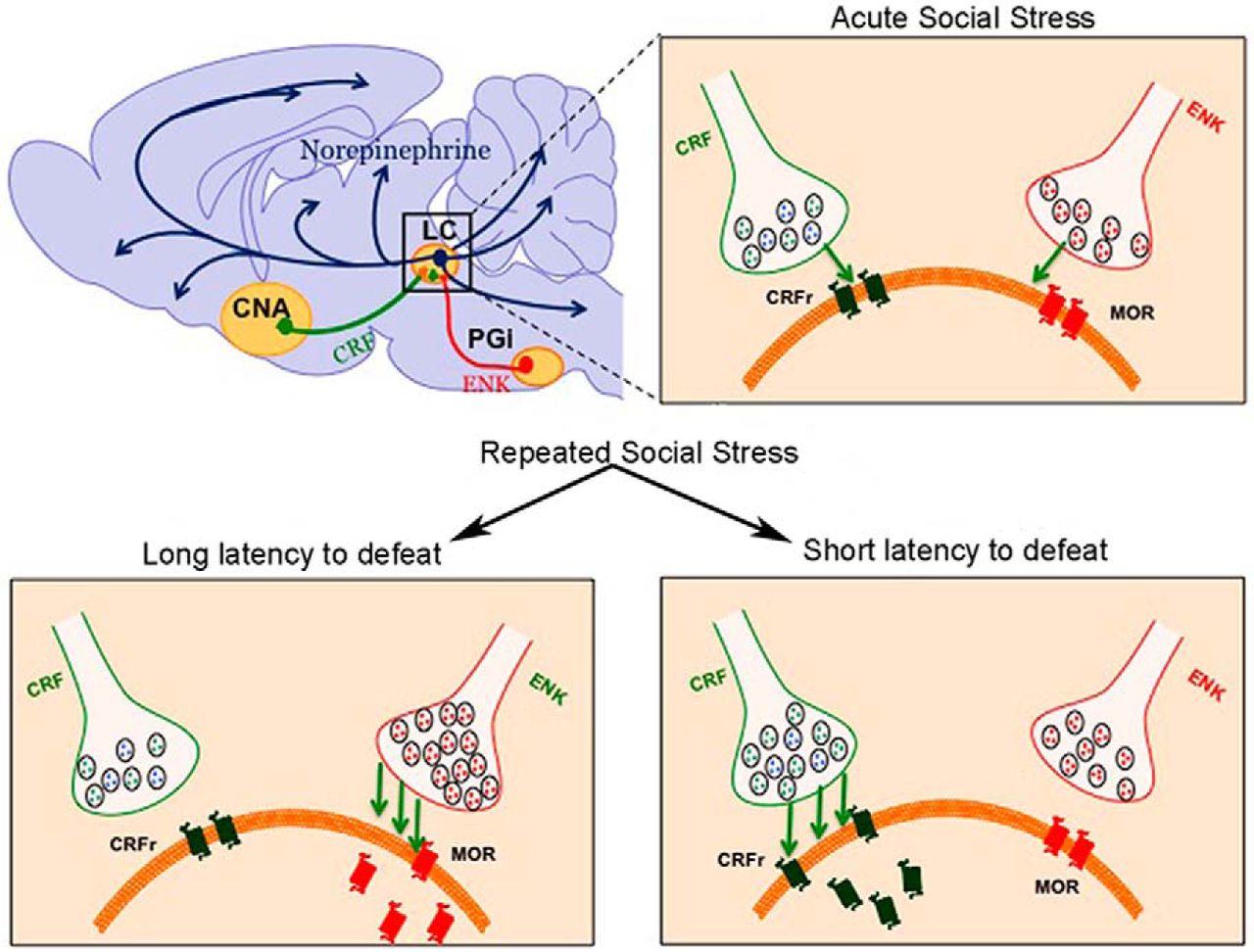
    Schematic depicting distinct engagement of CRF and ENK afferents to the LC and adaptations in receptors in LC neurons depending on social stress history and coping strategy. Acute social stress engages CRF inputs to the LC from the CNA and ENK inputs from the PGi to the LC. The emergence of different coping strategies with repeated social stress is associated with distinct biases toward regulation by one afferent. In rats that resist defeat (LL rats) PGi-ENK afferents to the LC remain engaged resulting in MOR internalization and upregulation in this phenotype. The CRF influence is decreased in LL rats. In contrast, in rats exhibiting a subordinate coping style (SL), amygdalar-CRF afferents are engaged and CRF1 becomes internalized in LC dendrites. The PGi-ENK influence is diminished in these rats. The selective engagement of afferents with opposing effects that are related to coping styles may be a basis for individual differences in the pathological consequences of social stress.
Tables

  • Figures
    • View popup
    Table 1.

    Repeated social stress, PGi

    c-fosFGENKFG+c-fosFG+c-fos, %FG+c-fos expressing ENK, %
    Control31 ± 3129 ± 2234 ± 722 ± 117 ± 19 ± 2
    SL31 ± 1120 ± 4256 ± 1221 ± 118 ± 111 ± 3
    LL55 ± 4*,#120 ± 4286 ± 5*40 ± 1*,#33 ± 1*,#41 ± 9**, ##
    • **p < 0.01, *p < 0.05 post hoc comparisons to control values; ## p < 0.01, # p < 0.05 post hoc comparisons to SL values.

    • View popup
    Table 2.

    Repeated social stress, CNA

    CNA
    c-fosFGCRFFG+c-fosFG+c-fos, %FG+c-fos expressing CRF, %
    Control75 ± 4240 ± 6130 ± 517 ± 27 ± 112 ± 1
    SL160 ± 6*,‡252 ± 10212 ± 10*,‡56 ± 4*,‡22 ± 1*,‡57 ± 5***,‡ ‡
    LL102 ± 12212 ± 28127 ± 1627 ± 313 ± 1*26 ± 5
    • ***p < 0.001, *p < 0.05 post hoc comparisons to control values; ‡ ‡ p < 0.01, ‡ p < 0.05 post hoc comparisons to LL values.

    • View popup
    Table 3.

    Acute social stress, PGi

    c-fosFGENKFG+c-fosFG+c-fos, %FG+c-fos expressing ENK, %
    Control37 ± 4137 ± 5224 ± 818 ± 313 ± 215 ± 4
    Defeat57 ± 4**155 ± 12255 ± 6*12 ± 215 ± 252 ± 2***
    • ***p < 0.001, **p < 0.01, *p < 0.05; one-way ANOVA comparisons to control values.

    • View popup
    Table 4.

    Acute social stress, CNA

    c-fosFGCRFFG+c-fosFG+c-fos, %FG+c-fos expressing CRF, %
    Control88 ± 4220 ± 6142 ± 720 ± 49 ± 219 ± 2
    Defeat180 ± 9***237 ± 12221 ± 9***57 ± 2***24 ± 2***70 ± 7***
    • ***p < 0.001; one-way ANOVA comparisons to control values.

    • View popup
    Table 5.

    Statistical table

    Data structureTest typePower
    a. Table 1-PGiNormal distributionANOVA/Tukey0.99
    b. Table 2-CANNormal distributionANOVA/Tukey0.99
    c. Table 3-PGiNormal distributionANOVA/Tukey0.82
    d. Table 4-CANNormal distributionANOVA/Tukey1.00
Back to top

In this issue

eneuro: 2 (6)
eNeuro
Vol. 2, Issue 6
November/December 2015
  • Table of Contents
  • Index by author
Email

Thank you for sharing this eNeuro article.

NOTE: We request your email address only to inform the recipient that it was you who recommended this article, and that it is not junk mail. We do not retain these email addresses.

Enter multiple addresses on separate lines or separate them with commas.
Social Stress Engages Neurochemically-Distinct Afferents to the Rat Locus Coeruleus Depending on Coping Strategy
(Your Name) has forwarded a page to you from eNeuro
(Your Name) thought you would be interested in this article in eNeuro.
CAPTCHA
This question is for testing whether or not you are a human visitor and to prevent automated spam submissions.
Print
View Full Page PDF
Citation Tools
Social Stress Engages Neurochemically-Distinct Afferents to the Rat Locus Coeruleus Depending on Coping Strategy
Beverly A. S. Reyes, Gerard Zitnik, Celia Foster, Elisabeth J. Van Bockstaele, Rita J. Valentino
eNeuro 1 November 2015, 2 (6) ENEURO.0042-15.2015; DOI: 10.1523/ENEURO.0042-15.2015

Citation Manager Formats

  • BibTeX
  • Bookends
  • EasyBib
  • EndNote (tagged)
  • EndNote 8 (xml)
  • Medlars
  • Mendeley
  • Papers
  • RefWorks Tagged
  • Ref Manager
  • RIS
  • Zotero
Respond to this article
Share
Social Stress Engages Neurochemically-Distinct Afferents to the Rat Locus Coeruleus Depending on Coping Strategy
Beverly A. S. Reyes, Gerard Zitnik, Celia Foster, Elisabeth J. Van Bockstaele, Rita J. Valentino
eNeuro 1 November 2015, 2 (6) ENEURO.0042-15.2015; DOI: 10.1523/ENEURO.0042-15.2015
Twitter logo Facebook logo Mendeley logo
  • Tweet Widget
  • Facebook Like
  • Google Plus One

Jump to section

  • Article
    • Visual Abstract
    • Abstract
    • Significance Statement
    • Introduction
    • Materials and Methods
    • Results
    • Discussion
    • Footnotes
    • References
    • Synthesis
  • Figures & Data
  • Info & Metrics
  • eLetters
  • PDF

Keywords

  • c-Fos
  • corticotropin-releasing factor
  • Enkephalin
  • Fluorogold
  • locus coeruleus
  • resident–intruder

Responses to this article

Respond to this article

Jump to comment:

No eLetters have been published for this article.

Related Articles

Cited By...

More in this TOC Section

New Research

  • A Very Fast Time Scale of Human Motor Adaptation: Within Movement Adjustments of Internal Representations during Reaching
  • Hsc70 Ameliorates the Vesicle Recycling Defects Caused by Excess α-Synuclein at Synapses
  • TrkB Signaling Influences Gene Expression in Cortistatin-Expressing Interneurons
Show more New Research

Integrative Systems

  • Neuronal activity regulating the dauer entry decision in Caenorhabditis elegans
  • Frazzled/DCC Regulates Gap Junction Formation at a Drosophila Giant Synapse
  • A Single NPFR Neuropeptide F Receptor Neuron That Regulates Thirst Behaviors in Drosophila
Show more Integrative Systems

Subjects

  • Integrative Systems
  • Home
  • Alerts
  • Follow SFN on BlueSky
  • Visit Society for Neuroscience on Facebook
  • Follow Society for Neuroscience on Twitter
  • Follow Society for Neuroscience on LinkedIn
  • Visit Society for Neuroscience on Youtube
  • Follow our RSS feeds

Content

  • Early Release
  • Current Issue
  • Latest Articles
  • Issue Archive
  • Blog
  • Browse by Topic

Information

  • For Authors
  • For the Media

About

  • About the Journal
  • Editorial Board
  • Privacy Notice
  • Contact
  • Feedback
(eNeuro logo)
(SfN logo)

Copyright © 2026 by the Society for Neuroscience.
eNeuro eISSN: 2373-2822

The ideas and opinions expressed in eNeuro do not necessarily reflect those of SfN or the eNeuro Editorial Board. Publication of an advertisement or other product mention in eNeuro should not be construed as an endorsement of the manufacturer’s claims. SfN does not assume any responsibility for any injury and/or damage to persons or property arising from or related to any use of any material contained in eNeuro.