Main menu

  • HOME
  • CONTENT
    • Early Release
    • Featured
    • Current Issue
    • Issue Archive
    • Blog
    • Collections
    • Podcast
  • TOPICS
    • Cognition and Behavior
    • Development
    • Disorders of the Nervous System
    • History, Teaching and Public Awareness
    • Integrative Systems
    • Neuronal Excitability
    • Novel Tools and Methods
    • Sensory and Motor Systems
  • ALERTS
  • FOR AUTHORS
  • ABOUT
    • Overview
    • Editorial Board
    • For the Media
    • Privacy Policy
    • Contact Us
    • Feedback
  • SUBMIT

User menu

Search

  • Advanced search
eNeuro
eNeuro

Advanced Search


  • HOME
  • CONTENT
    • Early Release
    • Featured
    • Current Issue
    • Issue Archive
    • Blog
    • Collections
    • Podcast
  • TOPICS
    • Cognition and Behavior
    • Development
    • Disorders of the Nervous System
    • History, Teaching and Public Awareness
    • Integrative Systems
    • Neuronal Excitability
    • Novel Tools and Methods
    • Sensory and Motor Systems
  • ALERTS
  • FOR AUTHORS
  • ABOUT
    • Overview
    • Editorial Board
    • For the Media
    • Privacy Policy
    • Contact Us
    • Feedback
  • SUBMIT
PreviousNext
Research ArticleNegative Results, Disorders of the Nervous System

Effects of Exercise on Progranulin Levels and Gliosis in Progranulin-Insufficient Mice

Andrew E. Arrant, Aashka R. Patel and Erik D. Roberson
eNeuro 22 June 2015, 2 (3) ENEURO.0061-14.2015; https://doi.org/10.1523/ENEURO.0061-14.2015
Andrew E. Arrant
Departments of Neurology and Neurobiology, Center for Neurodegeneration and Experimental Therapeutics, University of Alabama at Birmingham, Birmingham, Alabama
  • Find this author on Google Scholar
  • Find this author on PubMed
  • Search for this author on this site
Aashka R. Patel
Departments of Neurology and Neurobiology, Center for Neurodegeneration and Experimental Therapeutics, University of Alabama at Birmingham, Birmingham, Alabama
  • Find this author on Google Scholar
  • Find this author on PubMed
  • Search for this author on this site
Erik D. Roberson
Departments of Neurology and Neurobiology, Center for Neurodegeneration and Experimental Therapeutics, University of Alabama at Birmingham, Birmingham, Alabama
  • Find this author on Google Scholar
  • Find this author on PubMed
  • Search for this author on this site
  • ORCID record for Erik D. Roberson
  • Article
  • Figures & Data
  • Info & Metrics
  • eLetters
  • PDF
Loading

Article Figures & Data

Figures

  • Tables
  • Figure 1
    • Download figure
    • Open in new tab
    • Download powerpoint
    Figure 1

    Exercise (3-4 weeks) produces a small increase in hippocampal progranulin in young adult wild-type mice. Two- to 3-month-old wild-type mice were randomized to sedentary or exercise groups for three to four weeks (A). B, Exercise produced a robust increase in BDNF (****p < 0.0001). C, Representative BDNF and α-tubulin blots. D, Exercise did not significantly increase frontal cortex progranulin protein. E, Exercise produced a small but statistically significant increase in hippocampal progranulin (*p = 0.038). F, Exercise did not affect plasma progranulin. n = 8–16 mice per group. Values in B–F are expressed relative to the sedentary group.

  • Figure 2
    • Download figure
    • Open in new tab
    • Download powerpoint
    Figure 2

    Progranulin deficiency does not affect wheel-running behavior. Mice aged 6 months were randomized to sedentary or exercise groups for 7.5 weeks. A, No genotype differences were detected in wheel running distance between Grn+/+ , Grn+/− , and Grn−/− mice. B, Exercise reduced body weight similarly in all three genotypes (***ANOVA exercise effect, p = 0.003). n = 10–15 mice per group.

  • Figure 3
    • Download figure
    • Open in new tab
    • Download powerpoint
    Figure 3

    Exercise (7.5 weeks) does not increase progranulin in wild-type or Grn+/− mice. Exercise for 7.5 weeks did not increase progranulin mRNA in frontal cortex (A) or thalamus (B), or progranulin protein levels in the hippocampus (C) or plasma (D). E–G, In contrast, exercise increased hippocampal BDNF levels across all three genotypes (E, ANOVA effect of exercise, p = 0.035), with no change in α-tubulin as a loading control (F). G, Representative BDNF and α-tubulin blots. H, Exercise also increased the number of doublecortin (DCX)-positive neurons in the dentate gyrus (ANOVA effect of exercise p < 0.0001, Sidak’s post hoc test exercise > sedentary Grn+/+ , p = 0.0089, Grn+/− , p = 0.0198). Representative images (20×) are shown of doublecortin immunostaining in the dentate gyrus. Scale bar, 25 µm. Mice were 6-months-old on average when beginning the study, and 8-months-old on average when samples were collected. n = 10–15 mice per group. Values in A–F are expressed relative to the wild-type sedentary group.

  • Figure 4
    • Download figure
    • Open in new tab
    • Download powerpoint
    Figure 4

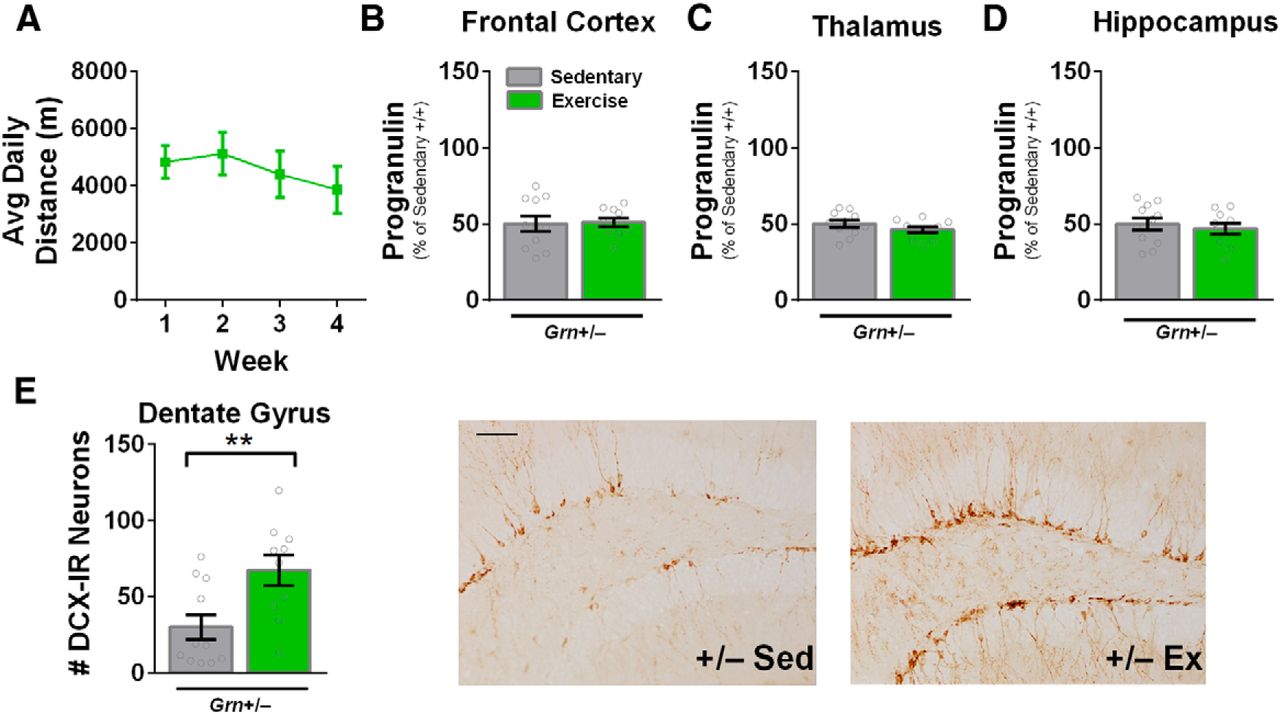
    Exercise (4 weeks) does not increase progranulin protein levels in multiple brain regions of Grn+/− mice. Four- to 8-month-old Grn+/− mice were randomized to sedentary or exercise groups for 4 weeks (A). Exercise did not increase progranulin protein levels in frontal cortex (B), thalamus (C), or hippocampus (D), despite producing the expected increase in the number of doublecortin-positive neurons in the dentate gyrus (E, ** p < 0.01). Values in B–D are expressed relative to sedentary Grn+/+ mice, with sedentary Grn+/− mice set at 0.5 to maintain a consistent scale with Figure 3. n = 11–12 per group.

  • Figure 5
    • Download figure
    • Open in new tab
    • Download powerpoint
    Figure 5

    Group housing does not potentiate the effects of exercise on progranulin. Six weeks of wheel running (A) failed to increase frontal cortex progranulin mRNA (B) or hippocampal progranulin protein (C) in either solo- or group-housed wild-type mice aged 3–6 months. D-F, Hippocampal BDNF was increased by exercise (D; ANOVA effect of exercise, p = 0.041). F, Representative BDNF and α-tubulin blots for each group. n = 8–14 mice per group. Values in B–E are expressed relative to the solo-housed sedentary group.

  • Figure 6
    • Download figure
    • Open in new tab
    • Download powerpoint
    Figure 6

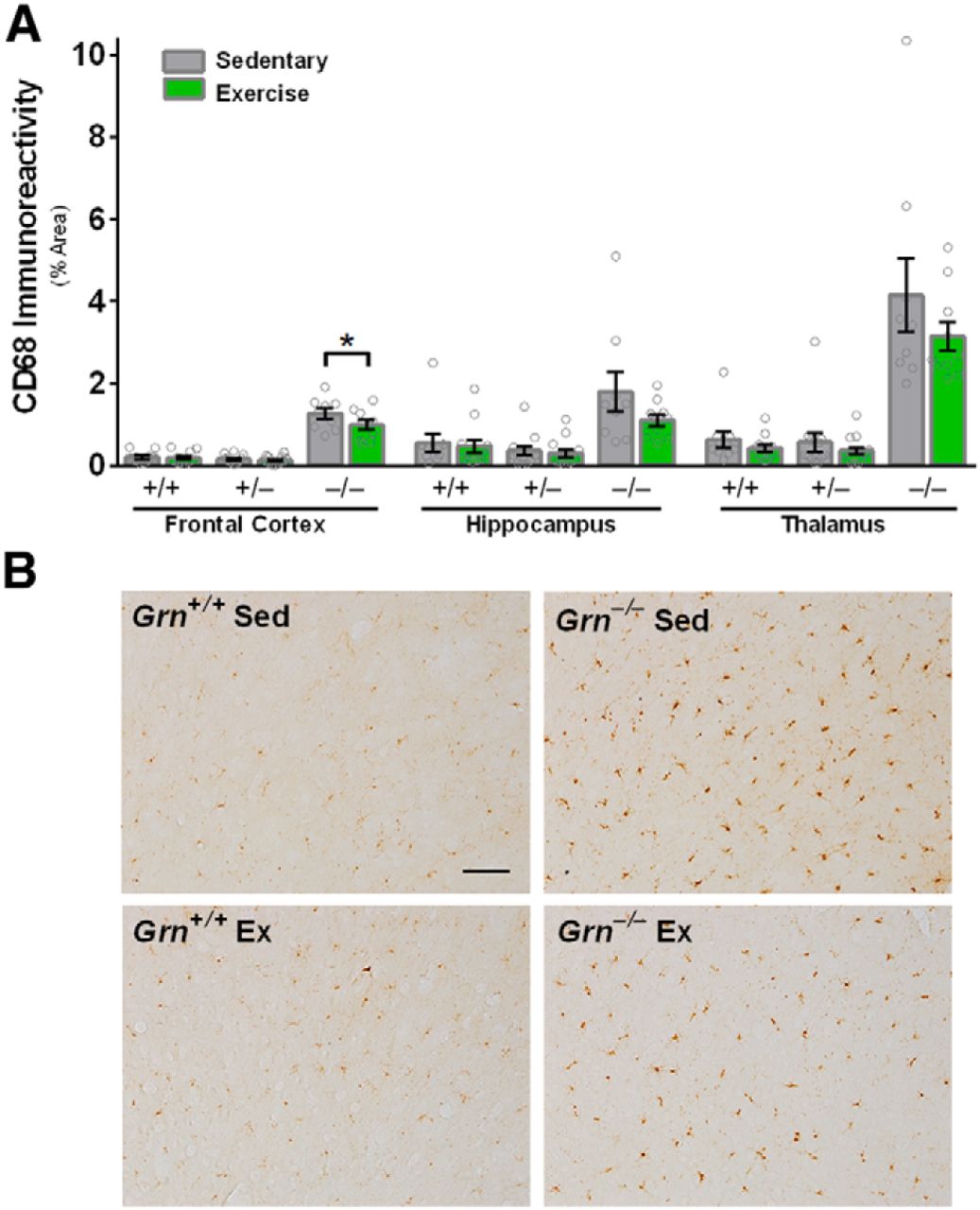
    Exercise (7.5 weeks) reduces cortical microgliosis in Grn−/− mice. A, Grn−/− mice had elevated CD68 immunoreactivity in the frontal cortex, hippocampus, and thalamus (ANOVA genotype effect, p < 0.0001). Global analysis of CD68 immunostaining revealed a region x genotype interaction (p < 0.0001), so each region was analyzed with a separate ANOVA. Analysis of CD68 immunostaining in the frontal cortex revealed an effect of genotype (ANOVA, p < 0.0001) and a strong trend for an exercise effect (ANOVA exercise effect, p = 0.051). Subsequent post hoc analysis revealed significantly lower CD68 immunoreactivity in exercised relative to sedentary Grn−/− mice (*p < 0.05). B, Representative images (20×) of CD68 immunostaining from the frontal cortex. Scale bar, 25 µm.

Tables

  • Figures
    • View popup
    Table 1

    Measures of progranulin levels

    RowFigurePanelDescriptionTestPower for 30% change70% power to detect change of:80% power to detect change of:
    Measures of progranulin levels
    a1DFrontal cortex progranulinStudent's t test0.9322%24%
    b1EHippocampus progranulinStudent's t test0.9818%21%
    c1FPlasma progranulinStudent's t test0.8226%29%
    d3AFrontal cortex progranulin mRNATwo-way ANOVA, Sidak's post hoc test15%6%
    e3BThalamus progranulin mRNATwo-way ANOVA, Sidak's post hoc test18%9%
    f3CHippocampus progranulinTwo-way ANOVA, Sidak's post hoc test111%12%
    g3DPlasma progranulinTwo-way ANOVA, Sidak's post hoc test115%17%
    h4BFrontal Cortex progranulinStudent's t test115%17%
    i4CThalamus progranulinStudent's t test18%9%
    j4DHippocampus progranulinStudent's t test114%16%
    k5BFrontal Cortex progranulinTwo-way ANOVA, Sidak's post hoc test0.3547%54%
    l5CHippocampus progranulinTwo-way ANOVA, Sidak's post hoc test0.5237%42%
    Exercise-related positive controls
    m1BHippocampus BDNFStudent's t test0.5735%39%
    n1BHippocampus α-tubulinStudent's t test19%10%
    o2ARunning distanceTwo-way Repeated Measures ANOVA0.502092 m (38% change)2360 m
    (43% change)
    p2BBody weightTwo-way ANOVA, Sidak's post hoc test0.976.5 g (22% change)7.3 g (25% change)
    q3EHippocampus BDNFTwo-way ANOVA, Sidak's post hoc test0.5635%40%
    r3FHippocampus α-tubulinTwo-way ANOVA, Sidak's post hoc test0.8425%29%
    s3GDentate gyrus doublecortin-positive neuronsTwo-way ANOVA, Sidak's post hoc test0.388.3 cells
    (45% change)
    9.4 cells
    (51% change)
    t4EDentate gyrus doublecortin-positive neuronsStudent's t test0.1033.9 cells
    (113% increase)
    38.3 cells
    (127% increase)
    u4DHippocampus BDNFTwo-way ANOVA, Sidak's post-hoc test0.8525%28%
    v5EHippocampus α-tubulinTwo-way ANOVA, Sidak's post-hoc test17%8%
    • View popup
    Table 2

    Measures of Gliosis

    RowFigurePanelDescriptionTestPower for 30% effect sizePower to normalize pathologyDelta at 70% powerDelta at 80% power
    Global CD68 analysisThree-way ANOVA
    w6AFrontal cortex CD68Two-way ANOVA, Sidak's post hoc test0.5410.45% area(36% change)0.51% area(41% change)
    x6AHippocampus CD68Two-way ANOVA, 's post hoc test0.160.551.40% area (78% change)1.58% area (88% change)
    y6AThalamus CD68Two-way ANOVA, Sidak's post hoc test0.230.942.61% area (63% change)2.95% area (71% change)
Back to top

In this issue

eneuro: 2 (3)
eNeuro
Vol. 2, Issue 3
May/June 2015
  • Table of Contents
  • Index by author
Email

Thank you for sharing this eNeuro article.

NOTE: We request your email address only to inform the recipient that it was you who recommended this article, and that it is not junk mail. We do not retain these email addresses.

Enter multiple addresses on separate lines or separate them with commas.
Effects of Exercise on Progranulin Levels and Gliosis in Progranulin-Insufficient Mice
(Your Name) has forwarded a page to you from eNeuro
(Your Name) thought you would be interested in this article in eNeuro.
CAPTCHA
This question is for testing whether or not you are a human visitor and to prevent automated spam submissions.
Print
View Full Page PDF
Citation Tools
Effects of Exercise on Progranulin Levels and Gliosis in Progranulin-Insufficient Mice
Andrew E. Arrant, Aashka R. Patel, Erik D. Roberson
eNeuro 22 June 2015, 2 (3) ENEURO.0061-14.2015; DOI: 10.1523/ENEURO.0061-14.2015

Citation Manager Formats

  • BibTeX
  • Bookends
  • EasyBib
  • EndNote (tagged)
  • EndNote 8 (xml)
  • Medlars
  • Mendeley
  • Papers
  • RefWorks Tagged
  • Ref Manager
  • RIS
  • Zotero
Respond to this article
Share
Effects of Exercise on Progranulin Levels and Gliosis in Progranulin-Insufficient Mice
Andrew E. Arrant, Aashka R. Patel, Erik D. Roberson
eNeuro 22 June 2015, 2 (3) ENEURO.0061-14.2015; DOI: 10.1523/ENEURO.0061-14.2015
Twitter logo Facebook logo Mendeley logo
  • Tweet Widget
  • Facebook Like
  • Google Plus One

Jump to section

  • Article
    • Abstract
    • Significance Statement
    • Introduction
    • Materials and Methods
    • Results
    • Discussion
    • Footnotes
    • References
    • Synthesis
  • Figures & Data
  • Info & Metrics
  • eLetters
  • PDF

Keywords

  • BDNF
  • exercise
  • Frontotemporal Dementia
  • Progranulin

Responses to this article

Respond to this article

Jump to comment:

No eLetters have been published for this article.

Related Articles

Cited By...

More in this TOC Section

Negative Results

  • Closed-Loop Acoustic Stimulation Enhances Sleep Oscillations But Not Memory Performance
  • Cyfip1 Haploinsufficiency Does Not Alter GABAA Receptor δ-Subunit Expression and Tonic Inhibition in Dentate Gyrus PV+ Interneurons and Granule Cells
  • Glucagon-Like Peptide-1 Receptor Agonist Treatment Does Not Reduce Abuse-Related Effects of Opioid Drugs
Show more Negative Results

Disorders of the Nervous System

  • Closed-Loop Acoustic Stimulation Enhances Sleep Oscillations But Not Memory Performance
  • Cyfip1 Haploinsufficiency Does Not Alter GABAA Receptor δ-Subunit Expression and Tonic Inhibition in Dentate Gyrus PV+ Interneurons and Granule Cells
  • Glucagon-Like Peptide-1 Receptor Agonist Treatment Does Not Reduce Abuse-Related Effects of Opioid Drugs
Show more Disorders of the Nervous System

Subjects

  • Disorders of the Nervous System
  • Home
  • Alerts
  • Follow SFN on BlueSky
  • Visit Society for Neuroscience on Facebook
  • Follow Society for Neuroscience on Twitter
  • Follow Society for Neuroscience on LinkedIn
  • Visit Society for Neuroscience on Youtube
  • Follow our RSS feeds

Content

  • Early Release
  • Current Issue
  • Latest Articles
  • Issue Archive
  • Blog
  • Browse by Topic

Information

  • For Authors
  • For the Media

About

  • About the Journal
  • Editorial Board
  • Privacy Notice
  • Contact
  • Feedback
(eNeuro logo)
(SfN logo)

Copyright © 2025 by the Society for Neuroscience.
eNeuro eISSN: 2373-2822

The ideas and opinions expressed in eNeuro do not necessarily reflect those of SfN or the eNeuro Editorial Board. Publication of an advertisement or other product mention in eNeuro should not be construed as an endorsement of the manufacturer’s claims. SfN does not assume any responsibility for any injury and/or damage to persons or property arising from or related to any use of any material contained in eNeuro.