Main menu

  • HOME
  • CONTENT
    • Early Release
    • Featured
    • Current Issue
    • Issue Archive
    • Blog
    • Collections
    • Podcast
  • TOPICS
    • Cognition and Behavior
    • Development
    • Disorders of the Nervous System
    • History, Teaching and Public Awareness
    • Integrative Systems
    • Neuronal Excitability
    • Novel Tools and Methods
    • Sensory and Motor Systems
  • ALERTS
  • FOR AUTHORS
  • ABOUT
    • Overview
    • Editorial Board
    • For the Media
    • Privacy Policy
    • Contact Us
    • Feedback
  • SUBMIT

User menu

Search

  • Advanced search
eNeuro
eNeuro

Advanced Search


  • HOME
  • CONTENT
    • Early Release
    • Featured
    • Current Issue
    • Issue Archive
    • Blog
    • Collections
    • Podcast
  • TOPICS
    • Cognition and Behavior
    • Development
    • Disorders of the Nervous System
    • History, Teaching and Public Awareness
    • Integrative Systems
    • Neuronal Excitability
    • Novel Tools and Methods
    • Sensory and Motor Systems
  • ALERTS
  • FOR AUTHORS
  • ABOUT
    • Overview
    • Editorial Board
    • For the Media
    • Privacy Policy
    • Contact Us
    • Feedback
  • SUBMIT
PreviousNext
Research ArticleNew Research, Neuronal Excitability

What Elements of the Inflammatory System Are Necessary for Epileptogenesis In Vitro?

Kyung-Il Park, Volodymyr Dzhala, Yero Saponjian and Kevin J. Staley
eNeuro 3 March 2015, 2 (2) ENEURO.0027-14.2015; https://doi.org/10.1523/ENEURO.0027-14.2015
Kyung-Il Park
1Department of Neurology, Massachusetts General Hospital, Boston, Massachusetts 02129
3Seoul Paik Hospital, Inje University, Seoul 100-032, South Korea
  • Find this author on Google Scholar
  • Find this author on PubMed
  • Search for this author on this site
  • ORCID record for Kyung-Il Park
Volodymyr Dzhala
1Department of Neurology, Massachusetts General Hospital, Boston, Massachusetts 02129
2Harvard Medical School, Boston, Massachusetts 02129
  • Find this author on Google Scholar
  • Find this author on PubMed
  • Search for this author on this site
Yero Saponjian
1Department of Neurology, Massachusetts General Hospital, Boston, Massachusetts 02129
  • Find this author on Google Scholar
  • Find this author on PubMed
  • Search for this author on this site
  • ORCID record for Yero Saponjian
Kevin J. Staley
1Department of Neurology, Massachusetts General Hospital, Boston, Massachusetts 02129
2Harvard Medical School, Boston, Massachusetts 02129
  • Find this author on Google Scholar
  • Find this author on PubMed
  • Search for this author on this site
  • Article
  • Figures & Data
  • Info & Metrics
  • eLetters
  • PDF
Loading

Article Figures & Data

Figures

  • Tables
  • Figure 1.
    • Download figure
    • Open in new tab
    • Download powerpoint
    Figure 1.

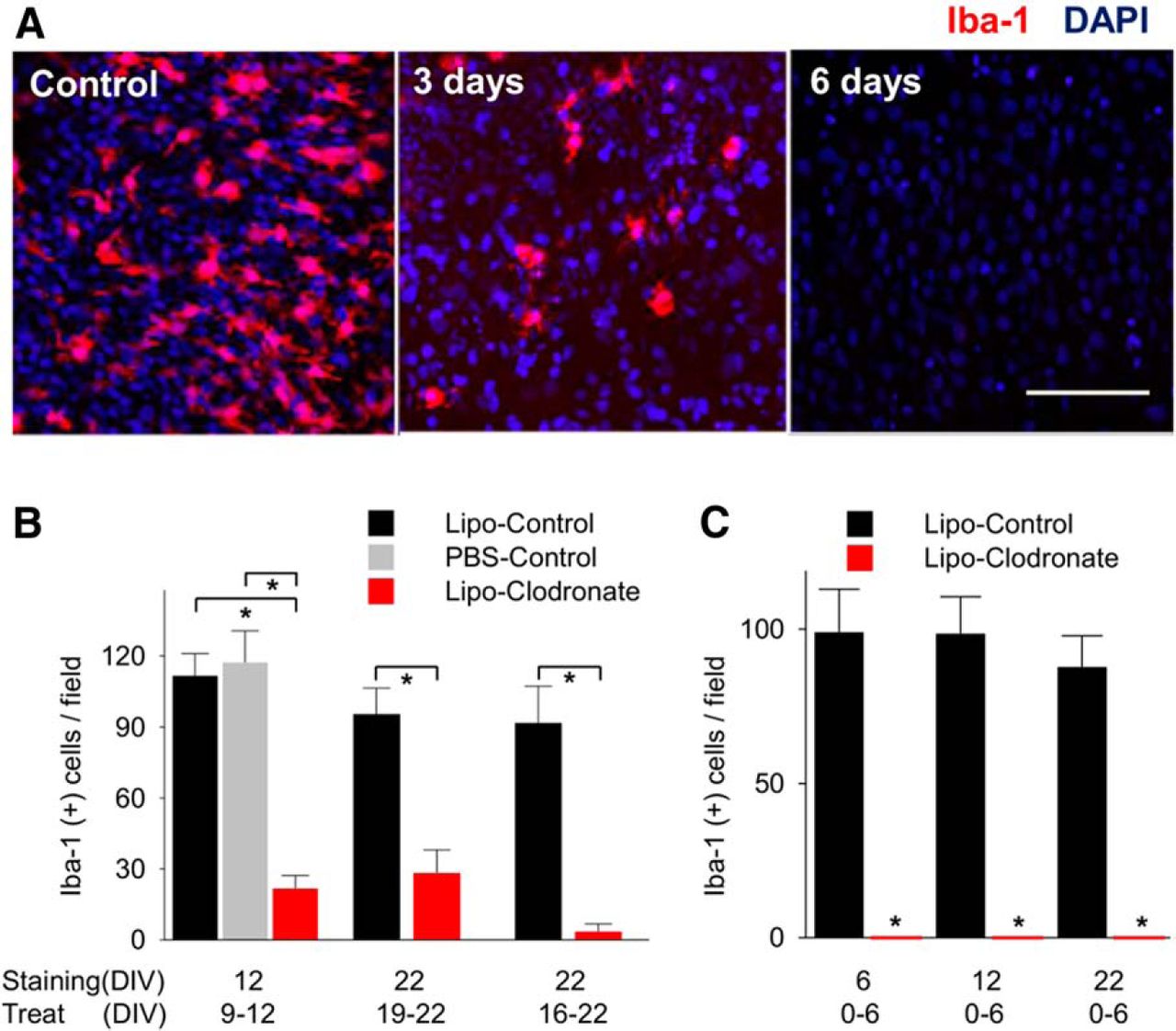
    Elimination of microglia using liposomal (Lipo) clodronate from organotypic hippocampal slices of rat. A, Iba-1-positive cells (microglia and macrophages) in CA1 were depleted by using liposomal clodronate (0.2 mg/ml). B, Treatment for 3 d (from DIV9 to 12) decreased the number of microglia comparing liposome-control group and saline control group. Six day treatment from DIV16 to DIV22 eliminated more Iba-1(+) cells than 3 d treatment (96.2% vs 70.4%, n = 4 per group, p = 0.07). C, Microglial depletion persisted 16 d after washout. All values are expressed as mean ± SEM. *p < 0.05. Scale bar, 100 µm.

  • Figure 2.
    • Download figure
    • Open in new tab
    • Download powerpoint
    Figure 2.

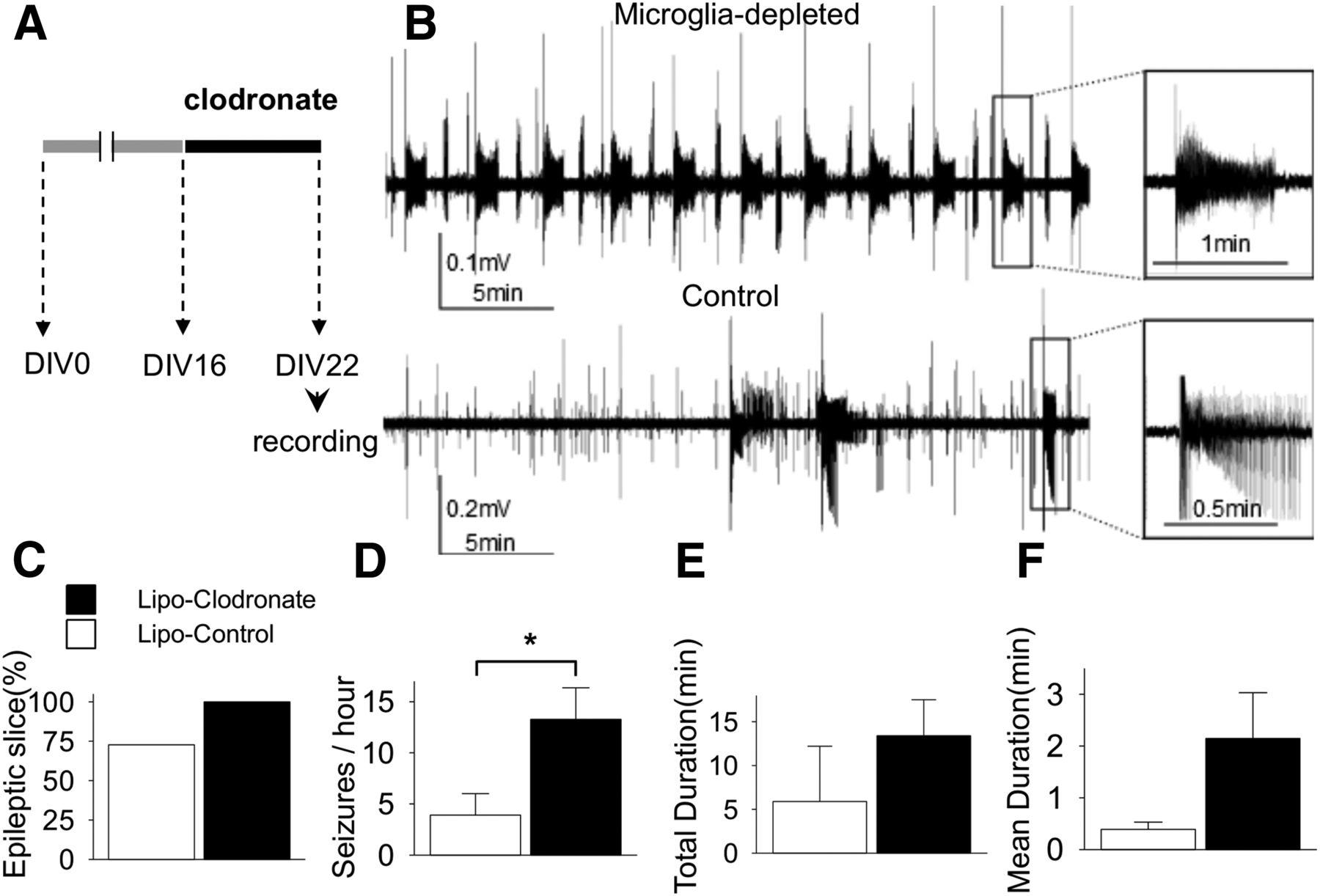
    Effect of microglial depletion on ictogenesis in cultured rat slices. A, Schematic drawing of experiment protocol. B, Representative traces of field potentials recorded at DIV22 show that the microglia-depleted slice had more frequent and longer seizure-like activities compared to the control slice. C, Bar graphs indicate the percentage of slices with more than one seizure-like activity during observation period in each group. D−F, The frequency of seizure-like activities was significantly greater in the microglia-depleted group (13.3 ± 3.1 vs 3.9 ± 2.1/h, n = 11 per group, p = 0.02). All values are expressed as mean ± SEM, *p < 0.05.

  • Figure 3.
    • Download figure
    • Open in new tab
    • Download powerpoint
    Figure 3.

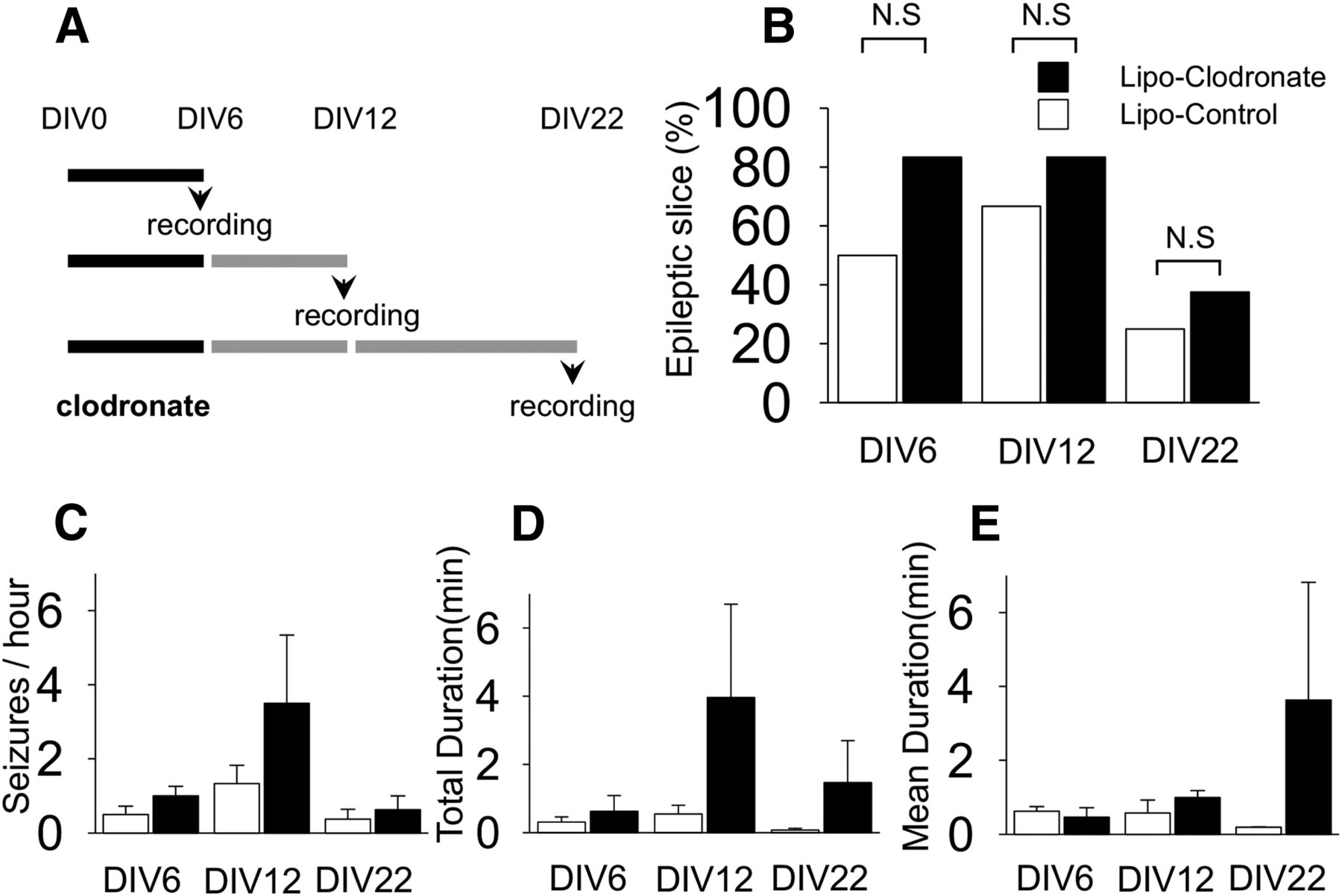
    Effect of microglial depletion on epileptogenesis in cultured rat slices. A, Liposomal (Lipo) clodronate or liposome-control was exposed to slices from DIV0 to 6 and spontaneous seizure-like activities were recorded at DIV6, 12, or 22 according to the indicated protocols. B, The proportions of slices demonstrating seizure-like activity during recording were not different between microglia-negative group and control group (n = 6-8 per group, p = 0.24, 0.52, and 0.60. respectively). C−E, Seizure frequency, total recorded seizure time, and mean seizure duration tend to be higher in slices depleted of microglia, although none of these differences were statistically different (n = 6-8 per group, p = 0.24, 0.30, and 0.28, respectively). N.S, Not significant. All values are expressed as mean ± SEM.

  • Figure 4.
    • Download figure
    • Open in new tab
    • Download powerpoint
    Figure 4.

    Effect of microglial depletion on epileptogenesis and ictogenesis in wild-type mice slices. A, Data was recorded at DIV6 after exposure of liposome clodronate from DIV0 to 6. B, Data was recorded at DIV12 after exposure of liposomal clodronate from DIV6 to 12. Microglial depletion did not alter the frequency, total duration, or mean duration of seizure-like activities (n = 4-5 per group). C, Representative traces recorded at DIV6 from microglia-depleted and control group, shows similar patterns of spontaneous seizure-like activities. All values are expressed as mean ± SEM. N.S, Not significant.

  • Figure 5.
    • Download figure
    • Open in new tab
    • Download powerpoint
    Figure 5.

    Microglial depletion from slices of nude mouse. A, Comparison of the density of Iba1-positive cells in area CA1 in control slices from different species (n = 5-6 per group) versus the percentage of slices that displayed seizure activity (n = 5-8 per group; different slices used for Iba-1 staining and recording). Across species, there was no significant correlation between microglial density and fraction of epileptic slices (R = −0.10, p = 0.94). B, Examples of hippocampal cultures from nude mice at each time point. Liposomal (Lipo) clodronate (top, 0.02 mg/ml) or liposome-control (bottom) was applied from DIV0 to 6. C, D, Double immunostaining was performed with NeuN and Iba-1 antibodies. Quantification at CA1 reveals that liposomal clodronate did not affect the neuronal populations of nude mouse (p = 0.33), whereas it depleted all microglia (n = 5 per group). E, The proportion of epileptic slices and total duration of seizure-like activities in microglia-depleted slices did not differ significantly from control slices, whereas the frequency of seizure-like activity was somewhat lower in microglia-depleted slices (n = 8-10 per group). All values are expressed as mean ± SEM. *p < 0.05; N.S, not significant. Scale bar, 100 μm.

  • Figure 6.
    • Download figure
    • Open in new tab
    • Download powerpoint
    Figure 6.

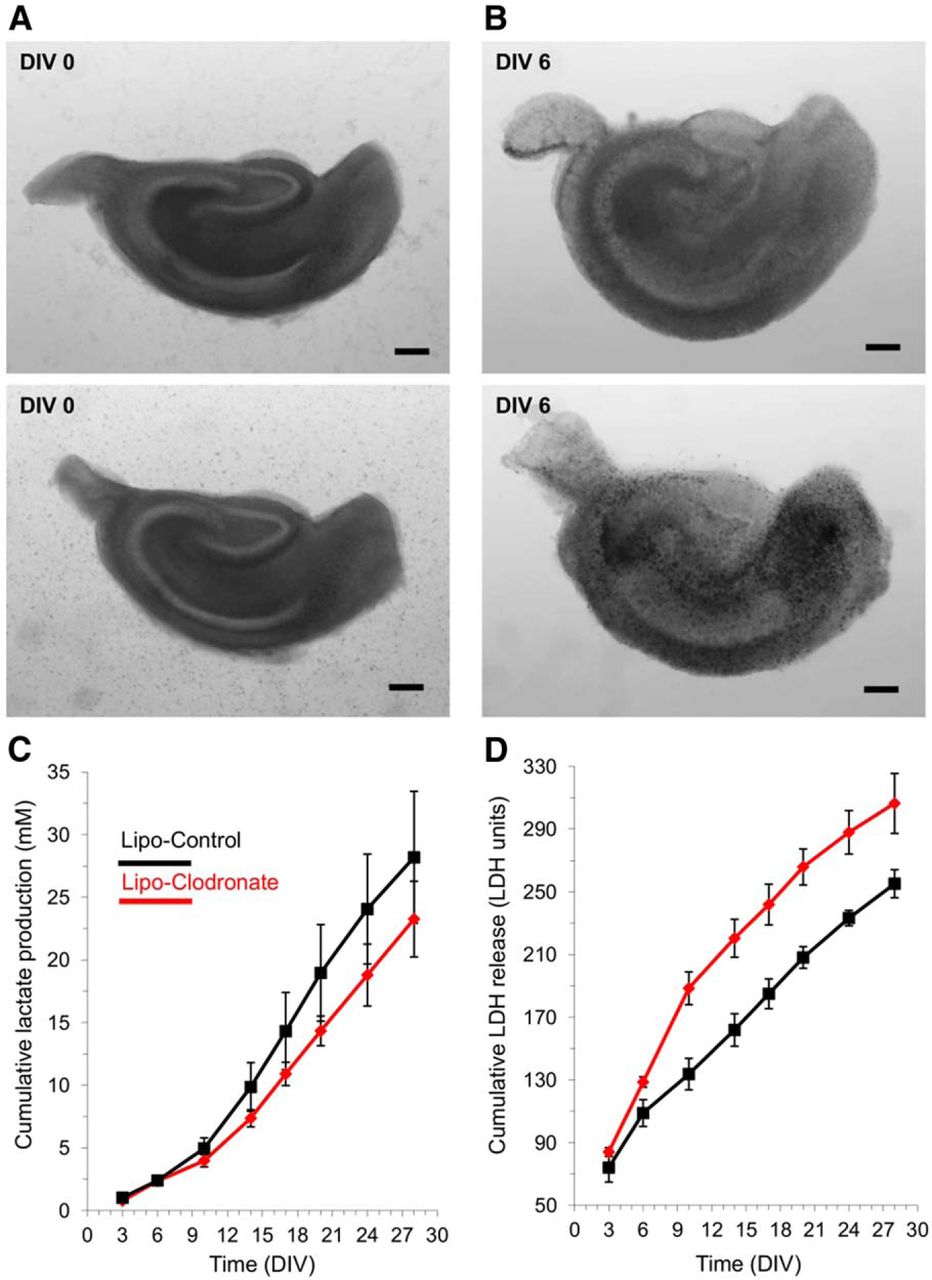
    Long-term assays of epileptogenesis in microglia-depleted versus control hippocampal slice cultures. A, Examples of slice culture brightfield micrographs at DIV0 prior to clodronate treatment of upper slice. B, Brightfield micrographs of the same slice cultures on DIV6 at the conclusion of clodronate treatment to the upper slice and empty liposome treatment of the lower slice. No deleterious effects of clodronate are evident at this magnification. C, Cumulative group mean lactate production, assayed in the spent culture media at 3-4 daintervals during twice weekly media changes. N = 3 slices each group; all slices from the same animal. D, Cumulative group mean LDH release, assayed in the spent culture media. Same groups slices and media as for lactate assays in panel C. All values are expressed as mean ± SEM. Scale bar, 250 μm.
Tables

  • Figures
    • View popup
    Table 1.

    Numbers of slices and animals used in each experiment

    Recording timingSlice numbers (per group)Frequency of seizure (/h)Number of animals usedIncidence of epilepsy (%)
    ClodronateControlClodronateControl
    Figure 2
    DIV12111-360-243 rats10072.7
    Figure 3
    DIV660-20-22 rats83.350
    DIV1260-120-32 rats83.366.7
    DIV2280-30-22 rats37.525.0
    Figure 4
    DIV64-59-191-162 mice100100
    DIV124-62-262-212 mice100100
    Figure 5
    DIV124-60-20-43 nude mice40.062.5
    • View popup
    Table 2.

    Statistical table

    Data structureType of testPower
    aNormally distributedt test0.004
    bNormally distributedt test0.001
    cNormally distributedt test0.77
    dCategoricalFisher’s exact test0.07
    eNormally distributedOne-way ANOVA0.02
    fNormally distributedOne-way ANOVA0.11
    gNormal distributedOne-way ANOVA0.14
    hCategoricalFisher’s exact test0.24
    iCategoricalFisher’s exact test0.52
    jCategoricalFisher’s exact test0.60
    kNormally distributedTwo-way ANOVA0.39 for frequency, 0.46 for total duration, and 0.30 for mean duration
    lNormally distributedOne-way ANOVA0.31
    mNormally distributedOne-way ANOVA0.36
    nNormally distributedOne-way ANOVA0.56
    oNormally distributedOne-way ANOVA0.99
    pNormally distributedOne-way ANOVA0.89
    qNormally distributedOne-way ANOVA0.62
    rNormally distributedt test0.003
    sNormally distributedt test0.01
    tCategoricalFisher’s exact test0.36
    uNormally distributedOne-way ANOVA0.54
    vNormally distributedOne-way ANOVA0.051
    w*Normally distributedt test with Sidak correction0.02, 0.42, 0.08, 0.07, 0.09, 0.08, 0.08, and 0.13 at each time point
    x*Normally distributedt test with Sidak correction0.10, 0.02, 0.001, 0.002, 0.002, 0.002, 0.007, 0.01 at each time point
    • *αSID = 1 − (1 − α)1/ m , α = 0.05, m = 1,2,3,4,5,6,7,8. αSID(MAX) = 0.06

    • View popup
    Table 3.

    Comparison of seizure-like activities between microglia-depleted and control slices

    Microglia-depletedControlp value
    Recording at DIV6
    Frequency (SLA/h)1.0 ± 0.30.5 ± 0.20.17
    Total duration (s/h)37.7 ± 27.718.7 ± 9.00.53
    Mean duration (s)27.7 ± 15.337.3 ± 7.70.67
    Recording at DIV12
    Frequency (SLA/h)3.5 ± 1.81.3 ± 0.50.24
    Total duration (s/h)237.7 ± 164.232.8 ± 15.30.30
    Mean duration (s)59.6 ± 11.134.5 ± 20.90.28
    Recording at DIV22
    Frequency (SLA/h)0.6 ± 0.40.4 ± 0.30.59
    Total duration (s/h)88.0 ± 73.84.4 ± 3.10.28
    Mean duration (s)217.8 ± 191.111.5 ± 0.50.46
Back to top

In this issue

eneuro: 2 (2)
eNeuro
Vol. 2, Issue 2
March/April 2015
  • Table of Contents
  • Index by author
Email

Thank you for sharing this eNeuro article.

NOTE: We request your email address only to inform the recipient that it was you who recommended this article, and that it is not junk mail. We do not retain these email addresses.

Enter multiple addresses on separate lines or separate them with commas.
What Elements of the Inflammatory System Are Necessary for Epileptogenesis In Vitro?
(Your Name) has forwarded a page to you from eNeuro
(Your Name) thought you would be interested in this article in eNeuro.
CAPTCHA
This question is for testing whether or not you are a human visitor and to prevent automated spam submissions.
Print
View Full Page PDF
Citation Tools
What Elements of the Inflammatory System Are Necessary for Epileptogenesis In Vitro?
Kyung-Il Park, Volodymyr Dzhala, Yero Saponjian, Kevin J. Staley
eNeuro 3 March 2015, 2 (2) ENEURO.0027-14.2015; DOI: 10.1523/ENEURO.0027-14.2015

Citation Manager Formats

  • BibTeX
  • Bookends
  • EasyBib
  • EndNote (tagged)
  • EndNote 8 (xml)
  • Medlars
  • Mendeley
  • Papers
  • RefWorks Tagged
  • Ref Manager
  • RIS
  • Zotero
Respond to this article
Share
What Elements of the Inflammatory System Are Necessary for Epileptogenesis In Vitro?
Kyung-Il Park, Volodymyr Dzhala, Yero Saponjian, Kevin J. Staley
eNeuro 3 March 2015, 2 (2) ENEURO.0027-14.2015; DOI: 10.1523/ENEURO.0027-14.2015
Twitter logo Facebook logo Mendeley logo
  • Tweet Widget
  • Facebook Like
  • Google Plus One

Jump to section

  • Article
    • Abstract
    • Significance Statement
    • Introduction
    • Materials and Methods
    • Results
    • Discussion
    • Acknowledgments
    • Footnotes
    • References
    • Synthesis
    • Author Response
  • Figures & Data
  • Info & Metrics
  • eLetters
  • PDF

Keywords

  • epileptogenesis
  • immune system
  • inflammatory
  • microglia

Responses to this article

Respond to this article

Jump to comment:

No eLetters have been published for this article.

Related Articles

Cited By...

More in this TOC Section

New Research

  • A Very Fast Time Scale of Human Motor Adaptation: Within Movement Adjustments of Internal Representations during Reaching
  • TrkB Signaling Influences Gene Expression in Cortistatin-Expressing Interneurons
  • Optogenetic Activation of β-Endorphin Terminals in the Medial Preoptic Nucleus Regulates Female Sexual Receptivity
Show more New Research

Neuronal Excitability

  • Psychedelics Reverse the Polarity of Long-Term Synaptic Plasticity in Cortical-Projecting Claustrum Neurons
  • Variation in the involvement of hippocampal pyramidal cell subtypes in spatial learning tasks
  • Dentate Granule Cell Capacitance Is Stable across the Light/Dark Cycle
Show more Neuronal Excitability

Subjects

  • Neuronal Excitability
  • Home
  • Alerts
  • Follow SFN on BlueSky
  • Visit Society for Neuroscience on Facebook
  • Follow Society for Neuroscience on Twitter
  • Follow Society for Neuroscience on LinkedIn
  • Visit Society for Neuroscience on Youtube
  • Follow our RSS feeds

Content

  • Early Release
  • Current Issue
  • Latest Articles
  • Issue Archive
  • Blog
  • Browse by Topic

Information

  • For Authors
  • For the Media

About

  • About the Journal
  • Editorial Board
  • Privacy Notice
  • Contact
  • Feedback
(eNeuro logo)
(SfN logo)

Copyright © 2025 by the Society for Neuroscience.
eNeuro eISSN: 2373-2822

The ideas and opinions expressed in eNeuro do not necessarily reflect those of SfN or the eNeuro Editorial Board. Publication of an advertisement or other product mention in eNeuro should not be construed as an endorsement of the manufacturer’s claims. SfN does not assume any responsibility for any injury and/or damage to persons or property arising from or related to any use of any material contained in eNeuro.