Main menu

  • HOME
  • CONTENT
    • Early Release
    • Featured
    • Current Issue
    • Issue Archive
    • Blog
    • Collections
    • Podcast
  • TOPICS
    • Cognition and Behavior
    • Development
    • Disorders of the Nervous System
    • History, Teaching and Public Awareness
    • Integrative Systems
    • Neuronal Excitability
    • Novel Tools and Methods
    • Sensory and Motor Systems
  • ALERTS
  • FOR AUTHORS
  • ABOUT
    • Overview
    • Editorial Board
    • For the Media
    • Privacy Policy
    • Contact Us
    • Feedback
  • SUBMIT

User menu

Search

  • Advanced search
eNeuro
eNeuro

Advanced Search


  • HOME
  • CONTENT
    • Early Release
    • Featured
    • Current Issue
    • Issue Archive
    • Blog
    • Collections
    • Podcast
  • TOPICS
    • Cognition and Behavior
    • Development
    • Disorders of the Nervous System
    • History, Teaching and Public Awareness
    • Integrative Systems
    • Neuronal Excitability
    • Novel Tools and Methods
    • Sensory and Motor Systems
  • ALERTS
  • FOR AUTHORS
  • ABOUT
    • Overview
    • Editorial Board
    • For the Media
    • Privacy Policy
    • Contact Us
    • Feedback
  • SUBMIT
PreviousNext
Research ArticleResearch Article: New Research-Registered Report, Novel Tools and Methods

Functional Changes in GABA and Glutamate during Motor Learning

Tiffany K. Bell, Alexander R. Craven, Kenneth Hugdahl, Ralph Noeske and Ashley D. Harris
eNeuro 8 February 2023, 10 (2) ENEURO.0356-20.2023; https://doi.org/10.1523/ENEURO.0356-20.2023
Tiffany K. Bell
1Department of Radiology, University of Calgary, Calgary, Alberta T2N 1N4, Canada
2Hotchkiss Brain Institute, University of Calgary, Calgary, Alberta T2N 1N4, Canada
3Alberta Children's Hospital Research Institute, University of Calgary, Calgary, Alberta T2N 1N4, Canada
  • Find this author on Google Scholar
  • Find this author on PubMed
  • Search for this author on this site
  • ORCID record for Tiffany K. Bell
Alexander R. Craven
4Department of Biological and Medical Psychology, University of Bergen, NO-5020 Bergen, Norway
5Department of Clinical Engineering, Haukeland University Hospital, N-5021 Bergen, Norway
  • Find this author on Google Scholar
  • Find this author on PubMed
  • Search for this author on this site
Kenneth Hugdahl
4Department of Biological and Medical Psychology, University of Bergen, NO-5020 Bergen, Norway
6Division of Psychiatry, Haukeland University Hospital, N-5021 Bergen, Norway
7Department of Radiology, Haukeland University Hospital, N-5021 Bergen, Norway
8NORMENT Center for the Study of Mental Disorders, Oslo University Hospital HF, N-0450 Bergen, Norway
  • Find this author on Google Scholar
  • Find this author on PubMed
  • Search for this author on this site
Ralph Noeske
9GE Healthcare, 12277 Berlin, Germany
  • Find this author on Google Scholar
  • Find this author on PubMed
  • Search for this author on this site
Ashley D. Harris
1Department of Radiology, University of Calgary, Calgary, Alberta T2N 1N4, Canada
2Hotchkiss Brain Institute, University of Calgary, Calgary, Alberta T2N 1N4, Canada
3Alberta Children's Hospital Research Institute, University of Calgary, Calgary, Alberta T2N 1N4, Canada
  • Find this author on Google Scholar
  • Find this author on PubMed
  • Search for this author on this site
  • Article
  • Figures & Data
  • Info & Metrics
  • eLetters
  • PDF
Loading

Article Figures & Data

Figures

  • Tables
  • Figure 1.
    • Download figure
    • Open in new tab
    • Download powerpoint
    Figure 1.

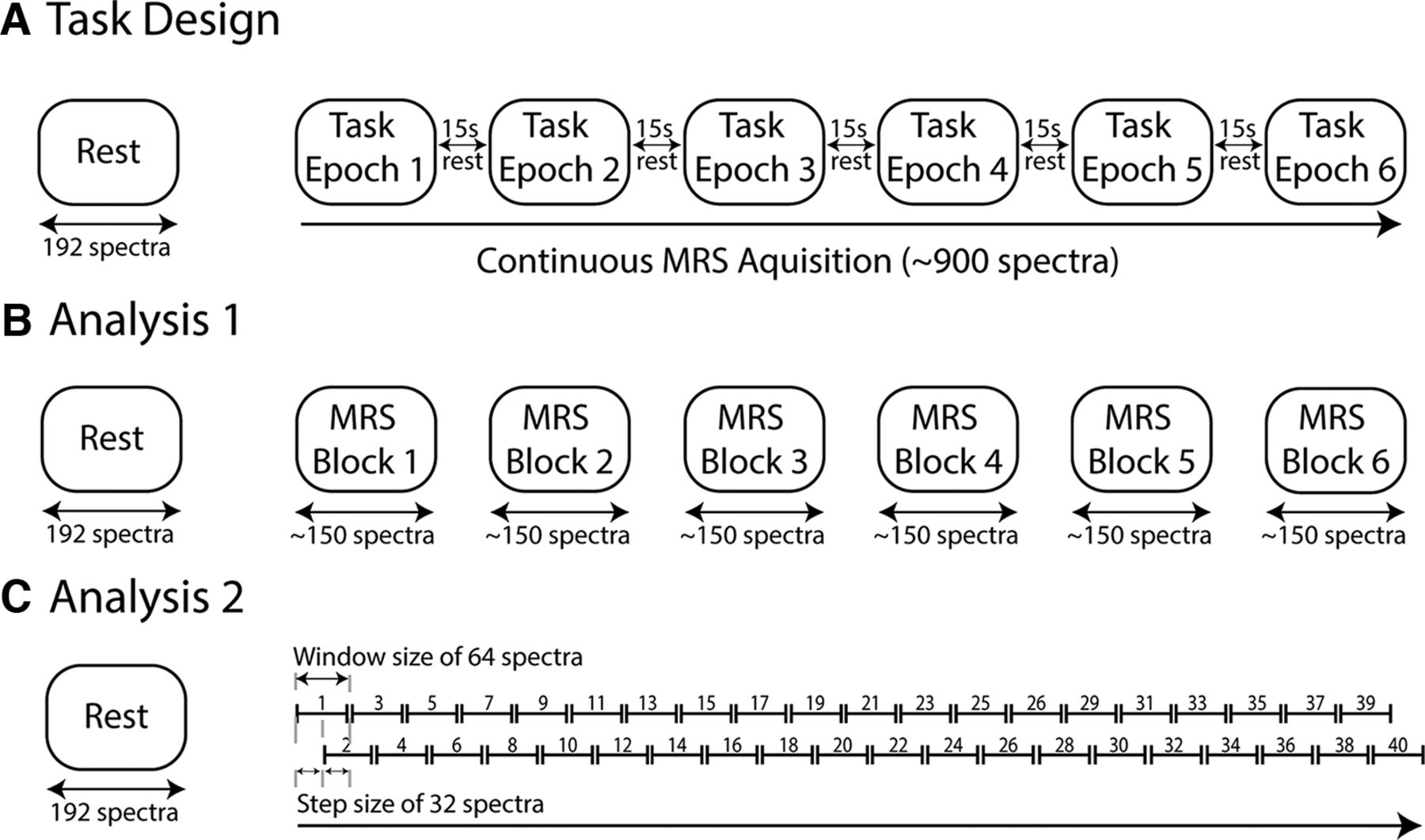
    A, Task design. The task consists of 6 epochs, each lasting ∼5 min, with a 15 s rest period in between. Each epoch consists of 48 trials in which participants are asked to press a button as quickly as possible in response to a cue. MRS data were continuously acquired during the task using a MEGA-PRESS sequence. B, Analysis 1. Spectra was averaged into blocks corresponding to the length of each task epoch, creating 6 averages of ∼150 spectra. ANOVAs were used to compare metabolite levels across blocks. C, Analysis 2. Spectra were analyzed using a sliding-window approach with a window size of 64 and a step size of 32, providing ∼40 timepoints.

  • Figure 2.
    • Download figure
    • Open in new tab
    • Download powerpoint
    Figure 2.

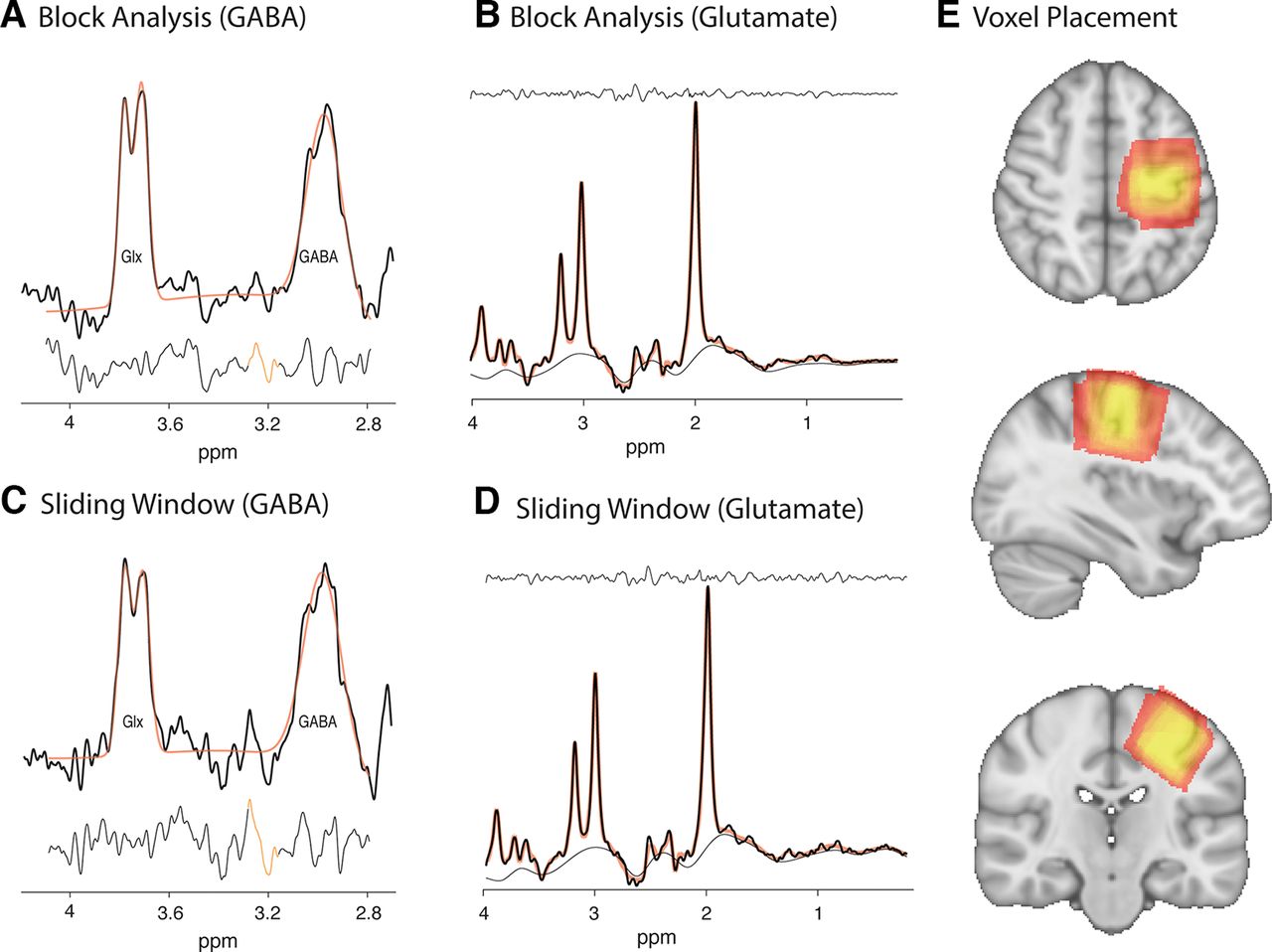
    A, Example of GABA+ data from the block analysis [number of signal averages (NSA) = 184]. B, Example of glutamate data obtained from the OFF sub-spectra from the block analysis (NSA = 184). C, Example of GABA+ data from the sliding-window analysis (NSA = 64). D, Example of glutamate data obtained from the OFF sub-spectra from the sliding-window analysis (NSA = 64). E, Heatmap of voxel placement, yellow shows areas of high overlap.

  • Figure 3.
    • Download figure
    • Open in new tab
    • Download powerpoint
    Figure 3.

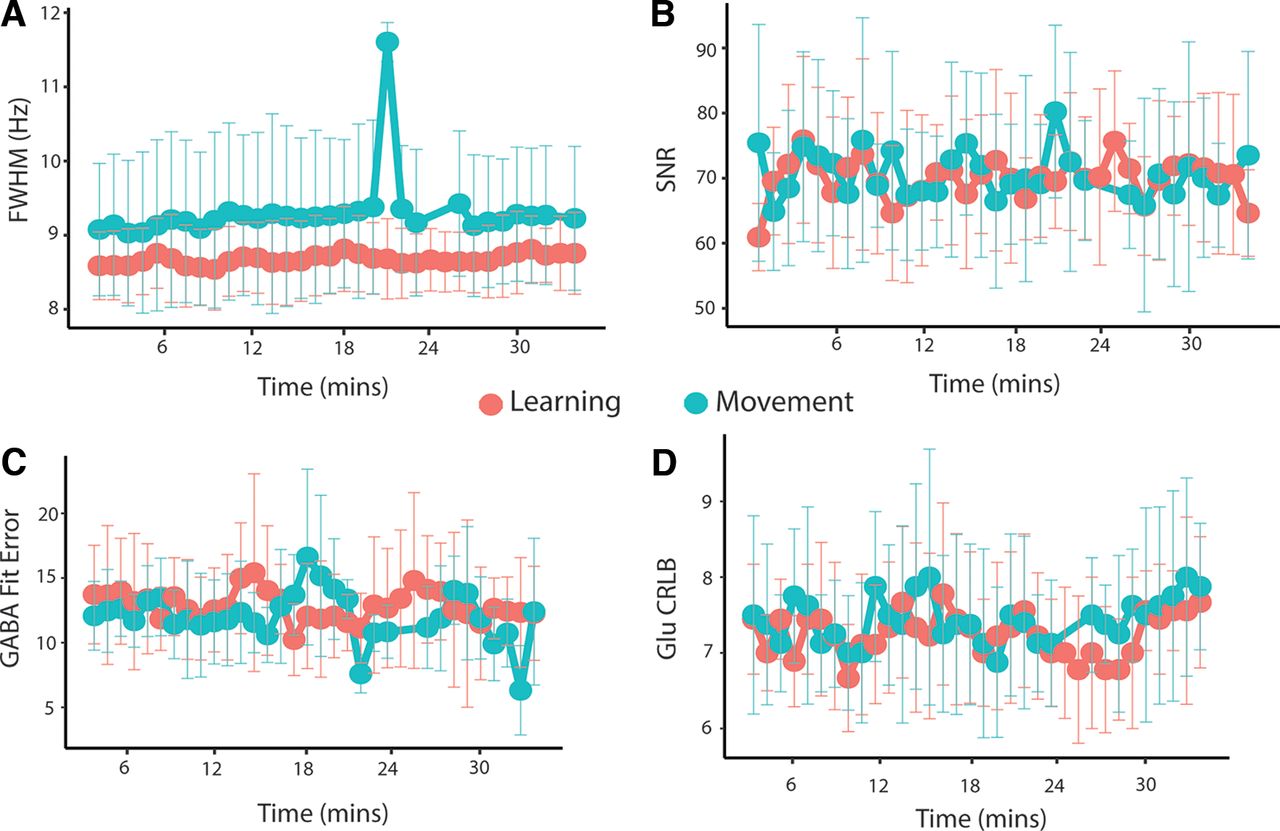
    Quality metrics for sliding-window analysis. A, Mean NAA FWHM in hertz. B, Mean NAA SNR. Error bars represent the SD. C, Mean GABA+ fit error (%) calculated in Gannet. D, Mean glutamate CRLB calculated in LCModel.

  • Figure 4.
    • Download figure
    • Open in new tab
    • Download powerpoint
    Figure 4.

    Example of frequency drift across the full data acquisition of each task from a single subject. A, Frequency drift during the motor learning task. B, Frequency drift during the control task.

  • Figure 5.
    • Download figure
    • Open in new tab
    • Download powerpoint
    Figure 5.

    Reaction time for each task block for each individual participant. Note: subject (Sub) 05 was removed because their button presses often preceded the queue.

  • Figure 6.
    • Download figure
    • Open in new tab
    • Download powerpoint
    Figure 6.

    Mean reaction time for each block throughout the task. Error bars represent the SD. Comparisons made to block 1: *p < 0.05, **p < 0.01, ***p < 0.001. All p-values are Bonferroni adjusted.

  • Figure 7.
    • Download figure
    • Open in new tab
    • Download powerpoint
    Figure 7.

    GABA+/tCr levels for each individual participant throughout the task. A, GABA+/tCr levels analyzed using the block analysis. B, GABA+/tCr levels analyzed using the sliding-window analysis. Note: subject (Sub) 08 was removed because of poor data quality. Data from the control task of subject (Sub) 09 was removed because of errors during data acquisition.

  • Figure 8.
    • Download figure
    • Open in new tab
    • Download powerpoint
    Figure 8.

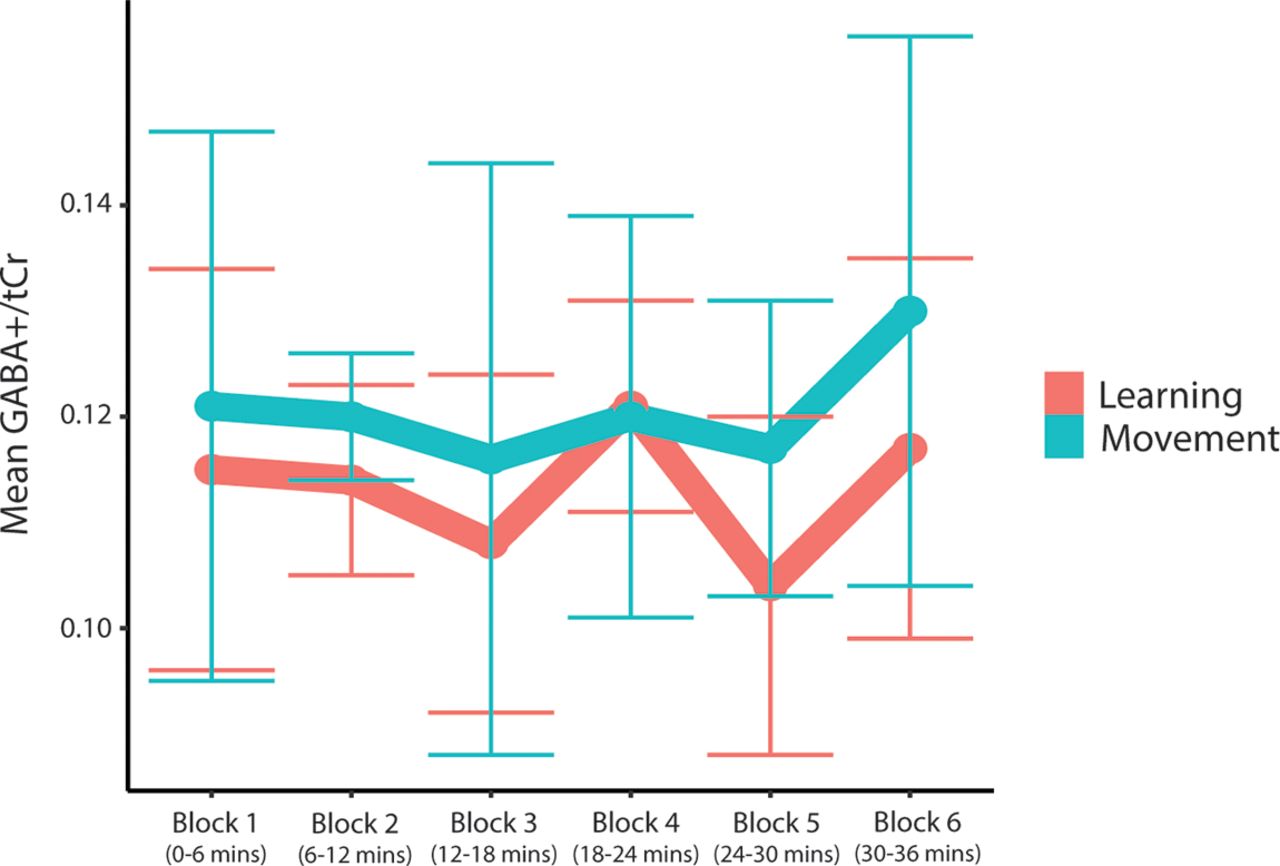
    Mean GABA+/tCr levels for each block throughout the task. Error bars represent the SD.

  • Figure 9.
    • Download figure
    • Open in new tab
    • Download powerpoint
    Figure 9.

    Mean GABA+/tCr levels for each window throughout the task. Dot and thin lines represent the mean of all participants, thick lines represent an estimated linear regression line. Shaded areas represent SE of the estimated regression. MRS data from all subjects for windows 24 (spectra 737–800; ∼22 min) and 25 (spectra 769–832; ∼23 min), and MRS data from three subjects from window 21 (spectra, 641–704; ∼19 min) were removed from the control task because of a NAA linewidth of >13 Hz.

  • Figure 10.
    • Download figure
    • Open in new tab
    • Download powerpoint
    Figure 10.

    Glx/tCr levels for each individual participant throughout the task. A, Glx/tCr levels analyzed using the block analysis. B, Glx/tCr levels analyzed using the sliding-window analysis. Note: data from the control task of subject (Sub) 09 was removed because of errors during data acquisition.

  • Figure 11.
    • Download figure
    • Open in new tab
    • Download powerpoint
    Figure 11.

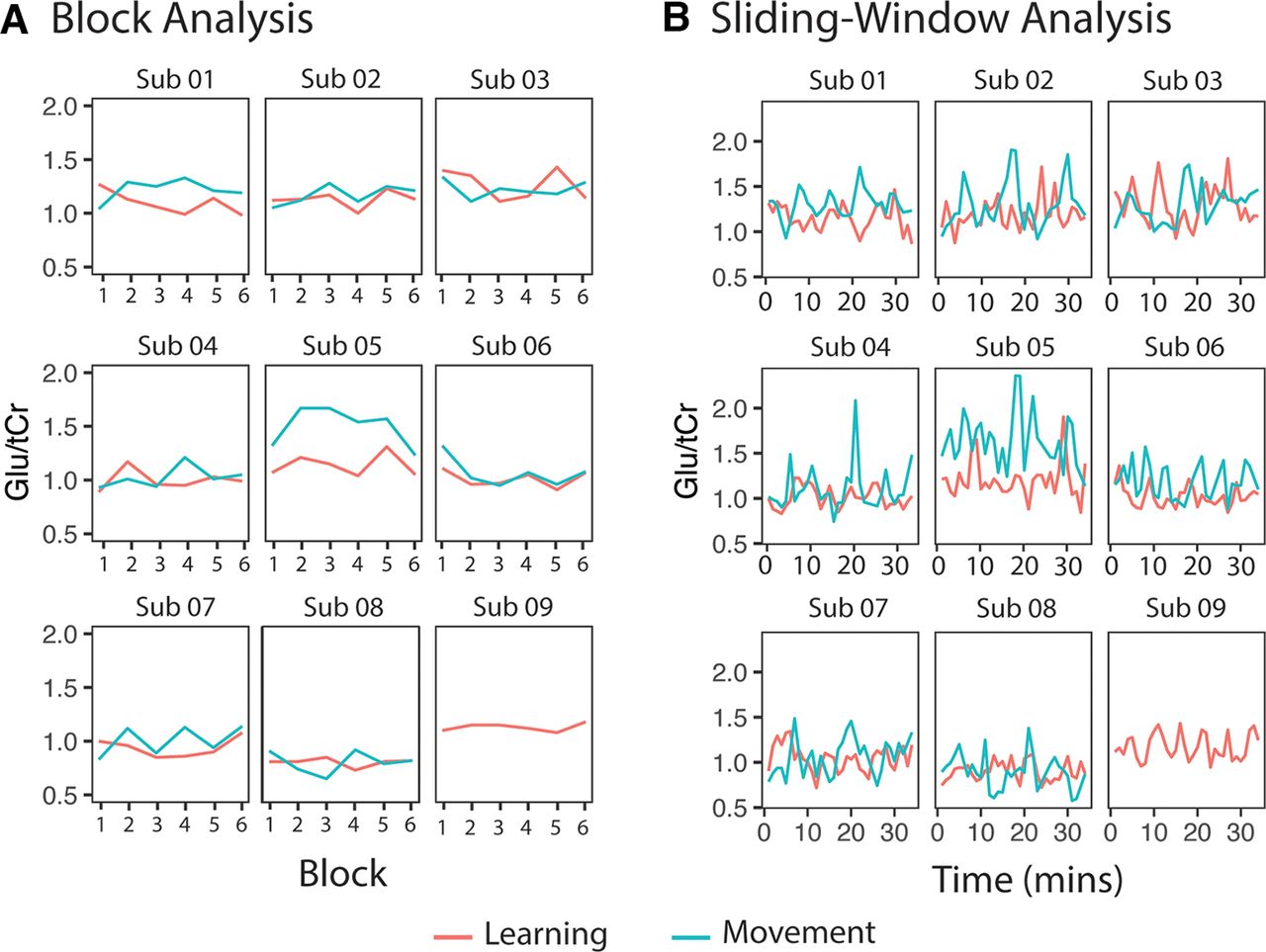
    Glu/tCr levels for each individual participant throughout the task. A, Glu/tCr levels analyzed using the block analysis. B, Glu/tCr levels analyzed using the sliding-window analysis. Note: Data from the control task of subject (Sub) 09 was removed because of errors during data acquisition.

  • Figure 12.
    • Download figure
    • Open in new tab
    • Download powerpoint
    Figure 12.

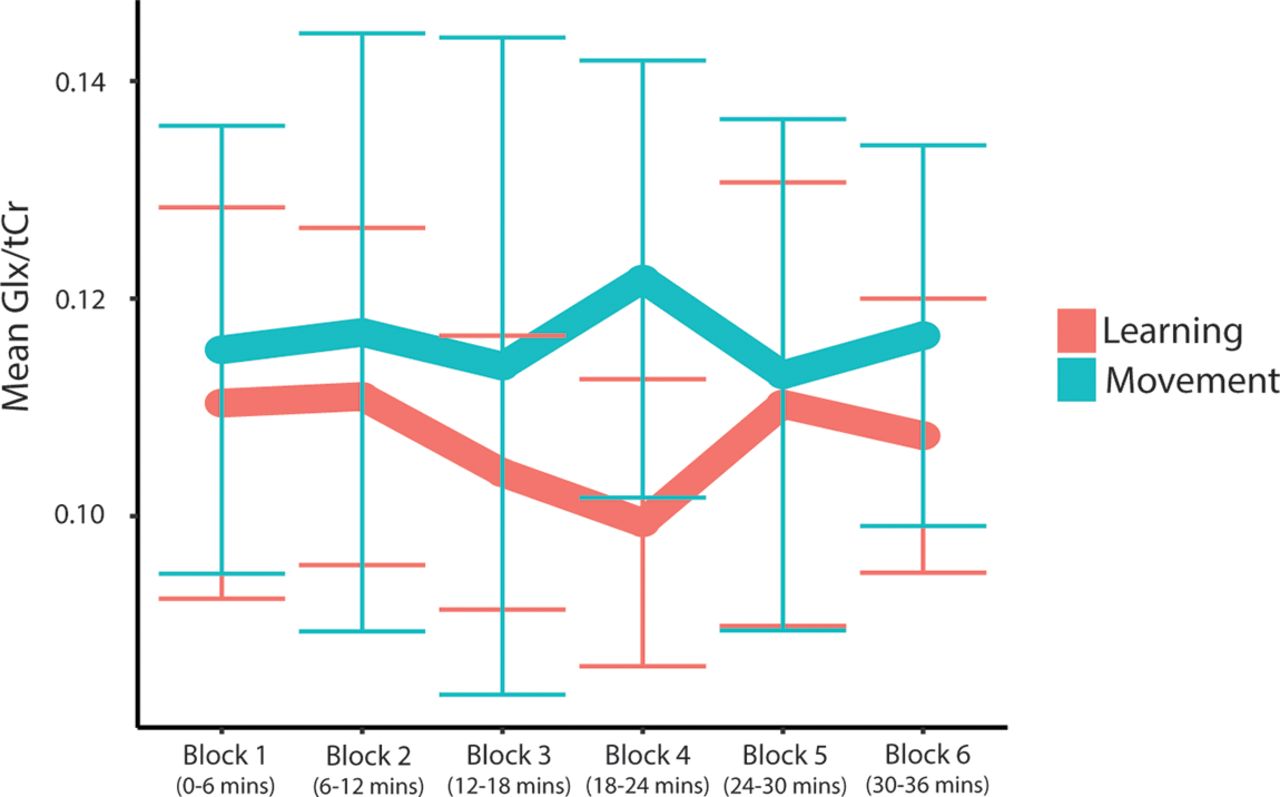
    Mean Glx/tCr levels for each block throughout the task. Error bars represent the SD.

  • Figure 13.
    • Download figure
    • Open in new tab
    • Download powerpoint
    Figure 13.

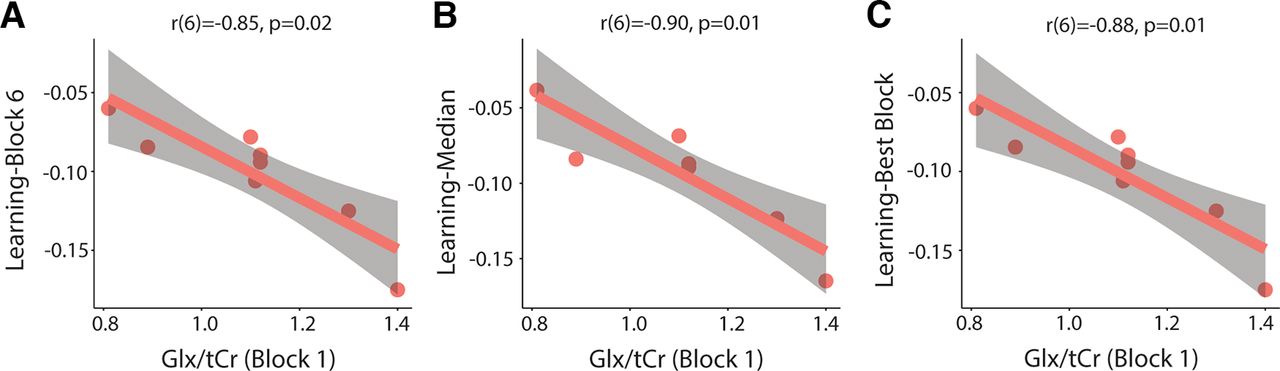
    Relationship between levels of Glx/tCr in block 1 and motor learning. A, Significant correlation between block 1 Glx/tCr levels and learning-block 6. B, Significant correlation between block 1 Glx/tCr levels and learning-median. C, Significant correlation between block 1 Glx/tCr levels and learning-best block. All p-values are Bonferroni adjusted. Shaded areas represent 95% confidence intervals.

  • Figure 14.
    • Download figure
    • Open in new tab
    • Download powerpoint
    Figure 14.

    Relationship between levels of Glx/tCr at rest and motor learning. A, Correlation between resting Glx/tCr levels and learning-block 6. B, Significant correlation between resting Glx/tCr levels and learning-median. C, Significant correlation between resting Glx/tCr levels and learning-best block. All p-values are Bonferroni adjusted. Shaded areas represent 95% confidence intervals.

  • Figure 15.
    • Download figure
    • Open in new tab
    • Download powerpoint
    Figure 15.

    Mean Glu/tCr levels for each block throughout the task. Error bars represent the SD.

  • Figure 16.
    • Download figure
    • Open in new tab
    • Download powerpoint
    Figure 16.

    Relationship between levels of Glu/tCr in block 1 and motor learning. A, Significant correlation between block 1 Glu/tCr levels and learning-block 6. B, Significant correlation between block 1 Glu/tCr levels and learning-median. C, Significant correlation between block 1 Glu/tCr levels and learning-best block. All p-values are Bonferroni adjusted. Shaded areas represent 95% confidence intervals.

  • Figure 17.
    • Download figure
    • Open in new tab
    • Download powerpoint
    Figure 17.

    Relationship between levels of Glu/tCr at rest and motor learning. A, Correlation between resting Glu/tCr levels and learning-block 6. B, Significant correlation between resting Glu/tCr levels and learning-median. C, Correlation between resting Glu/tCr levels and learning-best block. All p-values are Bonferroni adjusted. Shaded areas represent 95% confidence intervals.

  • Figure 18.
    • Download figure
    • Open in new tab
    • Download powerpoint
    Figure 18.

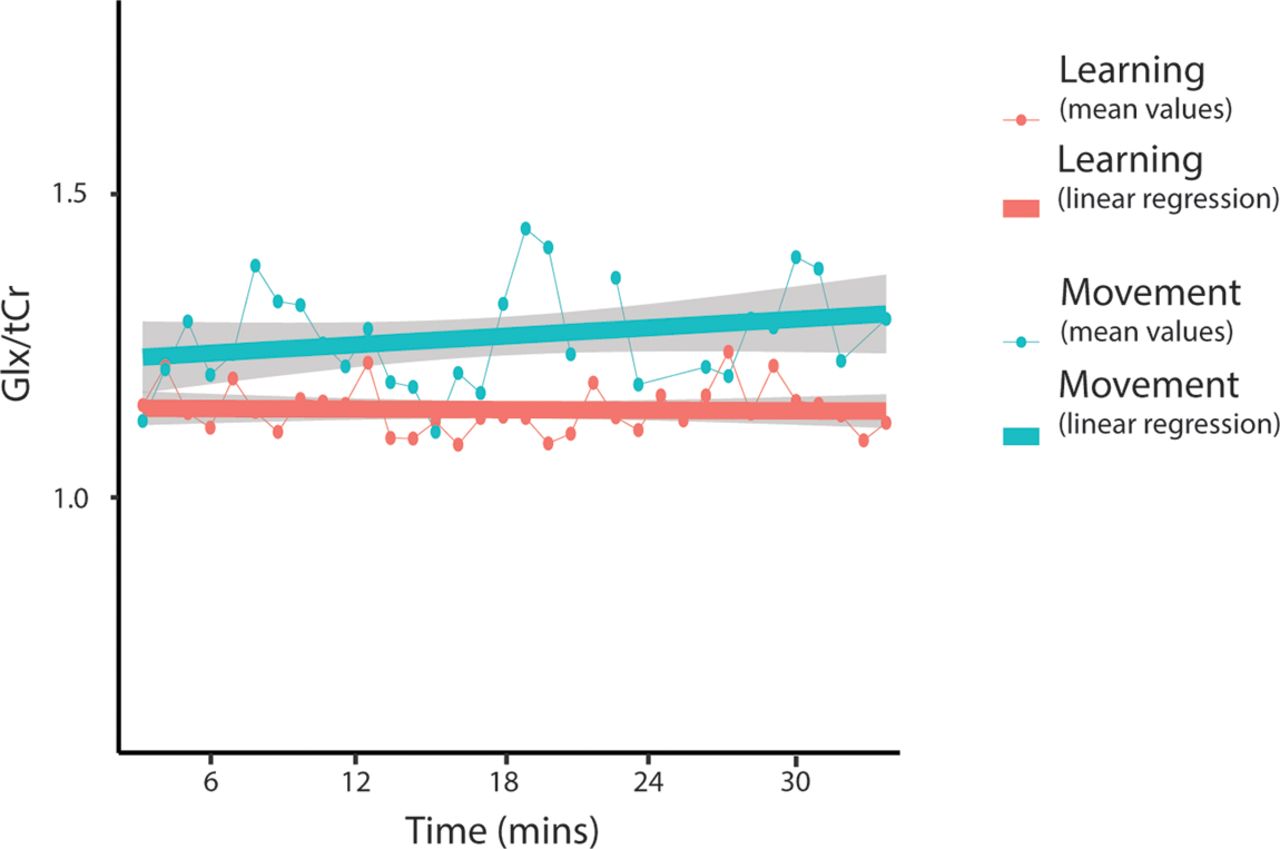
    Mean Glx/tCr levels for each window throughout the task. Dot and thin lines represent the mean of all participants, thick lines represent an estimated linear regression line. Shaded areas represent the SE of the estimated regression. MRS data from all subjects for windows 24 (spectra 737–800; ∼22 min) and 25 (spectra 769–832; ∼23 min), and MRS data from three subjects from window 21 (spectra 641–704; ∼19 min) were removed from the control task because of a NAA linewidth of >13 Hz.

  • Figure 19.
    • Download figure
    • Open in new tab
    • Download powerpoint
    Figure 19.

    Mean Glu/tCr levels for each window throughout the task. Dot and thin lines represent the mean of all participants, thick lines represent an estimated linear regression line. Shaded areas represent SE of the estimated regression. MRS data from all subjects for windows 24 (spectra 737–800; ∼22 min) and 25 (spectra 769–832; ∼23 min), and MRS data from three subjects from window 21 (spectra 641–704; ∼19 min) were removed from the control task because of a NAA linewidth of >13 Hz.
Tables

  • Figures
    • View popup
    Table 1

    Quality metrics for block analysis

    NAA FWHM (Hz)NAA SNR
    Motor learningControl taskMotor learningControl task
    Block 18.49 (0.46)8.92 (1.00)115.11 (17.64)117.90 (21.92)
    Block 28.45 (0.51)9.03 (1.11)108.42 (14.05)117.29 (18.80)
    Block 38.52 (0.54)9.08 (1.17)110.47 (17.37)112.44 (15.44)
    Block 48.53 (0.48)9.09 (1.02)112.48 (17.03)113.39 (22.91)
    Block 58.52 (0.45)9.05 (0.98)113.39 (12.41)107.16 (21.97)
    Block 68.55 (0.47)9.05 (0.95)106.73 (15.37)109.03 (23.36)
    • Values are mean (SD).

    • View popup
    Table 2

    Fit metrics for block analysis

    GABA fit errorGlutamate CRLB
    Motor
    learning
    Control
    task
    Motor
    learning
    Control
    task
    Block 18.94 (2.61)8.71 (1.29)6.44 (1.01)6.50 (0.53)
    Block 28.79 (1.76)7.66 (2.23)6.22 (0.83)6.00 (0.76)
    Block 39.06 (2.21)9.03 (1.41)6.78 (0.44)6.63 (0.74)
    Block 47.66 (1.39)7.60 (0.90)6.67 (0.71)6.63 (0.74)
    Block 59.38 (2.64)8.62 (1.48)6.44 (0.53)6.75 (0.46)
    Block 68.26 (1.80)8.29 (3.46)6.44 (0.88)7.00 (0.53)
    • Values are mean (SD).

    • View popup
    Table 3

    Summary of linear mixed effects model parameters from the sliding-window analysis of GABA+/tCr

    ParameterFixed effectsRandom
    effects
    EstimateSE95% CItpVarianceSD
    Intercept0.120.0040.11, 0.1327.73p < 0.0010.000030.006
    Condition−0.0030.008−0.02, 0.01−0.460.6560.00030.02
    Time−0.00020.0002−0.0006, 0.0001−1.190.235
    Condition by time0.00030.0003−0.0003, 0.00091.070.287
    • 95% CIs were approximated using the Wald method.

    • View popup
    Table 4

    Summary of linear mixed effects model parameters from the sliding window analysis of Glx/tCr

    ParameterFixed effectsRandom
    effects
    EstimateSE95% CItpVarianceSD
    Intercept1.150.041.05, 1.2425.90p < 0.010.010.11
    Condition0.090.06−0.03, 0.221.630.130.020.13
    Time−0.00020.001−0.003, 0.002−0.130.90
    Condition by time0.0030.002−0.0004, 0.00671.740.08
    • 95% CIs were approximated using the Wald method.

    • View popup
    Table 5

    Summary of linear mixed effects model parameters from the sliding window analysis of Glu/tCr

    ParameterFixed effectsRandom
    effects
    EstimateSE95% CItpVarianceSD
    Intercept1.120.041.05, 1.2426.10p < 0.010.010.11
    Condition0.070.06−0.03, 0.221.350.200.020.13
    Time−0.00060.001−0.003, 0.002−0.530.60
    Condition by time0.0030.002−0.0004, 0.00671.750.08
    • 95% CIs were approximated using the Wald method.

Back to top

In this issue

eneuro: 10 (2)
eNeuro
Vol. 10, Issue 2
February 2023
  • Table of Contents
  • Index by author
  • Masthead (PDF)
Email

Thank you for sharing this eNeuro article.

NOTE: We request your email address only to inform the recipient that it was you who recommended this article, and that it is not junk mail. We do not retain these email addresses.

Enter multiple addresses on separate lines or separate them with commas.
Functional Changes in GABA and Glutamate during Motor Learning
(Your Name) has forwarded a page to you from eNeuro
(Your Name) thought you would be interested in this article in eNeuro.
CAPTCHA
This question is for testing whether or not you are a human visitor and to prevent automated spam submissions.
Print
View Full Page PDF
Citation Tools
Functional Changes in GABA and Glutamate during Motor Learning
Tiffany K. Bell, Alexander R. Craven, Kenneth Hugdahl, Ralph Noeske, Ashley D. Harris
eNeuro 8 February 2023, 10 (2) ENEURO.0356-20.2023; DOI: 10.1523/ENEURO.0356-20.2023

Citation Manager Formats

  • BibTeX
  • Bookends
  • EasyBib
  • EndNote (tagged)
  • EndNote 8 (xml)
  • Medlars
  • Mendeley
  • Papers
  • RefWorks Tagged
  • Ref Manager
  • RIS
  • Zotero
Respond to this article
Share
Functional Changes in GABA and Glutamate during Motor Learning
Tiffany K. Bell, Alexander R. Craven, Kenneth Hugdahl, Ralph Noeske, Ashley D. Harris
eNeuro 8 February 2023, 10 (2) ENEURO.0356-20.2023; DOI: 10.1523/ENEURO.0356-20.2023
Twitter logo Facebook logo Mendeley logo
  • Tweet Widget
  • Facebook Like
  • Google Plus One

Jump to section

  • Article
    • Abstract
    • Significance Statement
    • Introduction
    • Materials and Methods
    • Results
    • Discussion
    • Acknowledgments
    • Footnotes
    • References
    • Synthesis
    • Author Response
  • Figures & Data
  • Info & Metrics
  • eLetters
  • PDF

Keywords

  • functional magnetic resonance spectroscopy (fMRS)
  • GABA
  • GABA editing
  • glutamate
  • MEGA-PRESS
  • motor learning

Responses to this article

Respond to this article

Jump to comment:

No eLetters have been published for this article.

Related Articles

Cited By...

More in this TOC Section

Show more Research Article: New Research-Registered Report

Subjects

  • Novel Tools and Methods
  • Home
  • Alerts
  • Follow SFN on BlueSky
  • Visit Society for Neuroscience on Facebook
  • Follow Society for Neuroscience on Twitter
  • Follow Society for Neuroscience on LinkedIn
  • Visit Society for Neuroscience on Youtube
  • Follow our RSS feeds

Content

  • Early Release
  • Current Issue
  • Latest Articles
  • Issue Archive
  • Blog
  • Browse by Topic

Information

  • For Authors
  • For the Media

About

  • About the Journal
  • Editorial Board
  • Privacy Notice
  • Contact
  • Feedback
(eNeuro logo)
(SfN logo)

Copyright © 2026 by the Society for Neuroscience.
eNeuro eISSN: 2373-2822

The ideas and opinions expressed in eNeuro do not necessarily reflect those of SfN or the eNeuro Editorial Board. Publication of an advertisement or other product mention in eNeuro should not be construed as an endorsement of the manufacturer’s claims. SfN does not assume any responsibility for any injury and/or damage to persons or property arising from or related to any use of any material contained in eNeuro.